Reading the Evidence · Case retrial
Kensington Runestone: Its 1910 Panel’s Own Expert Said No
Hoax and Hindsight Published
In 1910 a Minnesota Historical Society committee gave the Kensington Runestone a favorable opinion, on one condition. The language specialist it chose to check its report rejected the stone, as two professors had by March 1899, and as of current evidence the runic text dated 1362 is not accepted as medieval, though advocates still defend it.
Docket
- Case
- The Kensington Runestone
- Years
- Found 1898; text dated 1362; backed on condition by a museum committee in 1910
- Place
- Olof Ohman’s farm, Solem township, Douglas County, Minnesota, about three miles northeast of Kensington
- The claim
- That Norse explorers carved it in 1362
- The verdict
- Research consensus as of 2026: not accepted as a medieval inscription; experts rejected it, per Krueger (2015); advocates still defend it
- Hinges on
- The language and rune forms, and witness accounts of the find
- Status
- As of current evidence
Docket as CSVWhere these entries come from (JSON)Data: The Kensington Rune Stone: Preliminary Report to the Minnesota Historical Society by its Museum Committee (1910); abstract of Krueger (2015)
The Kensington Runestone is a slab of graywacke, 36 inches long, 15 inches wide and 5½ inches thick, weighing about 230 pounds (Exhibit A, p. 5). It was reported found on November 8, 1898, on Olof Ohman’s farm in Solem township, Douglas County, Minnesota, about three miles northeast of Kensington. Its runic text tells of Goths and Norwegians on a journey from Vinland and ends with the year 1362, which is 536 years before the find (Exhibit A, pp. 1, 6).
The committee’s report was printed in December 1910 and reprinted in the Society’s Collections in 1915 (Exhibits A, B). It is the record this page reopens. The timeline below sets each reading in the order it was made, and the sections that follow mark each for what it is: a witness’s memory, a committee’s argument, or a scholar’s finding.
Order of proceedings 7 parts
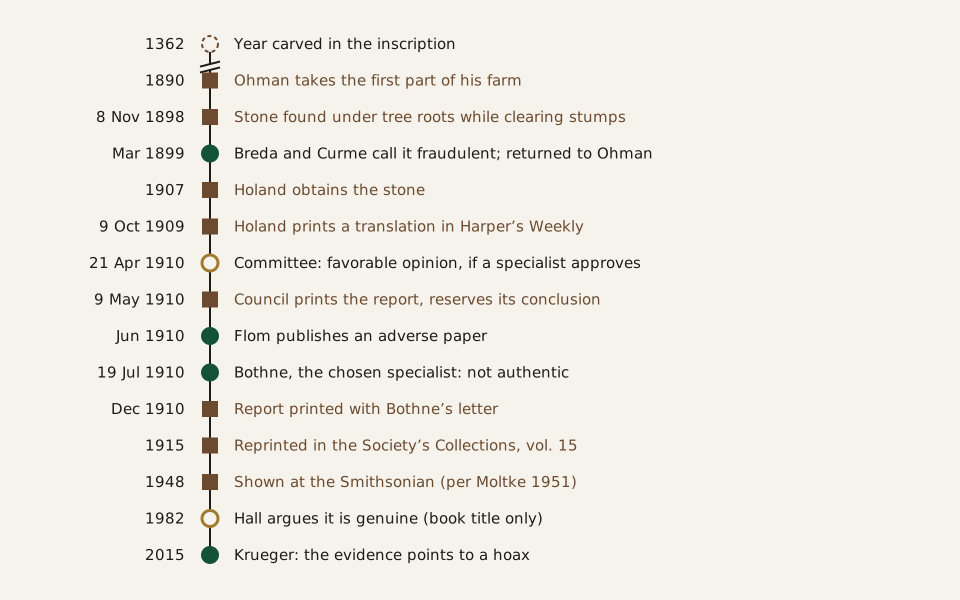
Diagram: Hoax and Hindsight · CC BY 4.0
Credit line to copy
"The Kensington Runestone, 1362 to 2015: the date it claims and the readings that followed" by Hoax and Hindsight, licensed under CC BY 4.0 (https://creativecommons.org/licenses/by/4.0/). Original: https://hoaxandhindsight.com/archaeology-retested/kensington-runestone/
Data: The Kensington Rune Stone: Preliminary Report to the Minnesota Historical Society by its Museum Committee (1910); abstracts and bibliographic records of Moltke (1951), Wahlgren (1983) and Krueger (2015)
The chain of readings, from the year the inscription gives itself to a 2015 study. Gold outlines mark readings for a medieval date, green dots readings against it, squares records. Drawn from the table published with this page (Exhibits A to E).
The events, one row per dated reading, with sources (CSV) (where the data comes from) Data: The Kensington Rune Stone: Preliminary Report to the Minnesota Historical Society by its Museum Committee (1910); Collections of the Minnesota Historical Society 15 (1915); abstract of Moltke (1951); bibliographic record of Wahlgren (1983); abstract of Krueger (2015)
What was found in 1898?
According to the 1910 report, Ohman was having timber cleared from a patch of land, and his men were grubbing out stumps (Exhibit A, p. 1). The stone lay face down under about six inches of soil, on the slope of a knoll that rose from a marsh. Ohman, his sons, aged 12 and 10, and a neighbor, Nils Olof Flaaten, were there at the finding or just after. A poplar or aspen had grown above the stone, its roots spread around it.
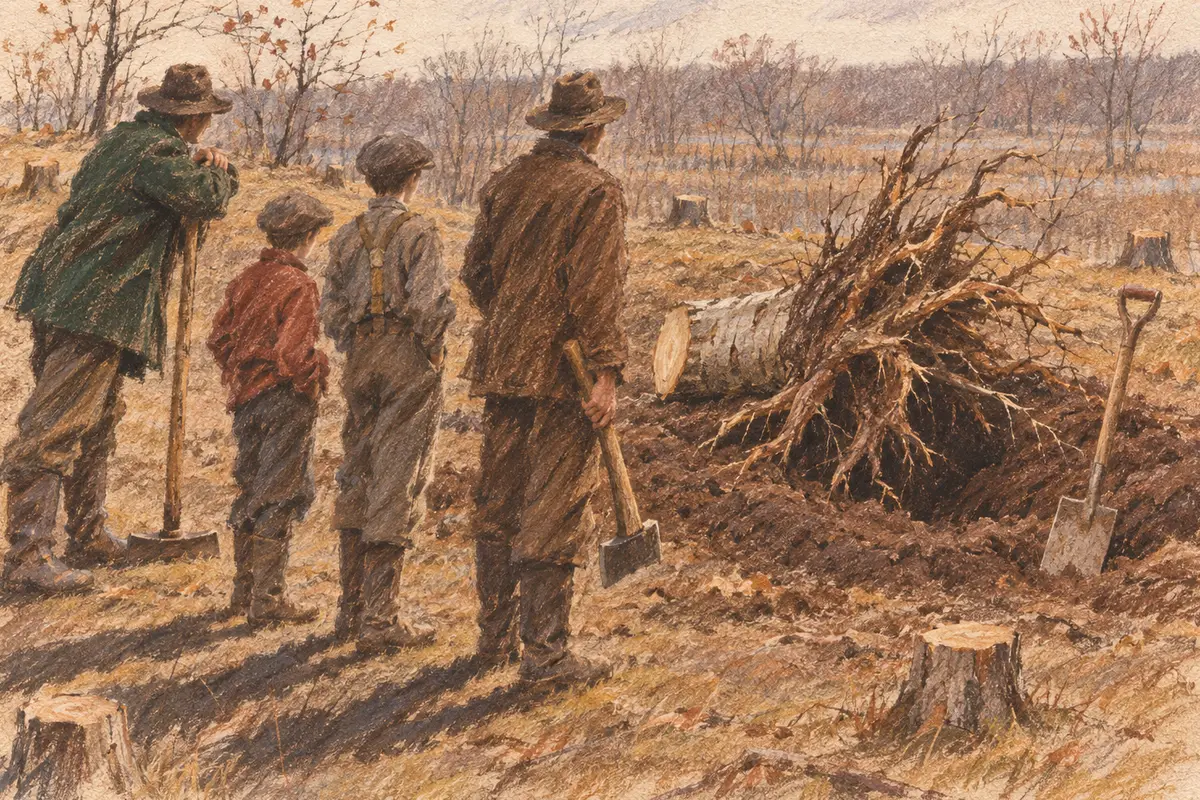
Illustration: Hoax and Hindsight. Generated schematic illustration — not a photograph or historical record. © Hoax and Hindsight, all rights reserved.
An illustration of an imagined scene of the kind the 1910 report describes: stumps being grubbed out on a Minnesota farm in November 1898. Not a picture of the find; the stone is not shown.
Nobody recorded the ground the way an excavator would. What survives is testimony, gathered by the committee more than a decade later, and a pencil sketch of the stump that Samuel Olson of Kensington drew from memory (Exhibit A, pp. 2–3, 25). A dig record would have described the layers the stone lay in and what lay with it; the stratigraphy page shows what such a record can settle and what it cannot.
The stone was soon shown in a Kensington drugstore, then sent to Minneapolis, where Professor O. J. Breda examined it, and to Evanston, Illinois, where Professor George O. Curme did. Both pronounced it fraudulent, the report says, so it went back to Ohman in March 1899 (Exhibit A, pp. 5–6). The report does not give their reasons. The stone then served as a stepping stone near Ohman’s granary for eight years, until Hjalmar Rued Holand obtained it in 1907 and brought it to the Society.
What does the stone say?
Holand published a translation in Harper’s Weekly on October 9, 1909, and the 1910 report printed the runic text in Latin letters (Exhibit A, p. 6). Rendered into English from that text (translated by Hoax and Hindsight), the face reads: eight Goths and twenty-two Norwegians on a voyage of discovery from Vinland in the west; a camp at two skerries, a day’s journey north of the stone; a day of fishing, and ten men found bloody and dead on the return. It ends with the letters A V M and a plea for deliverance from evil. The edge adds ten men by the sea to watch the ships, fourteen days’ journey from this island, and the year 1362.
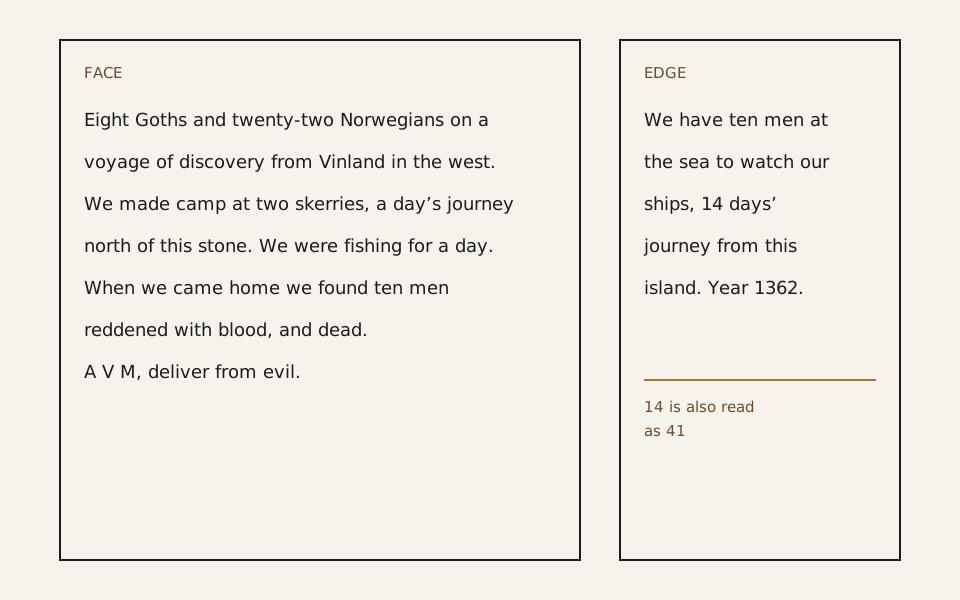
Diagram: Hoax and Hindsight · CC BY 4.0
Credit line to copy
"The text of the Kensington Runestone in English, translated by Hoax and Hindsight" by Hoax and Hindsight, licensed under CC BY 4.0 (https://creativecommons.org/licenses/by/4.0/). Original: https://hoaxandhindsight.com/archaeology-retested/kensington-runestone/
Data: The Kensington Rune Stone: Preliminary Report to the Minnesota Historical Society by its Museum Committee (1910), p. 6; English translation by Hoax and Hindsight
The text of face and edge in English, translated for this page from the runic text as printed in 1910. No rune shapes are drawn. The 1910 committee judged “fourteen” more likely than “forty-one” for the edge’s number (Exhibit A, p. 47).
The numbers are cut with unusual number signs, which the committee counted in the stone’s favor (Exhibit A, p. 46), and the committee read A V M as a prayer to the Virgin Mary, common in 14th-century Scandinavia (Exhibit A, p. 33).
The word Vinland ties the stone to a larger claim: that Norse sailors reached the American mainland long before Columbus. The Kensington stone is not the only object offered as proof of it. The Vinland Map, another piece of supposed Norse evidence, was called a forgery by Yale in 2021, on the strength of a modern pigment in its ink.
What did the 1910 committee decide?
On April 21, 1910, the Museum Committee resolved that it “renders a favorable opinion of the authenticity of the Kensington rune stone” (Exhibit A, p. 48). The same sentence set a condition. A competent specialist in the Scandinavian languages, chosen by the committee, had to check the report’s references and approve its conclusions. The five members who signed were Edward C. Mitchell, F. J. Schaefer, O. D. Wheeler, N. H. Winchell and Warren Upham.
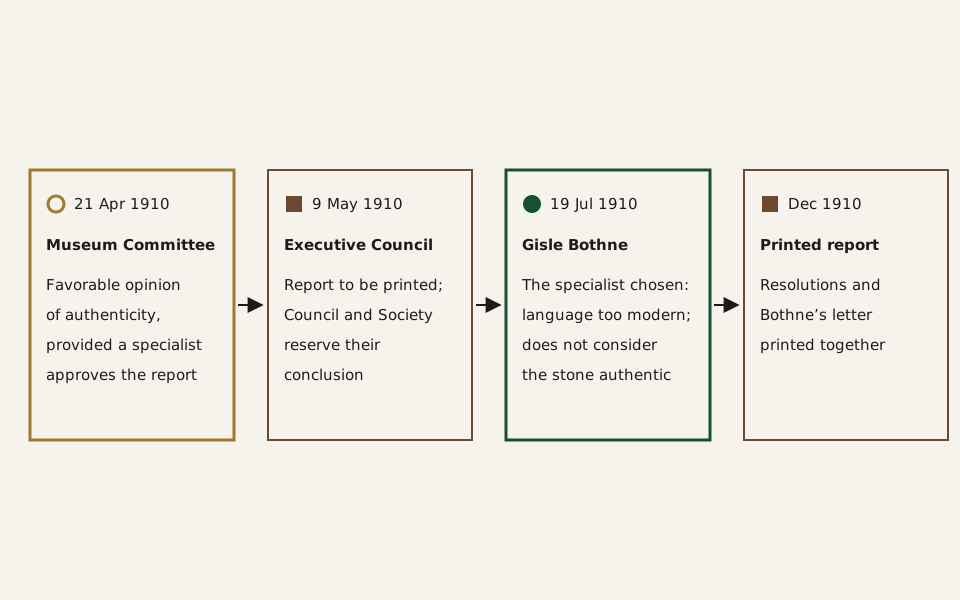
Diagram: Hoax and Hindsight · CC BY 4.0
Credit line to copy
"The 1910 resolution on the Kensington Runestone, its condition, and what followed" by Hoax and Hindsight, licensed under CC BY 4.0 (https://creativecommons.org/licenses/by/4.0/). Original: https://hoaxandhindsight.com/archaeology-retested/kensington-runestone/
Data: The Kensington Rune Stone: Preliminary Report to the Minnesota Historical Society by its Museum Committee (1910), pp. 47-49
How the 1910 approval ran: a conditional resolution in April, a reserved conclusion in May, and a rejection from the specialist in July, all printed together in December (Exhibit A, pp. 47–49).
The Society’s Executive Council did not adopt the opinion. On May 9, 1910, it voted to print the report with a statement that the Council and Society “reserve their conclusion until more agreement of opinions for or against the rune inscription may be attained” (Exhibit A, p. 48). The committee then chose Professor Gisle Bothne of the University of Minnesota as its specialist.
Bothne’s reply, dated July 19, 1910, is printed in the report itself. He wrote that he had long agreed with the leading authorities of Norway and Sweden, naming among them Magnus Olsen, Bugge, Noreen and Montelius, in holding that the language was too modern and faulty. He found the testimony about the find unconvincing and closed plainly: “I do not consider the Kensington stone authentic” (Exhibit A, p. 49). He proposed that the stone go to Norway “to be examined by expert runologists,” adding that nothing else would settle the matter.
So the condition the committee set was not met. The report printed the committee’s favorable resolution and the specialist’s rejection side by side. In June 1910, the Illinois Historical Society had also published an adverse paper by the philologist George T. Flom, who called the inscription modern (Exhibit A, p. 50).
Can letter forms and words date the stone?
The case against the stone in 1910 rested on language. The objectors, summarized in the report as experts in the Scandinavian languages, held that several words and letter forms on the stone were not in use in 1362 (Exhibit A, pp. 34–35). Each objection works like a terminus post quem, the earliest date a thing can have, set by its newest part. If a form first appears in 1495, an inscription that uses it can be no older than 1495, whatever date it carries.
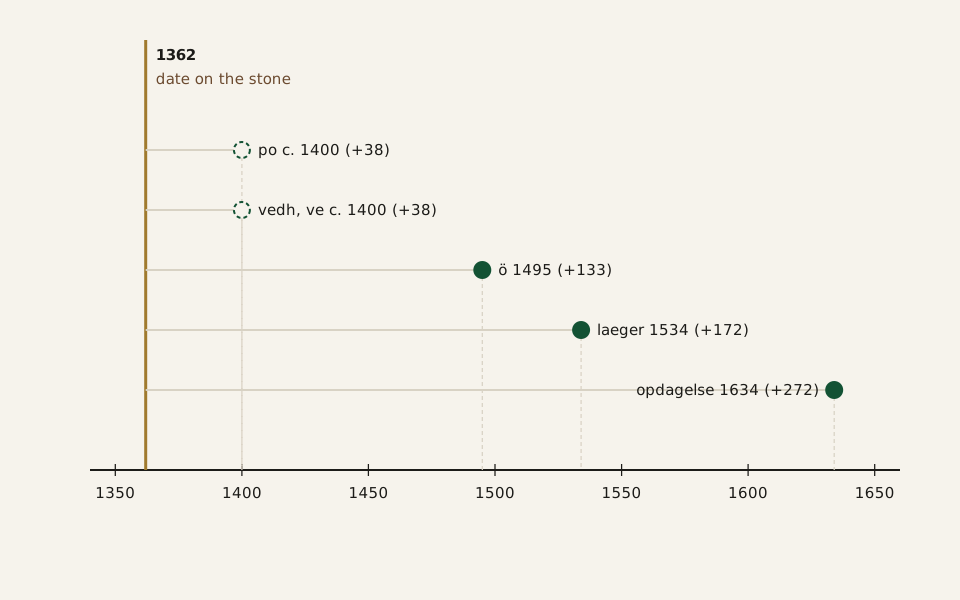
Diagram: Hoax and Hindsight · CC BY 4.0
Credit line to copy
"Dated objections to the Kensington inscription, set against the year it gives" by Hoax and Hindsight, licensed under CC BY 4.0 (https://creativecommons.org/licenses/by/4.0/). Original: https://hoaxandhindsight.com/archaeology-retested/kensington-runestone/
Data: The Kensington Rune Stone: Preliminary Report to the Minnesota Historical Society by its Museum Committee (1910), pp. 34-41, 50-52
Five objections that came with a year, set against the stone’s own date. Every year is an earliest known use cited in the 1910 report, not a proven first use (Exhibit A, pp. 34–41, 50–52).
| Form on the stone | Objection, as printed in 1910 | Earliest year given | Committee’s reply |
|---|---|---|---|
| ö (o with an e inside) | Appears in Swedish first in 1495 | 1495 | None found in the report |
| po (on) | Dated to about 1400 by Söderwall’s dictionary | c. 1400 | Only 38 years; speech runs ahead of dictionaries |
| laeger (camp) | Earliest date in Kalkar’s dictionary 1534 | 1534 | The vowel change came about 1200; Kalkar shows the camp sense about 1524 |
| opdagelse (discovery) | In neither dictionary; the committee itself cites a 1634 active use from Kalkar | 1634 | Kalkar dates other words centuries late |
| vedh, ve (by) | Should be vidh; the change to e begins about 1400 (Flom) | c. 1400 | ve is a phonetic spelling of vedh |
| thorn rune for d | By 1362, d had its own rune | none | No rule on record for 1362 |
The dated objections and the committee’s replies, one row per form (CSV) (where the data comes from) Data: The Kensington Rune Stone: Preliminary Report to the Minnesota Historical Society by its Museum Committee (1910)
The committee’s answer goes to the weakness of every floor built from words: a dictionary gives the earliest use its compiler found, not the first use in speech. The report listed words that Kalkar dated to 1550, 1575 and 1610 but that appear in documents of 1329, 1250 and 1241 (Exhibit A, p. 39). It argued that the 1910 objectors were comparing a single inscription with a “usage,” and that usage is uncertain (Exhibit A, p. 37).
That reply works best for single words with small gaps: the committee itself counted only 38 years between 1362 and about 1400 for po. It does not answer the pattern, and no reply to the letter ö, said to appear in 1495, turned up in the pages read here. In this page’s reading, one borrowed word can be older than its dictionary entry, but a run of separate forms, each dated later than 1362, is harder to set aside. Bothne, who had examined the committee’s report, was not persuaded (Exhibit A, pp. 48–49).
What do the tree and the weathering show?
The committee leaned on the tree. Witnesses said a poplar had grown over the stone with roots flattened against it, and the report gave their estimates of the tree’s age as at least ten, twenty to thirty, or about forty years (Exhibit A, p. 2). From ring counts of other poplars from the farm, shown to witnesses in 1910, the committee judged the tree nearer fifty than ten years old (Exhibit A, p. 3).
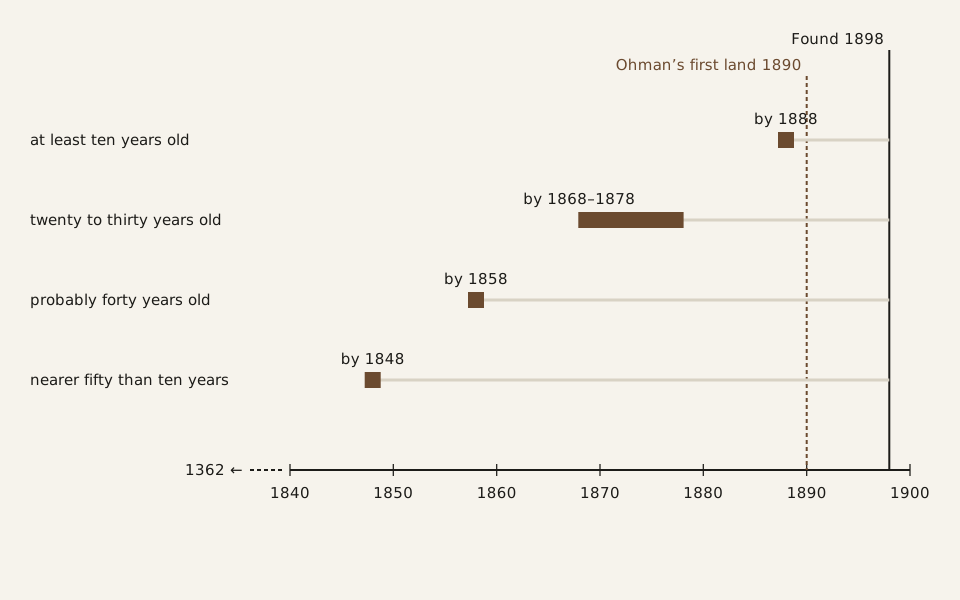
Diagram: Hoax and Hindsight · CC BY 4.0
Credit line to copy
"Tree-age estimates for the Kensington find and the latest burial years they imply" by Hoax and Hindsight, licensed under CC BY 4.0 (https://creativecommons.org/licenses/by/4.0/). Original: https://hoaxandhindsight.com/archaeology-retested/kensington-runestone/
Data: The Kensington Rune Stone: Preliminary Report to the Minnesota Historical Society by its Museum Committee (1910), pp. 2-3, 26
What the tree can say. An age of 10 years puts the stone in the ground by 1888; an age of about 50 years, by about 1848. The year 1362 lies far off this scale (Exhibit A, pp. 2–3, 26).
The tree-age estimates and the burial years they imply (CSV) (where the data comes from) Data: The Kensington Rune Stone: Preliminary Report to the Minnesota Historical Society by its Museum Committee (1910)
A tree sets a terminus ante quem, a latest date: the stone was in the ground before the tree grew over it. Even the oldest estimate reaches only to about 1848, which is 486 years short of 1362, so the tree bears on who placed the stone, not on when it was carved.
Ohman took the first part of his farm in 1890, and the committee argued that a tree of the size most witnesses described could not have grown in the eight years he had owned it (Exhibit A, p. 26). In the same paragraph it allowed that the stone could have been placed while an earlier owner held the land, and said it had not looked into that.
The weathering was read both ways inside the same report. It states that “The first impression derived from the inscription is that it is of recent date, and not 548 years old” (Exhibit A, p. 14). Then it built a scale of weathering stages that gave the cuts about 500 years, while warning that the figures were rough estimates open to personal error. The report also quotes the Wisconsin state geologist W. O. Hotchkiss estimating the time since the runes were cut at “at least 50 to 100 years” (Exhibit A, p. 16).
Who carved it, and why was it believed?
No test or document read for this page names a carver. The 1910 report followed rumors that Ohman knew runes and found a Swedish grammar of 1840 among his books that had belonged to a former preacher, Sven Fogelblad (Exhibit A, pp. 18–19). The committee treated the rumors as unproved and vouched for Ohman’s honesty; Ohman wrote that he did not remember writing runes anywhere (Exhibit A, pp. 5, 24). Those are a committee’s judgment and a finder’s own statement, and this page takes them as testimony, not as proof either way.
"KensingtonStone.jpg (the Kensington Runestone on display)" by Mauricio Valle — https://commons.wikimedia.org/wiki/File:KensingtonStone.jpg — CC BY-SA 4.0 (https://creativecommons.org/licenses/by-sa/4.0/)
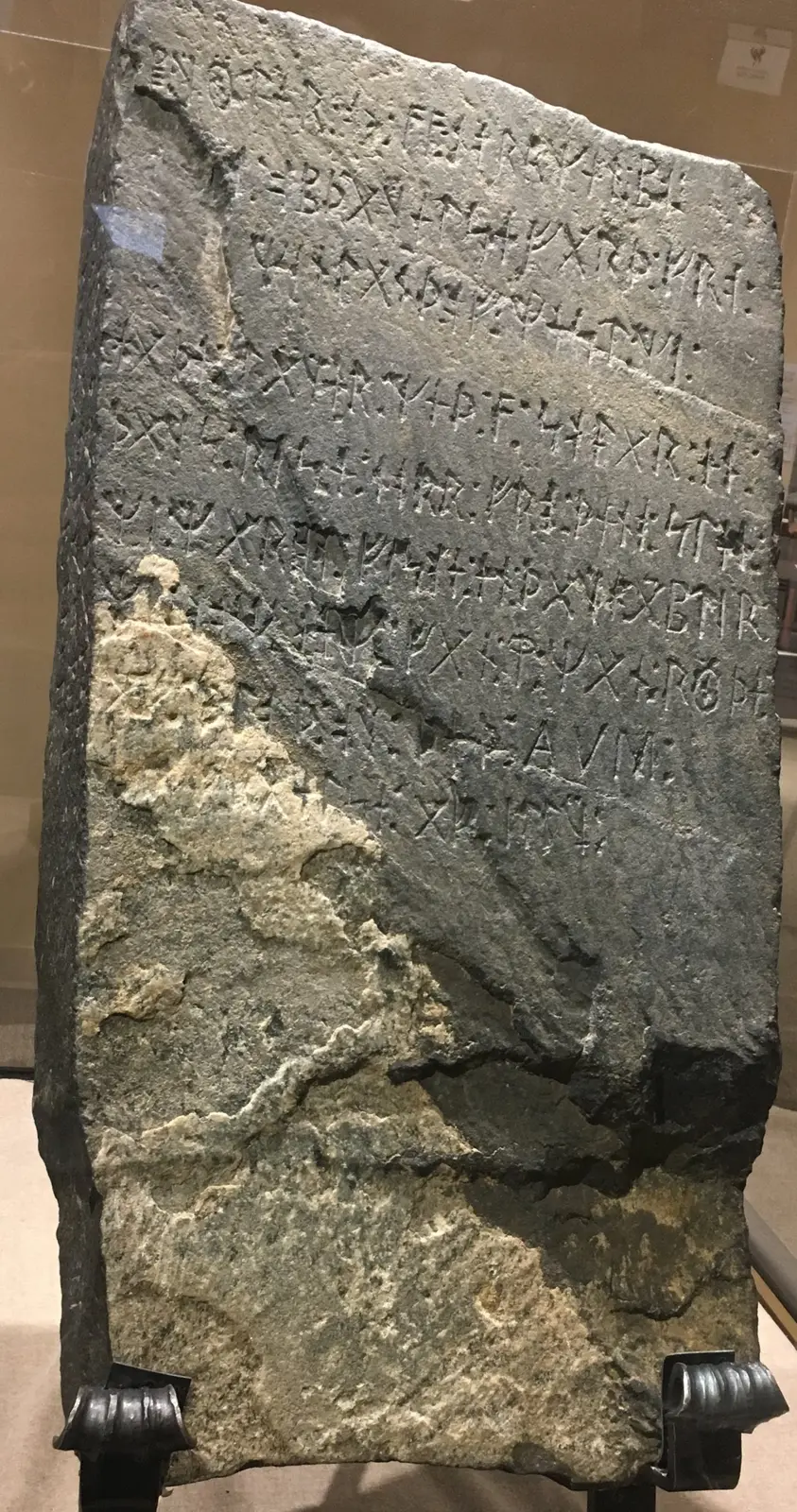
The stone on display, photographed in 2018. The pale area at lower left may be the layer of calcite the 1910 report describes on the inscribed face (Exhibit A, p. 5). Photograph, not a reconstruction.
Why the stone kept its believers is a separate question from who made it. According to the summary of his 2015 book, the historian David M. Krueger found that belief in the stone became part of how a local Nordic community saw itself, and that its story served for years as the basis of civic celebrations (Exhibit E). The same summary says advocates still promote it “despite the overwhelming evidence that it was a hoax.”
If the stone is the hoax that summary calls it, those findings meet this site’s test for the wish-shaped fake, a forgery that published studies show was accepted partly because it fit what its audience expected. The fit is this page’s reading of the summary, not Krueger’s term. The pull was local, and the specialists consulted in 1899 and 1910 were not swayed.
The stone also traveled. According to Erik Moltke, writing in Antiquity in 1951, it was shown at the Smithsonian Institution in Washington in 1948 (Exhibit C). In 1982 Robert A. Hall Jr. published a book arguing that it is genuine, read here only by its title in a review record (Exhibit D). Runic scholarship still returns to it: in 2019 Futhark, a journal of runic studies, printed “The Dialect of the Kensington Stone” by Staffan Fridell and Mats G. Larsson, read here only as a bibliographic entry (Exhibit F).
Popular version vs. the record
Each claim below is the charge, taken from the case printed for the stone, with the record set after it. The rules for the test are those of the retrial method.
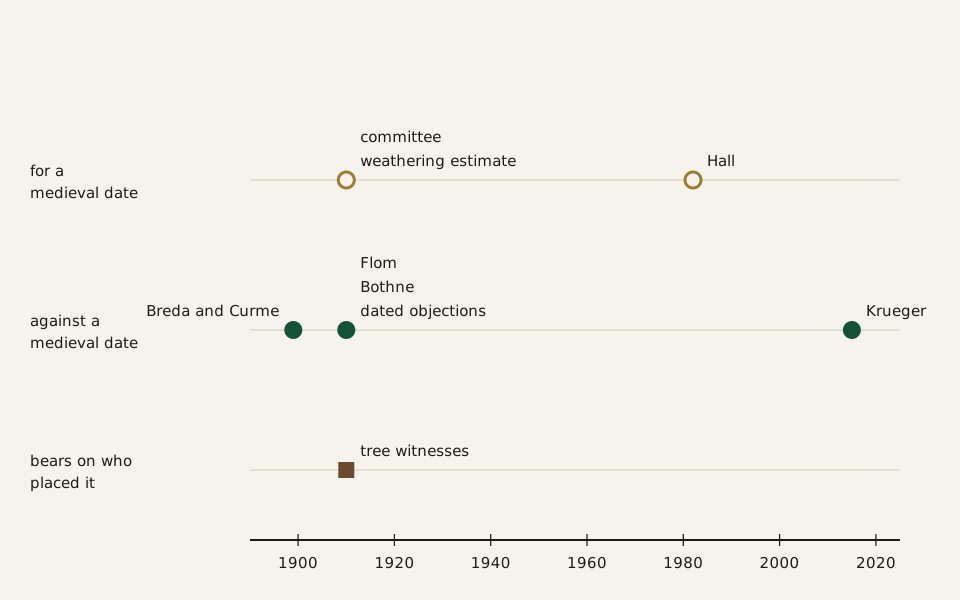
Diagram: Hoax and Hindsight · CC BY 4.0
Credit line to copy
"Claims about the Kensington Runestone, for and against a medieval date, 1899 to 2015" by Hoax and Hindsight, licensed under CC BY 4.0 (https://creativecommons.org/licenses/by/4.0/). Original: https://hoaxandhindsight.com/archaeology-retested/kensington-runestone/
Data: The Kensington Rune Stone: Preliminary Report to the Minnesota Historical Society by its Museum Committee (1910); bibliographic record of Wahlgren (1983); abstract of Krueger (2015)
Each claim in the table published with this page, placed by year and by what it bears on. The inscription’s own claim, 1362, lies off the scale (Exhibits A, D, E).
The claims, one row per claim with who made it and who answered it (CSV) (where the data comes from) Data: The Kensington Rune Stone: Preliminary Report to the Minnesota Historical Society by its Museum Committee (1910); bibliographic record of Wahlgren (1983); abstract of Krueger (2015)
A tree grew over the stone, so it lay there long before the finder could have faked it. The 1910 committee argued that the tree ruled out Ohman as the maker (Exhibit A, pp. 25–26).
The tree’s age rests on memories and on sections of other poplars from the farm, from at least 10 to about 50 years. Even 50 years reaches only to about 1848, not 1362, and the committee allowed an earlier owner could have placed it. (Exhibit A, pp. 2–3, 26)
The weathering shows the runes are centuries old. The 1910 report’s scale gave the cuts about 500 years (Exhibit A, pp. 16–17).
The same report called its first impression one of recent work, called its own figures rough, and quoted a state geologist’s estimate of at least 50 to 100 years. (Exhibit A, pp. 14, 16)
Only a master philologist could have forged the language, and such a scholar would not have made its spelling slips, so it is a medieval record. The committee argued this in 1910 (Exhibit A, p. 46).
The specialist the committee chose found the language too modern, and Flom called the inscription modern the same year. As of current evidence, experts reject it, according to Krueger (2015). (Exhibits A, E)
The Kensington Runestone is genuine. This is the title of Hall’s 1982 book (Exhibit D).
Hall’s argument was read here only by title. As of current evidence, the stone is not accepted as medieval, according to Krueger (2015), who notes that advocates still defend it. (Exhibits D, E)
Is the Kensington Runestone real?
Not as a medieval inscription, as of current evidence. Two professors called it fraudulent by March 1899, the specialist chosen by the 1910 committee rejected it, and the historian David M. Krueger (2015) concludes that the evidence points to a hoax. Advocates still defend it, according to the same study.
What does the Kensington Runestone say?
It tells of 8 Goths and 22 Norwegians on a journey from Vinland, ten men found dead after a day of fishing, and ten more men by the sea with the ships. It gives the year 1362.
Did Vikings reach Minnesota?
No dated Norse find in Minnesota turned up in the sources read for this page. A 2022 study dated a Norse presence in Newfoundland to AD 1021 (Exhibit G).
Who carved the Kensington Runestone?
No test or document read here names a carver. The 1910 committee looked into rumors about the finder and set them aside; this page does not treat any person as proven responsible.
What would overturn it:
- Dated Swedish or Norwegian writing from before 1362 that uses the stone’s disputed forms. Securely dated texts showing the letter ö, opdagelse in the sense of discovery, and the other forms objected to in 1910, all in use by 1362, would remove the language floor this page relies on.
- A 14th-century Norse object from a recorded excavation near Kensington. A find dated independently of the stone, from a documented layer in Douglas County, would reopen the question of a Norse party in Minnesota.
Exhibits
Records and period publications
- Exhibit A: Minnesota Historical Society Museum Committee, The Kensington Rune Stone: Preliminary Report to the Minnesota Historical Society by its Museum Committee (St. Paul: The Volkszeitung Company, December 1910), 66 pp.
- Exhibit B: Collections of the Minnesota Historical Society, vol. 15 (St. Paul: Minnesota Historical Society, 1915), pp. 221-286 (reprint of the 1910 report).
Studies
- Exhibit C: Erik Moltke, “The Kensington Stone,” Antiquity 25 (1951): 87-93.
- Exhibit D: Erik Wahlgren, review of Robert A. Hall Jr., The Kensington Rune-Stone Is Genuine: Linguistic, Practical, Methodological Considerations (Columbia, SC: Hornbeam, 1982), Language 59 (1983): 231-232.
- Exhibit E: David M. Krueger, Myths of the Rune Stone: Viking Martyrs and the Birthplace of America (Minneapolis: University of Minnesota Press, 2015).
- Exhibit F: Staffan Fridell and Mats G. Larsson, “The Dialect of the Kensington Stone,” Futhark: International Journal of Runic Studies 8 (2019).
- Exhibit G: Margot Kuitems, Birgitta L. Wallace, Charles Lindsay and others, “Evidence for European presence in the Americas in AD 1021,” Nature 601 (2022): 388–391.
Cite this page
Hoax and Hindsight. “Kensington Runestone: Its 1910 Panel’s Own Expert Said No.” Hoax and Hindsight, published November 6, 2026. https://hoaxandhindsight.com/archaeology-retested/kensington-runestone/. Accessed [the date you read it].
Related cases
Stratigraphy: The Deepest Layer in a Dig Isn’t Always Oldest
Stratigraphy reads the order of layers: lower is earlier, unless a later pit, burrow or collapse cuts through. It gives a sequence, not a calendar date.
Picture credit
"Archaeological excavation (חפירה ארכיאולוגית), Israel, August 1957" by Benno Rothenberg / Meitar Collection / National Library of Israel / The Pritzker Family National Photography Collection — https://commons.wikimedia.org/wiki/File:Archaeological_excavations_(997009157511605171.jpg — CC BY 4.0 (https://creativecommons.org/licenses/by/4.0/); modified: card and share image cropped to 16:10 by the site build; the article page shows the full frame
Terminus Post Quem: Newest Original Part Sets a Date Floor
A terminus post quem is the earliest date a layer or object can have, set by its newest dated part. It gives a floor, not a date; the ante quem sets a ceiling.
Picture credit
"Cranborne chase stater (PAS FindID 983439)" by The Portable Antiquities Scheme — https://commons.wikimedia.org/wiki/File:Cranborne_chase_stater_(FindID_983439).jpg — CC BY 2.0 (https://creativecommons.org/licenses/by/2.0/); modified: card and share image cropped to 16:10 by the site build; the article page shows the full frame
Proctor’s Ledge: Perley Put Salem’s Hangings There in 1921
Salem's 1692 hangings most likely took place at Proctor's Ledge, below Gallows Hill's summit, as Perley argued in 1921. No archaeological dig has been reported.
Picture credit
"Gallows Hill, Salem, where the witches were hung." by Unknown author — https://commons.wikimedia.org/wiki/File:Gallows_Hill,_Salem,_where_the_witches_were_hung._-_DPLA_-_64eb4c9dba10556ef5bc3647d684749c.jpg — Public domain (anonymous mounted photograph dated by the cataloguer between 1895 and 1905. US: if published, before 1931; if never published, an anonymous unpublished work is protected 120 years from creation, which ended at the latest at the end of 2025; the Boston Public Library marks it No Copyright - United States. EU: anonymous work, more than 70 years since it was made and since any publication. Risk noted: no publication record was checked, and the photographer is not known.); modified: card and share image only: cropped by the site build inside the photograph's mount; the article page shows the whole mount uncropped