Reading the Evidence · Method and mechanism
Stratigraphy: The Deepest Layer in a Dig Isn’t Always Oldest
Hoax and Hindsight Published
Stratigraphy rests on one rule: a lower layer formed earlier, unless a later pit, burrow or collapse disturbed it. By current evidence and practice, reading the layers and the pits cut into them gives a sequence of events, not a calendar date, and one later pit can put newer things below older layers.
Method
- Method
- Archaeological stratigraphy: reading the order of deposits and of the cuts made into them
- What it measures
- The relative order of layers, pits and other features: which formed before which
- What it can show
- Which layer or feature came before which, and which finds were sealed together
- What it cannot show
- How many years a layer took to form, or a calendar date; depth alone is not a clock, and a later pit can put newer things below older layers
- Key case
- Pitt-Rivers at Woodcuts, Cranborne Chase (1887): finds within 1.5 feet of the surface were kept apart from pit finds, even over a pit
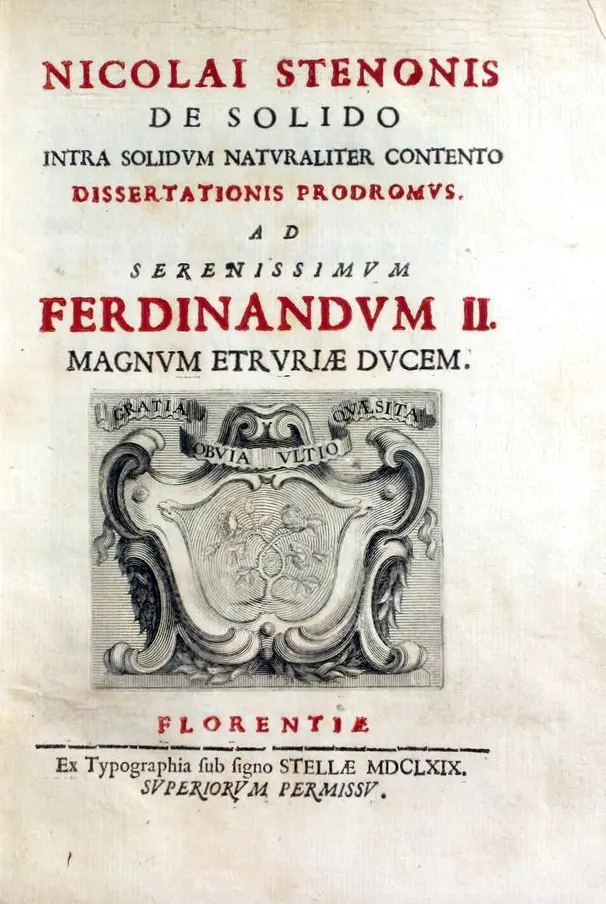
Layers are what stratigraphy studies: in archaeology, the soil, rubbish, floors and fills that build up on a site, and the pits and trenches later dug into them. The rule about lower and upper layers is now usually called the law of superposition. Nicolaus Steno set it down in Latin at Florence in 1669 (Exhibit A), and an English translation appeared in London in 1671 (Exhibit B).
The rule is sound. It is a rule about how a layer formed, not about how deep a thing now lies. The section drawn below is made up for this page, not taken from a real site. It shows the difference in nine numbered units.
Order of proceedings 6 parts
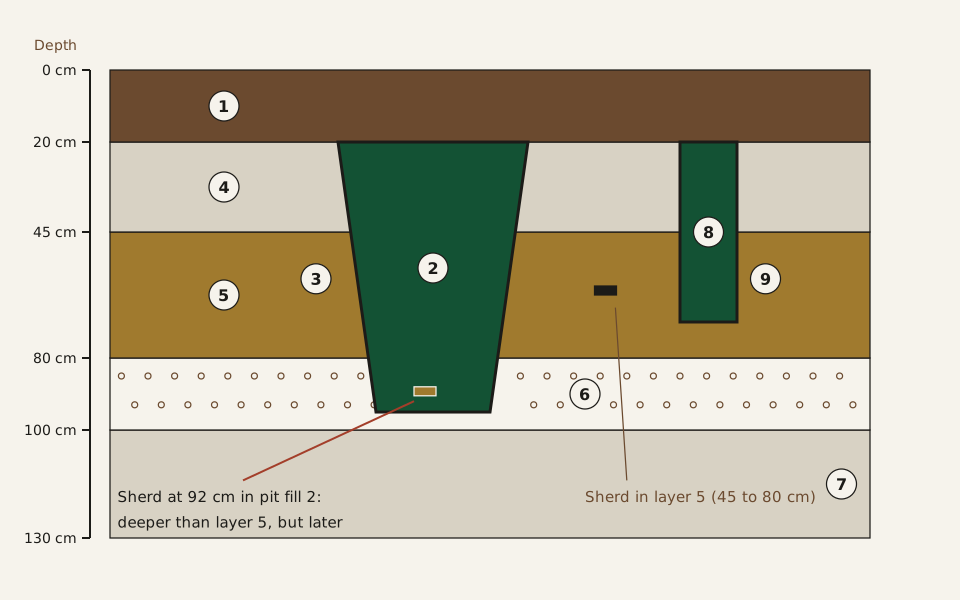
Diagram: Hoax and Hindsight · CC BY 4.0
Credit line to copy
"An illustrative excavation section: a later pit below an older layer" by Hoax and Hindsight, licensed under CC BY 4.0 (https://creativecommons.org/licenses/by/4.0/). Original: https://hoaxandhindsight.com/archaeology-retested/stratigraphy/
Data: Illustrative section designed for this page from the principle stated by Nicolaus Steno, De solido intra solidum naturaliter contento dissertationis prodromus (Florence, 1669), pp. 29-30
An illustrative section, not a real site. Pit fill 2 holds a sherd at 92 cm, below the whole of layer 5 (45 to 80 cm), yet the pit was dug through layer 5 and is later than it. Drawn from the table published with this page.
The illustrative section, one row per unit with its relations (CSV) (where the data comes from) Data: Illustrative section designed for this page (not a real site)
How does stratigraphy work?
Steno was writing about rocks and fossils, not ruins. His Prodromus asked how one solid body came to be enclosed in another, such as a shell inside stone. Along the way it stated what can be known about the place of layers, or “Beds” in the 1671 translation, that settled out of a fluid (Exhibit A, pp. 29–30; Exhibit B, pp. 42–43).
“De solido intra solidum naturaliter contento dissertationis prodromus (title page)” · Nicolaus Steno · Public domain
Full credit
"De solido intra solidum naturaliter contento dissertationis prodromus (title page)" by Nicolaus Steno — https://commons.wikimedia.org/wiki/File:Steno_De_Solido_Dissertationis_Prodromus_1669.jpg — Public domain (book printed in 1669; author Nicolaus Steno (d. 1686): public domain in the US and the EU; a flat photographic reproduction of a public-domain printed page adds no new copyright (US: Bridgeman v. Corel; EU: Directive (EU) 2019/790, art. 14); Commons tags it Public Domain Mark 1.0; scan from the University of Oklahoma History of Science Collections exhibit site (hsci.cas.ou.edu/exhibits/), as given on the file page)
Title page of Steno’s Prodromus, printed at Florence in 1669 and dedicated to Ferdinando II, Grand Duke of Tuscany. Its pages 29 and 30 hold the propositions on layers that this section quotes from the 1671 English translation.
Two of his propositions carry the rule. The second, in the 1671 English, says: “At what time there was form’d one of the upper Beds, the lower Bed had then already obtained a Solid consistency.” The fourth draws the consequence: “when the lowest Bed was laid, none of the upper Beds was extant” (Exhibit B, pp. 42–43). Quotations from the 1671 translation are given with the long s printed as a modern s.
Archaeologists apply the same logic to a different kind of layer: not beds that settled out of a fluid, as Steno described, but floors, rubbish and fills that people and nature left on a site. A floor laid on a layer of ash is later than the ash. A pit is later than every layer it cuts, and the soil that fills the pit is later still. In the section above, the result is a chain: topsoil 1 is the latest unit and natural subsoil 7 the earliest.
What breaks the order?
Steno knew that layers can shift after they form, and he gave two ways their position could change: “a violent excussion of the Beds upwards,” and “a spontaneous falling down of the upper Beds” when the material under them was taken away (Exhibit B, p. 44). He had fire, water and underground caverns in mind, but the same two movements, things pushed up and things sinking in, happen on a small scale on an archaeological site.
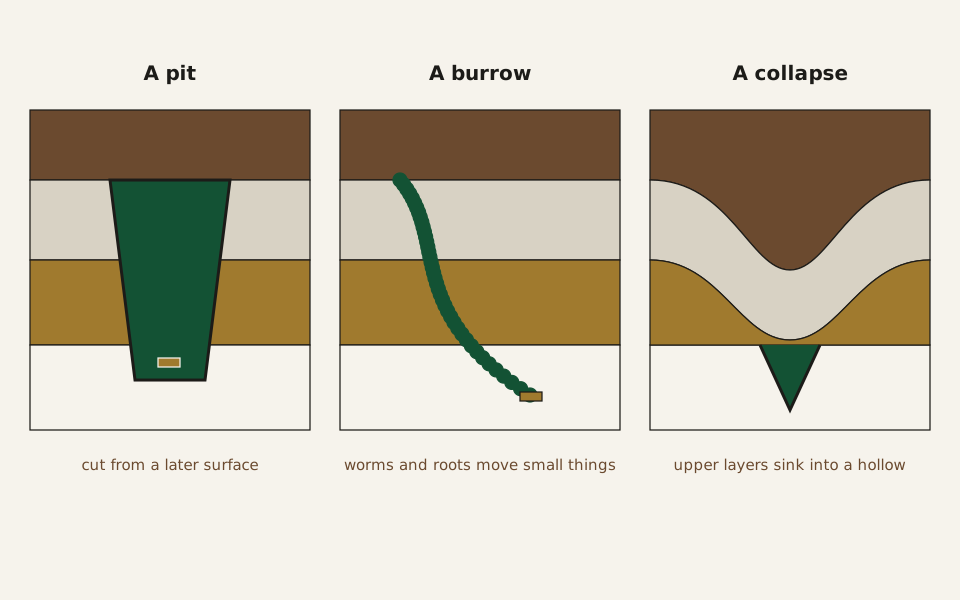
Diagram: Hoax and Hindsight · CC BY 4.0
Credit line to copy
"Three ways later material ends up below older layers" by Hoax and Hindsight, licensed under CC BY 4.0 (https://creativecommons.org/licenses/by/4.0/). Original: https://hoaxandhindsight.com/archaeology-retested/stratigraphy/
Data: Henry Oldenburg's English translation of Steno's Prodromus (London, 1671), p. 44; Charles Darwin, The Formation of Vegetable Mould through the Action of Worms (London, 1881), ch. 4
Three ways later material can end up below older layers: a pit dug from a later surface, a burrow, and a collapse into a hollow. Schematic drawings, not to scale.
The commonest break is human. A pit, grave, well or posthole is dug from one surface and goes down through older layers. Whatever falls into it, or is buried in it, now lies deeper than material that is centuries older. In the illustrative section, the sherd at 92 cm sits in pit fill 2, which is later than layers 4, 5 and 6 even though it lies below most of them.
Living things move material too. Charles Darwin wrote in 1881 that coins, ornaments and stone tools dropped on the ground “will infallibly be buried by the castings of worms in a few years” (Exhibit E, ch. 4). On his estate at Rushmore, on the Dorset and Wiltshire border, the excavator Augustus Pitt-Rivers found the burial mounds “uninjured save by the roots of trees, which were often found to have done much damage to the fragile urns” inside them (Exhibit C, p. xiii).
What can stratigraphy show?
What it can show well is which deposit came before which, and which finds were sealed together. Pitt-Rivers turned that into field rules. Publishing his excavation of a Romano-British village at Woodcuts, on Cranborne Chase, in 1887, he explained why his record was fuller than usual: an earlier dig on the same village had reported no pits at all, while he had found 95 (Exhibit C, p. xvii).
“Excavators, as a rule, record only those things which appear to them important at the time,” he wrote, so “Every detail should, therefore, be recorded” (Exhibit C, p. xvii). At Woodcuts that meant a rule about depth. Once pits turned out to be common, every object found within a foot and a half of the surface was kept apart from the rest. In his words: “All relics found within that depth have consequently been recorded as surface finds, even when they occur over a pit” (Exhibit C, p. 12).
"Archaeological excavation (חפירה ארכיאולוגית), Israel, August 1957" by Benno Rothenberg / Meitar Collection / National Library of Israel / The Pritzker Family National Photography Collection — https://commons.wikimedia.org/wiki/File:Archaeological_excavations_(997009157511605171.jpg — CC BY 4.0 (https://creativecommons.org/licenses/by/4.0/); modified: card and share image cropped to 16:10 by the site build; the article page shows the full frame
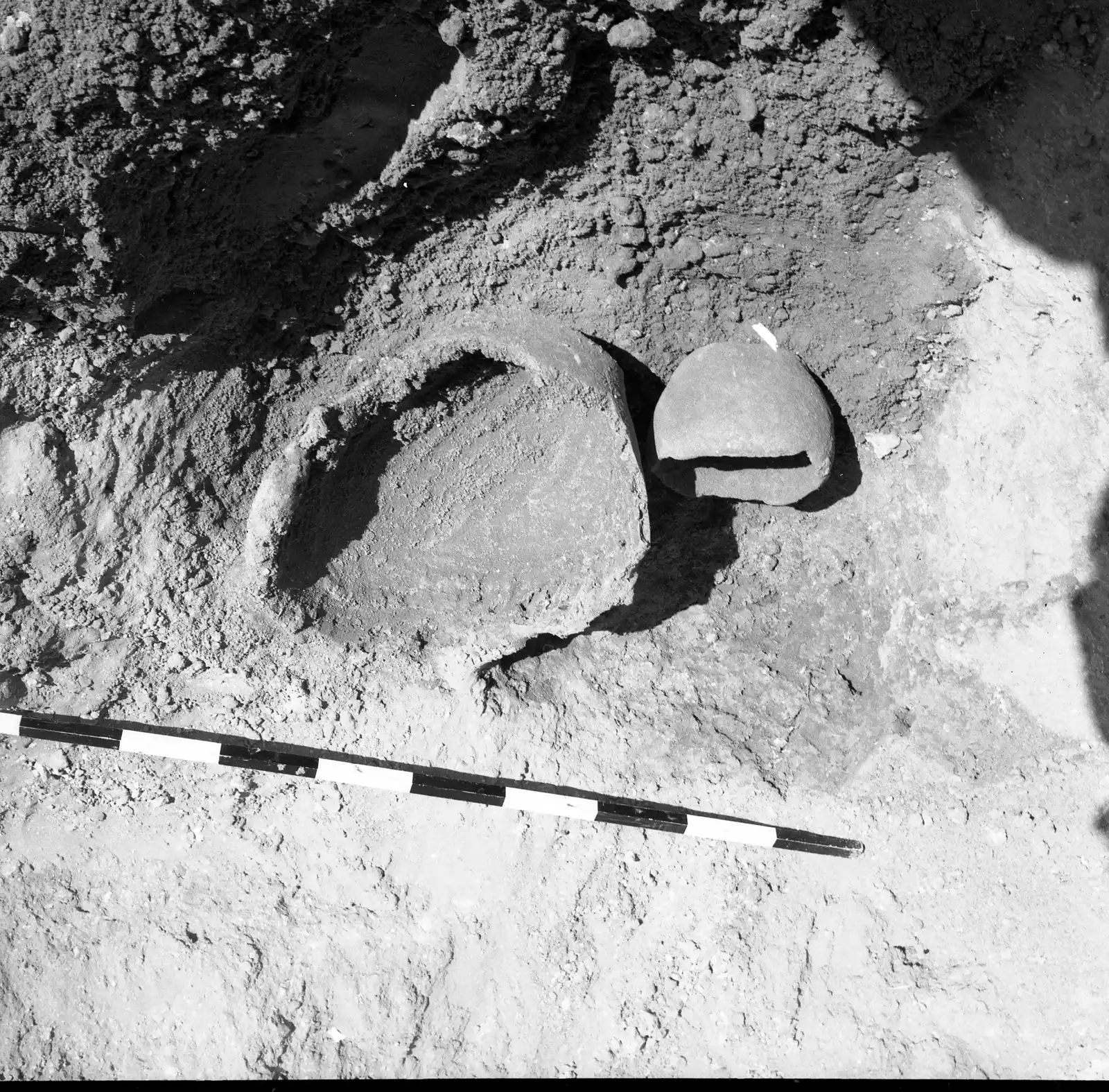
Pottery exposed in place beside a scale bar during an excavation in Israel, August 1957, photographed by Benno Rothenberg. Recording finds where they lie, before they are lifted, is what lets the order be checked later.
The point of the rule is that a find logged simply as a pit find could have come from the topsoil above the pit. Keeping the two apart costs nothing at the time and can save a wrong date later. The Egyptologist Flinders Petrie made the same argument from the other side in 1904. Groups of objects burnt in pits and then covered over, he wrote, “cannot possibly have been disturbed later on to insert objects,” because the ash around them was undisturbed (Exhibit D, p. 145).
Petrie also compared archaeological proof with the evidence used in court, insisting that “there is not one logic for the present, and a different logic for the past” (Exhibit D, pp. 136–137). This site’s retrial method uses that comparison throughout. The same way of reading the ground, for what it can and cannot hold, is applied to Proctor’s Ledge, where Salem’s hanging site was traced from deeds, family memory and the lie of the land.
How is the order written down?
On a large site, hundreds of units touch one another, and many contacts say nothing new. If topsoil 1 lies on pit fill 2, and the pit was cut through ash layer 4, then 1 is later than 4 whether or not the two touch anywhere. Archaeologists draw the order as a diagram, latest at the top, that keeps only the contacts needed to fix the sequence. It is called a Harris matrix, after Edward C. Harris, whose Principles of Archaeological Stratigraphy appeared in 1979 (Exhibit G).
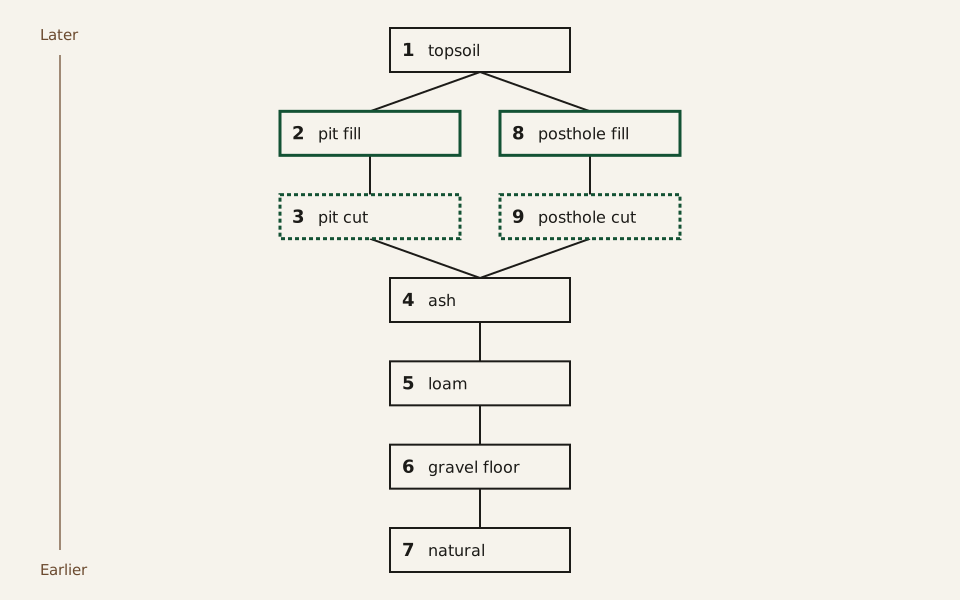
Diagram: Hoax and Hindsight · CC BY 4.0
Credit line to copy
"Sequence diagram of the illustrative section" by Hoax and Hindsight, licensed under CC BY 4.0 (https://creativecommons.org/licenses/by/4.0/). Original: https://hoaxandhindsight.com/archaeology-retested/stratigraphy/
Data: Illustrative section designed for this page; diagram form after Edward C. Harris, Principles of Archaeological Stratigraphy (London, 1979)
The illustrative section as a sequence diagram, latest unit at the top. Solid boxes are deposits; dashed boxes are cuts. Drawn from the table published with this page.
The section has 13 observed contacts between its nine units. Four of them, such as topsoil 1 lying on ash layer 4, follow from the others and drop out, leaving 9 lines in the diagram. The diagram also shows what the section cannot decide. The pit (units 2 and 3) and the posthole (units 8 and 9) never touch, so the order between them is unknown: 4 pairs of units have no order at all.
| Unit | What it is | Relation | Depth (cm) |
|---|---|---|---|
| 1 | Topsoil | lies on 2, 8 and 4 | 0–20 |
| 2 | Fill of pit 3, with a sherd at 92 cm | fills 3 | 20–95 |
| 3 | Cut of a pit | cuts 4, 5 and 6 | 20–95 |
| 8 | Fill of posthole 9 | fills 9 | 20–70 |
| 9 | Cut of a posthole | cuts 4 and 5 | 20–70 |
| 4 | Ash and burnt clay | lies on 5 | 20–45 |
| 5 | Brown loam with potsherds | lies on 6 | 45–80 |
| 6 | Gravel floor | lies on 7 | 80–100 |
| 7 | Natural subsoil | (earliest) | 100–130 |
What can’t a layer tell you?
A layer has an order, not an age. Nothing in the section says whether layer 5 took a week or three centuries to build up. Even its contents can mislead, as Petrie warned: “in strata or tomb-groups there is a chance of older things being reused” (Exhibit D, p. 139). An old coin or pot can end up in a much later layer.
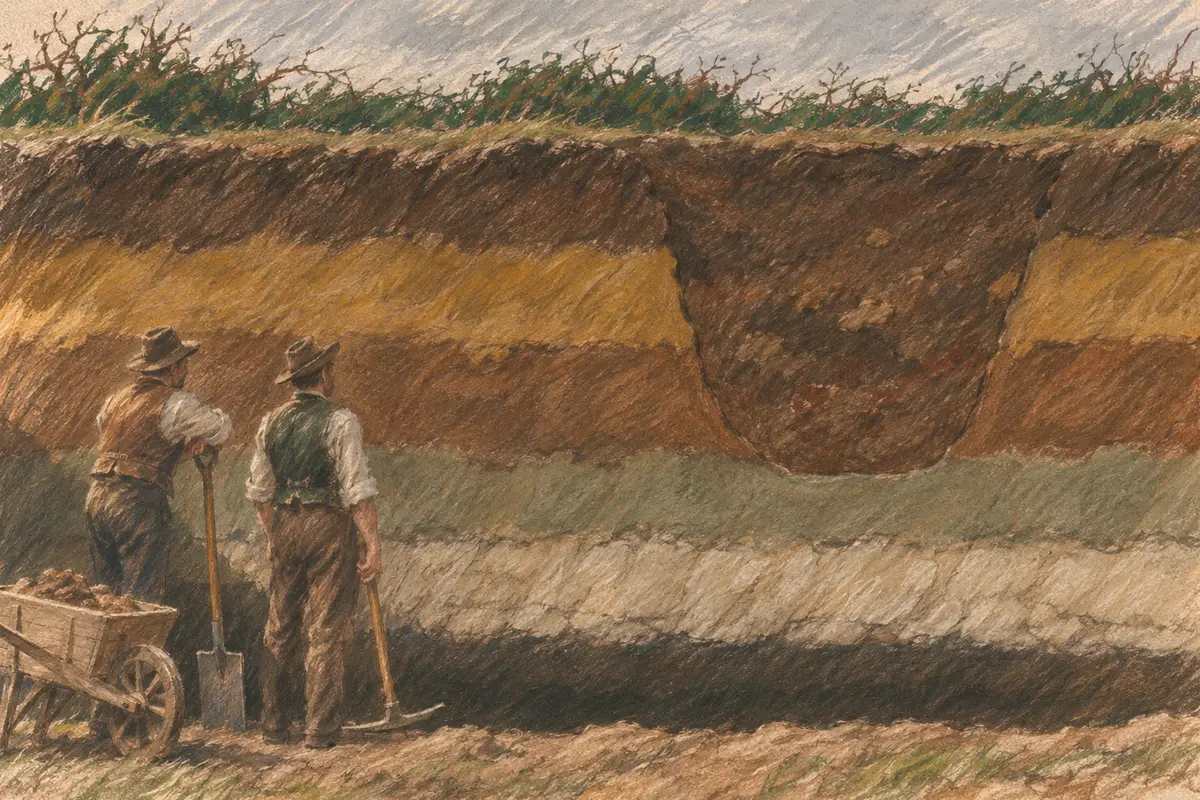
Illustration: Hoax and Hindsight. Generated schematic illustration — not a photograph or historical record. © Hoax and Hindsight, all rights reserved.
An illustration, not a record: excavators of the 1890s at a trench wall. The bands show the order in which layers formed; nothing in them shows how many years each took.
Dates come from outside the layers. They come from objects that can be dated, such as coins or inscribed pieces, and from laboratory methods such as radiocarbon, which this page does not cover. Stratigraphy then spreads those dates through the sequence. A coin sealed under a floor gives the earliest date the floor can have, the logic set out on the page on terminus post quem, the newest part setting the earliest date.
Layers out of their expected order came up in a Tennessee courtroom in 1925. Questioned by Clarence Darrow on July 20, William Jennings Bryan said that George M. Price, whom he described as a professor of geology, pointed out that “attempts to measure age by those layers where they are not in the order in which they are usually found makes it difficult to fix the exact age” (Exhibit F, p. 297). The exchange is retried on the Scopes trial page, where Darrow put Bryan on the stand. On an archaeological site, out-of-order material is not a reason to give up on order; it is a sign to look for the pit, burrow or collapse that explains it.
A worked case: Petrie’s town mounds
Petrie showed in 1904 how tempting it is to read depth as time, and how far to trust it. For Egyptian town mounds, he suggested allowing “a rate of growth of 20 inches a century,” with Nile mud adding about 4 inches a century in cultivated ground (Exhibit D, pp. 10–11).
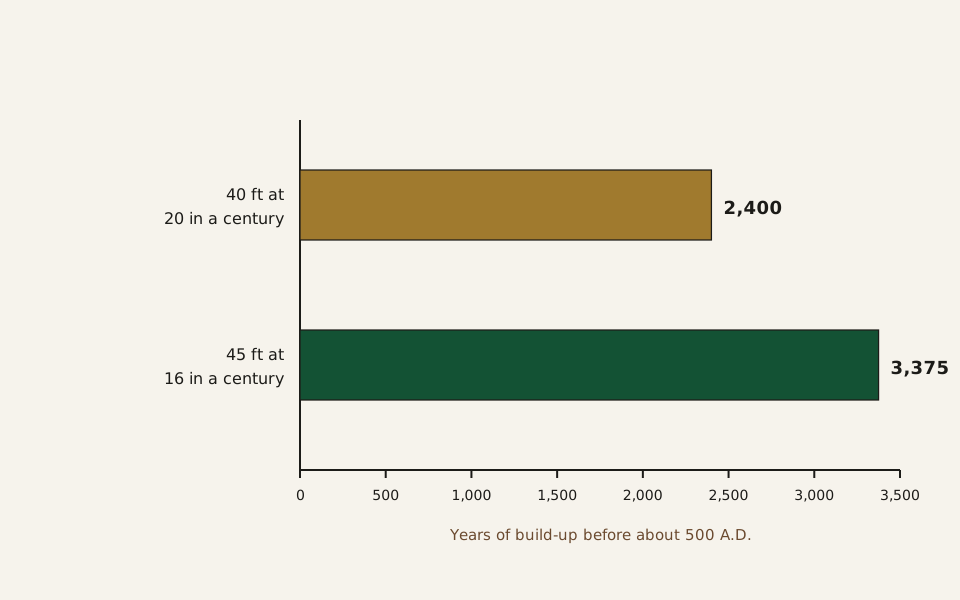
Diagram: Hoax and Hindsight · CC BY 4.0
Credit line to copy
"Petrie's 1904 estimates for a Delta town mound" by Hoax and Hindsight, licensed under CC BY 4.0 (https://creativecommons.org/licenses/by/4.0/). Original: https://hoaxandhindsight.com/archaeology-retested/stratigraphy/
Data: W. M. Flinders Petrie, Methods & Aims in Archaeology (London: Macmillan, 1904), pp. 10-11
Petrie’s two estimates for a Delta mound whose deposits end about 500 A.D., in years of build-up. Drawn from the table published with this page, from Petrie (1904).
Petrie’s town-mound arithmetic, with page references (CSV) (where the data comes from) Data: W. M. Flinders Petrie, Methods & Aims in Archaeology (London: Macmillan, 1904)
His example was a Delta mound about 40 feet high whose deposits end about 500 A.D. Forty feet is 480 inches; at 20 inches a century that is 24 centuries, or 2,400 years of build-up, which Petrie rounded to “say 2000 B.C.” Allowing for a buried base 5 feet lower and a net rate of 16 inches a century, 45 feet gives 33.75 centuries, or 3,375 years, which he gave as “about 2900 B.C.”
The two figures for the same mound differ by 975 years, and the only change is in the assumptions. Petrie did not hide that: “No exact conclusion could be based on this; but it is a valuable clue” (Exhibit D, p. 11). The order of the layers in such a mound is evidence. The number of years is an estimate that depends on a rate assumed for that mound, not measured on it.
What would overturn it:
- Studies of whole sites mixed beyond reading. Published excavation reports showing that, on a given kind of site, worms, roots and soil processes had mixed the deposits so thoroughly that no cut or boundary could be traced would narrow this page’s claim that the order of layers can usually be read.
- A sealed deposit with a later object inside it. A well-recorded case in which an object datable to after a sealing layer formed was found beneath it, with no pit, burrow or collapse to explain it, would weaken the rule as this page states it.
Exhibits
Records and period publications
- Exhibit A: Nicolaus Steno, De solido intra solidum naturaliter contento dissertationis prodromus (Florence: Ex typographia sub signo Stellae, 1669).
- Exhibit B: Nicolaus Steno, The Prodromus to a Dissertation Concerning Solids Naturally Contained within Solids, English translation by Henry Oldenburg (London: F. Winter for M. Pitt, 1671).
- Exhibit C: Augustus Henry Lane-Fox Pitt-Rivers, Excavations in Cranborne Chase, near Rushmore, on the Borders of Dorset and Wilts, vol. 1 (London: printed privately, 1887).
- Exhibit D: W. M. Flinders Petrie, Methods & Aims in Archaeology (London: Macmillan, 1904).
- Exhibit E: Charles Darwin, The Formation of Vegetable Mould through the Action of Worms, with Observations on Their Habits (London: John Murray, 1881), ch. 4.
- Exhibit F: The World's Most Famous Court Trial: Tennessee Evolution Case. A Complete Stenographic Report of the Famous Court Test of the Tennessee Anti-Evolution Act, at Dayton, July 10 to 21, 1925 (Cincinnati: National Book Company, 1925).
Studies
- Exhibit G: Edward C. Harris, Principles of Archaeological Stratigraphy (London: Academic Press, 1979; 2nd ed., 1989); 2nd edition chapter 'The laws of archaeological stratigraphy', doi:10.1016/b978-0-12-326651-4.50013-4.
Cite this page
Hoax and Hindsight. “Stratigraphy: The Deepest Layer in a Dig Isn’t Always Oldest.” Hoax and Hindsight, published November 6, 2026. https://hoaxandhindsight.com/archaeology-retested/stratigraphy/. Accessed [the date you read it].
Related cases
Terminus Post Quem: Newest Original Part Sets a Date Floor
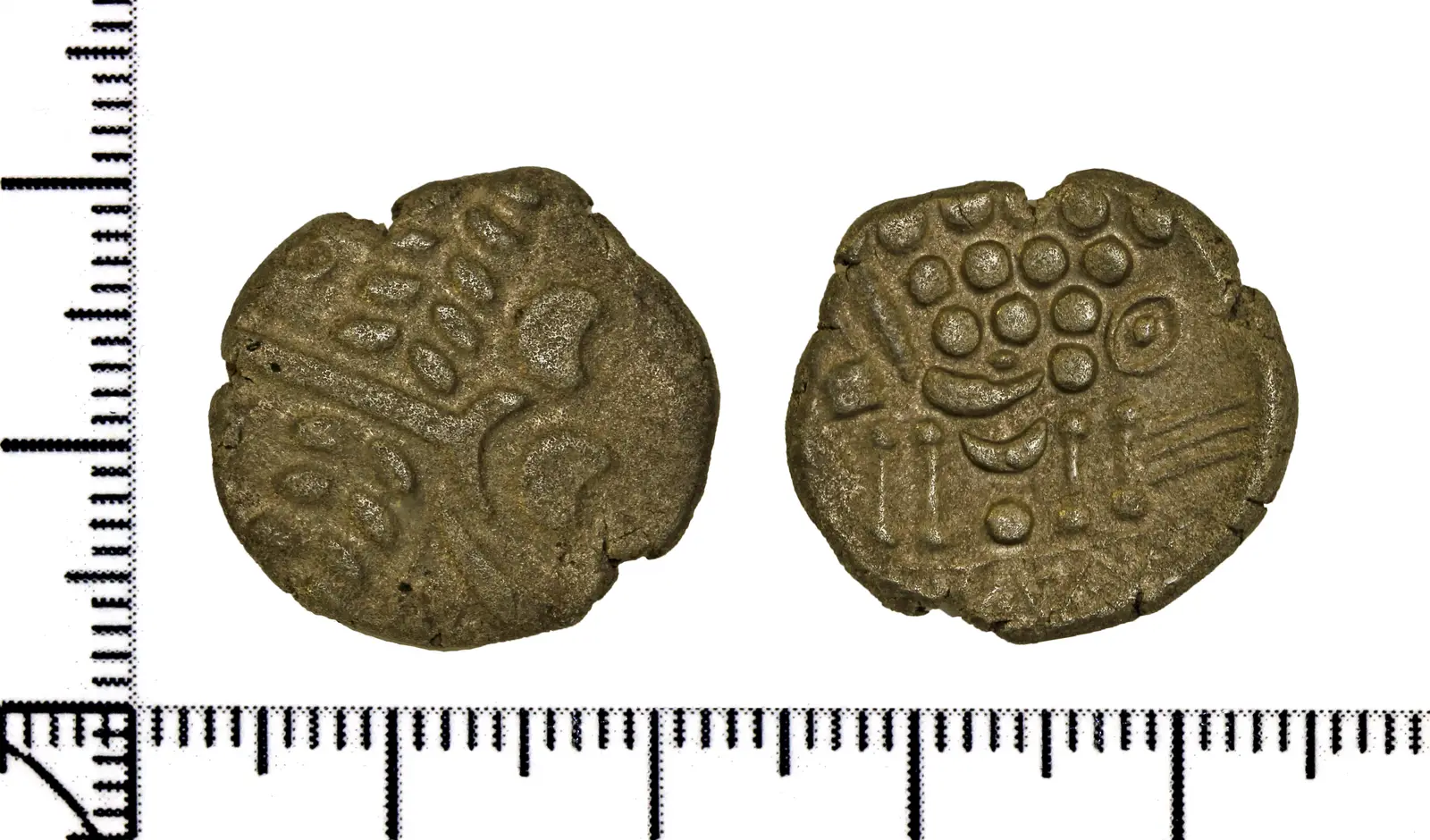
A terminus post quem is the earliest date a layer or object can have, set by its newest dated part. It gives a floor, not a date; the ante quem sets a ceiling.
Picture credit
"Cranborne chase stater (PAS FindID 983439)" by The Portable Antiquities Scheme — https://commons.wikimedia.org/wiki/File:Cranborne_chase_stater_(FindID_983439).jpg — CC BY 2.0 (https://creativecommons.org/licenses/by/2.0/); modified: card and share image cropped to 16:10 by the site build; the article page shows the full frame
 Illustration
Kensington Runestone: Its 1910 Panel’s Own Expert Said No
In 1910 a Minnesota panel backed the Kensington Runestone on one condition; its specialist rejected it. By current evidence it is not accepted as medieval.
Picture credit
Illustration: Hoax and Hindsight. Generated schematic illustration — not a photograph or historical record. © Hoax and Hindsight, all rights reserved.
Proctor’s Ledge: Perley Put Salem’s Hangings There in 1921
Salem's 1692 hangings most likely took place at Proctor's Ledge, below Gallows Hill's summit, as Perley argued in 1921. No archaeological dig has been reported.
Picture credit
"Gallows Hill, Salem, where the witches were hung." by Unknown author — https://commons.wikimedia.org/wiki/File:Gallows_Hill,_Salem,_where_the_witches_were_hung._-_DPLA_-_64eb4c9dba10556ef5bc3647d684749c.jpg — Public domain (anonymous mounted photograph dated by the cataloguer between 1895 and 1905. US: if published, before 1931; if never published, an anonymous unpublished work is protected 120 years from creation, which ended at the latest at the end of 2025; the Boston Public Library marks it No Copyright - United States. EU: anonymous work, more than 70 years since it was made and since any publication. Risk noted: no publication record was checked, and the photographer is not known.); modified: card and share image only: cropped by the site build inside the photograph's mount; the article page shows the whole mount uncropped