Famous Trials · Case retrial
Scopes Monkey Trial: The Defense Asked for a Guilty Verdict
Hoax and Hindsight Published
The Scopes monkey trial ended on July 21, 1925, when a jury in Dayton, Tennessee, returned a verdict of guilty. The 1925 stenographic report shows that the defense had asked for that verdict so the case could reach a higher court, and that the judge, not the jury, then fined the teacher John T. Scopes $100.
Docket
- Case
- State of Tennessee v. John Thomas Scopes
- Years
- 1925–1927
- Place
- Circuit court of Rhea County, at the courthouse in Dayton, Tennessee
- The claim
- That on April 24, 1925, Scopes taught in a Rhea County public school a theory denying the story of the divine creation of man as taught in the Bible, and taught instead that man is descended from a lower order of animals
- The verdict
- Court finding: July 21, 1925, guilty; the jury left the fine to the court and the judge set it at $100 and costs
- Hinges on
- Testimony that Scopes taught that man descended from a lower order of animals, which the defense said it could not contradict
- Status
- Reversed (1927) over the fine, with the act itself upheld, both as reported at the time
Docket as CSVWhere these entries come from (JSON)Data: The World's Most Famous Court Trial: Tennessee Evolution Case (Cincinnati: National Book Company, 1925); Hong Kong Telegraph, January 17, 1927
Scopes was charged under a Tennessee act of March 1925 that made it unlawful for a public-school teacher to teach that man descended from a lower order of animals. Clarence Darrow led the lawyers for the defense, and William Jennings Bryan joined the prosecution. The trial was printed the same year as The World's Most Famous Court Trial, a stenographic report that is the main witness on this page (Exhibit A).
The case did not end in Dayton. In January 1927, according to a Reuters report printed in the Hong Kong Telegraph, the Tennessee Supreme Court upheld the act but quashed the verdict, because a fine above $50 had to be set by a jury (Exhibit B). The court's written opinion could not be read for this page, so that step rests on the news report. By the rules of the retrial method, later retellings are treated here as the charge, and the record is called after them.
Order of proceedings 6 parts
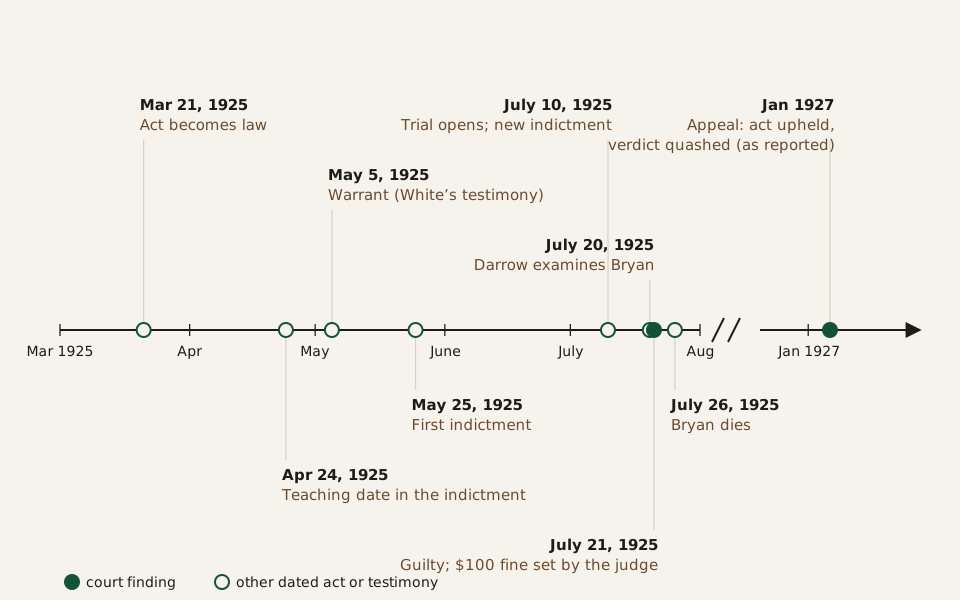
Diagram: Hoax and Hindsight · CC BY 4.0
Credit line to copy
"The Scopes case, March 1925 to January 1927" by Hoax and Hindsight, licensed under CC BY 4.0 (https://creativecommons.org/licenses/by/4.0/). Original: https://hoaxandhindsight.com/trials/scopes-trial/
Data: The World's Most Famous Court Trial: Tennessee Evolution Case (Cincinnati: National Book Company, 1925); Hong Kong Telegraph, January 17, 1927; Biographical Directory of the United States Congress, 1774-1989 (Washington: Government Printing Office, 1989), p. 692
The dated acts on this page, March 1925 to January 1927, with the axis broken after August 1925. Drawn from the timeline table published with this page (Exhibits A, B and F).
| Date | What happened | Where it is recorded |
|---|---|---|
| March 21, 1925 | The act becomes law in Tennessee | Exhibit A, p. 5 |
| April 24, 1925 | The day the indictment says Scopes taught the theory | Exhibit A, p. 309 |
| May 5, 1925 | Warrant sworn out, by Walter White's testimony | Exhibit A, p. 120 |
| May 25, 1925 | First indictment | Exhibit A, p. 4 |
| July 10, 1925 | Trial opens; a new indictment is returned | Exhibit A, pp. 4–7 |
| July 20, 1925 | Court moves to the lawn; Darrow examines Bryan | Exhibit A, pp. 229, 284–304 |
| July 21, 1925 | Bryan's testimony struck; guilty; $100 fine set by the judge | Exhibit A, pp. 305–313 |
| July 26, 1925 | Bryan dies | Exhibit F |
| January 1927 | Act upheld, verdict quashed over the fine (as reported) | Exhibit B |
The timeline, one row per dated act (CSV) (where the data comes from) Data: The World's Most Famous Court Trial: Tennessee Evolution Case (Cincinnati: National Book Company, 1925); Hong Kong Telegraph, January 17, 1927; Biographical Directory of the United States Congress, 1774-1989 (Washington: Government Printing Office, 1989), p. 692
What did the indictment charge, and what did the witnesses say?
The act became law on March 21, 1925 (Exhibit A, p. 5). Its first section made it unlawful for a teacher in a state-funded school “to teach any theory that denies the story of the Divine creation of man as taught in the Bible, and to teach instead that man has descended from a lower order of animals” (p. 5). Scopes was first indicted on May 25, 1925. Because of “some uncertainty” about that indictment, the judge called a new grand jury on the trial's first morning, July 10, and it returned a new one (pp. 4, 7).
The indictment, as the judge read it to the jury, charged that Scopes taught the forbidden theory on April 24, 1925, in the public schools of Rhea County (p. 309). Walter White, the superintendent of schools, testified that Scopes taught “Hunter’s biology” and that the warrant was sworn out on May 5 (p. 120). The book was George William Hunter's A Civic Biology of 1914, which tells students that “Evolution means change” and arranges animals from one-celled forms up to “a group which contains man himself” (Exhibit C, p. 194).
The state's main witness on the teaching itself was Howard Morgan, a student who gave his age as 14. He said Scopes had taught that “there was a little germ of one cell organism formed” and that it kept evolving until “from this was man” (Exhibit A, p. 126). Asked which book the class was using, he named a General Science book, and said he could not find the lesson in it (pp. 126–127). Scopes himself did not testify; Darrow told the jury on the last day that Scopes “could not deny the statements made by the boys” (p. 311).
“Dr. John R. Neal, John T. Scopes” · Bain News Service · Public domain
Full credit
"Dr. John R. Neal, John T. Scopes" by Bain News Service — https://commons.wikimedia.org/wiki/File:Dr._John_R._Neal,_John_T._Scopes_LCCN2014718360.jpg — Public domain (news-agency photograph by the Bain News Service, no named photographer; the negative is marked 7/10/25 (July 10, 1925). US: public domain on the ground that Bain distributed its photographs to newspapers when they were taken, which counts as publication, and this was before 1931. Risk: whether this negative was actually distributed in 1925 has not been checked; if it was never published, an anonymous unpublished US work of 1925 is protected until 120 years after creation (end of 2045). EU: anonymous work, 70 years from first making available (or, if never made available, from creation), long expired. Library of Congress Prints and Photographs, George Grantham Bain Collection, ggbain.38214, 'No known restrictions on publication' (a lead, not the basis))
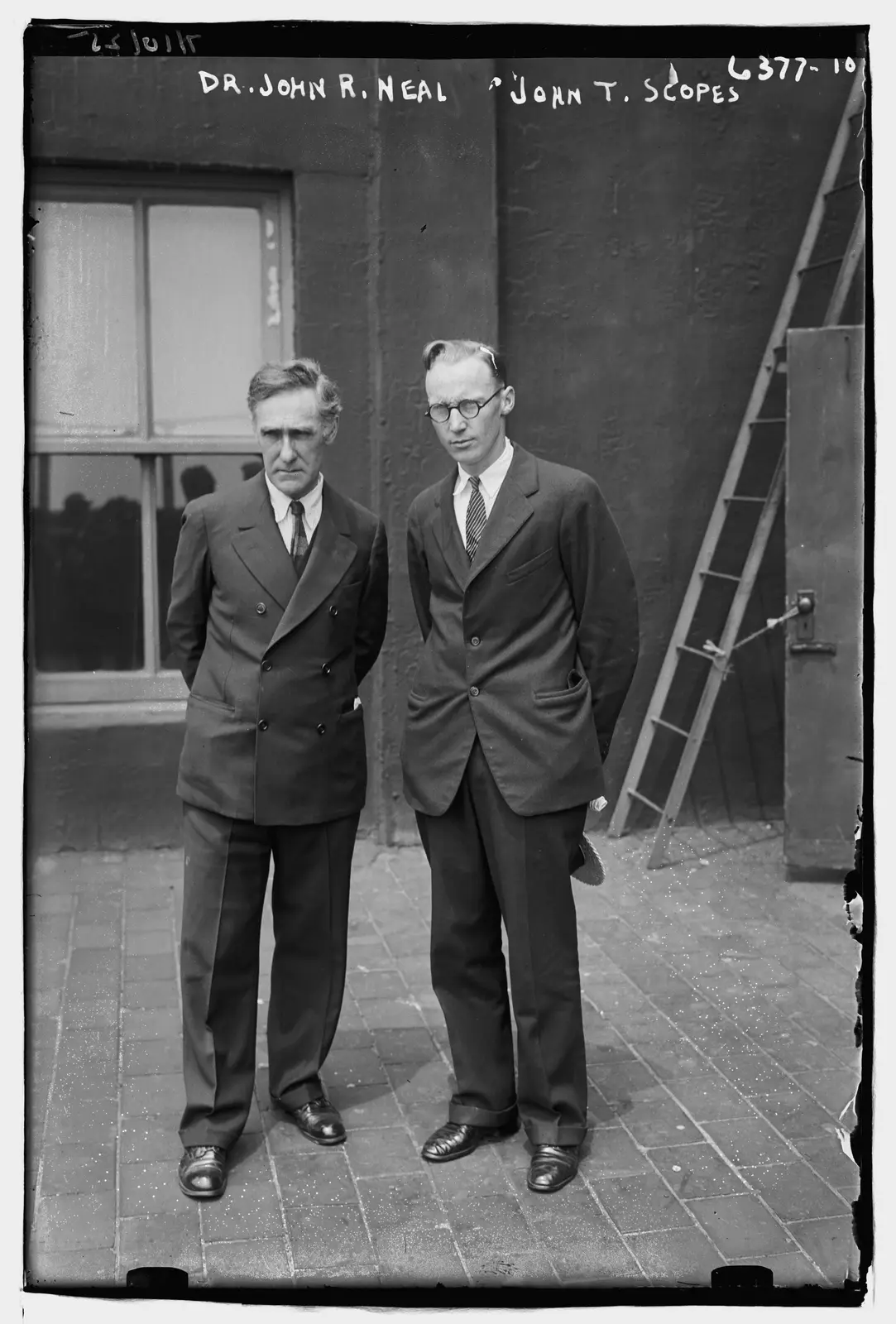
John R. Neal, the defense lawyer who entered the plea of not guilty for Scopes on July 15 (Exhibit A, p. 112), and John T. Scopes, right, in a Bain News Service photograph of 1925. The negative names both men and is dated 7/10/25, the day the trial opened.
How did the eight days in court run?
The trial ran from Friday, July 10, to Tuesday, July 21, 1925: twelve calendar days, with the court sitting on eight of them and on neither weekend. The report fills 317 pages for those eight days, from page 3 to page 319, counting the blank and picture pages that fall between one day and the next. Monday, July 20, alone takes 94 of them. That day holds the defense statements read into the record as well as Darrow's examination of Bryan.
The report is a record with its own limits. Its publisher says it gives the case “from the court record as it was made from day to day,” used the Chattanooga Times's copy of the transcript, and added “some of the headings and sub-heads” (Exhibit A, publisher's note). On the last day, defense lawyer Arthur Garfield Hays told the judge that, after so much confusion, “there may be a chance of having some of it missing” (p. 314).
The headings quoted on this page are the publisher's. The words of the court are the stenographer's. The book also prints Bryan's examination in full, though the judge struck it the next morning, so it is a publisher's record of what was said in court, not the court's own certified record.
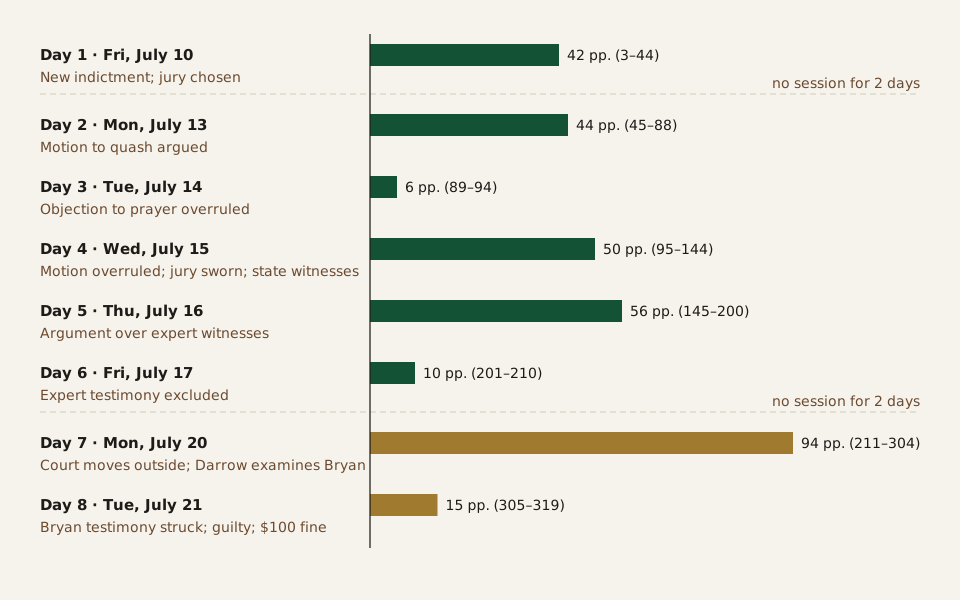
Diagram: Hoax and Hindsight · CC BY 4.0
Credit line to copy
"The eight days in court, July 10 to 21, 1925, by pages of the report" by Hoax and Hindsight, licensed under CC BY 4.0 (https://creativecommons.org/licenses/by/4.0/). Original: https://hoaxandhindsight.com/trials/scopes-trial/
Data: The World's Most Famous Court Trial: Tennessee Evolution Case (Cincinnati: National Book Company, 1925)
One bar per day in court, measured in pages of the 1925 stenographic report (Exhibit A); dashed lines mark the two weekends without a session. Each day's pages run to the page before the next day's chapter, so a few blank and picture pages are counted. Drawn from the table of court days published with this page.
| Day | Date | Pages | Main ruling |
|---|---|---|---|
| 1 | Friday, July 10 | 3–44 | New indictment returned |
| 2 | Monday, July 13 | 45–88 | None that day; motion to quash argued |
| 3 | Tuesday, July 14 | 89–94 | Objection to prayer overruled |
| 4 | Wednesday, July 15 | 95–144 | Motion to quash overruled; jury sworn |
| 5 | Thursday, July 16 | 145–200 | None that day; experts argued over |
| 6 | Friday, July 17 | 201–210 | Expert testimony excluded |
| 7 | Monday, July 20 | 211–304 | Contempt forgiven; Bryan examined |
| 8 | Tuesday, July 21 | 305–319 | Guilty; $100 fine set by the judge |
The eight court days, one row per day (CSV) (where the data comes from) Data: The World's Most Famous Court Trial: Tennessee Evolution Case (Cincinnati: National Book Company, 1925)
The two rulings that shaped the end came on the fourth and sixth days. On July 15 the judge refused to quash the indictment (pp. 100–108), and on July 17 he excluded the scientists the defense had brought as expert witnesses (p. 201). After that, as the judge put it on the last morning, the only question left was whether Scopes had taught “that man descended from a lower order of animals” (p. 305).
What did Bryan say about layers of rock?
On Monday, July 20, the judge moved the court outside, saying: “I am afraid of the building. The court will convene down in the yard” (Exhibit A, p. 229). Any jurors present were told to retire, and the defense read statements from scientists and Bible scholars into the record. Then the defense called Bryan himself, and Darrow questioned him (p. 284).
Darrow asked: “Mr. Bryan, could you tell me how old the earth is?” Bryan answered: “No, sir, I couldn’t” (p. 296). When Darrow pressed him for a scientist he respected, Bryan named George M. Price, a “Professor of geology in a college” (p. 297).
A few questions later, Darrow told the court that Price was “a montebank and a pretender and not a geologist at all” (p. 297), which is one lawyer's charge in court, not a finding. Asked how old Price said the earth was, Bryan first said he had not examined the book to answer that. Pressed again, he said Price “speaks of the layers that are supposed to measure age” and that “attempts to measure age by those layers where they are not in the order in which they are usually found makes it difficult to fix the exact age” (p. 297).
Layers out of their usual order are also a problem archaeologists meet on their own sites, and they treat it as a sign of later disturbance to explain rather than a reason to give up on order. The stratigraphy page shows how diggers explain layers found out of order, and it quotes this same exchange. The stenographer also recorded the crowd: Bryan's line “You cannot measure the length of my answer by the length of your question” drew “Laughter in the courtyard” (p. 286).
“W. J. Bryan at Scopes Trial, 1925 photo by United News Pictures” · United News Pictures · Public domain
Full credit
"W. J. Bryan at Scopes Trial, 1925 photo by United News Pictures" by United News Pictures — https://commons.wikimedia.org/wiki/File:W._J._Bryan_at_Scopes_Trial,_1925_photo_by_United_News_Pictures.jpg — Public domain (news-agency photograph credited to United News Pictures, no named photographer, reproduced from a newspaper page (the halftone screen is visible across the picture); the 1925 printing and the identification are the Commons file description's statements, not checked here, and Bryan died in July 1925. US: published in 1925, before 1931, so public domain (PD-US-expired). EU: anonymous work published in 1925; 70 years from publication expired at the end of 1995); modified: halftone screen softened with a Gaussian blur (radius 2 px) and converted to greyscale; not cropped
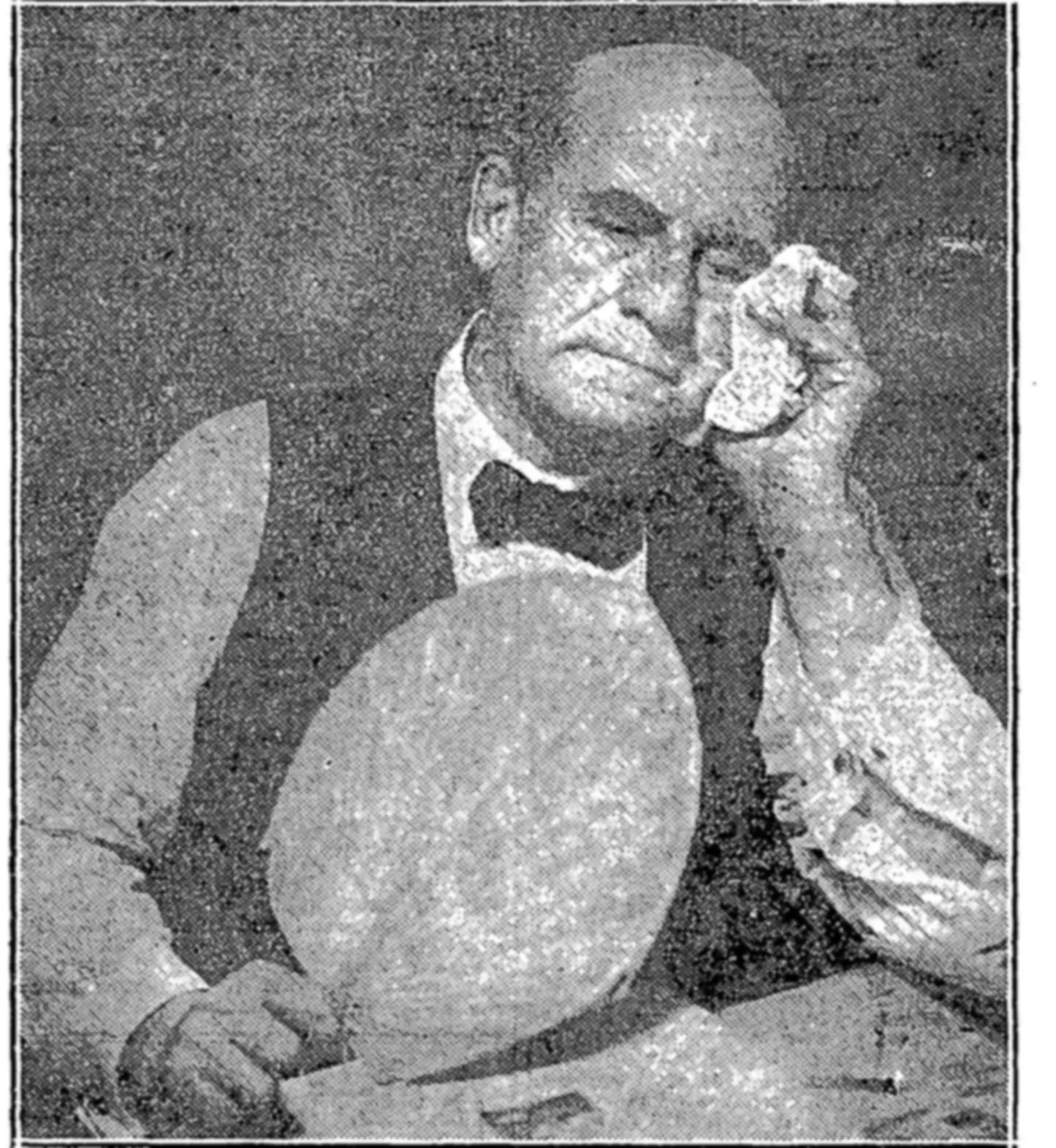
William Jennings Bryan, in a newspaper halftone that its archive record credits to United News Pictures and places at the Dayton trial of 1925; the picture itself carries no caption. He testified on July 20 and died on July 26 (Exhibit F).
The next morning the judge took it all back. He said he feared he “may have committed error on yesterday” and that Bryan's testimony “can shed no light upon any issues that will be pending before the higher courts,” and he struck it from the record (p. 305). Bryan told the court, “I fully agree with the court that the testimony taken yesterday was not legitimate or proper” (p. 307). Asked whether the questions went too, the judge answered, “I expunged the whole proceedings” (p. 307).
Why did the defense ask for a guilty verdict?
With the experts excluded and Bryan's testimony struck, Darrow told the court: “we have no witnesses to offer, no proof to offer on the issues that the court has laid down here” (Exhibit A, p. 306). He went on: “we will ask the court to bring in the jury and instruct the jury to find the defendant guilty” (p. 306). The attorney general, A. T. Stewart, accepted the suggestion. Out of the jury's hearing, Darrow added that the request “was not made as a plea of guilty or an admission of guilt” but as the way to reach “the higher court” (p. 308).
The judge then read his charge. The act set a fine of not less than $100 and not more than $500, and he told the jurors: “But if you are content with a $100 fine, then you may simply find the defendant guilty and leave the punishment to the court” (pp. 310–311). Darrow spoke to the jury briefly: “We do not see how you could” return a verdict of not guilty, he said, adding, “We do not ask it” (p. 311).
The jury came back at 11:23 a.m. (p. 312). The heading “Jury Out Nine Minutes” above that line is the publisher's, so the length of the deliberation is the report's summary, not the stenographer's record.
Asked for the verdict, the foreman said: “We have found for the state, found the defendant guilty” (p. 313). Asked whether the jury had fixed the fine, he answered, “Leave it to the court” (p. 313).
“John T. Raulson, 1925 photo by United Newspictures” · United Newspictures · Public domain
Full credit
"John T. Raulson, 1925 photo by United Newspictures" by United Newspictures — https://commons.wikimedia.org/wiki/File:John_T._Raulson,_1925_photo_by_United_Newspictures.jpg — Public domain (news-agency photograph credited in the printed caption to United Newspictures, no named photographer; a clipping of a 1925 newspaper page whose caption says the judge 'will preside in Scopes case'. US: published in 1925, before 1931, so public domain (PD-US-expired). EU: anonymous work published in 1925; 70 years from publication expired at the end of 1995)
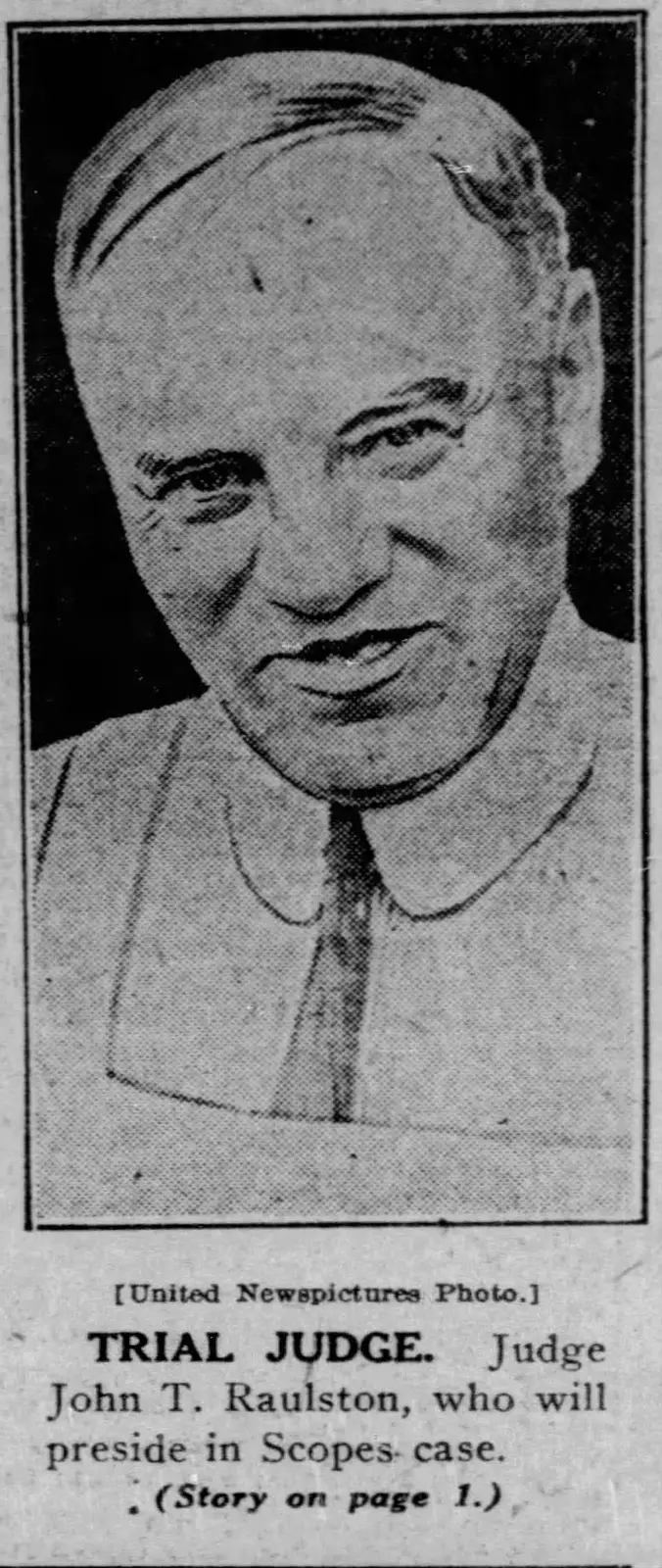
Judge John T. Raulston in a United Newspictures photograph printed in a newspaper in 1925, before the trial opened, under a caption calling him the judge “who will preside in Scopes case” that summer.
The judge then said, “The court now fixes your fine at $100” (p. 313). Scopes spoke next: “Your honor, I feel that I have been convicted of violating an unjust statute” (p. 313). The fine was $100 and costs, and bond was set at $500, which the Baltimore Evening Sun offered to give (p. 313). According to the report's publisher, Bryan's prepared closing speech was never delivered because both sides agreed to skip arguments to the jury; he died on July 26, five days after the verdict (Exhibit A, p. 321; Exhibit F).
What happened to the $100 fine on appeal?
The flaw was spoken aloud in court before the verdict came in. After the charge, Stewart asked the judge about the fine: “I had it in mind that it would be the duty of the jury to fix whatever fine was imposed” (Exhibit A, p. 312). The judge answered that the jury could fix the minimum, but “The practice, however, is for the court to impose the minimum” (p. 312). The jury left the fine to the court, and the judge set it.
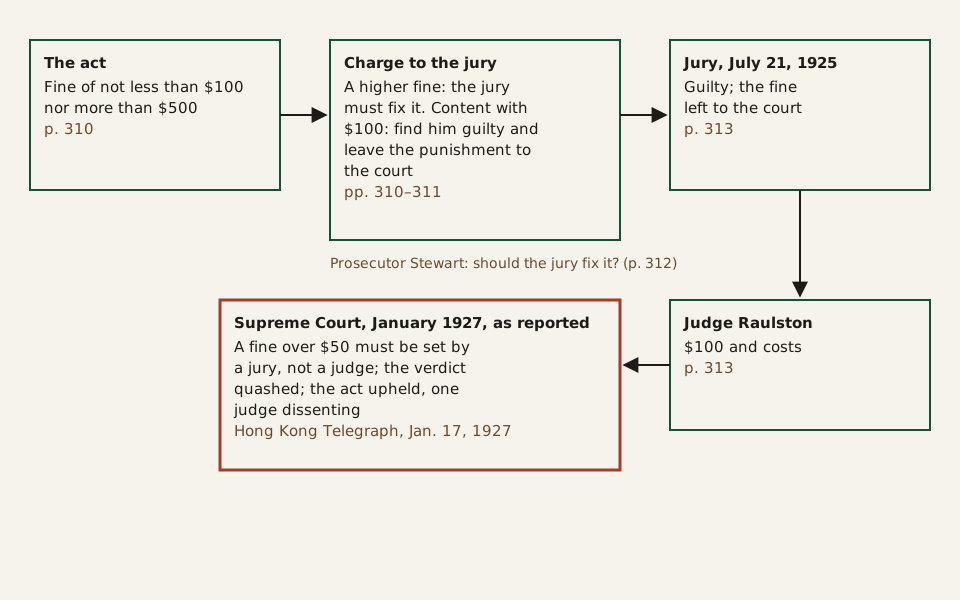
Diagram: Hoax and Hindsight · CC BY 4.0
Credit line to copy
"Who set the Scopes fine, 1925, and the appeal of 1927 as reported" by Hoax and Hindsight, licensed under CC BY 4.0 (https://creativecommons.org/licenses/by/4.0/). Original: https://hoaxandhindsight.com/trials/scopes-trial/
Data: The World's Most Famous Court Trial: Tennessee Evolution Case (Cincinnati: National Book Company, 1925); Hong Kong Telegraph, January 17, 1927
Who set the fine: the steps of July 21, 1925, with pages of the stenographic report (Exhibit A), and the appeal of January 1927 as a Reuters report gave it (Exhibit B). The appeal court's own opinion was not read for this page.
In January 1927 the Tennessee Supreme Court ruled on the appeal. According to the Reuters report in the Hong Kong Telegraph of January 17, 1927, the court held, with one judge dissenting, that the act under which Scopes was convicted was constitutional. It also held, by that report, that the verdict should be quashed, because a fine over $50 had to be set by a jury and not by a judge (Exhibit B). The same report says the defense planned to carry the case to the United States Supreme Court; no later step was read for this page.
If the report is right, the conviction was set aside on the one point Stewart had raised at the bar, and the act itself stood. The court finding of July 21, 1925, is on the Docket card as the record states it, and the 1927 outcome is in its Status line, marked as reported.
Popular version vs. the record
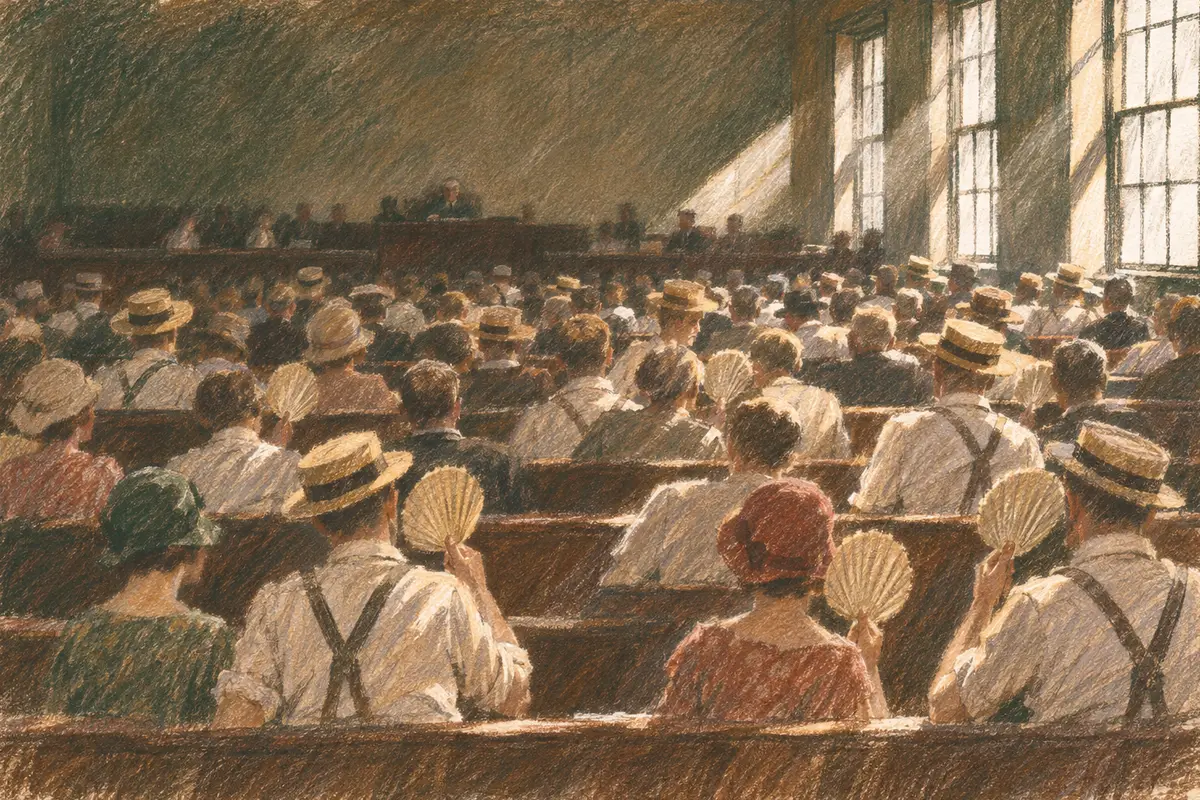
Illustration: Hoax and Hindsight. Generated schematic illustration — not a photograph or historical record. © Hoax and Hindsight, all rights reserved.
An illustration, not a record: a courtroom gallery in July 1925. The retellings below are tested against the court’s stenographic report.
This site has tested retellings against the record in two other trials: the Salem witch trials of 1692, where popular versions also run ahead of the papers and the 1633 trial of Galileo, another case where a court sat in judgment on science. Here the charge comes from two early retellings. One is Marcet Haldeman-Julius's 1927 pamphlet Clarence Darrow's Two Great Trials, which reprints the report she wrote in 1925 after watching the trial (Exhibit D). The other is the unsigned foreword to a 1929 Little Blue Book edition of the Bryan examination (Exhibit E).
On this site, courtroom folklore means the “popular versions of a famous trial that contradict the surviving record and still outlive it.” Two details below contradict the record. Whether they outlived it is not something the sources read here can show, so they are tested as claims, not labeled as folklore.
“The eyes of the world were fixed upon the Dayton courthouse for those twelve days” (1929 foreword, p. 3; Exhibit E)
Matches on the length. July 10 to 21 is twelve calendar days; the court sat on eight of them (Exhibit A, pp. 3–319). How closely the world watched is not in the record.
Scopes “was found guilty and fined $100” (1929 foreword, p. 3; Exhibit E)
Matches. The jury found him guilty and the judge fixed the fine at $100 and costs (Exhibit A, p. 313). The foreword leaves out the 1927 appeal.
On the last morning the judge said, “I made a very grave mistake” (Haldeman-Julius, 1927, p. 25; Exhibit D)
Contradicts the wording. The report has the judge say he feared he “may have committed error on yesterday in my over-zeal” (Exhibit A, p. 305).
“The jury actually was summoned — for the first time since the second day of the trial” (Haldeman-Julius, 1927, p. 25; Exhibit D)
Contradicts. The jury was sworn on the fourth day, July 15, and heard the state's witnesses that day (Exhibit A, pp. 119–133).
The trial ended “with Darrow, apparently defeated, really the Victor” (Haldeman-Julius, 1927, p. 25; Exhibit D)
The record cannot settle who won the argument. In court, Darrow asked for the guilty verdict, and the jury returned it (Exhibit A, pp. 306, 313).
The cross-examination “made Bryan the laughing-stock of every educated person” (1929 foreword, p. 3; Exhibit E)
The record cannot measure reputation. It records laughter in the courtyard, then the judge striking the whole examination the next morning, with Bryan agreeing (Exhibit A, pp. 286, 305, 307).
The popular versions and the record, one claim per row (CSV) (where the data comes from) Data: Marcet Haldeman-Julius, Clarence Darrow's Two Great Trials (1927); Little Blue Book No. 1424 (1929); The World's Most Famous Court Trial (1925)
Who won the Scopes trial?
The State of Tennessee won the trial: on July 21, 1925, the jury found Scopes guilty, after his own lawyer asked the court to instruct that verdict so the case could be appealed (Exhibit A, pp. 306, 313). In January 1927, according to a Reuters report, the Tennessee Supreme Court upheld the act but quashed the verdict because the judge, not the jury, had set the fine (Exhibit B).
Was John Scopes jailed?
Not in the 1925 record. After the $100 fine, the judge set bond at $500 for Scopes's appearance at a later term, and the defense said the Baltimore Evening Sun had offered to give the bond (Exhibit A, p. 313). The report records no arrest at the trial and no time in jail.
Is Inherit the Wind a true story?
Inherit the Wind, the 1955 play by Jerome Lawrence and Robert E. Lee, is catalogued by libraries as a drama about the Scopes trial (Exhibit G). Its script was not read for this page, so it is not scored here. The record that any version can be checked against is the 1925 stenographic report (Exhibit A).
What would overturn it:
- The Tennessee Supreme Court's own 1927 opinion, if it gives a different reason for setting aside the conviction than the jury-and-fine rule in the Reuters report.
- The clerk's bill of exceptions or another court copy of the transcript, if it gives Darrow's request of July 21 or the jury's verdict in words that differ from the published report.
Exhibits
- Exhibit A: The World's Most Famous Court Trial: Tennessee Evolution Case. A Complete Stenographic Report of the Famous Court Test of the Tennessee Anti-Evolution Act, at Dayton, July 10 to 21, 1925 (Cincinnati: National Book Company, 1925).
- Exhibit B: “The Scopes’ Trial Recalled,” Reuters report, Hong Kong Telegraph, January 17, 1927.
- Exhibit C: George William Hunter, A Civic Biology, Presented in Problems (New York: American Book Company, 1914).
- Exhibit D: Marcet Haldeman-Julius, Clarence Darrow’s Two Great Trials: Reports of the Scopes Anti-Evolution Case and the Dr. Sweet Negro Trial (Girard, Kansas: Haldeman-Julius, 1927).
- Exhibit E: Clarence Darrow, The Famous Examination of Bryan at the Scopes Evolution Trial, Little Blue Book No. 1424, ed. E. Haldeman-Julius (Girard, Kansas: Haldeman-Julius Publications, 1929), unsigned foreword.
- Exhibit F: Biographical Directory of the United States Congress, 1774–1989, Bicentennial Edition (Washington: Government Printing Office, 1989).
- Exhibit G: Jerome Lawrence and Robert E. Lee, Inherit the Wind (New York: Bantam Books, 1955 edition).
Cite this page
Hoax and Hindsight. “Scopes Monkey Trial: The Defense Asked for a Guilty Verdict.” Hoax and Hindsight, published November 6, 2026. https://hoaxandhindsight.com/trials/scopes-trial/. Accessed [the date you read it].
Related cases
Salem Witch Trials: 3 of 52 Convicted in 1693, Phips Wrote
Salem witch trials: 19 hanged in 1692; in 1693, by the governor's count, all but 3 of 52 tried were cleared. What spectral evidence was and what changed.
Picture credit
"Trial of George Jacobs for Witchcraft, Salem, Mass" by T. H. Matteson; postcard by Detroit Publishing Co. — https://commons.wikimedia.org/wiki/File:Trial_of_George_Jacobs_for_Witchcraft,_Salem,_Mass_(NYPL_b12647398-75594).tiff — Public domain (painting of 1855 by T. H. Matteson (1813–1884) reproduced on a Detroit Publishing Co. postcard (series 13270, published after 1898 and before 1931): public domain in the US (published before 1931) and in the EU (painter dead since 1884; the postcard is an anonymous company publication more than 70 years old); New York Public Library scan, PD-scan); modified: cropped to the printed picture, removing the postcard's white margin and the printed caption and publisher's copyright line along the lower edge, converted from TIFF to JPEG
Galileo Trial: No ‘Eppur Si Muove’ in the 1633 Record
Galileo’s 1633 sentence found him vehemently suspected of heresy. Eppur si muove is not in it; the earliest printing found, per Mario Livio, is from 1757.
Picture credit
"Hamburg, Kunsthalle, Friedrich Karl Hausmann, Galilei vor dem Konzil" by Dguendel — https://commons.wikimedia.org/wiki/File:Hamburg,_Kunsthalle,_Friedrich_Karl_Hausmann,_Galilei_vor_dem_Konzil.jpg — CC BY 4.0 (https://creativecommons.org/licenses/by/4.0/); modified: cropped to the painted surface, removing a strip of the gilt frame along the top (16 px) and left (18 px) edges, re-encoded as JPEG
Trial by Ordeal: Most Várad Cases With a Result Were Cleared
In the Várad register, dated 1208–1235 by its 1903 editors, 131 of 209 hot-iron cases with a written result end with everyone cleared, by this site’s count.
Picture credit
"Wasserprobe (ordeal by water), drawing in the Rituale of Lambach Abbey" by Unknown author — https://commons.wikimedia.org/wiki/File:Wasserprobe.jpg — Public domain (medieval drawing (the Commons file page dates it to the 12th century, author unknown): public domain in the US and the EU, where every term ran out centuries ago; the image is a faithful photographic reproduction of a two-dimensional public-domain work, which adds no new copyright in the US (PD-Art) or in the EU (Directive (EU) 2019/790, Art. 14). The reproduction was photographed from a plate in Peter Dinzelbacher, Das fremde Mittelalter (Essen: Magnus, 2006).); modified: cropped to the drawing (x 60-1361, y 0-712 of the 1,361 x 1,599 original), removing the Latin text below it and a pencil folio mark at the top left, re-encoded as JPEG