Famous Trials · Case retrial
Galileo Trial: No ‘Eppur Si Muove’ in the 1633 Record
Hoax and Hindsight Published
“Eppur si muove,” the defiant line credited to Galileo, is not in the 1633 sentence or in his abjuration. The Roman Inquisition’s sentence of June 22, 1633, found him “vehemently suspected of heresy” rather than calling him a heretic, and the earliest printing of the line found so far, according to Mario Livio, is Giuseppe Baretti’s Italian Library of 1757.
Docket
- Case
- The trial of Galileo Galilei before the Roman Inquisition
- Years
- 1632–1633
- Place
- Rome: the palace of the Holy Office, and the convent of Santa Maria sopra Minerva for the sentence and abjuration
- The claim
- That Galileo held and defended the motion of the earth in his Dialogue of 1632, after a 1616 injunction not to hold, teach or defend it
- The verdict
- Court finding: on June 22, 1633, vehemently suspected of heresy; absolution only after abjuring; the Dialogue prohibited; formal prison at the court's discretion; the seven penitential psalms weekly for three years
- Hinges on
- A disputed note of February 26, 1616, recording an injunction not to hold, teach or defend the doctrine in any way
- Status
- Upheld: no reversal of the 1633 sentence appears in the records read here; the Dialogue left the Index of Prohibited Books in 1835, according to Gebler
The trial ran in Rome from the autumn of 1632 to June 1633, before the cardinals of the Holy Office, the court of the Roman Inquisition. Its papers survive in print. In 1907 Antonio Favaro published the trial file, the sentence and the abjuration in volume 19 of the national edition of Galileo’s works (Exhibit A). The Italian and Latin passages quoted on this page are translated by Hoax and Hindsight.
The popular story is older than that edition. In 1757 the Italian writer Giuseppe Baretti, publishing in London, told it in an annotated list of Italian books: Galileo, he wrote, spent six years in the Inquisition, was tortured, and said “Eppur si move” once he was free (Exhibit B). This page takes Baretti’s story as the charge and calls the court’s own papers after it, by the rules set out in the retrial method.
Order of proceedings 8 parts
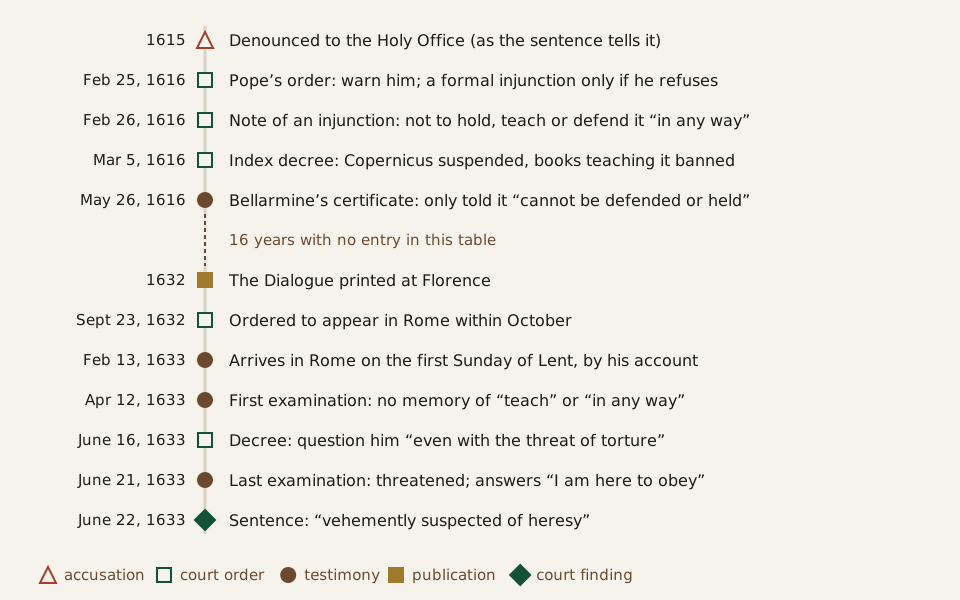
Diagram: Hoax and Hindsight · CC BY 4.0
Credit line to copy
"The Galileo trial file, 1615 to June 22, 1633" by Hoax and Hindsight, licensed under CC BY 4.0 (https://creativecommons.org/licenses/by/4.0/). Original: https://hoaxandhindsight.com/trials/galileo-trial/
Data: Antonio Favaro, ed., Le opere di Galileo Galilei, vol. 19 (Florence, 1907); Giuseppe Baretti, The Italian Library (London, 1757)
The main dated acts in the trial file from the 1615 denunciation to the sentence of June 22, 1633, marked by kind; sixteen years pass between Bellarmine’s certificate and the printing of the Dialogue. Drawn from the table published with this page, compiled from Favaro’s volume 19 (Exhibit A) and Baretti’s book list (Exhibit B).
| Date | Document | Kind |
|---|---|---|
| 1615 | Denunciation, as the 1633 sentence tells it | accusation |
| February 25, 1616 | Pope Paul V’s order to warn Galileo | court order |
| February 26, 1616 | Note of an injunction (disputed) | court order |
| March 5, 1616 | Decree of the Congregation of the Index | court order |
| May 26, 1616 | Cardinal Bellarmine’s certificate | testimony |
| 1632 | The Dialogue printed at Florence | publication |
| September 23, 1632 | Order to appear in Rome within October | court order |
| February 13, 1633 | Arrival in Rome, by Galileo’s account | testimony |
| April 12, 1633 | First examination | testimony |
| June 16, 1633 | Decree on the final questioning | court order |
| June 21, 1633 | Last examination | testimony |
| June 22, 1633 | Sentence | court finding |
The trial file, 1615 to 1879, one row per document or passage (CSV) (where the data comes from) Data: Antonio Favaro, ed., Le opere di Galileo Galilei, vol. 19 (Florence, 1907); Giuseppe Baretti, The Italian Library (London, 1757); Karl von Gebler, Galileo Galilei and the Roman Curia (London, 1879)
What was Galileo told in 1616?
The injunction at the center of the 1633 case goes back to an order of February 25, 1616. Pope Paul V told Cardinal Robert Bellarmine to warn Galileo to give up the opinion that the sun stands still at the center of the world and the earth moves. Only if Galileo refused was the Commissary of the Holy Office to give him a formal injunction before a notary and witnesses (Exhibit A, p. 321).
A note dated the next day says both things happened. Bellarmine warned him, and then, “successive ac incontinenti,” at once, the Commissary ordered him to omnino relinquat, nec eam de caetero, quovis modo, teneat, doceat aut defendat, verbo aut scriptis: to “abandon it entirely, and from now on not hold, teach or defend it in any way, by word or in writing” (pp. 321–322). The note records no refusal by Galileo.
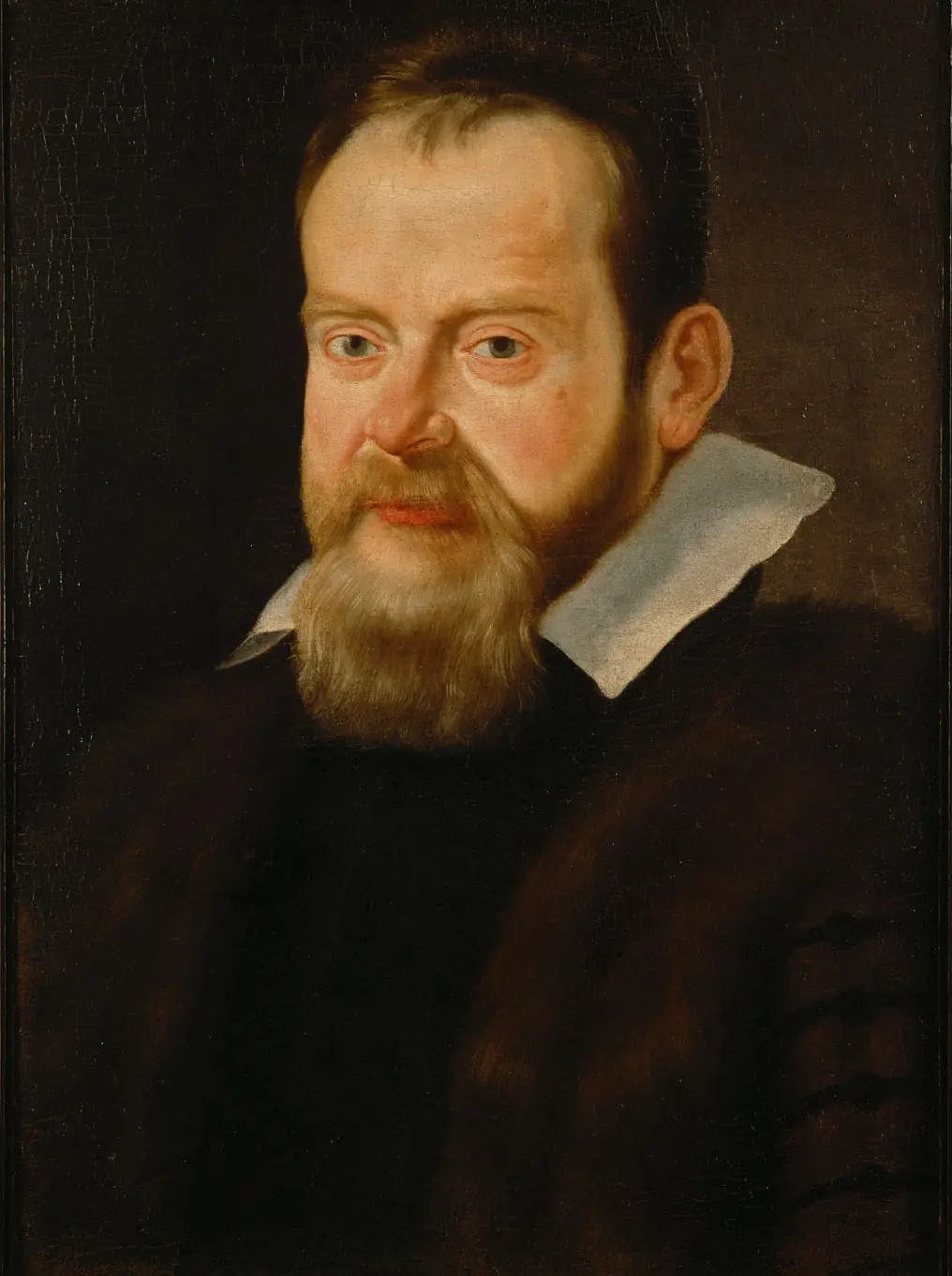
“Galileo Galilei (1564-1642) in pelzverbrämtem Mantel, Brustbild” · Tiberio Titi (attributed) · Public domain
Full credit
"Galileo Galilei (1564-1642) in pelzverbrämtem Mantel, Brustbild" by Tiberio Titi (attributed) — https://commons.wikimedia.org/wiki/File:Anonymous_-_Galileo_Galilei_(1564-1642)_in_pelzverbr%C3%A4mtem_Mantel,_Brustbild_-_GG_7976_-_Kunsthistorisches_Museum.jpg — Public domain (oil painting of about 1610-1612 attributed to Tiberio Titi (d. 1627): public domain in the US (published before 1931) and in the EU (painter dead for far more than 70 years); faithful reproduction of a two-dimensional work (PD-Art) from the Kunsthistorisches Museum, Vienna (GG 7976), marked Public Domain Mark 1.0 on Commons)
Galileo around 1610–1612, a few years before the warning of 1616. Portrait attributed to Tiberio Titi, Kunsthistorisches Museum, Vienna.
Galileo kept a different paper. On May 26, 1616, Bellarmine certified in writing that Galileo had not abjured and had received no penance. He had only been told of the declaration that the Copernican doctrine non si possa difendere né tenere, “cannot be defended or held” (p. 342). The certificate does not say “teach,” and it does not say “in any way.”
That gap is the hinge of the whole trial. Karl von Gebler, who examined the original file, concluded in his history of 1879 that the second half of the February 26 note was untrue, though written in 1616 and not forged later (Exhibit C). Emil Wohlwill, Gebler reports, had suspected a later insertion. The 1633 court treated the note as valid.
Why did the court object to the Dialogue?
The Dialogue on the Two Great Systems of the World, Ptolemaic and Copernican was printed at Florence by Giovan Battista Landini in 1632, as Baretti’s own book list records (Exhibit B, p. 52). On September 23, 1632, the Holy Office told the Florence inquisitor to order Galileo to appear in Rome within the month of October (Exhibit A, pp. 279–280). By his own account he arrived “la prima domenica di Quaresima,” the first Sunday of Lent, which in 1633 fell on February 13 (p. 337).
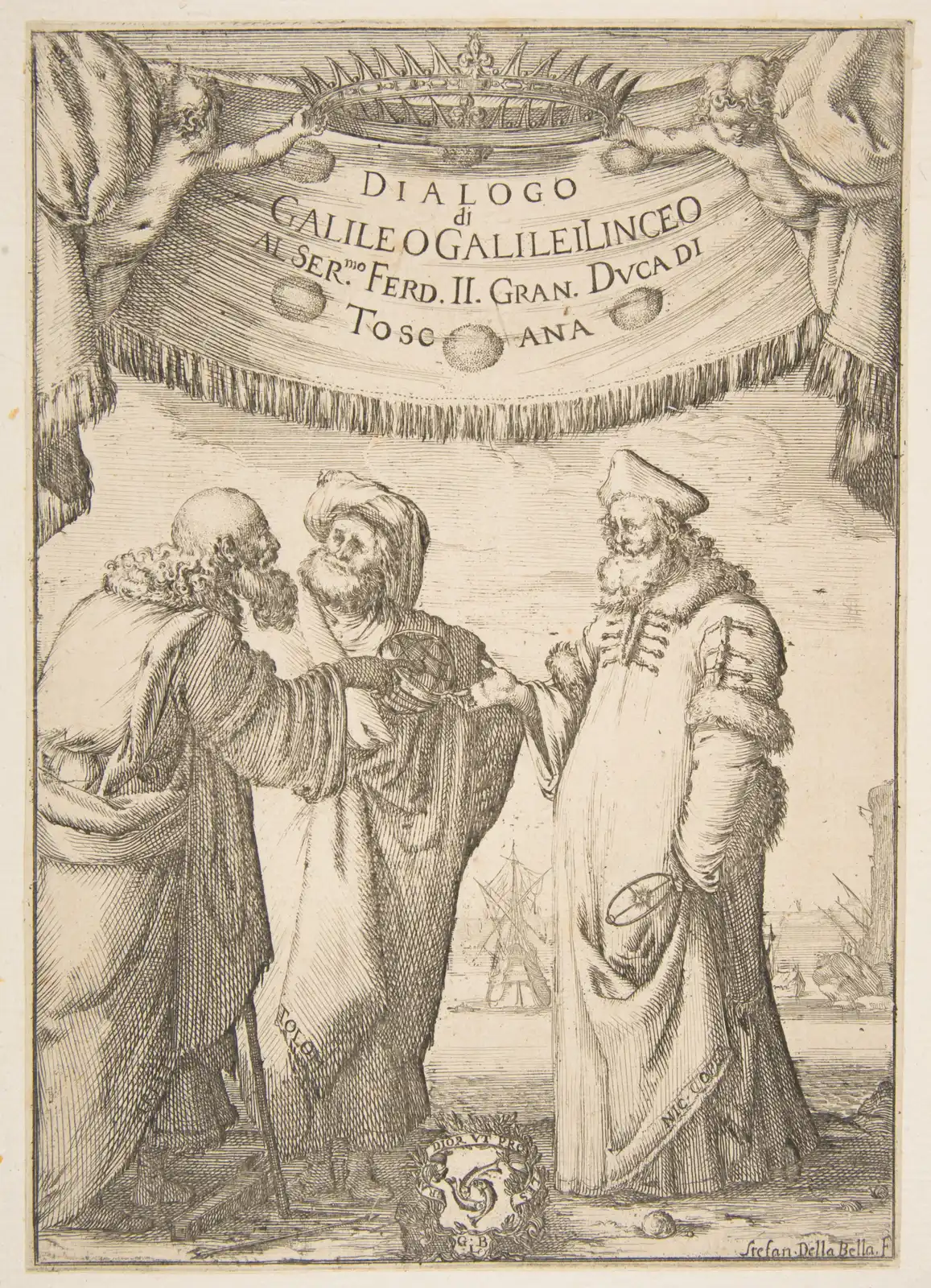
"Frontispiece for Dialogo di Galileo Galilei" by Stefano della Bella — https://commons.wikimedia.org/wiki/File:Frontispiece_for_Dialogo_di_Galileo_Galilei_MET_DP818095.jpg — CC0 1.0 (https://creativecommons.org/publicdomain/zero/1.0/)
Stefano della Bella’s etched frontispiece, made for the Dialogue printed at Florence in 1632; this impression is the fourth and last state of the plate. The lettering on the robes of the middle and right-hand figures names Ptolemy and Copernicus.
The sentence gives the court’s reading of the book. It found in the Dialogue “expressly the transgression” of the 1616 injunction, because Galileo defended the condemned opinion there. He had tried “with various evasions” to present it as undecided and probable, the sentence says, which was itself “a very grave error,” since an opinion declared contrary to Scripture could not be probable (p. 404).
The sentence also lists two admissions. Galileo had asked for a license to print without telling the licensers about the injunction. He also confessed that some arguments for the false side were written so that a reader might find them hard to answer, and blamed the dialogue form and a natural pride in his own cleverness, not intent (p. 404). These are the court’s summaries of his words, written to justify its finding.
What did Galileo tell the court in 1633?
On April 12, 1633, Galileo was examined under oath before the Commissary General, Vincenzo Maculano (Exhibit A, pp. 336–337). He said that in February 1616 Bellarmine told him the Copernican opinion, taken absolutely, could not be held or defended, but could be used as a supposition (p. 339). Then he was asked about the injunction itself.
“It may be that some injunction was given me not to hold or defend that opinion,” he answered, ma non ne ho memoria, “but I have no memory of it” (p. 340). Told that the injunction also said “teach” and “in any way,” he said he did not remember those words. He believed he had forgotten them because the certificate he relied on did not contain them.
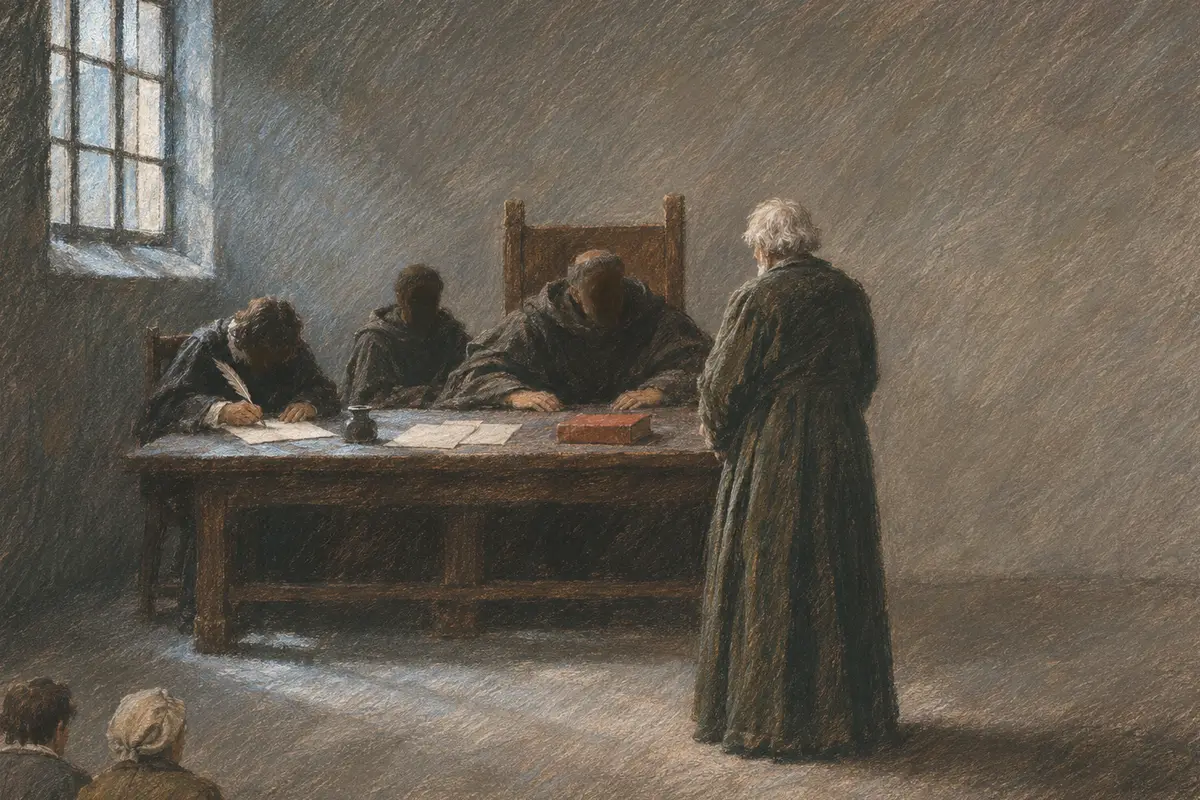
Illustration: Hoax and Hindsight. Generated schematic illustration — not a photograph or historical record. © Hoax and Hindsight, all rights reserved.
An illustration of the setting of the 1633 examinations, drawn for this page; it does not show any real person or the actual room.
This is testimony, and it was given in self-defense. Galileo needed the injunction to be as narrow as Bellarmine’s certificate, and his answers point that way. The record shows what he said under questioning, not what happened in Bellarmine’s rooms in 1616.
He was not kept in a cell for months. Gebler, working from the dispatches of the Tuscan ambassador, puts Galileo inside the Holy Office buildings only from April 12 to 30 and from June 21 to 24, 1633, in an official’s apartment rather than a prison cell (Exhibit C). For the rest of his time in Rome, according to his pupil Vincenzio Viviani, he was held at the palace of the Tuscan ambassador at Trinità dei Monti (Exhibit A, p. 617).
What did the sentence of June 22, 1633, say?
The sentence opens with the names of ten cardinals, the inquisitors general. Favaro printed it from a copy made at the time and kept in the State Archive at Modena; in that copy, seven of them signed at the foot (Exhibit A, pp. 402–406). It retells the case from the 1615 denunciation through 1616, the book, Galileo’s confessions and the certificate, and then pronounces.
The core is one phrase. Galileo had made himself vehementemente sospetto d’heresia, “vehemently suspected of heresy, that is, of having held and believed a doctrine false and contrary to the Sacred and divine Scriptures” (p. 405). The sentence does not call him a heretic. Everything else in it follows from that finding.
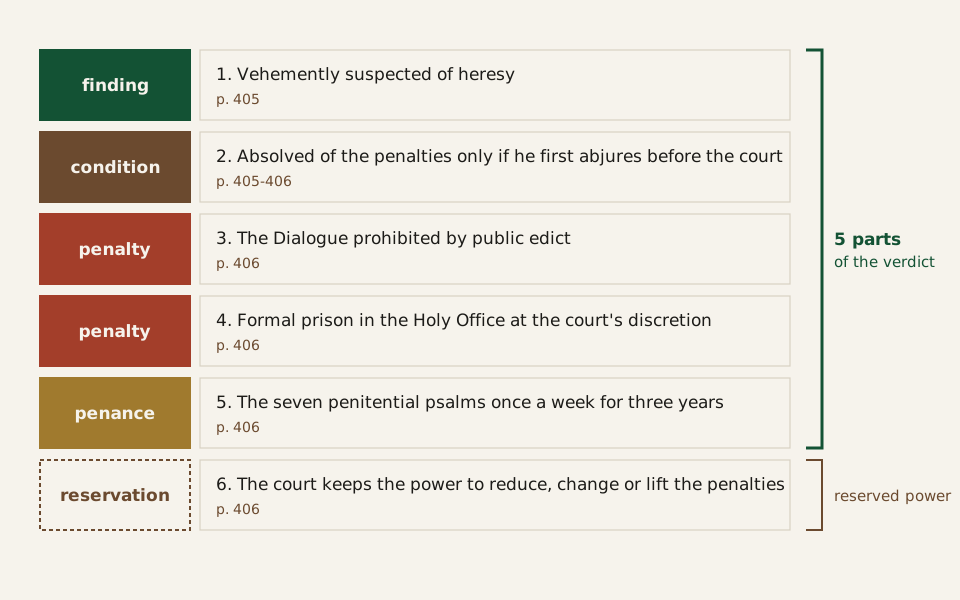
Diagram: Hoax and Hindsight · CC BY 4.0
Credit line to copy
"The sentence of June 22, 1633, clause by clause" by Hoax and Hindsight, licensed under CC BY 4.0 (https://creativecommons.org/licenses/by/4.0/). Original: https://hoaxandhindsight.com/trials/galileo-trial/
Data: Antonio Favaro, ed., Le opere di Galileo Galilei, vol. 19 (Florence, 1907); translations by Hoax and Hindsight
The sentence of June 22, 1633, clause by clause, from Favaro’s volume 19, pp. 405–406. Clauses 1 to 5 are the verdict; clause 6 keeps the court’s power to change it. Drawn from the table published with this page.
| Clause | What the sentence orders | Page |
|---|---|---|
| 1. Finding | Vehemently suspected of heresy | 405 |
| 2. Condition | Absolved of the penalties only if he first abjures before the court | 405–406 |
| 3. Penalty | The Dialogue prohibited by public edict | 406 |
| 4. Penalty | Carcere formale, formal prison in the Holy Office, at the court’s discretion | 406 |
| 5. Penance | The seven penitential psalms once a week for three years | 406 |
| 6. Reservation | The court may reduce, change or lift the penalties | 406 |
The sentence, clause by clause (CSV) (where the data comes from) Data: Antonio Favaro, ed., Le opere di Galileo Galilei, vol. 19 (Florence, 1907)
The prison clause did not stand for long. The reservation clause is why. The court kept the power to moderare, mutare, o levar, to moderate, change or lift, the penalties, and it used that power within days.
What did Galileo swear, and where did he go next?
The abjuration followed the same day at the convent of Santa Maria sopra Minerva. Kneeling, with his hands on the Gospels and giving his age as 70, Galileo swore that he had always believed what the Church teaches (Exhibit A, pp. 406–407). Then came the formula: abiuro, maledico e detesto li sudetti errori et heresie, “I abjure, curse and detest the said errors and heresies.”
He promised never again to say or write anything that could bring the same suspicion on him. He also promised to denounce any heretic, or anyone suspected of heresy, he came to know of, to the Holy Office or the local inquisitor. At the foot he signed: Io Galileo Galilei ho abiurato come di sopra, mano propria, “I, Galileo Galilei, have abjured as above, in my own hand” (p. 407).
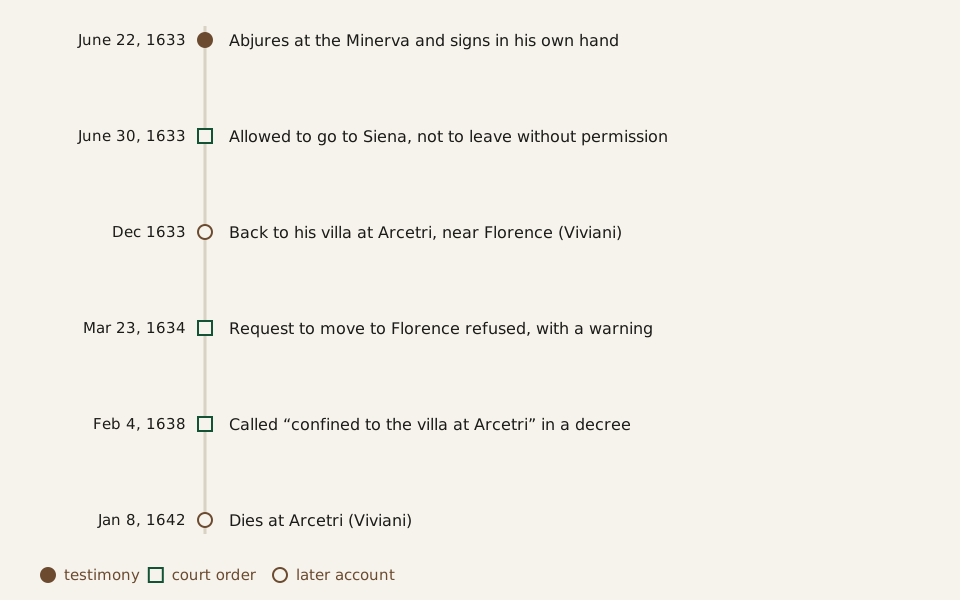
Diagram: Hoax and Hindsight · CC BY 4.0
Credit line to copy
"After the sentence: June 1633 to January 1642" by Hoax and Hindsight, licensed under CC BY 4.0 (https://creativecommons.org/licenses/by/4.0/). Original: https://hoaxandhindsight.com/trials/galileo-trial/
Data: Antonio Favaro, ed., Le opere di Galileo Galilei, vol. 19 (Florence, 1907), including Vincenzio Viviani's Racconto istorico
After the sentence, from the abjuration to Galileo’s death at Arcetri. Drawn from the table published with this page, compiled from the decrees in Favaro’s volume 19 and Vincenzio Viviani’s account printed in it (Exhibit A).
| Date | What the record says | Page |
|---|---|---|
| June 30, 1633 | The Pope lets him go to Siena, not to leave without permission | 362 |
| December 1633 | He moves to his villa at Arcetri, near Florence (Viviani) | 617 |
| March 23, 1634 | A request to move to Florence for his health is refused, with a warning | 286 |
| February 4, 1638 | A decree describes him as “confined to the villa at Arcetri” | 287 |
| January 8, 1642 | He dies at Arcetri (Viviani) | 623 |
The 1634 refusal carried a threat. If he kept asking, the decree says, he could be called back to the prisons of the Holy Office (p. 286). A decree of February 25, 1638, let him move to his house in Florence for treatment, but he was not to go out into the city, receive gatherings of visitors or discuss the motion of the earth (p. 287).
Viviani dated the death to Wednesday, January 8, “1641 ab Incarnatione,” in Florence’s style of counting years, which still called that January 1641 (p. 623). Favaro’s family table in the same volume gives the year as 1642.
No reversal of the 1633 sentence appears in the records read for this page. The Dialogue stayed on the Index of Prohibited Books until the edition of 1835, according to Gebler (Exhibit C).
Was Galileo tortured?
The surviving record shows a threat of torture, not torture. On June 16, 1633, the Pope decreed that Galileo be questioned about his intention, etiam comminata ei tortura, “even with the threat of torture.” If he held firm, he was to abjure and be condemned to prison (Exhibit A, p. 360).
The examination took place on June 21. Galileo said that after the 1616 decision he had held Ptolemy’s view as true. Pressed, he was told to speak the truth, alias devenietur ad torturam, “otherwise they would proceed to torture.” He answered, Io son qua per far l’obedienza, “I am here to obey,” and repeated that he had not held the opinion since 1616 (pp. 361–362).
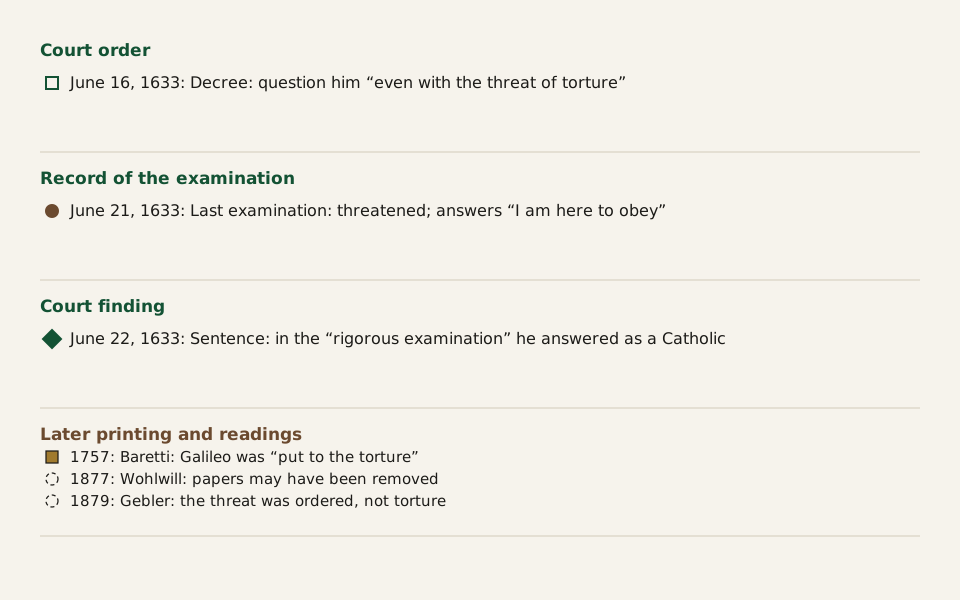
Diagram: Hoax and Hindsight · CC BY 4.0
Credit line to copy
"Torture in the Galileo file, by layer" by Hoax and Hindsight, licensed under CC BY 4.0 (https://creativecommons.org/licenses/by/4.0/). Original: https://hoaxandhindsight.com/trials/galileo-trial/
Data: Antonio Favaro, ed., Le opere di Galileo Galilei, vol. 19 (Florence, 1907); Giuseppe Baretti, The Italian Library (London, 1757); Karl von Gebler, Galileo Galilei and the Roman Curia (London, 1879)
What each layer of the record says about torture, from the decree of June 16, 1633, to Gebler’s reading of 1879. Drawn from the table published with this page (Exhibit A, Exhibit B and Exhibit C).
The June 21 record then closes. Since nihil aliud posset haberi, “nothing more could be had” in carrying out the decree, his signature was taken and he was sent back to his place (p. 362). The next day the sentence spoke of a “rigorous examination” in which he had answered as a Catholic (p. 405).
| Layer | Date | What it says |
|---|---|---|
| Court order | June 16, 1633 | Question him “even with the threat of torture” |
| Record of the examination | June 21, 1633 | Threatened; answers “I am here to obey”; signs; sent back |
| Court finding | June 22, 1633 | He answered as a Catholic in the “rigorous examination” |
| Later printing | 1757 | Baretti: he was “put to the torture” |
| Later reading | 1877 | Wohlwill, as Gebler reports: papers of torture may have been removed |
| Later reading | 1879 | Gebler: the closing words are the formula for an examination that ended without torture |
Later writers split over what those words hide. Baretti, in 1757, simply said Galileo was “put to the torture” (Exhibit B). Wohlwill argued in 1877, as Gebler reports, that the file had been tampered with and that papers recording torture could have been removed (Exhibit C). Gebler answered that the closing line is the usual formula for an examination that ended without torture, and that the decree ordered the threat, not its use.
Where does “Eppur si muove” come from?
The line is not in the sentence, the abjuration or the June 21 record in Favaro’s volume (Exhibit A). The earliest printing found so far, according to Mario Livio (2020), is Baretti’s Italian Library, printed in London in 1757 (Exhibit D). In his entry for the Dialogue, Baretti wrote that Galileo “was in the inquisition for six years, and put to the torture, for saying, that the earth moved” (Exhibit B, p. 52; long s printed as s).
Then comes the scene. “The moment he was set at liberty, he looked up to the sky and down to the ground, and, stamping with his foot, in a contemplative mood, said, Eppur si move; that is, still it moves, meaning the earth.” Baretti gives no source, and he spells the verb move. His book appeared 124 years after the sentence and 115 years after Galileo’s death.
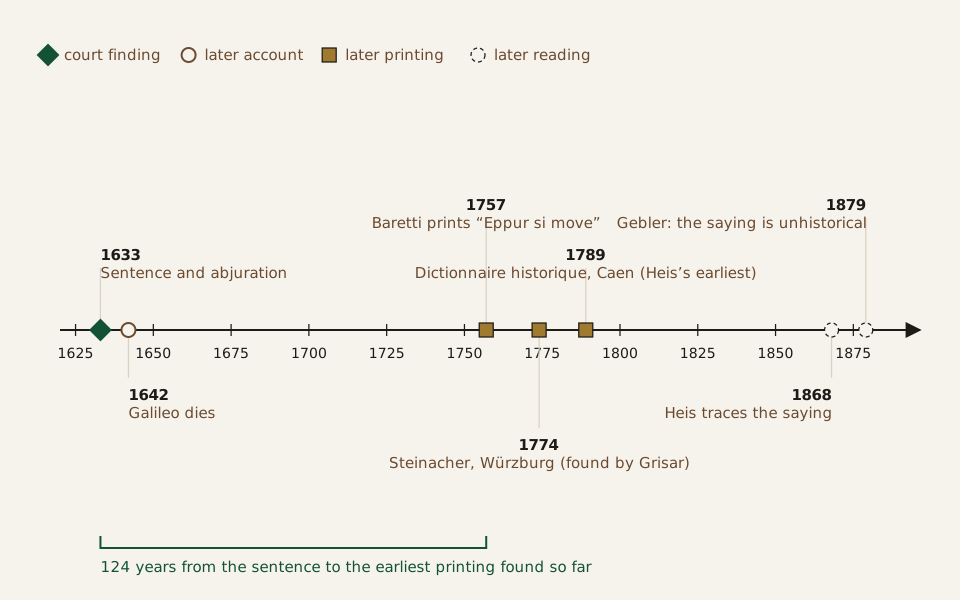
Diagram: Hoax and Hindsight · CC BY 4.0
Credit line to copy
"Eppur si muove in print, 1633 to 1879" by Hoax and Hindsight, licensed under CC BY 4.0 (https://creativecommons.org/licenses/by/4.0/). Original: https://hoaxandhindsight.com/trials/galileo-trial/
Data: Giuseppe Baretti, The Italian Library (London, 1757); Karl von Gebler, Galileo Galilei and the Roman Curia (London, 1879); Antonio Favaro, ed., Le opere di Galileo Galilei, vol. 19 (Florence, 1907)
When the saying appears in print, 1633 to 1879. Baretti’s 1757 entry is the earliest printing found so far, according to Mario Livio; the 1774 and 1789 printings are known here only through Gebler’s report. Drawn from the table published with this page (Exhibits A to D).
| Year | Printing or study | How it is known here |
|---|---|---|
| 1757 | Baretti, The Italian Library, London | Read in two scans |
| 1774 | Steinacher, a textbook printed at Würzburg | Found by Grisar, as Gebler reports |
| 1789 | Dictionnaire historique, Caen | Taken by Heis as the first appearance, as Gebler reports |
| 1868 | Heis, a treatise on the saying | Gebler’s bibliography |
| 1879 | Gebler, Galileo Galilei and the Roman Curia | Read in full |
The search for the first printing has moved backward over time. Gebler, writing in the 1870s, reported nothing earlier than 1774. “It is not known who was the inventor of the assumed exclamation,” he wrote (Exhibit C). Baretti’s 1757 entry is seventeen years older than the printing Gebler knew.
A printed book can only prove that a story existed by its date of printing. That makes 1757 a terminus ante quem for the story, a latest possible date of the kind explained on the page on dating limits.
Popular version vs. the record
Baretti’s entry is a compact piece of courtroom folklore, this site’s term for popular versions of a famous trial that contradict the surviving record and still outlive it. Below, each of his claims is the charge, with the court papers set after it. The same test is run on the Salem witch trials of 1692 and on the Scopes trial of 1925, another case in which the teaching of science reached a courtroom.
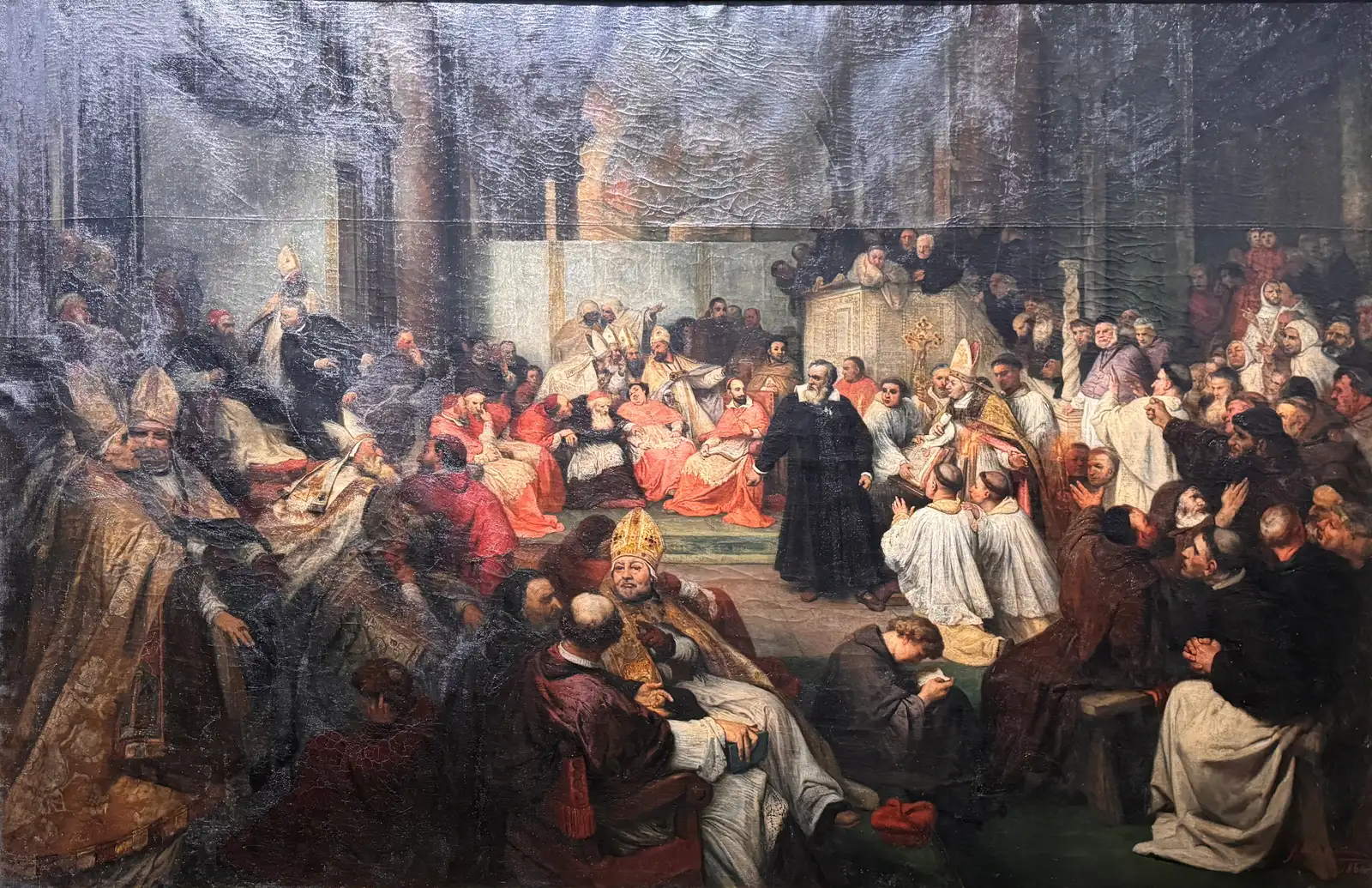
"Hamburg, Kunsthalle, Friedrich Karl Hausmann, Galilei vor dem Konzil" by Dguendel — https://commons.wikimedia.org/wiki/File:Hamburg,_Kunsthalle,_Friedrich_Karl_Hausmann,_Galilei_vor_dem_Konzil.jpg — CC BY 4.0 (https://creativecommons.org/licenses/by/4.0/); modified: cropped to the painted surface, removing a strip of the gilt frame along the top (16 px) and left (18 px) edges, re-encoded as JPEG
Galileo before the Council by Friedrich Karl Hausmann, an imagined scene painted in the 1860s, not a record of the trial; Hamburger Kunsthalle, photographed in 2024.
The charge
Baretti (1757, p. 52): Galileo was tried “for saying, that the earth moved.”
This matches the record. The sentence found him vehemently suspected of holding that the earth moves, and of breaking the 1616 injunction by writing the Dialogue (Exhibit A, pp. 403–405).
Six years
Baretti (1757, p. 52): he “was in the inquisition for six years.”
Summoned in September 1632, he reached Rome on February 13, 1633, and was sentenced on June 22, 1633; on June 30 he was allowed to go to Siena (Exhibit A, pp. 279–280, 337, 362, 402–407).
Torture
Baretti (1757, p. 52): he was “put to the torture.”
The words
Baretti (1757, p. 52): “The moment he was set at liberty,” he stamped his foot and said “Eppur si move.”
The words are not in the sentence, the abjuration or the June 21 record. He was not set at liberty: the sentence imposed prison at the court’s discretion, and later decrees kept him confined at Siena, then Arcetri, and from 1638 in his house in Florence (Exhibit A, pp. 286–287, 362, 405–407).
Baretti’s claims set against the record (CSV) (where the data comes from) Data: Giuseppe Baretti, The Italian Library (London, 1757); Antonio Favaro, ed., Le opere di Galileo Galilei, vol. 19 (Florence, 1907); Karl von Gebler, Galileo Galilei and the Roman Curia (London, 1879)
Did Galileo say “Eppur si muove”?
None of the 1633 records in Favaro’s volume has him say it. The words are not in the sentence, the abjuration or the June 21 examination printed by Favaro, and the earliest printing found so far, according to Mario Livio, is Giuseppe Baretti’s Italian Library of 1757, 124 years after the trial. Baretti gave no source for the scene.
Was Galileo tortured?
The surviving record shows a threat, not torture. A papal decree of June 16, 1633, ordered him questioned “even with the threat of torture,” and the record of June 21 shows the threat, his answer “I am here to obey,” and his return to his place. In the 1870s Emil Wohlwill argued that papers had been removed and Karl von Gebler rejected that.
Was Galileo convicted of heresy?
The sentence of June 22, 1633, found him “vehemently suspected of heresy,” not a heretic. It made his absolution depend on abjuring, banned the Dialogue, ordered formal prison at the court’s discretion, and set the seven penitential psalms once a week for three years.
What happened to Galileo after the trial?
He was allowed to go to Siena on June 30, 1633, and moved to his villa at Arcetri, near Florence, about December 1633. A decree of 1634 refused his request to return to Florence; one of February 1638 let him into his house there for treatment, but not out into the city. He died at Arcetri on January 8, 1642, according to his pupil Vincenzio Viviani.
What would overturn it:
- A witness to the words. A letter, diary or report written before 1757 that has Galileo say “Eppur si muove” and names the occasion would replace Baretti as the earliest source and change this page’s answer on where the line comes from.
- A record of torture. A protocol of the torture chamber dated June 21, 1633, or a ratification of his answers made after it, would overturn this page’s reading that the surviving record shows only a threat.
Exhibits
Records and period publications
- Exhibit A: Antonio Favaro, ed., Le opere di Galileo Galilei, Edizione nazionale, vol. 19 (Florence: G. Barbèra, 1907): document XXIV, 'Processo di Galileo', including the sentence and abjuration of June 22, 1633 (pp. 402–407), and Vincenzio Viviani's 'Racconto istorico' of Galileo's life.
- Exhibit B: Giuseppe Baretti, The Italian Library: Containing an Account of the Lives and Works of the Most Valuable Authors of Italy (London: A. Millar, 1757), p. 52, entry for Galileo's Dialogo (Florence: Landini, 1632).
Studies
- Exhibit C: Karl von Gebler, Galileo Galilei and the Roman Curia, translated by Mrs. George Sturge (London: C. Kegan Paul, 1879).
- Exhibit D: Mario Livio, ‘Did Galileo Truly Say, “And Yet It Moves”? A Modern Detective Story,’ Scientific American Observations blog, 2020.
Cite this page
Hoax and Hindsight. “Galileo Trial: No ‘Eppur Si Muove’ in the 1633 Record.” Hoax and Hindsight, published November 6, 2026. https://hoaxandhindsight.com/trials/galileo-trial/. Accessed [the date you read it].
Related cases
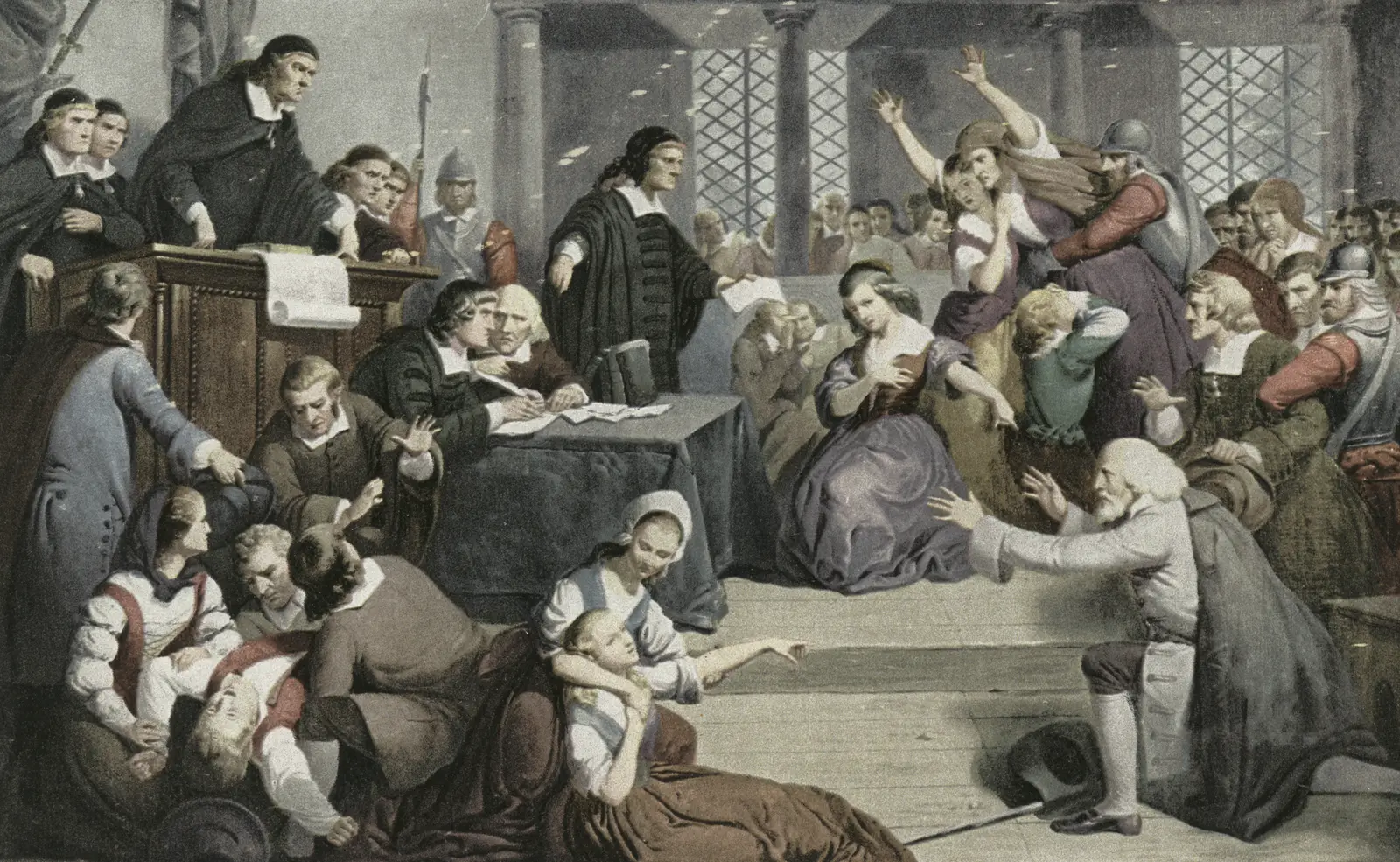
Salem Witch Trials: 3 of 52 Convicted in 1693, Phips Wrote
Salem witch trials: 19 hanged in 1692; in 1693, by the governor's count, all but 3 of 52 tried were cleared. What spectral evidence was and what changed.
Picture credit
"Trial of George Jacobs for Witchcraft, Salem, Mass" by T. H. Matteson; postcard by Detroit Publishing Co. — https://commons.wikimedia.org/wiki/File:Trial_of_George_Jacobs_for_Witchcraft,_Salem,_Mass_(NYPL_b12647398-75594).tiff — Public domain (painting of 1855 by T. H. Matteson (1813–1884) reproduced on a Detroit Publishing Co. postcard (series 13270, published after 1898 and before 1931): public domain in the US (published before 1931) and in the EU (painter dead since 1884; the postcard is an anonymous company publication more than 70 years old); New York Public Library scan, PD-scan); modified: cropped to the printed picture, removing the postcard's white margin and the printed caption and publisher's copyright line along the lower edge, converted from TIFF to JPEG
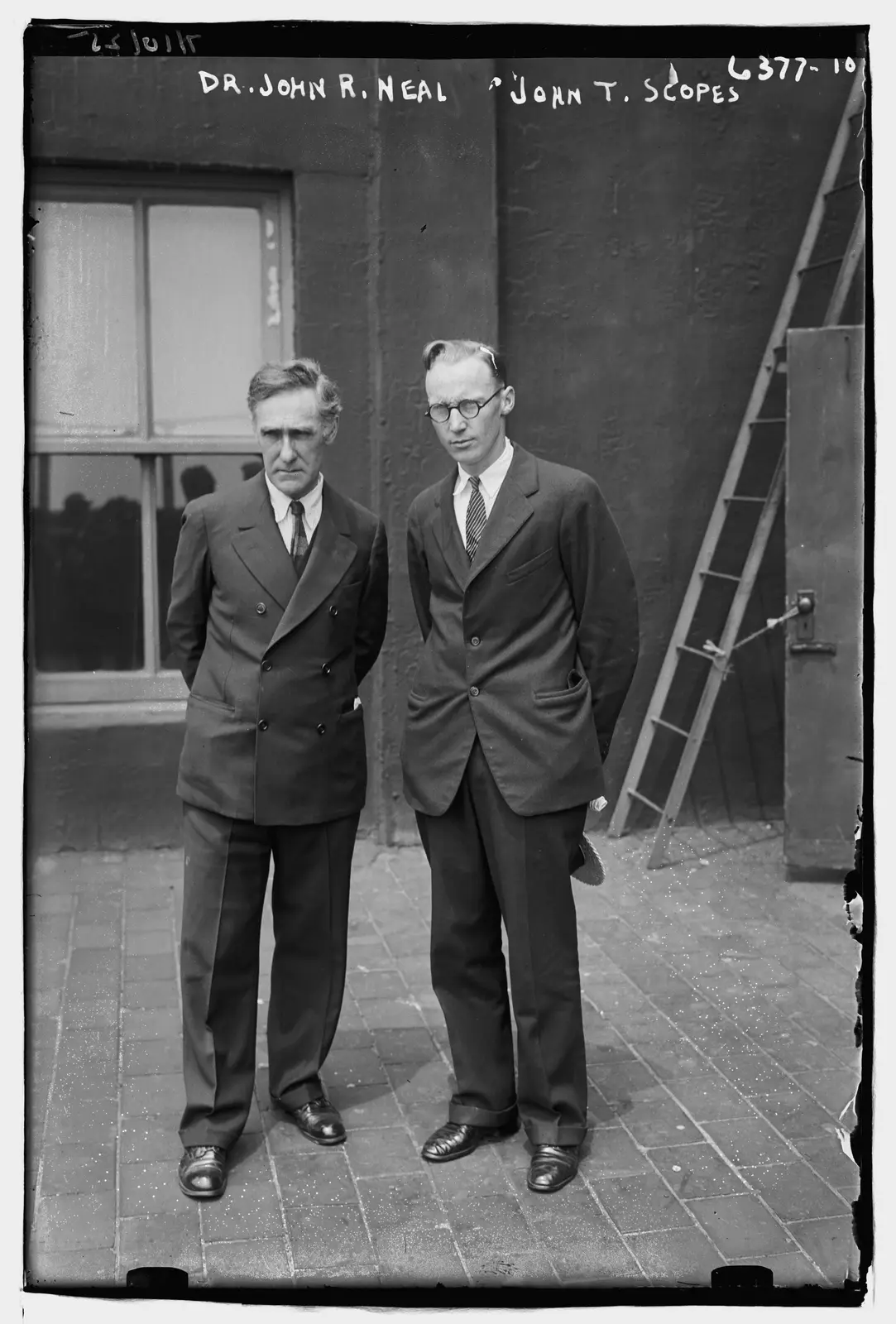
Scopes Monkey Trial: The Defense Asked for a Guilty Verdict
The Scopes monkey trial ended in a guilty verdict on July 21, 1925, after the defense asked for it to reach a higher court; the judge set the $100 fine.
Picture credit
"Dr. John R. Neal, John T. Scopes" by Bain News Service — https://commons.wikimedia.org/wiki/File:Dr._John_R._Neal,_John_T._Scopes_LCCN2014718360.jpg — Public domain (news-agency photograph by the Bain News Service, no named photographer; the negative is marked 7/10/25 (July 10, 1925). US: public domain on the ground that Bain distributed its photographs to newspapers when they were taken, which counts as publication, and this was before 1931. Risk: whether this negative was actually distributed in 1925 has not been checked; if it was never published, an anonymous unpublished US work of 1925 is protected until 120 years after creation (end of 2045). EU: anonymous work, 70 years from first making available (or, if never made available, from creation), long expired. Library of Congress Prints and Photographs, George Grantham Bain Collection, ggbain.38214, 'No known restrictions on publication' (a lead, not the basis))
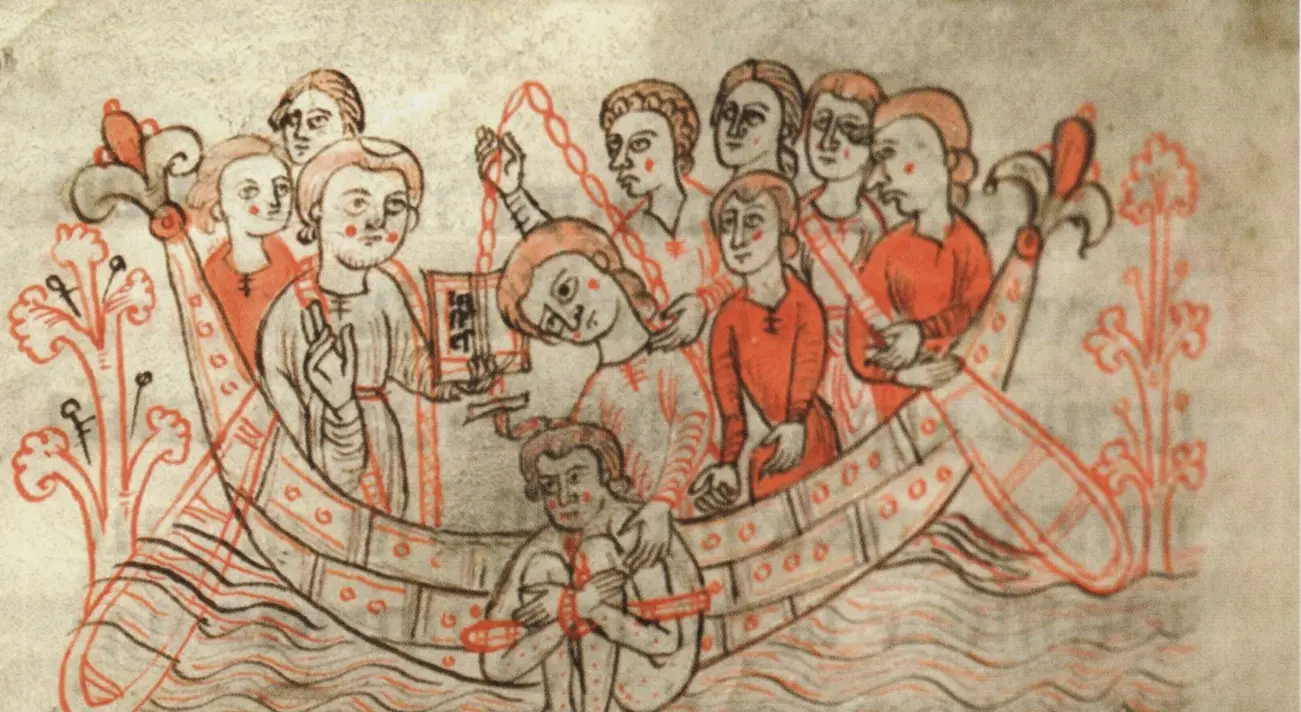
Trial by Ordeal: Most Várad Cases With a Result Were Cleared
In the Várad register, dated 1208–1235 by its 1903 editors, 131 of 209 hot-iron cases with a written result end with everyone cleared, by this site’s count.
Picture credit
"Wasserprobe (ordeal by water), drawing in the Rituale of Lambach Abbey" by Unknown author — https://commons.wikimedia.org/wiki/File:Wasserprobe.jpg — Public domain (medieval drawing (the Commons file page dates it to the 12th century, author unknown): public domain in the US and the EU, where every term ran out centuries ago; the image is a faithful photographic reproduction of a two-dimensional public-domain work, which adds no new copyright in the US (PD-Art) or in the EU (Directive (EU) 2019/790, Art. 14). The reproduction was photographed from a plate in Peter Dinzelbacher, Das fremde Mittelalter (Essen: Magnus, 2006).); modified: cropped to the drawing (x 60-1361, y 0-712 of the 1,361 x 1,599 original), removing the Latin text below it and a pencil folio mark at the top left, re-encoded as JPEG