Famous Trials · Case retrial
Salem Witch Trials: 3 of 52 Convicted in 1693, Phips Wrote
Hoax and Hindsight Published
The Salem witch trials sent nineteen people to the gallows in 1692; in 1693, almost everyone brought to trial was cleared. Governor William Phips wrote in February 1693 that once the court's method was altered, the fifty-two people brought to trial were all cleared “saving three,” so by his figures 49 of the 52 were cleared.
Docket
- Case
- The Salem witch trials (Court of Oyer and Terminer, 1692; Superior Court of Judicature, 1693)
- Years
- 1692–1693
- Place
- Salem, Essex County, Province of Massachusetts Bay; 1693 sessions also at Charlestown
- The claim
- That the accused used “certain detestable Arts, called Witchcrafts, and Sorceries” on the afflicted accusers, or made a covenant with the Devil (the wording of the indictments)
- The verdict
- Court finding: 1692, the Court of Oyer and Terminer convicted, and 19 people were hanged. 1693, by Governor Phips's account, 52 were tried and all but 3 cleared.
- Hinges on
- How much weight the judges gave spectral evidence
- Status
- Reversed (1711) for 22 people named in the act
The trials ran through 1692 and into 1693 in the Province of Massachusetts Bay. Besides the nineteen hanged, Giles Corey was pressed to death. Historian Benjamin Ray counts at least 155 people arrested and jailed and five more dead in prison (Exhibit I).
What changed between the two years, by the governor's own account, was the weight given to one kind of testimony. Spectral evidence was an accuser's sworn claim that a suspect's specter, or shape, had attacked them.
In February 1693, Phips told London why: the court's “method of proceeding” had been “altered.” This page reopens his account and sets it against the court papers.
Order of proceedings 8 parts
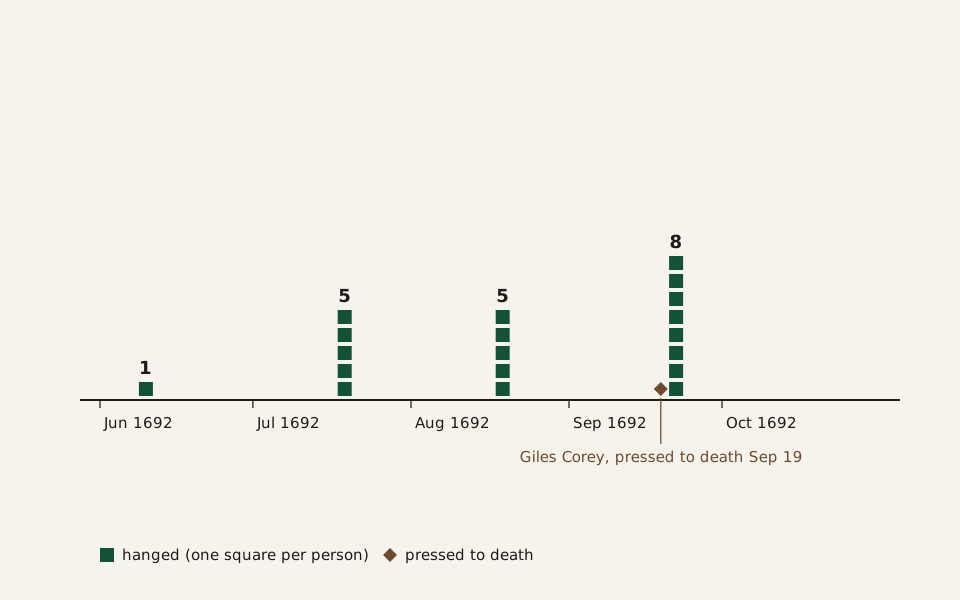
Diagram: Hoax and Hindsight · CC BY 4.0
Credit line to copy
"Deaths by court action at Salem in 1692" by Hoax and Hindsight, licensed under CC BY 4.0 (https://creativecommons.org/licenses/by/4.0/). Original: https://hoaxandhindsight.com/trials/salem-witch-trials/
Data: Robert Calef, More Wonders of the Invisible World (1700), ed. Samuel G. Drake (1866), vol. 3; Diary of Samuel Sewall, vol. 1 (Massachusetts Historical Society, 1878); Charles W. Upham, Salem Witchcraft (1867); death warrant of Bridget Bishop with the sheriff's return (1692)
Deaths by court action at Salem in 1692, one square per person: nineteen hanged on four dates from June 10 to September 22, and Giles Corey pressed to death on September 19 (Sewall's date; Calef gives September 16). Drawn from the table published with this page (Exhibits A, B, F and H).
The 1692 deaths, row by row with sources (CSV) (where the data comes from) Data: Robert Calef, More Wonders of the Invisible World (1700), ed. Samuel G. Drake (1866), vol. 3; Diary of Samuel Sewall, vol. 1 (1878); Charles W. Upham, Salem Witchcraft (1867); W. Elliot Woodward, Records of Salem Witchcraft, vol. 2 (1864)
What was spectral evidence at Salem?
Bridget Bishop was examined on April 19, 1692, before the magistrate John Hathorne. Samuel Parris and Ezekiel Cheever both took minutes, and the historian Charles Upham printed their substance in 1867 (Exhibit H).
The “afflicted children,” Upham wrote, charged her with trying to persuade them to sign the Devil's book. Bishop answered, “I am innocent. I know nothing of it. I am no witch. I know not what a witch is.”
"Death warrant for the hanging of Bridget Bishop for witchcraft" by Frank Cousins — https://commons.wikimedia.org/wiki/File:Death_warrant_for_the_hanging_of_Bridget_Bishop_for_witchcraft,_by_Frank_Cousins,_c._1865-1914,_from_the_Digital_Commonwealth_-_commonwealth_2b88r6940.jpg — Public domain (manuscript of 1692; photograph by Frank Cousins (d. 1925): public domain in the US and, 70 years after the photographer's death, in the EU; Public Domain Mark 1.0 from Digital Commonwealth (commonwealth:2b88r6940))
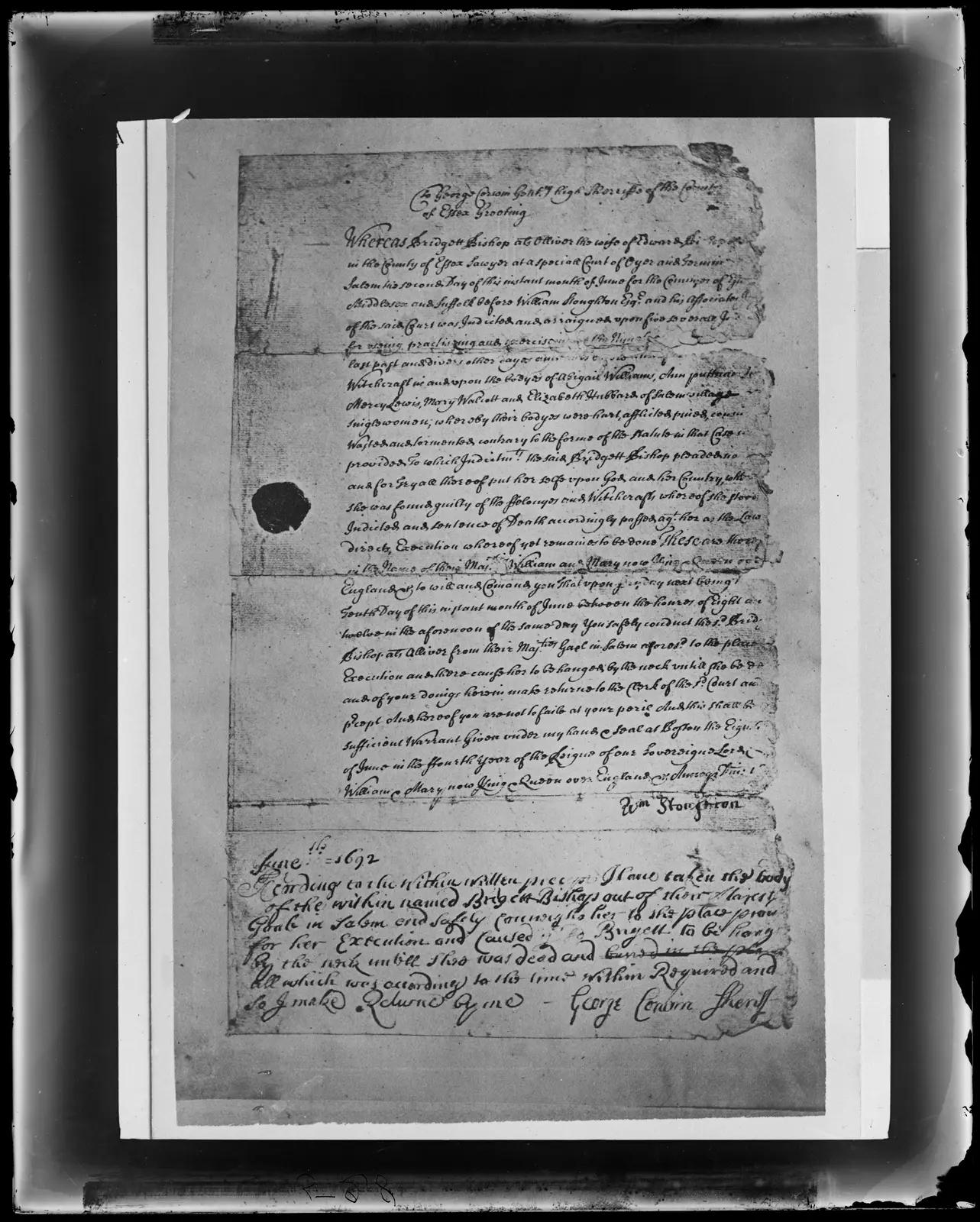
Bridget Bishop's death warrant, signed by William Stoughton on June 8, 1692, with Sheriff George Corwin's return of June 10 written at the foot (Exhibit A). Photograph of the manuscript by Frank Cousins.
The same minutes show how a specter could leave a physical trace, at least in the examiners' eyes. Asked “Is not your coat cut?” Bishop said no, and the examiners found it “cut or torn two ways.” Jonathan Walcot then said that “the sword that he struck at Goody Bishop was not naked, but was within the scabbard.” Cheever wrote that the rent “may very probably be the very same that Mary Walcot did tell” of after Jonathan struck at Bishop's “appearance.”
Giles Corey's examination before Hathorne and Jonathan Corwin the same day, printed in the appendix to Samuel G. Drake's 1866 edition of Robert Calef (Exhibit B), shows the charge in its plainest form. “Giles Cory, they accuse you, or your Appearance, of hurting them,” the questioner said. Corey said, “I never did hurt them.” The reply: “It is your Appearance hurts them, they charge you.”
A suspect could deny what her hands had done, but the charge was about her likeness, which the accusers said they could see. Upham printed the theory in one exchange from George Jacobs's examination: “The Devil can take any likeness,” Jacobs said, and the answer came back, “Not without their consent.” According to Upham, opinion split on that point: “Some maintained that the Devil could employ only the spectres of persons in league with him,” while others held that he could send the specters of innocent people “without their consent or knowledge.” “The chief-justice held the former opinion,” Upham wrote, so on that view a specter pointed back to its owner.
Phips later described the courtroom version (Exhibit E). Accusers fell “to the ground in strange agonies” when a suspect looked at them and revived when touched. Then they swore they “saw their shape or spectre come from their bodies.”
Did Salem convict people on spectral evidence alone?
For some defendants it may have come close. For others the files hold more, and for most of the 1692 cases no one can fully check. In 1869 Upham described Bishop's trial and execution as “resting as they did, entirely upon spectral evidence” (Exhibit D). That is the charge this section tests.
Bishop's file says more than that. Cotton Mather's account of her trial at the Court of Oyer and Terminer on June 2, 1692, printed in 1693 (Exhibit C), sums up the sworn testimony of John Bly and William Bly. Hired to take down the cellar wall of her old house, they found “several Poppets, made up of Rags and Hogs-bristles, with headless Pins in them, the Points being outward.”
"Cotton Mather" by Peter Pelham — https://commons.wikimedia.org/wiki/File:Peter_Pelham,_Cotton_Mather,_1727,_NGA_146700.jpg — CC0 1.0 (https://creativecommons.org/publicdomain/zero/1.0/)
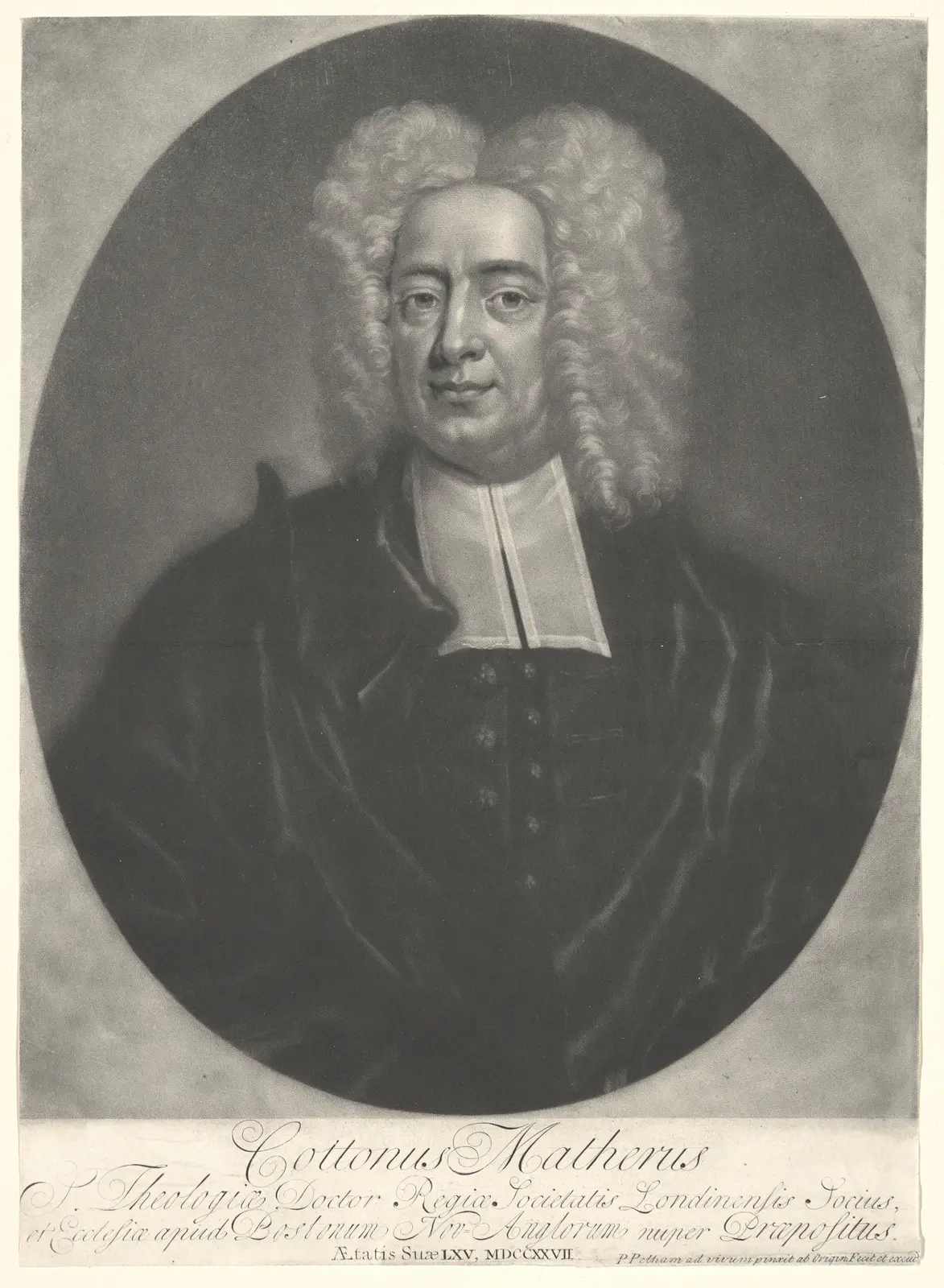
Cotton Mather, whose 1693 account of Bridget Bishop's trial is quoted in this section. Mezzotint by Peter Pelham, 1727.
Mather's account adds that “a Jury of Women found a preternatural Teat upon her Body: But upon a second search, within 3 or 4 hours, there was no such thing to be seen.”
The judges also told Phips that they began with the afflicted persons' evidence “but had humane testimony against such as were condemned” (Exhibit E). Other cases look thinner. Robert Calef, a Boston critic of the trials, wrote that against Samuel Wardwell “his former Confession and Spectre Testimony was all that appeared against him” (Exhibit B). Phips himself wrote that when he stopped the court, at least fifty people sat in prison, “most of them having only spectre evidence against them.”
The weak point in any answer is the archive. Benjamin Ray built the University of Virginia's digital archive of the trials. He writes that the trial records of those convicted in 1692 are missing (Exhibit I).
The surviving papers hold examinations, sworn statements and indictments, but not what each trial jury heard and weighed. The record puts spectral evidence at the center of the 1692 cases with other testimony beside it; it does not say which one carried each conviction.
What did the ministers tell the judges?
The warnings came early, and in writing. On May 31, 1692, the Boston minister Cotton Mather wrote to John Richards, one of the judges, in a letter Upham printed in full in 1869 (Exhibit D). He asked Richards not to “lay more stress upon pure Spectre testimony than it will bear.”
According to Upham, the same letter endorsed evidence from “witch-marks.” It also called wounds given to specters and later found on suspects “intimations, broad enough, in concurrence with other things, to bring out the guilty.”
Bishop was hanged on June 10. The governor and council then consulted several ministers. Their answer is dated June 15 and survives as the “Return of the Ministers consulted by his Excellency and the honorable Council” (Exhibit D).
The Return's Section VI said that grounds for conviction “ought certainly to be more considerable than barely the accused persons being represented by a spectre unto the afflicted.” The reason it gave: “a Demon may, by God's permission, appear, even to ill purposes, in the shape of an innocent, yea, and a virtuous man.”
“Title page of Cases of Conscience Concerning Evil Spirits, by Increase Mather” · Increase Mather; printed by Benjamin Harris · Public domain
Full credit
"Title page of Cases of Conscience Concerning Evil Spirits, by Increase Mather" by Increase Mather; printed by Benjamin Harris — https://commons.wikimedia.org/wiki/File:Title_page_of_Cases_of_Conscience_Concerning_Evil_Spirits,_...,_by_Increase_Mather_LCCN2005692000.jpg — Public domain (book printed at Boston in 1693: public domain in the US (published before 1931) and in the EU (author and printer dead for far more than 70 years); photograph of the title page from the Library of Congress Prints and Photographs Division (cph.3b05939), marked Public Domain Mark 1.0 on Commons)
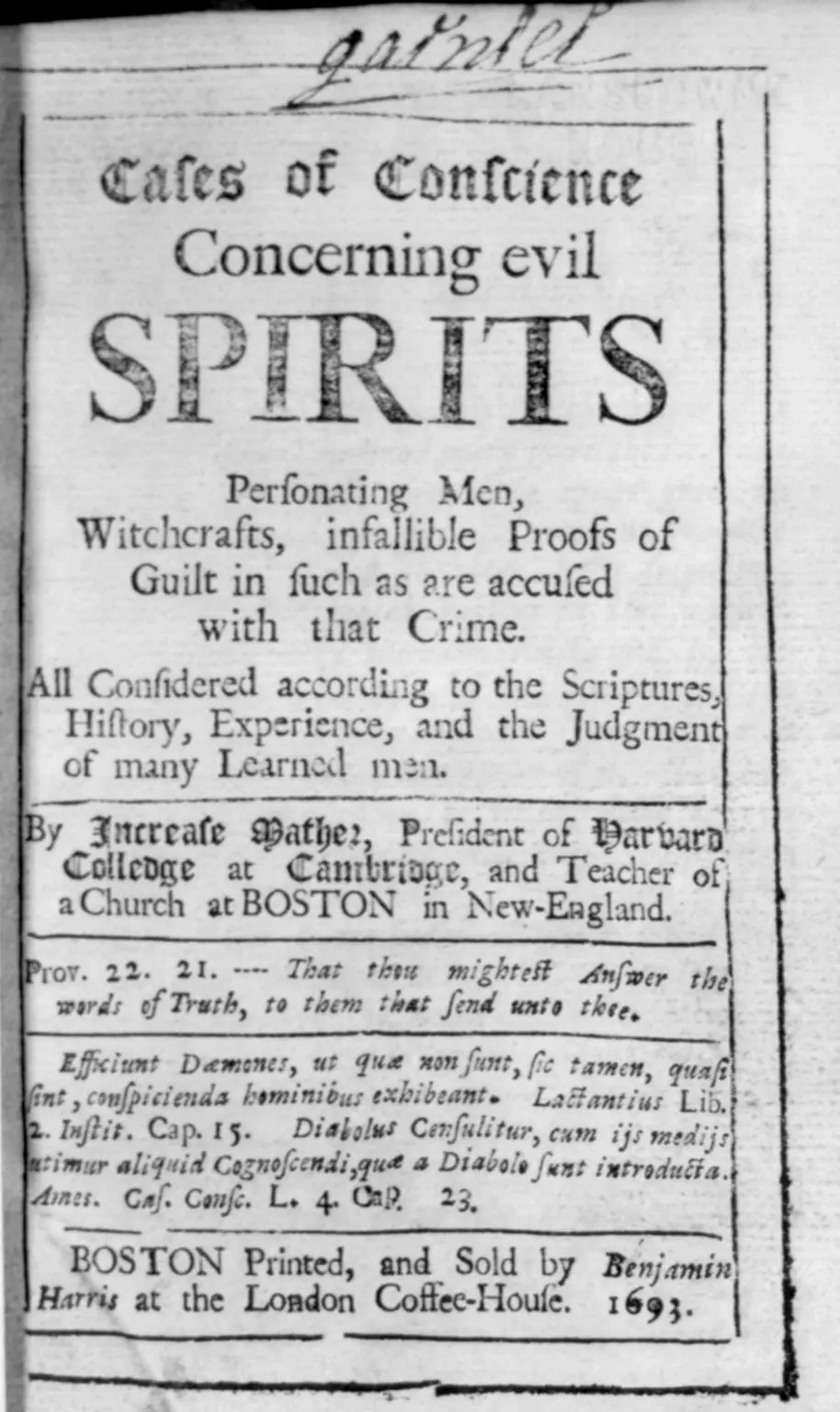
Increase Mather's own answer to the same question, Cases of Conscience, was dated October 3, 1692, and printed at Boston in 1693. It is quoted below, in the section on why the trials stopped.
Section VIII pulled the other way. It recommended “the speedy and vigorous prosecutions of such as have rendered themselves obnoxious.” Upham, who attributed the Return to Cotton Mather, read it as caution “in the use” of spectral evidence rather than “against the use.”
Look at the dates in the first chart. Of the 19 hangings, 18 came after June 15, and so did Giles Corey's death in September. The ministers' paper did not stop the court; what it changed inside the jury room, the surviving records do not show.
How did Rebecca Nurse's “not guilty” become “guilty”?
One file shows what the 1692 court did with a jury that disagreed with it. On July 4, 1692, the juror Thomas Fisk put in writing why the jury “brought her in Guilty, after her Verdict not Guilty” (Exhibit B). “When the Verdict not Guilty was, the honored Court was pleased to object against it,” he wrote. The judges pointed to words Nurse had spoken about two confessed witnesses who testified against her: “What do these persons give in Evidence against me now, they used to come among us.”
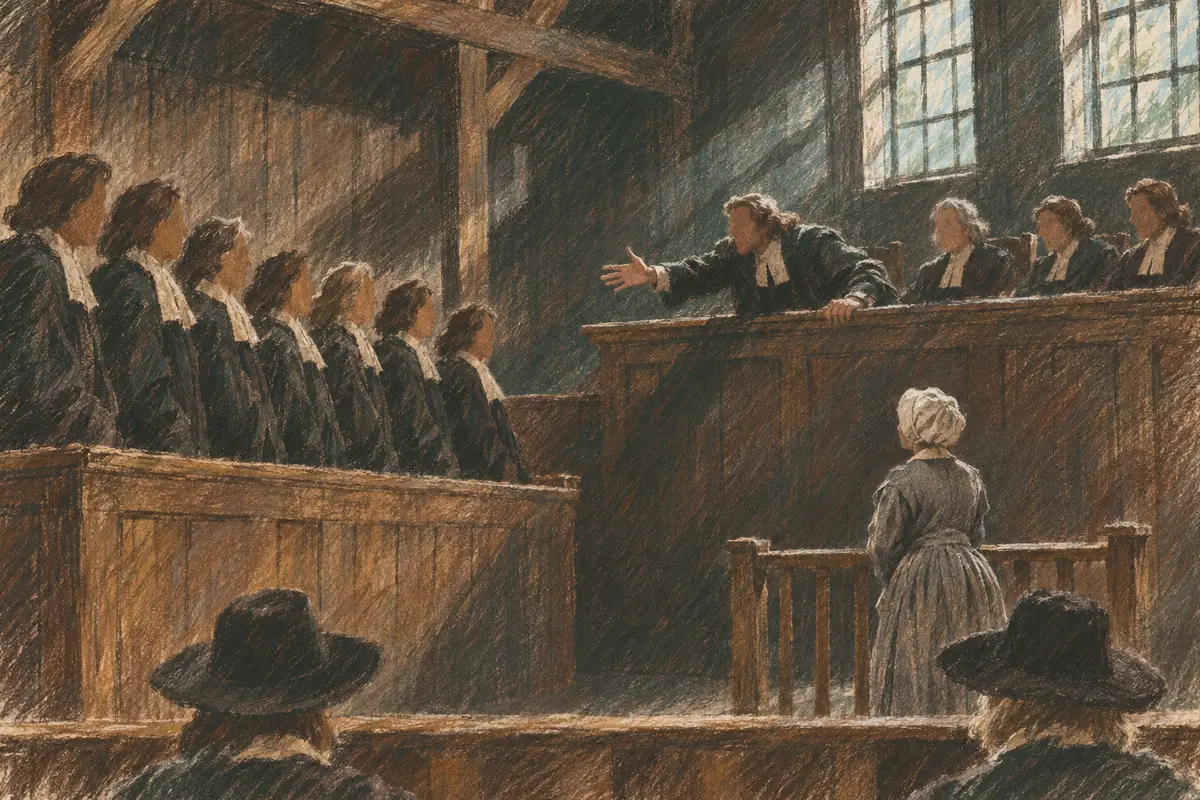
Illustration: Hoax and Hindsight. Generated schematic illustration — not a photograph or historical record. © Hoax and Hindsight, all rights reserved.
An illustration of the kind of moment Thomas Fisk described: the jury back in court after the bench objected to its verdict. Not a record of the room or of the people in it.
Several jurors asked to go out again. Back in court, Fisk raised the words. Nurse, at the bar, “made no reply, nor interpretation of them.” So, Fisk wrote, “these words were to me a principal Evidence against her.”
In her own declaration to the court, Nurse said she was “something hard of hearing, and full of grief,” and had meant only that the two women were fellow prisoners. She was hanged on July 19.
By Fisk's account, the turn came from the bench's objection and from her silence. His statement names no specter. Calef later claimed the court had “cleared none upon Tryal” (Exhibit B). Nurse's file shows that one jury did try, briefly.
Why did the Salem witch trials stop?
The end came from the top of the colony. On October 3, 1692, Increase Mather, Cotton's father and president of Harvard College, dated his Cases of Conscience. It said: “It were better that ten suspected Witches should escape, than that one innocent Person should be Condemned” (Exhibit C).
On October 12, Phips wrote to London from Boston (Exhibit E). Back from fighting in the east, he had found “that the Devill had taken upon him the name and shape of severall persons who were doubtless inocent.” He had forbidden jailing anyone else who was accused “without unavoydable necessity” and had “put a stop to the proceedings of the Court.” In late October, the judge Samuel Sewall wrote in his diary that the Court of Oyer and Terminer “count themselves thereby dismissed” (Exhibit F).
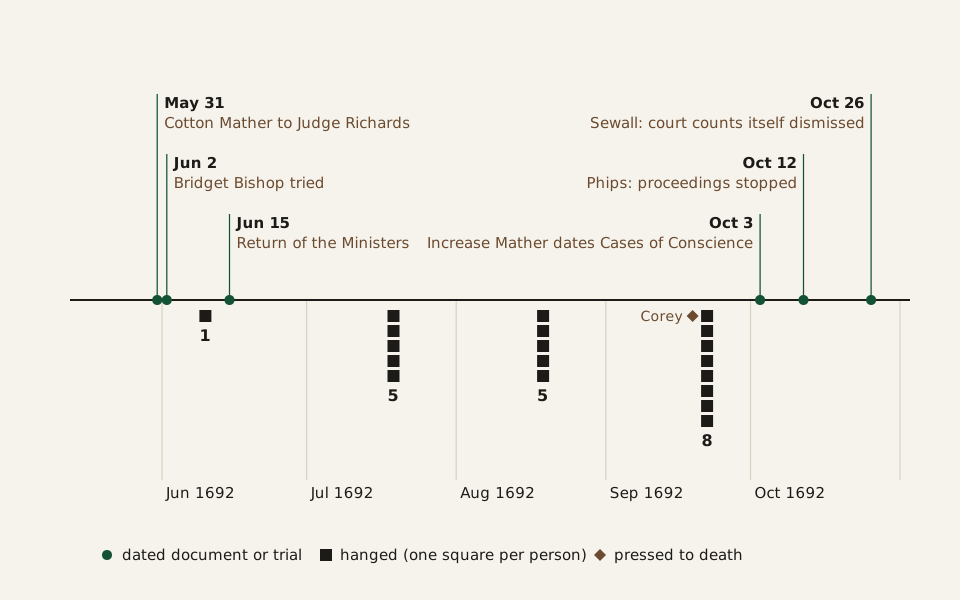
Diagram: Hoax and Hindsight · CC BY 4.0
Credit line to copy
"Documents and deaths at Salem, May to October 1692" by Hoax and Hindsight, licensed under CC BY 4.0 (https://creativecommons.org/licenses/by/4.0/). Original: https://hoaxandhindsight.com/trials/salem-witch-trials/
Data: Charles W. Upham, Salem Witchcraft and Cotton Mather: A Reply (1869); Cotton Mather and Increase Mather, The Wonders of the Invisible World (1862 reprint); George Lincoln Burr, ed., Narratives of the Witchcraft Cases (1914); Diary of Samuel Sewall, vol. 1 (1878); Robert Calef, More Wonders of the Invisible World (1700), ed. Drake (1866), vol. 3; Charles W. Upham, Salem Witchcraft (1867)
From Cotton Mather's letter of May 31 to Sewall's diary entry of October 26, 1692: dated documents and Bridget Bishop's trial above the line, deaths by court action below. Drawn from the tables published with this page.
| Date (1692) | Document or event | By |
|---|---|---|
| May 31 | Letter to Judge John Richards | Cotton Mather |
| June 2 | Trial of Bridget Bishop | Court of Oyer and Terminer (account by Cotton Mather, 1693) |
| June 15 | Return of the Ministers | Boston ministers |
| October 3 | Cases of Conscience | Increase Mather |
| October 12 | Letter to London | Governor William Phips |
| October 26 | Diary entry on the fast-day bill | Samuel Sewall |
The documents, with sources (CSV) (where the data comes from) Data: Charles W. Upham, Salem Witchcraft and Cotton Mather: A Reply (1869); Cotton Mather and Increase Mather, The Wonders of the Invisible World (1862 reprint); George Lincoln Burr, ed., Narratives of the Witchcraft Cases (1914); Diary of Samuel Sewall, vol. 1 (1878)
Two cautions apply to Phips as a witness. He wrote partly in self-defense; the same letter says “my enemies are seeking to turn it all upon me.” He also did not doubt that the Devil was at work. His objection was that the Devil could wear an innocent person's shape, so “the evidence of the afflicted persons only” should not decide who was jailed or tried.
What happened at the 1693 trials?
A new Superior Court of Judicature opened at Salem on January 3, 1693, a date written 1692/3 at the time (Exhibit E). Its chief judge, Phips wrote, was again the lieutenant governor, William Stoughton. Stoughton had led the 1692 court and signed Bishop's death warrant (Exhibit A). Phips wrote that Increase Mather and other ministers had judged “that the look and the touch of the suspected persons was not sufficient proofe,” and so “these things had not the same stress layd upon them as before.”
Phips's count of the result is short: “all that were brought to tryall to the number of fifety two, were cleared saving three.” By his figures, 49 of the 52 were cleared. His letter does not say how he counted, which sessions he included, or what “cleared” covered.
“Trial of George Jacobs for Witchcraft, Salem, Mass” · T. H. Matteson; postcard by Detroit Publishing Co. · Public domain
Full credit
"Trial of George Jacobs for Witchcraft, Salem, Mass" by T. H. Matteson; postcard by Detroit Publishing Co. — https://commons.wikimedia.org/wiki/File:Trial_of_George_Jacobs_for_Witchcraft,_Salem,_Mass_(NYPL_b12647398-75594).tiff — Public domain (painting of 1855 by T. H. Matteson (1813–1884) reproduced on a Detroit Publishing Co. postcard (series 13270, published after 1898 and before 1931): public domain in the US (published before 1931) and in the EU (painter dead since 1884; the postcard is an anonymous company publication more than 70 years old); New York Public Library scan, PD-scan); modified: cropped to the printed picture, removing the postcard's white margin and the printed caption and publisher's copyright line along the lower edge, converted from TIFF to JPEG
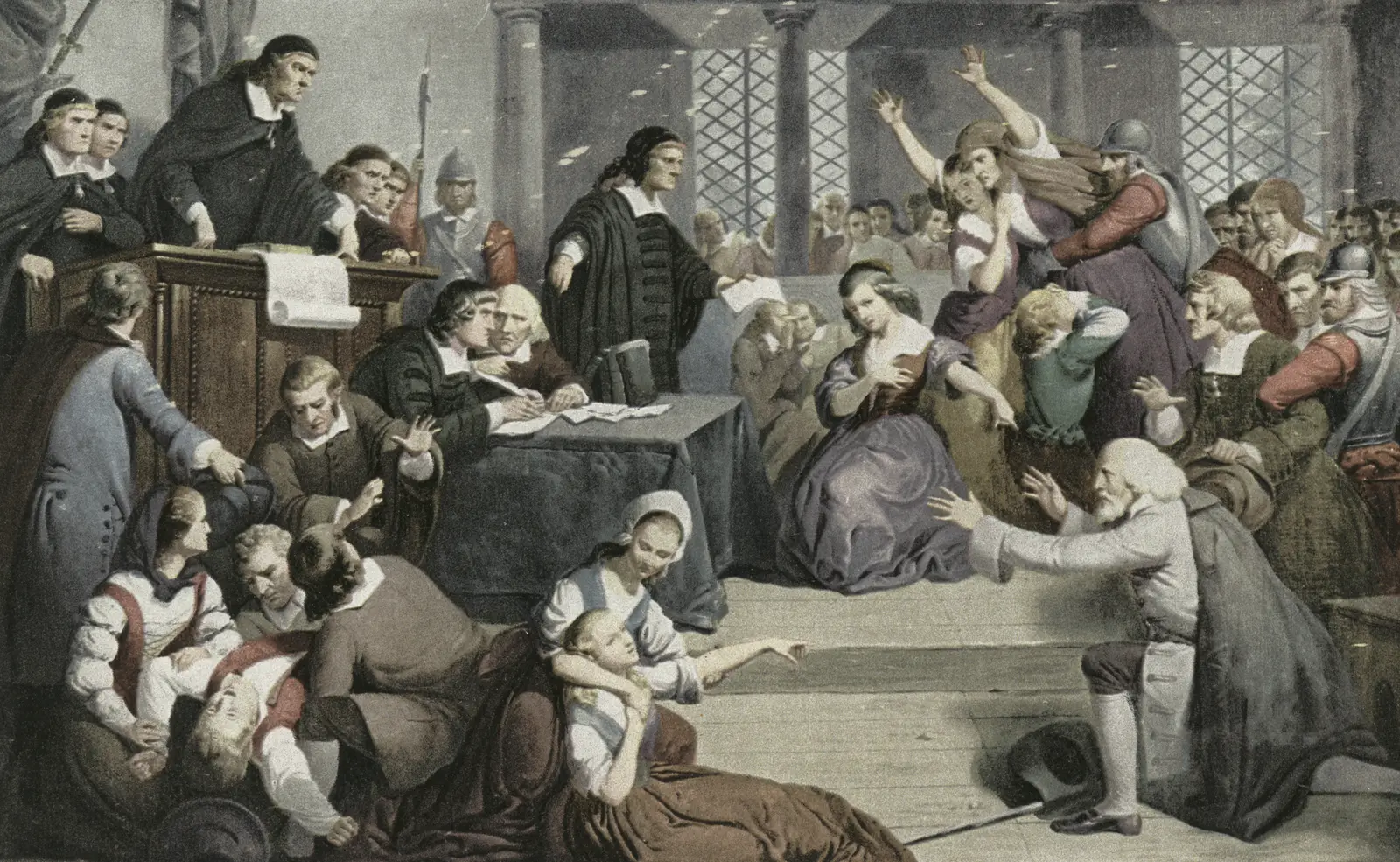
Trial of George Jacobs, August 5, 1692, painted by T. H. Matteson in 1855 — an imagined scene, not a record. Shown from a Detroit Publishing Co. postcard reproduction, cropped to the painted picture.
Two other published accounts cover the Salem session alone. Calef wrote that bills against thirty people were thrown out, that bills against twenty-six more were found, and that “of all these Three only were found Guilty by the Jewry upon Trial” (Exhibit B). Upham named twenty people tried at Salem that January and wrote that the last three, Sarah Wardwell, Elizabeth Johnson Jr. and Mary Post, “were condemned, but not executed: all the rest were acquitted” (Exhibit H).
The court's own record of the 1693 sessions is transcribed, verdict by verdict, in the University of Virginia's Salem archive (Exhibit K). Every account read here ends with the same three convictions.
Phips's letter explains why those three did not hang. Stoughton signed a warrant for their “speedy execucion,” along with five others condemned in 1692. Phips “sent a reprieve.” Stoughton, Phips wrote, was “inraged and filled with passionate anger” and refused to sit when the court met at Charlestown.
How were the Salem convictions reversed?
One judge went first. Samuel Sewall handed the Rev. Samuel Willard a bill to read on a public fast day, and stood while it was read; in it he desired “to take the Blame and shame of it” (Exhibit F). The province's proclamation, printed with the diary, set “Thursday the Fourteenth of January next” as the fast: January 14, 1696/7 in the dating of the time, which the diary's 1878 editors give as January 14, 1697.
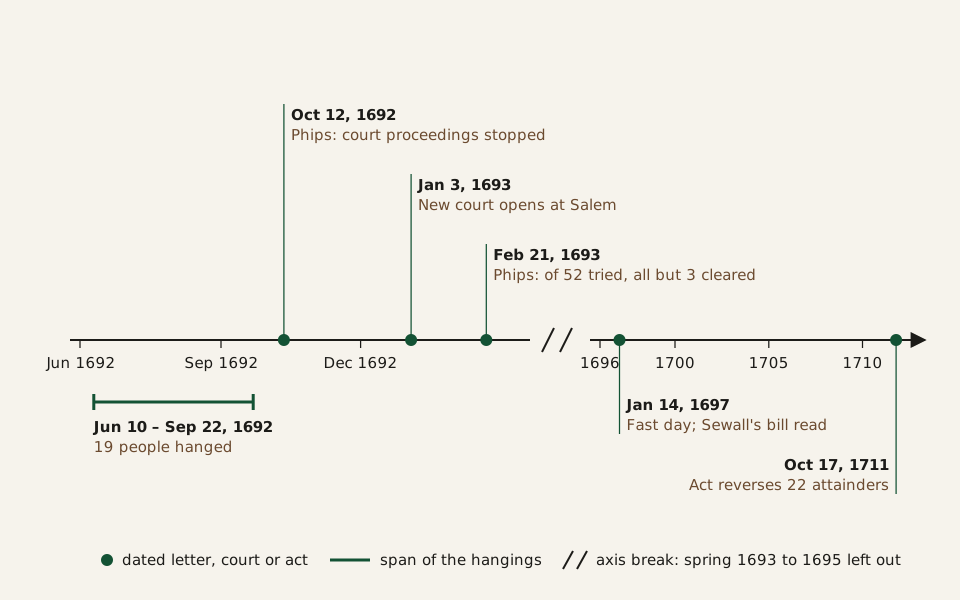
Diagram: Hoax and Hindsight · CC BY 4.0
Credit line to copy
"Salem, 1692 to 1711: from the hangings to the act reversing the attainders" by Hoax and Hindsight, licensed under CC BY 4.0 (https://creativecommons.org/licenses/by/4.0/). Original: https://hoaxandhindsight.com/trials/salem-witch-trials/
Data: George Lincoln Burr, ed., Narratives of the Witchcraft Cases (1914), pp. 197-201; Robert Calef, More Wonders of the Invisible World (1700), ed. Samuel G. Drake (1866), vol. 3; Diary of Samuel Sewall, vol. 1 (1878); W. Elliot Woodward, Records of Salem Witchcraft, vol. 2 (1864), pp. 216-218; Charles W. Upham, Salem Witchcraft (1867); death warrant of Bridget Bishop with the sheriff's return (1692)
From the hanging of June 10, 1692, to the act of 1711, on an axis broken between spring 1693 and 1696. The dates in early 1693 and in January 1697 were written 1692/3 and 1696/7 at the time.
| Date | Event | Source |
|---|---|---|
| June 10 to September 22, 1692 | 19 people hanged | Exhibits A, B, F and H |
| October 12, 1692 | Phips writes that he has put a stop to the court's proceedings | Exhibit E |
| January 3, 1693 (1692/3) | Superior Court of Judicature opens at Salem | Exhibits B and E |
| February 21, 1693 (1692/3) | Phips: of 52 brought to trial, all but 3 cleared; he reprieved the 3 | Exhibit E |
| January 14, 1697 (1696/7) | Public fast day; Sewall's bill read | Exhibit F |
| October 17, 1711 | Act reverses the attainders of 22 named people | Exhibit G |
From 1692 to 1711, dated events with sources (CSV) (where the data comes from) Data: George Lincoln Burr, ed., Narratives of the Witchcraft Cases (1914); Robert Calef, More Wonders of the Invisible World (1700), ed. Samuel G. Drake (1866), vol. 3; Diary of Samuel Sewall, vol. 1 (1878); W. Elliot Woodward, Records of Salem Witchcraft, vol. 2 (1864); Charles W. Upham, Salem Witchcraft (1867)
On October 17, 1711, the General Court passed “An Act to reverse the attainders of George Burroughs and others for Witchcraft” (Exhibit G). It declared the convictions of 22 named people “null and void.” It also kept the old frame of the events. The act blamed the “Influence and Energy of the Evil Spirits” acting “in and upon those who were the principal accusers and Witnesses,” and said some accusers had since shown themselves “persons of profligate and vicious conversation.”
The act did not name everyone. Comparing its list with the deaths in this page's table, 14 of the 20 people who died by court action are named. Six are not: Bridget Bishop, Susanna Martin, Alice Parker, Ann Pudeator, Wilmot Reed and Margaret Scott.
Popular version vs. the record
Salem has gathered its share of courtroom folklore, this site's term for popular versions of a famous trial that contradict the surviving record and still outlive it. Below, each popular claim is the charge, with the record set after it. The same test is run on Galileo's trial of 1633 and on the Scopes trial of 1925.
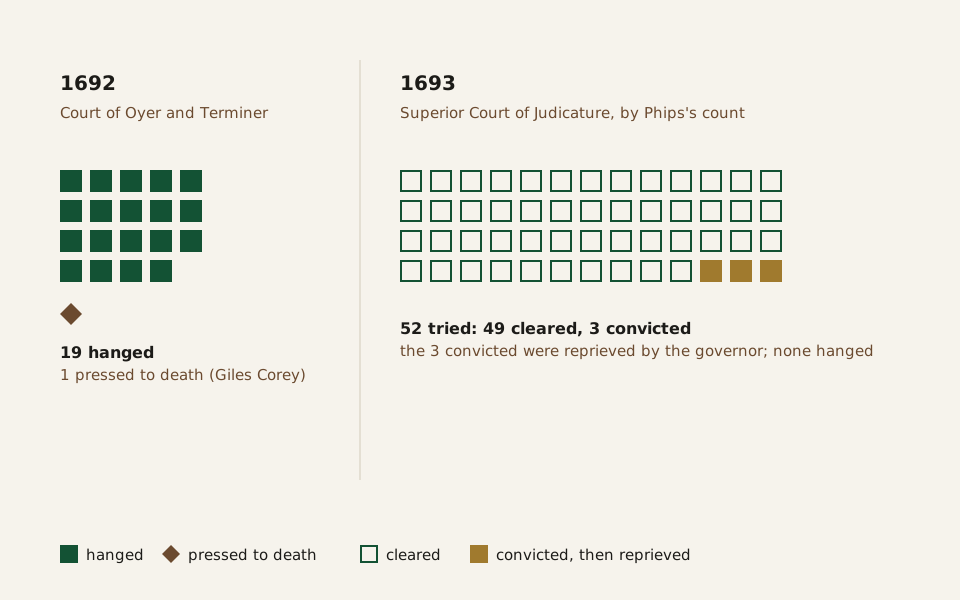
Diagram: Hoax and Hindsight · CC BY 4.0
Credit line to copy
"Salem outcomes, 1692 and 1693 (1693 by Governor Phips's count)" by Hoax and Hindsight, licensed under CC BY 4.0 (https://creativecommons.org/licenses/by/4.0/). Original: https://hoaxandhindsight.com/trials/salem-witch-trials/
Data: Robert Calef, More Wonders of the Invisible World (1700), ed. Samuel G. Drake (1866), vol. 3; Diary of Samuel Sewall, vol. 1 (1878); Charles W. Upham, Salem Witchcraft (1867); death warrant of Bridget Bishop with the sheriff's return (1692); Governor William Phips to the Earl of Nottingham, February 21, 1692/3, in George Lincoln Burr, ed., Narratives of the Witchcraft Cases (1914), p. 201
One square per person: in 1692, nineteen hanged and Giles Corey pressed to death; in 1693, by Governor Phips's count, 52 tried, 49 cleared and 3 convicted, all three reprieved. Drawn from the tables published with this page.
“Spectral evidence alone convicted them.” Upham (1869) said Bishop's case rested “entirely upon spectral evidence.”
Phips said most of those still in prison when he stopped the court had “only spectre evidence” against them; he did not say which of them had been convicted. Cotton Mather's account of Bishop's trial also reports testimony about poppets and a body search. (Exhibits C, E)
“The new court banned spectral evidence.” Upham (1867) wrote that in 1693 it was “wholly thrown out.”
Phips, writing in 1693, said only that it no longer had “the same stress” laid upon it. The new court still convicted three people. A governor's reprieve, not an acquittal, saved them. (Exhibits E, H)
“Nineteen people were hanged.” John Hale's account, as Upham quoted it in 1867, says “nineteen were executed.”
This one matches the record: nineteen hangings on four dates, with Giles Corey pressed to death besides. (Exhibits A, B, F, H and this page's table)
Were the Salem witches burned at the stake?
No. The sheriff's return on Bridget Bishop's death warrant, dated June 10, 1692, says he caused her to be hanged “by the neck untill Shee was dead,” and eighteen more people were hanged by September 22. Giles Corey was pressed to death after refusing a jury trial, on September 19 according to Samuel Sewall's diary (Robert Calef gives September 16). No burning appears in the Salem records read for this page.
What was spectral evidence?
Spectral evidence was sworn testimony that an accused person's specter, or shape, had tormented the accuser or urged them to sign the Devil's book. At Salem in 1692 it stood beside other evidence, such as confessions, neighbors' accounts and body searches. In June 1692 ministers consulted by the governor and council warned that the Devil could appear in an innocent person's shape, so a specter alone should not convict.
How many people died in the Salem witch trials?
At least twenty-five, by Benjamin Ray's count. Nineteen people were hanged in 1692, Giles Corey was pressed to death, and at least five died in jail. At least 155 people were arrested and jailed. In 1693, by Governor Phips's account, 52 people were tried and all but three were cleared, and no one else was executed.
Why did the Salem witch trials end?
Governor William Phips stopped the special court in October 1692, after ministers including Increase Mather argued that the Devil could take the shape of innocent people. By Phips's account, the 1693 court gave spectral evidence less weight, and all but three of the 52 brought to trial were cleared; he reprieved the three it convicted. His letters were also written to defend himself, so his explanation is one witness's account.
Where were the Salem witches hanged?
At Salem; Upham (1867) calls the place Witch Hill. Where exactly the gallows stood is a separate question, retried on the page on Proctor's Ledge.
What would overturn it:
- The missing 1692 trial records. If the trial papers for the 1692 convictions turn up and show that a jury convicted Bridget Bishop on spectral testimony with nothing else before it, this page's answer to “spectral evidence alone?” would change for her case.
- A public-domain printing of the 1693 court record. If a public-domain printing of the Superior Court of Judicature's 1693 record gives a different number of people tried, or different verdicts, from Phips's letter, this page's 52 and 3 would change.
Exhibits
Records and period publications
- Exhibit A: Death warrant for Bridget Bishop, signed by William Stoughton at Boston, June 8, 1692, with the return of George Corwin, sheriff, dated June 10, 1692. Manuscript, photographed by Frank Cousins; Digital Commonwealth, commonwealth:2b88r6940.
- Exhibit B: Robert Calef, More Wonders of the Invisible World (London, 1700), in Samuel G. Drake, ed., The Witchcraft Delusion in New England, vol. 3 (Roxbury, Mass., 1866), with Drake's notes and appendix.
- Exhibit C: Cotton Mather, The Wonders of the Invisible World (Boston and London, 1693), with Increase Mather, Cases of Conscience Concerning Evil Spirits Personating Men (dated Boston, October 3, 1692; printed 1693); reprinted London: John Russell Smith, 1862.
- Exhibit D: Charles W. Upham, Salem Witchcraft and Cotton Mather: A Reply (Morrisania, N.Y., 1869), printing Cotton Mather's letter to John Richards of May 31, 1692, and the 'Return of the Ministers consulted by his Excellency and the honorable Council' of June 15, 1692.
- Exhibit E: George Lincoln Burr, ed., Narratives of the Witchcraft Cases, 1648–1706 (New York: Charles Scribner's Sons, 1914), 'Letters of Governor Phips to the Home Government, 1692–1693': to William Blathwayt, October 12, 1692 (pp. 196–198), and to the Earl of Nottingham, February 21, 1692/3 (pp. 198–202).
- Exhibit F: Diary of Samuel Sewall, 1674–1729, vol. 1, Collections of the Massachusetts Historical Society, 5th series, vol. 5 (Boston, 1878).
- Exhibit G: W. Elliot Woodward, ed., Records of Salem Witchcraft, Copied from the Original Documents, vol. 2 (Roxbury, Mass., 1864), pp. 216–218: 'An Act to reverse the attainders of George Burroughs and others for Witchcraft' (October 17, 1711).

Studies
- Exhibit H: Charles W. Upham, Salem Witchcraft, 2 vols. (Boston, 1867).
- Exhibit I: Benjamin C. Ray, 'The Salem Witch Trials Digital Archive: How and Why,' Salem Witch Trials Documentary Archive and Transcription Project, University of Virginia.
- Exhibit J: Benjamin C. Ray, 'Overview of the Salem Witch Trials: Brief Account,' Salem Witch Trials Documentary Archive and Transcription Project, University of Virginia.
Databases and data sets
- Exhibit K: Salem Witchcraft Papers, ed. Paul Boyer and Stephen Nissenbaum (1977), No. 170: Superior Court of Judicature, witchcraft trials of 1693, transcription in the Salem Witch Trials Documentary Archive and Transcription Project, University of Virginia.
Cite this page
Hoax and Hindsight. “Salem Witch Trials: 3 of 52 Convicted in 1693, Phips Wrote.” Hoax and Hindsight, published November 6, 2026. https://hoaxandhindsight.com/trials/salem-witch-trials/. Accessed [the date you read it].
Related cases
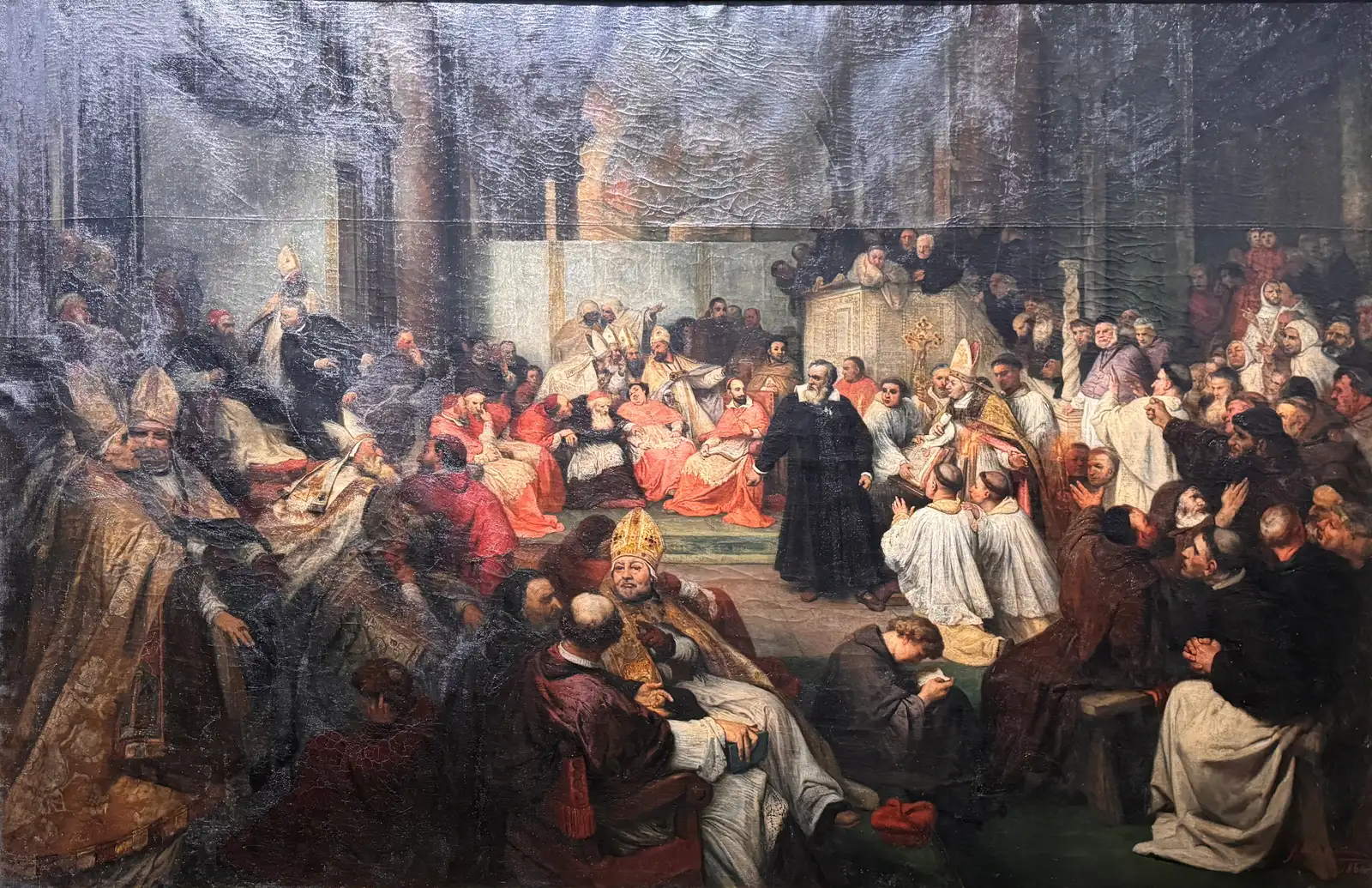
Galileo Trial: No ‘Eppur Si Muove’ in the 1633 Record
Galileo’s 1633 sentence found him vehemently suspected of heresy. Eppur si muove is not in it; the earliest printing found, per Mario Livio, is from 1757.
Picture credit
"Hamburg, Kunsthalle, Friedrich Karl Hausmann, Galilei vor dem Konzil" by Dguendel — https://commons.wikimedia.org/wiki/File:Hamburg,_Kunsthalle,_Friedrich_Karl_Hausmann,_Galilei_vor_dem_Konzil.jpg — CC BY 4.0 (https://creativecommons.org/licenses/by/4.0/); modified: cropped to the painted surface, removing a strip of the gilt frame along the top (16 px) and left (18 px) edges, re-encoded as JPEG
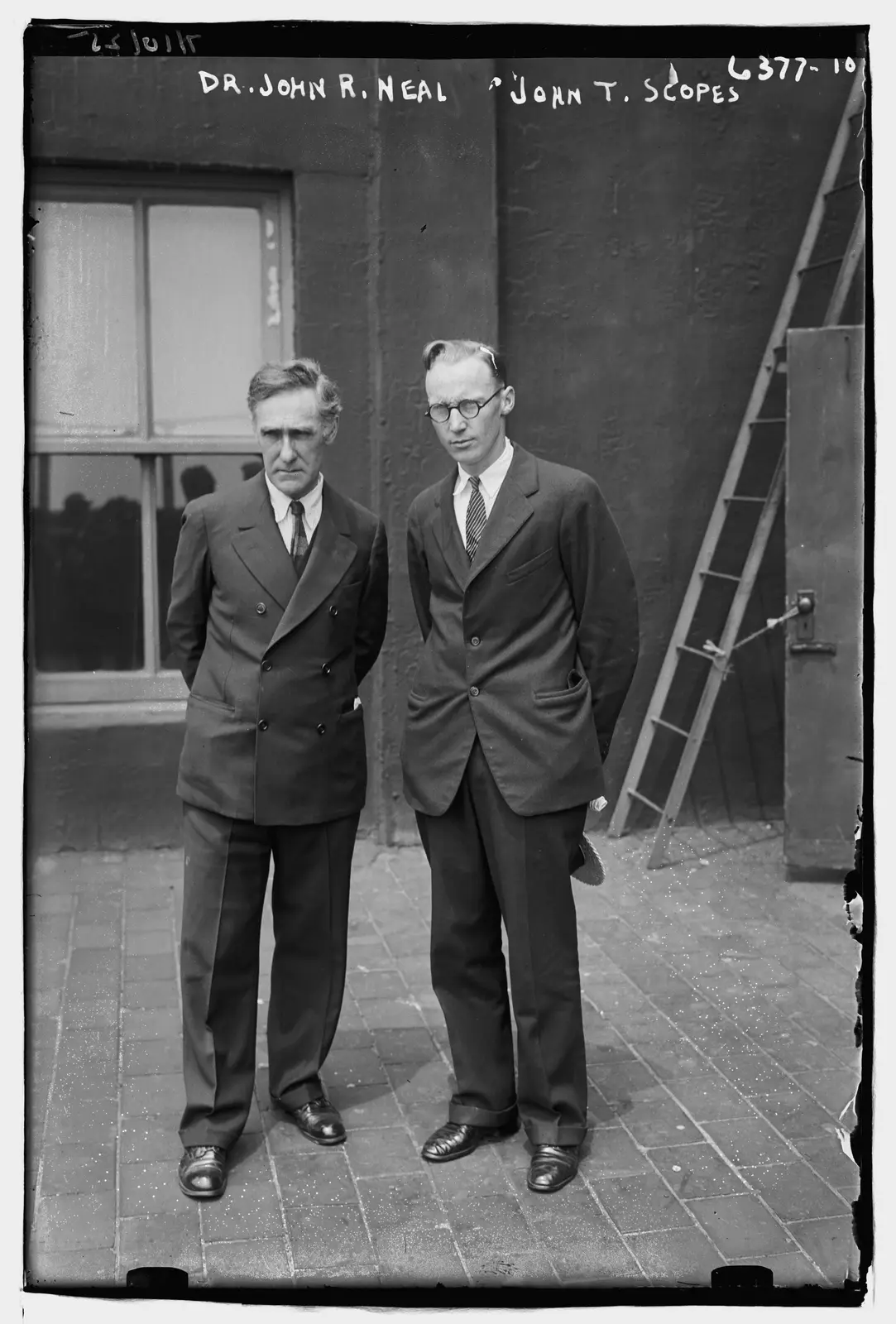
Scopes Monkey Trial: The Defense Asked for a Guilty Verdict
The Scopes monkey trial ended in a guilty verdict on July 21, 1925, after the defense asked for it to reach a higher court; the judge set the $100 fine.
Picture credit
"Dr. John R. Neal, John T. Scopes" by Bain News Service — https://commons.wikimedia.org/wiki/File:Dr._John_R._Neal,_John_T._Scopes_LCCN2014718360.jpg — Public domain (news-agency photograph by the Bain News Service, no named photographer; the negative is marked 7/10/25 (July 10, 1925). US: public domain on the ground that Bain distributed its photographs to newspapers when they were taken, which counts as publication, and this was before 1931. Risk: whether this negative was actually distributed in 1925 has not been checked; if it was never published, an anonymous unpublished US work of 1925 is protected until 120 years after creation (end of 2045). EU: anonymous work, 70 years from first making available (or, if never made available, from creation), long expired. Library of Congress Prints and Photographs, George Grantham Bain Collection, ggbain.38214, 'No known restrictions on publication' (a lead, not the basis))
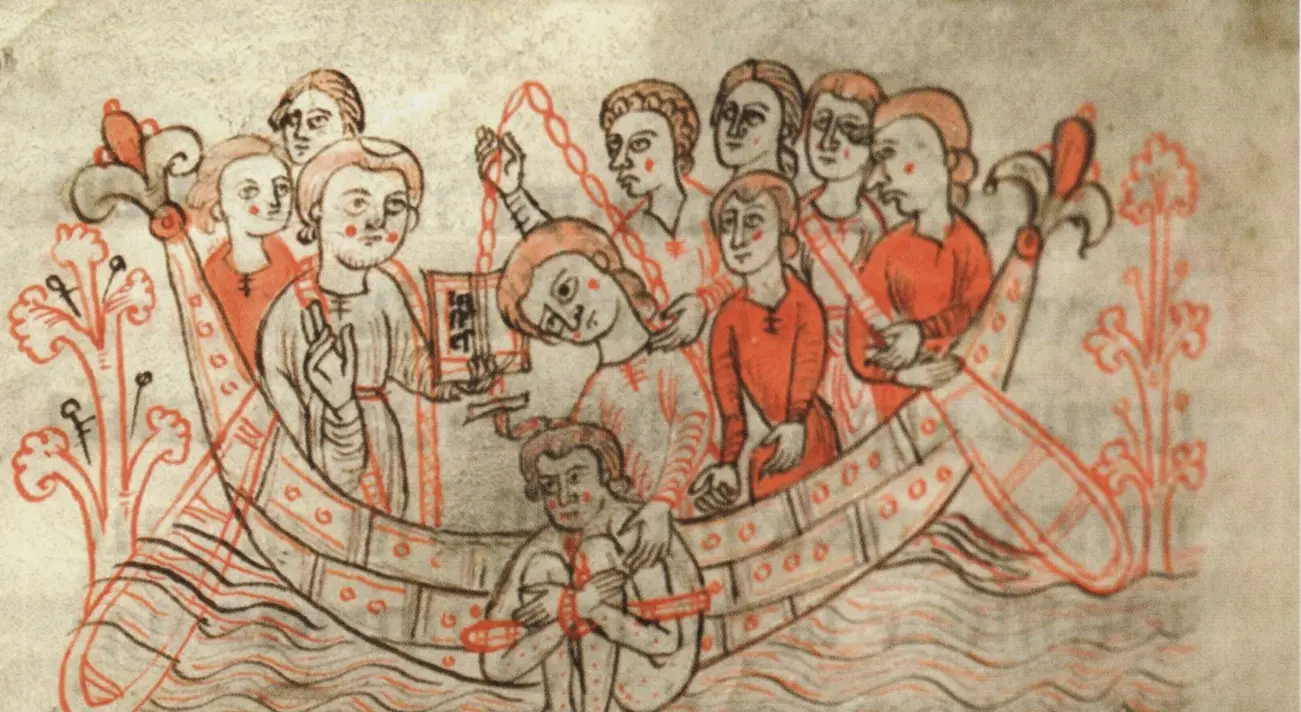
Trial by Ordeal: Most Várad Cases With a Result Were Cleared
In the Várad register, dated 1208–1235 by its 1903 editors, 131 of 209 hot-iron cases with a written result end with everyone cleared, by this site’s count.
Picture credit
"Wasserprobe (ordeal by water), drawing in the Rituale of Lambach Abbey" by Unknown author — https://commons.wikimedia.org/wiki/File:Wasserprobe.jpg — Public domain (medieval drawing (the Commons file page dates it to the 12th century, author unknown): public domain in the US and the EU, where every term ran out centuries ago; the image is a faithful photographic reproduction of a two-dimensional public-domain work, which adds no new copyright in the US (PD-Art) or in the EU (Directive (EU) 2019/790, Art. 14). The reproduction was photographed from a plate in Peter Dinzelbacher, Das fremde Mittelalter (Essen: Magnus, 2006).); modified: cropped to the drawing (x 60-1361, y 0-712 of the 1,361 x 1,599 original), removing the Latin text below it and a pencil folio mark at the top left, re-encoded as JPEG