Famous Trials · Method and mechanism
Giles Corey: ‘More Weight’ Is Absent From Sewall and Calef
Hoax and Hindsight Published
Giles Corey's famous last words, “More weight!”, are not in Sewall’s or Calef’s account of his death. He was pressed to death at Salem in September 1692 for refusing a jury trial, and the earliest printings of the words found here are a ballad reprinted in 1866 from a newspaper of about 1850 and a boys' rhyme printed in 1867.
Method
- Method
- Peine forte et dure: the English penalty for a prisoner who stood mute, refusing to plead or to accept a jury trial
- What it measures
- Nothing physical; it weighed no evidence and was used to compel a prisoner to put himself upon trial by jury, including one who had already pleaded not guilty
- What it can show
- That a prisoner refused a jury trial, and that the law of the time would not try him by jury without his consent
- What it cannot show
- Guilt or innocence, or a prisoner's motive; for Giles Corey, Calef (1700) and Upham (1867) give different reasons
- Key case
- Giles Corey, Salem, September 1692: pressed to death for standing mute, on September 19 by Sewall's diary (Calef gives September 16)
Method card as CSVWhere these entries come from (JSON)Data: William Blackstone, Commentaries on the Laws of England, vol. 4 (Oxford, 1775); James Bradley Thayer, A Preliminary Treatise on Evidence at the Common Law (Boston, 1898); Robert Calef, More Wonders of the Invisible World (1700), in S. G. Drake, ed., vol. 3 (Roxbury, 1866); Charles W. Upham, Salem Witchcraft, vol. 2 (Boston, 1867); Diary of Samuel Sewall, vol. 1 (Boston, 1878)
Peine forte et dure, Law French for strong and hard punishment, was the English penalty for a prisoner who stood mute: one who would not plead to the charge, or would not accept trial by jury. Corey, accused of witchcraft, was the first person in New England ever pressed to death, by Robert Calef's account. This page sets out how the procedure worked, what it can and cannot tell about one prisoner, and where the famous words turn up in the earliest printings found here, following the site's retrial method. The other Salem cases are retried on the Salem witch trials page, which sets the 1692 deaths against the court papers.
Order of proceedings 6 parts
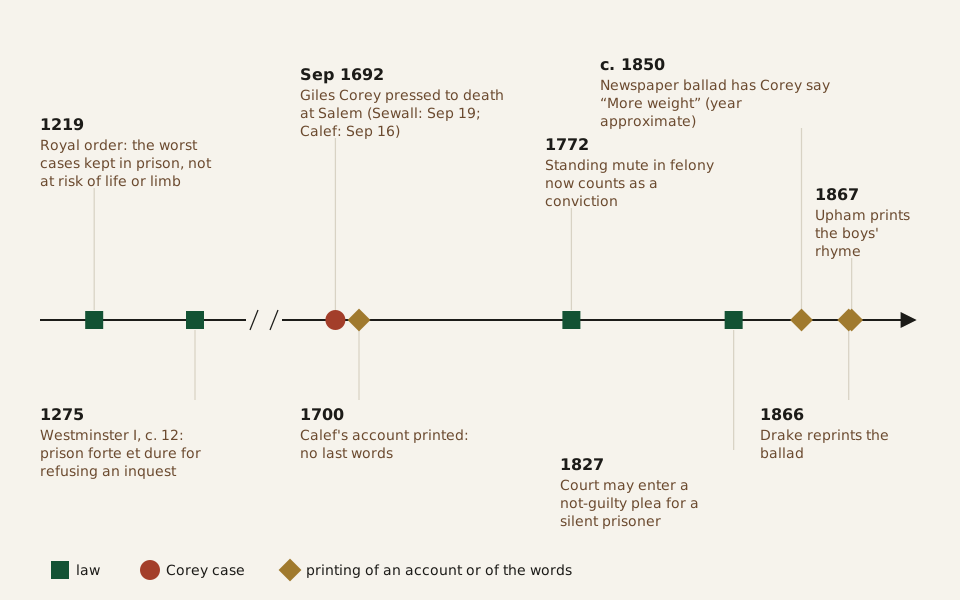
Diagram: Hoax and Hindsight · CC BY 4.0
Credit line to copy
"Peine forte et dure and the words More weight, 1219 to 1867" by Hoax and Hindsight, licensed under CC BY 4.0 (https://creativecommons.org/licenses/by/4.0/). Original: https://hoaxandhindsight.com/trials/giles-corey/
Data: James Bradley Thayer, A Preliminary Treatise on Evidence at the Common Law (Boston, 1898); William Blackstone, Commentaries on the Laws of England, vol. 4 (Oxford, 1775); Diary of Samuel Sewall, vol. 1 (Boston, 1878); Robert Calef, More Wonders of the Invisible World (1700), in S. G. Drake, ed., vol. 3 (Roxbury, 1866); Charles W. Upham, Salem Witchcraft, vol. 2 (Boston, 1867)
From the royal order of 1219 to the earliest printings of “More weight” found here, on an axis broken between 1300 and 1680. The newspaper year of about 1850 is approximate, worked back from Samuel Drake's 1866 note. Drawn from the table published with this page.
The timeline, one row per law, case or printing with its source (CSV) (where the data comes from) Data: James Bradley Thayer, A Preliminary Treatise on Evidence at the Common Law (Boston, 1898); William Blackstone, Commentaries on the Laws of England, vol. 4 (Oxford, 1775); Diary of Samuel Sewall, vol. 1 (Boston, 1878); Robert Calef, More Wonders of the Invisible World (1700), in S. G. Drake, ed., vol. 3 (Roxbury, 1866); Charles W. Upham, Salem Witchcraft, vol. 2 (Boston, 1867)
How did peine forte et dure work?
In England the penalty came after the end of the ordeal. Once the courts had turned to the jury that replaced the ordeal, it seems to have become the rule, wrote James Bradley Thayer at Harvard Law School in 1898, that “the accused could not be put on his trial by a jury without his consent” (Exhibit F, p. 73).
A statute of 1275, the Statute of Westminster the First, chapter 12, dealt with those who refused. In Thayer's translation, notorious felons who would not put themselves on inquests “shall be put in strong and hard imprisonment (en le prison forte et dure) as refusing the common law of the land.” Thayer added: “This appears to be the first mention of what came to be known as the peine forte et dure” (Exhibit F, p. 74).
William Blackstone's Commentaries on the Laws of England, read here in its 1775 edition, sets out three ways a prisoner could stand mute (Exhibit C, p. 324). He could make no answer at all, answer beside the point, or, “Upon having pleaded not guilty, refuses to put himself upon the country,” that is, refuse a jury. If he said nothing, a jury first decided whether he was silent by choice or unable to speak.
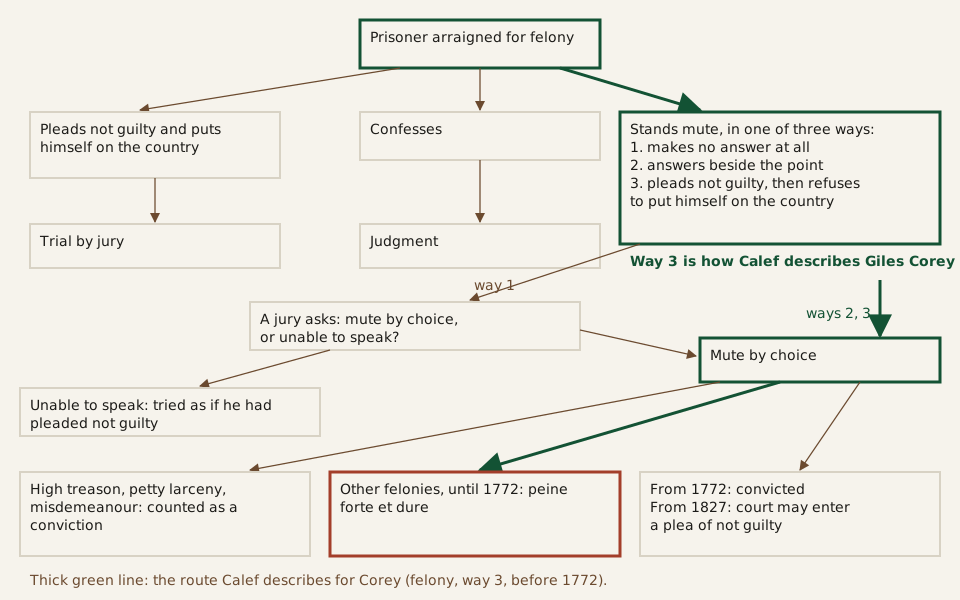
Diagram: Hoax and Hindsight · CC BY 4.0
Credit line to copy
"What happened to a prisoner who would not plead, as Blackstone sets it out" by Hoax and Hindsight, licensed under CC BY 4.0 (https://creativecommons.org/licenses/by/4.0/). Original: https://hoaxandhindsight.com/trials/giles-corey/
Data: William Blackstone, Commentaries on the Laws of England, vol. 4 (Oxford, 1775); James Bradley Thayer, A Preliminary Treatise on Evidence at the Common Law (Boston, 1898); Robert Calef, More Wonders of the Invisible World (1700), in S. G. Drake, ed., vol. 3 (Roxbury, 1866)
What followed a refusal to plead in English law, as Blackstone set it out in 1775, with the changes of 1772 and 1827 from Thayer. The thick line is the route Calef describes for Corey. Drawn from the table published with this page.
The routes from arraignment, one row per step with its source (CSV) (where the data comes from) Data: William Blackstone, Commentaries on the Laws of England, vol. 4 (Oxford, 1775); James Bradley Thayer, A Preliminary Treatise on Evidence at the Common Law (Boston, 1898); Robert Calef, More Wonders of the Invisible World (1700), in S. G. Drake, ed., vol. 3 (Roxbury, 1866)
For high treason, petty larceny and misdemeanours, a prisoner mute by choice was treated as convicted. For other felonies, the old law did not count him as convicted, so it applied the penance instead (Exhibit C, p. 325). Blackstone believed the weights were a later addition; the early form, as he read it, was hard confinement with almost no food (Exhibit C, p. 328).
Blackstone separated the penalty from torture: the rack sought a confession, while this penalty was used “to compel a man to put himself upon his trial” (Exhibit C, p. 326). He also wrote that “it rarely was carried into practice” (Exhibit C, p. 328).
The penalty ended by statute: in 1772, Parliament made standing mute on a charge of felony or piracy count as a conviction, and from 1827 a court could enter a plea of not guilty for a silent prisoner (Exhibit F, pp. 74, 77–78). Corey's case came eighty years before the first of those changes.
What do Sewall and Calef say about Giles Corey?
Among the writers of the time, two read here recorded his death. Samuel Sewall, one of the Salem judges, wrote in his diary for Monday, September 19, 1692: “About noon, at Salem, Giles Corey was press'd to death for standing Mute” (Exhibit A, p. 364). He added that “much pains was used with him two days, one after another,” by the court and by an acquaintance, Captain Gardner of Nantucket, without success.
Robert Calef, a Boston merchant and critic of the trials, gave a fuller account in a book printed in London in 1700 (Exhibit B, vol. 3, pp. 44–45). Corey, he wrote, “pleaded not Guilty to his Indictment, but would not put himself upon Tryal by the Jury (they having cleared none upon Tryal).” Calef adds one physical detail of Corey's last moments, involving the sheriff, and records no words from Corey. He calls him “the first in New-England that was ever prest to Death.”
"Robert Calef title page More Wonders of the Invisible World.jpg" by Lewismr — https://commons.wikimedia.org/wiki/File:Robert_Calef_title_page_More_Wonders_of_the_Invisible_World.jpg — CC BY-SA 4.0 (https://creativecommons.org/licenses/by-sa/4.0/)
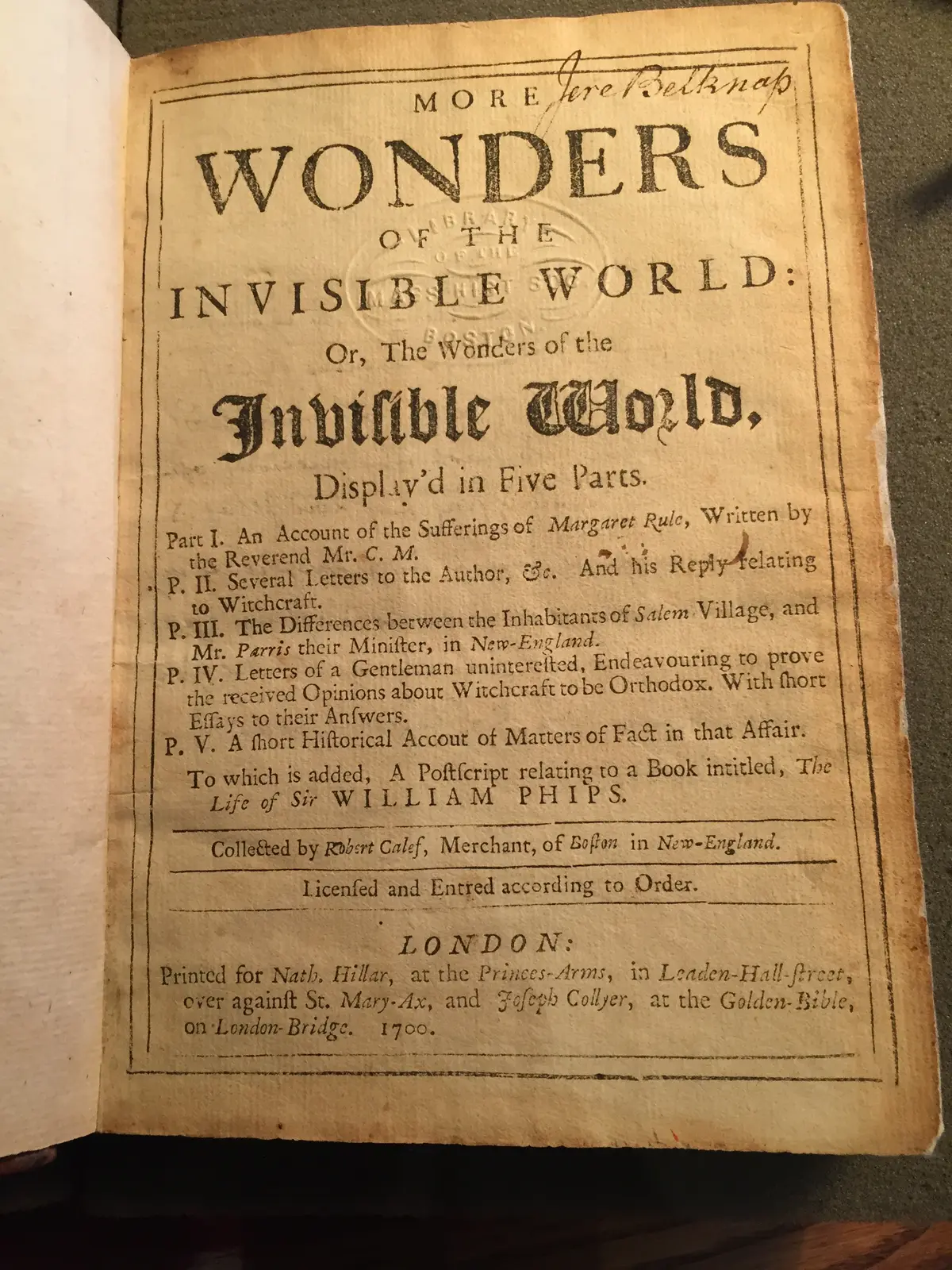
The title page of Calef's More Wonders of the Invisible World (London, 1700). His note on Corey is in the book's fifth part, an account of the events of 1692.
Read against Blackstone, the two accounts fit together. Calef describes a man who pleaded not guilty and then refused a jury, the third way of standing mute, and Sewall uses the legal term for it. The court's own papers say less: the historian Charles Upham found only “a few brief depositions” on file for Corey, and wrote in 1867 that “No information has come to us of the details of the proceedings” (Exhibit E, vol. 2, pp. 334, 338).
Each witness had a position: Sewall was one of the judges trying the accused, and Calef was a critic of the trials. Neither gives Corey any last words.
Did Giles Corey die on September 16 or September 19?
The two accounts disagree on the day: Calef's list of events reads “September 16, Giles Cory was prest to Death” (Exhibit B, vol. 3, pp. 44–45). Sewall's entry is headed September 19. Both use the Julian calendar of the time.
The calendar below gives the weekdays. September 19, 1692, in that calendar fell on a Monday, the day Sewall names, and September 16 on a Friday. Later writers split along the same line. Upham wrote that Corey died “Three days before” the hanging of September 22, which is Sewall's date (Exhibit E, vol. 2, p. 334), while the ballad discussed below says that Corey's wife Martha “lived but six Dayes more,” which is Calef's.
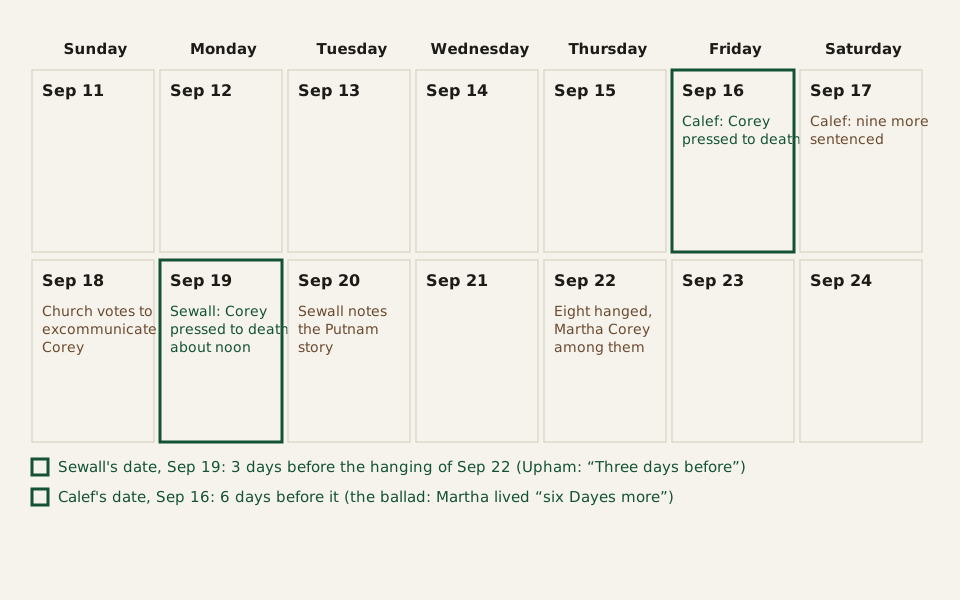
Diagram: Hoax and Hindsight · CC BY 4.0
Credit line to copy
"September 11 to 24, 1692, on the calendar used at the time" by Hoax and Hindsight, licensed under CC BY 4.0 (https://creativecommons.org/licenses/by/4.0/). Original: https://hoaxandhindsight.com/trials/giles-corey/
Data: Diary of Samuel Sewall, vol. 1 (Boston, 1878); Robert Calef, More Wonders of the Invisible World (1700), in S. G. Drake, ed., vol. 3 (Roxbury, 1866); Charles W. Upham, Salem Witchcraft, vol. 2 (Boston, 1867)
September 1692 in the Julian calendar used at the time, with the events dated in Calef, Sewall and the Salem church record. The weekdays are calculated, two ways, from the dates.
September 1692, one row per dated event with its weekday and source (CSV) (where the data comes from) Data: Robert Calef, More Wonders of the Invisible World (1700), in S. G. Drake, ed., vol. 3 (Roxbury, 1866); Diary of Samuel Sewall, vol. 1 (Boston, 1878); Charles W. Upham, Salem Witchcraft, vol. 2 (Boston, 1867)
The First Church of Salem added one more date. Its record of March 1712, which Upham printed, says that on September 18, 1692, the church voted to excommunicate Corey because he had “obstinately refused to plead, and so threw himself on certain death” (Exhibit E, vol. 2, p. 483). It does not say whether he was still alive.
Like the Salem witch trials page, this page uses Sewall's date, from a diary entry headed with the day and weekday, and gives Calef's beside it. Martha Corey was among eight people hanged on September 22 (Exhibit B, vol. 3, pp. 44–45), at a site retried on the page on where Salem's hangings took place.
Why did Giles Corey refuse a jury?
Calef gives one reason. Corey, “knowing there would be the same Witnesses against him, rather chose to undergo what Death they would put him to” (Exhibit B, vol. 3, pp. 44–45). That is Calef's reading of a man he does not quote.
Upham gave another. He printed a deed Corey had made in Ipswich jail, handing all his property to two sons-in-law, and argued that Corey refused trial so that no conviction could undo it (Exhibit E, vol. 2, pp. 336–337). The editors of Sewall's diary repeated this in 1878, writing that Corey “resolutely preserved silence” to keep his estate from being confiscated (Exhibit A, p. 364, note).
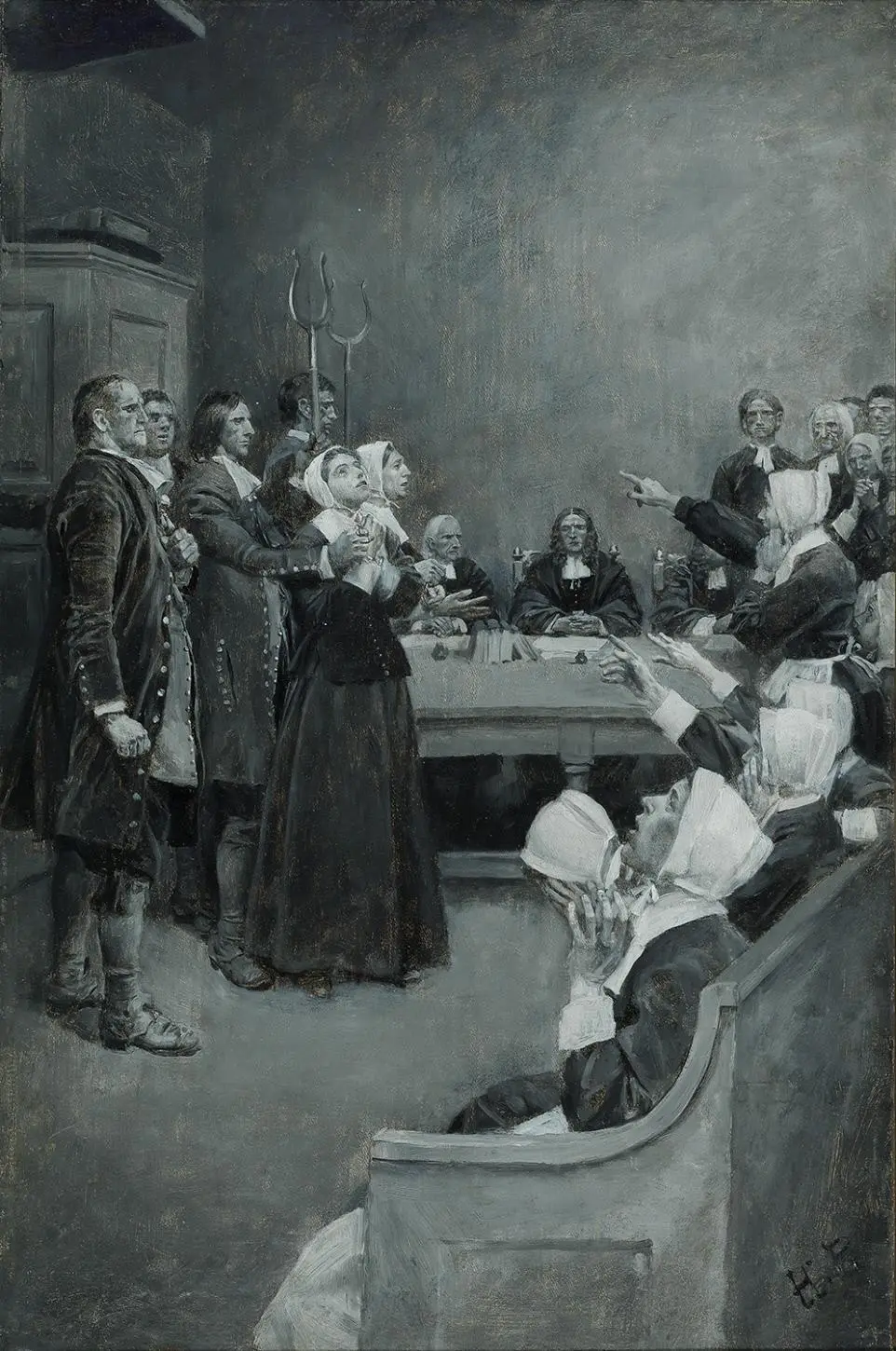
“There is a flock of yellow birds around her head (Brandywine River Museum of Art, 2007.9)” · Howard Pyle · Public domain
Full credit
"There is a flock of yellow birds around her head (Brandywine River Museum of Art, 2007.9)" by Howard Pyle — https://commons.wikimedia.org/wiki/File:There_is_a_flock_of_yellow_birds_around_her_head.jpg — Public domain (Painting by Howard Pyle (1853-1911, per the Commons creator record), printed in Mary E. Wilkins, Giles Corey, Yeoman: A Play (New York: Harper & Brothers, 1893), facing p. 46, under the same title (list of illustrations read in the University of Toronto scan, Internet Archive gilescoreyyeoman00freeuoft): public domain in the US (published 1893, before 1931) and in the EU (author dead since 1911, more than 70 years). The image is a faithful photographic reproduction of a two-dimensional public-domain work, which adds no new copyright in the US (PD-Art) or in the EU (Directive (EU) 2019/790, Art. 14); marked Public Domain Mark 1.0 on Commons. The museum's own terms were not read.)
Howard Pyle's 1892 painting for Mary E. Wilkins's play Giles Corey, Yeoman, printed in its 1893 book edition beside the accuser's line “There is a flock of yellow birds around her head.” An imagined courtroom from a play, not a record.
English law gives Upham's reading some footing. Blackstone wrote that a prisoner who stood mute and suffered the penance avoided judgment, so his lands did not escheat, though his goods were still forfeited (Exhibit C, p. 329). Whether a Massachusetts court in 1692 would have treated Corey's estate that way is not shown in the sources read here.
This is where the method stops, because peine forte et dure records that a prisoner refused a jury, not why he refused it. For Corey, Sewall and Calef give no words of his own on the question.
Where does “More weight” come from?
The earliest dated printing found here is in the appendix to Samuel G. Drake's 1866 edition of Calef. Drake reprinted a ballad he had “cut from a Newspaper sixteen years ago,” introduced there as coming from the Salem Observer (Exhibit B, vol. 3, p. 174). Its title, “A Ballad of 1692,” gives the year of the events, not of the writing, and Drake called it a ballad “in the Chevy Chase Style,” spelled to look old. Drake thought only one writer could have produced it and pointed to the poems of Mr. Whittier, which he had not checked.
In the ballad, a magistrate tells the silent Corey “We'll press it out of thee,” and then: “‘More weight,’ now sayd this wretched Man” (Exhibit B, vol. 3, pp. 174–177). The same poem has Corey stay silent before the court, “he sayde not a Word,” where Calef has him plead not guilty.
Illustration: Hoax and Hindsight. Generated schematic illustration — not a photograph or historical record. © Hoax and Hindsight, all rights reserved.
An illustration of an imagined scene, not a record: a prisoner standing silent before a colonial court. The 1692 accounts read for this page give Giles Corey no last words; the words came later, in verse.
Upham's history of 1867 is the second printing found. Upham wrote that “It is said that Corey urged the executioners to increase the weight,” and that some people then living remembered a “popular superstition” that Corey's ghost haunted the spot, and a ditty that boys sang there, beginning “‘More weight! more weight!’ Giles Corey he cried” (Exhibit E, vol. 2, pp. 339–340). He reported the words as tradition, not as testimony from 1692. A later retelling, Mary E. Wilkins's 1893 play Giles Corey, Yeoman, does not use them at all in the text read here (Exhibit D).
One later record points the other way. The 1712 church record says the church had “testimony in his behalf” that before his death “he did bitterly repent of his obstinate refusal to plead” (Exhibit E, vol. 2, pp. 483–484). Upham called that statement “a misrepresentation,” and the record names no witness.
The site uses the term courtroom folklore for popular versions of a famous trial that contradict the surviving record and still outlive it. “More weight” is a boundary case. No 1692 account read here contains the words, and none records what Corey said while he was pressed; the church's later claim that he repented concerns his refusal to plead, not his words. Silence in the record is a gap, not a contradiction.
Popular version vs. the record
Each popular claim below comes with the publication that carried it. The record follows it.
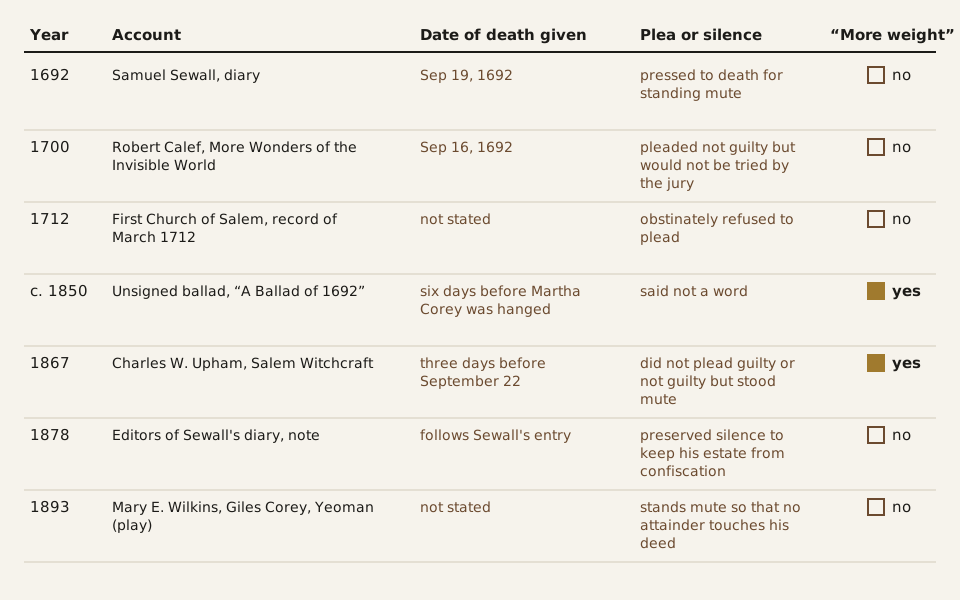
Diagram: Hoax and Hindsight · CC BY 4.0
Credit line to copy
"Seven accounts of Giles Corey’s death, 1692 to 1893, and whether they contain More weight" by Hoax and Hindsight, licensed under CC BY 4.0 (https://creativecommons.org/licenses/by/4.0/). Original: https://hoaxandhindsight.com/trials/giles-corey/
Data: Diary of Samuel Sewall, vol. 1 (Boston, 1878); Robert Calef, More Wonders of the Invisible World (1700), in S. G. Drake, ed., vol. 3 (Roxbury, 1866); Charles W. Upham, Salem Witchcraft, vol. 2 (Boston, 1867); Mary E. Wilkins, Giles Corey, Yeoman (New York, 1893)
Seven accounts of Corey's death, from Sewall's diary of 1692 to Wilkins's play of 1893, with the date each gives and whether it contains “More weight.” The ballad's year is approximate. Drawn from the table published with this page.
The accounts, one row per account with its source (CSV) (where the data comes from) Data: Diary of Samuel Sewall, vol. 1 (Boston, 1878); Charles W. Upham, Salem Witchcraft, vol. 2 (Boston, 1867); Robert Calef, More Wonders of the Invisible World (1700), in S. G. Drake, ed., vol. 3 (Roxbury, 1866); Mary E. Wilkins, Giles Corey, Yeoman (New York, 1893)
Last words
Silence in court
In the ballad, “he sayde not a Word”; Upham (1867) wrote that he did not plead guilty or not guilty.
What the pressing was for
In the ballad the pressing is for a confession: Corey “would no true Confession make,” and a magistrate says, “We'll press it out of thee.”
In English law the penalty was meant to make a prisoner accept trial by jury, not to make him confess; Blackstone set it apart from the rack (Exhibit C).
His motive
Upham (1867), the editors of Sewall's diary (1878) and Wilkins's play (1893): he refused trial to protect his property from an attainder.
Did Giles Corey say “more weight”?
No account from 1692 read here records it. Samuel Sewall's diary and Robert Calef's account describe his death without any words from him. The earliest printings found are a ballad that Samuel Drake reprinted in 1866 from a newspaper of about 1850, and a boys' rhyme that Charles Upham printed in 1867 as part of a local tradition. Nothing in Sewall's or Calef's account contradicts the words either.
Why did Giles Corey refuse to plead?
The accounts disagree. Robert Calef wrote in 1700 that Corey refused a jury because it had cleared no one and the same witnesses would testify against him. Charles Upham argued in 1867 that he wanted to protect a deed giving his property to his sons-in-law. No words of Corey's own on his reasons survive in the accounts read here.
What was peine forte et dure, and when did it end?
It was the English penalty for a prisoner who would not plead to a felony charge or would not accept a jury trial. A 1275 statute ordered such prisoners into hard imprisonment; Blackstone believed pressing with weights was added later. A 1772 act made standing mute count as a conviction, ending the penalty, and from 1827 a court could enter a plea of not guilty for a silent prisoner.
When did Giles Corey die?
On Monday, September 19, 1692, according to the diary of Samuel Sewall, one of the judges. Robert Calef's account, printed in 1700, gives September 16. Both dates are in the Julian calendar used at the time. This page uses Sewall's date and gives Calef's beside it.
What would overturn it:
- A 1692 record of the words. A letter, diary entry or court paper written in 1692 or 1693 that records Corey saying “more weight,” or any last words, would move the words from later verse into the record.
- An earlier printing. A dated printing of the words earlier than the newspaper ballad of about 1850 would push the earliest printing back. It would not change what Sewall and Calef say.
Exhibits
Records and period publications
- Exhibit A: Diary of Samuel Sewall, 1674–1729, vol. 1, Collections of the Massachusetts Historical Society, 5th series, vol. 5 (Boston, 1878).
- Exhibit B: Robert Calef, More Wonders of the Invisible World (London, 1700), in Samuel G. Drake, ed., The Witchcraft Delusion in New England, vol. 3 (Roxbury, Mass., 1866), with Drake's notes and appendix.
- Exhibit C: William Blackstone, Commentaries on the Laws of England, 7th ed., vol. 4 (Oxford: Clarendon Press, 1775), book IV, chapter 25.
- Exhibit D: Mary E. Wilkins, Giles Corey, Yeoman: A Play (New York: Harper & Brothers, 1893).
Studies
- Exhibit E: Charles W. Upham, Salem Witchcraft, 2 vols. (Boston, 1867).
- Exhibit F: James Bradley Thayer, A Preliminary Treatise on Evidence at the Common Law (Boston: Little, Brown, 1898).
Cite this page
Hoax and Hindsight. “Giles Corey: ‘More Weight’ Is Absent From Sewall and Calef.” Hoax and Hindsight, published November 6, 2026. https://hoaxandhindsight.com/trials/giles-corey/. Accessed [the date you read it].
Related cases
Salem Witch Trials: 3 of 52 Convicted in 1693, Phips Wrote
Salem witch trials: 19 hanged in 1692; in 1693, by the governor's count, all but 3 of 52 tried were cleared. What spectral evidence was and what changed.
Picture credit
"Trial of George Jacobs for Witchcraft, Salem, Mass" by T. H. Matteson; postcard by Detroit Publishing Co. — https://commons.wikimedia.org/wiki/File:Trial_of_George_Jacobs_for_Witchcraft,_Salem,_Mass_(NYPL_b12647398-75594).tiff — Public domain (painting of 1855 by T. H. Matteson (1813–1884) reproduced on a Detroit Publishing Co. postcard (series 13270, published after 1898 and before 1931): public domain in the US (published before 1931) and in the EU (painter dead since 1884; the postcard is an anonymous company publication more than 70 years old); New York Public Library scan, PD-scan); modified: cropped to the printed picture, removing the postcard's white margin and the printed caption and publisher's copyright line along the lower edge, converted from TIFF to JPEG
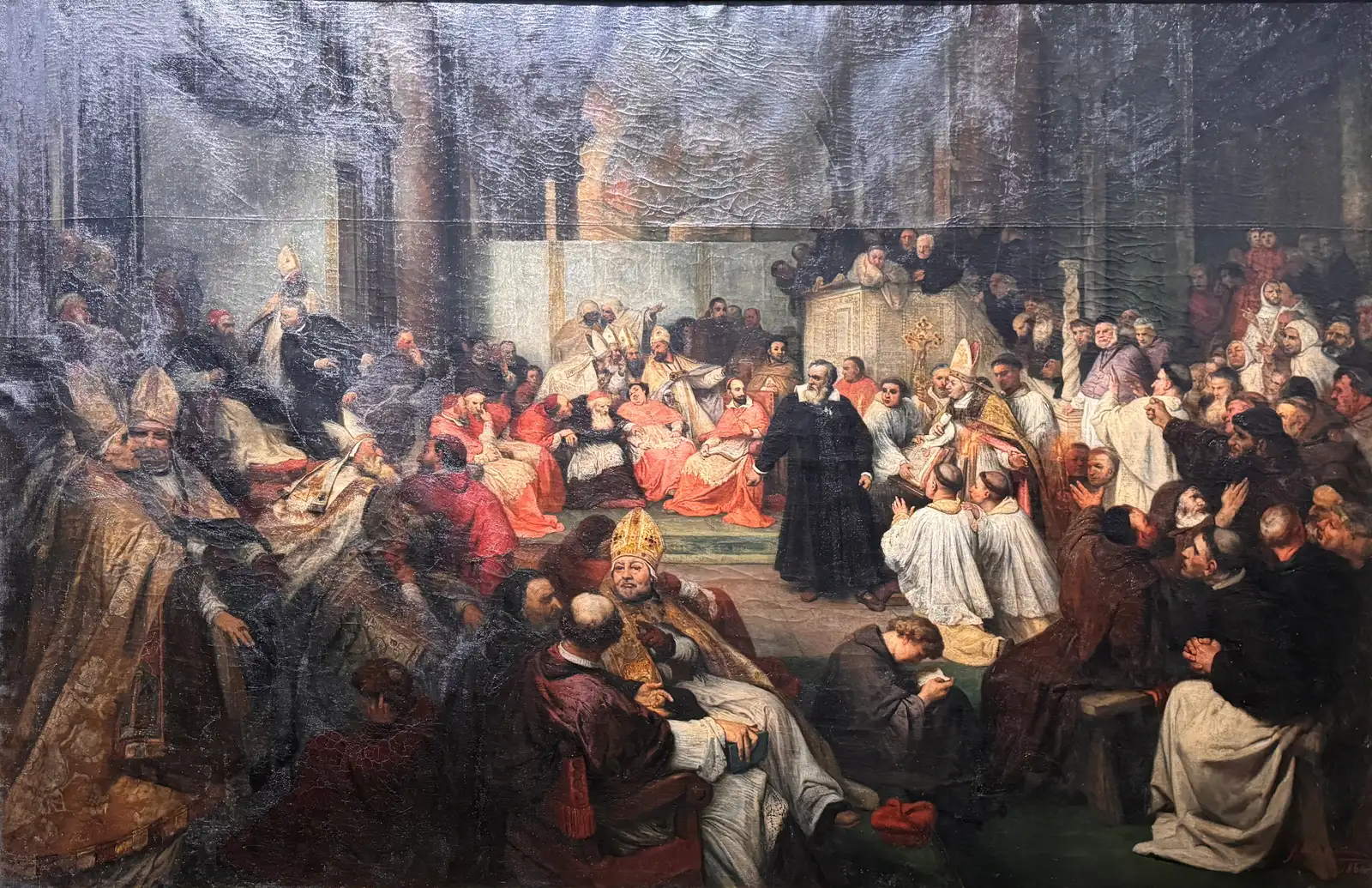
Galileo Trial: No ‘Eppur Si Muove’ in the 1633 Record
Galileo’s 1633 sentence found him vehemently suspected of heresy. Eppur si muove is not in it; the earliest printing found, per Mario Livio, is from 1757.
Picture credit
"Hamburg, Kunsthalle, Friedrich Karl Hausmann, Galilei vor dem Konzil" by Dguendel — https://commons.wikimedia.org/wiki/File:Hamburg,_Kunsthalle,_Friedrich_Karl_Hausmann,_Galilei_vor_dem_Konzil.jpg — CC BY 4.0 (https://creativecommons.org/licenses/by/4.0/); modified: cropped to the painted surface, removing a strip of the gilt frame along the top (16 px) and left (18 px) edges, re-encoded as JPEG
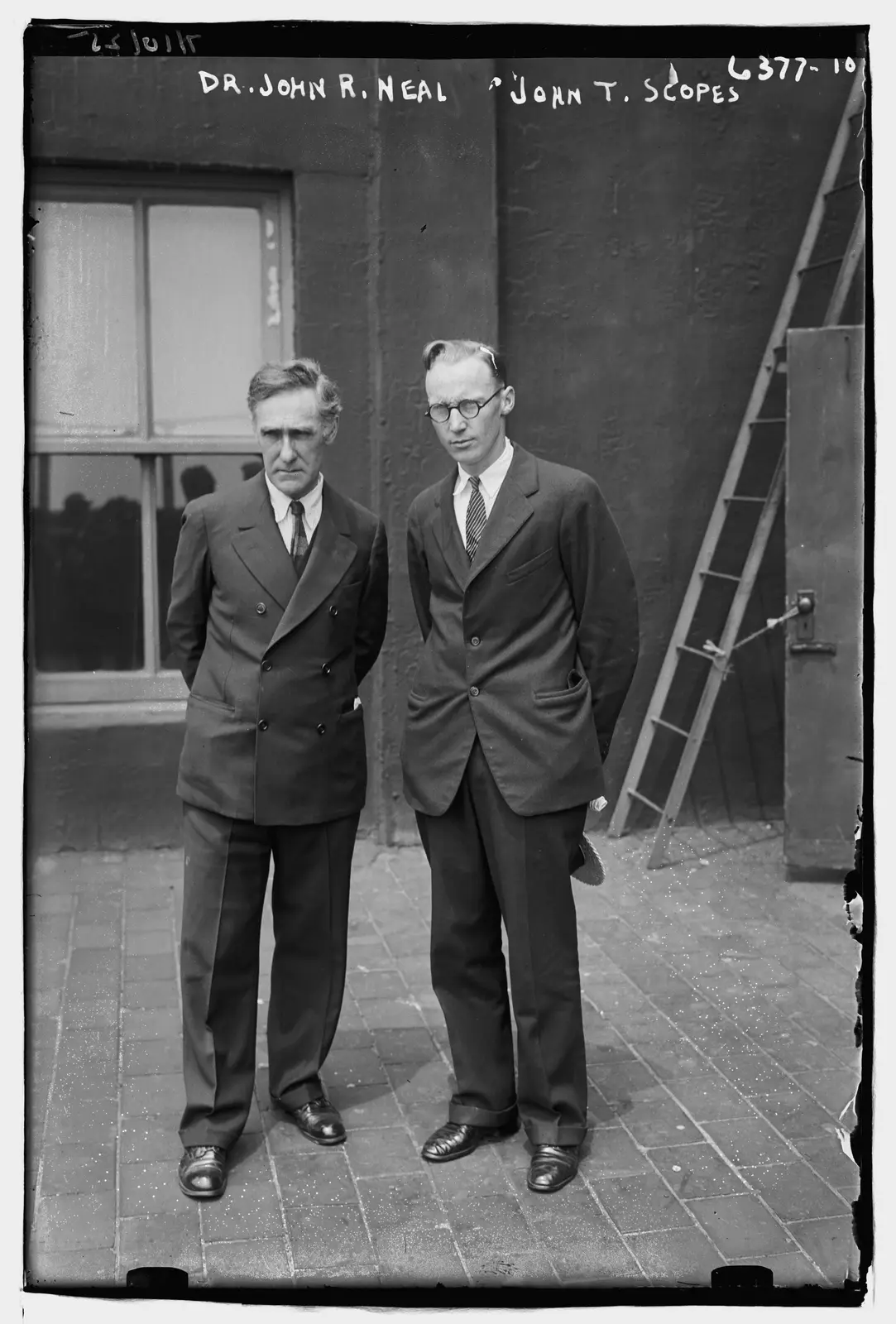
Scopes Monkey Trial: The Defense Asked for a Guilty Verdict
The Scopes monkey trial ended in a guilty verdict on July 21, 1925, after the defense asked for it to reach a higher court; the judge set the $100 fine.
Picture credit
"Dr. John R. Neal, John T. Scopes" by Bain News Service — https://commons.wikimedia.org/wiki/File:Dr._John_R._Neal,_John_T._Scopes_LCCN2014718360.jpg — Public domain (news-agency photograph by the Bain News Service, no named photographer; the negative is marked 7/10/25 (July 10, 1925). US: public domain on the ground that Bain distributed its photographs to newspapers when they were taken, which counts as publication, and this was before 1931. Risk: whether this negative was actually distributed in 1925 has not been checked; if it was never published, an anonymous unpublished US work of 1925 is protected until 120 years after creation (end of 2045). EU: anonymous work, 70 years from first making available (or, if never made available, from creation), long expired. Library of Congress Prints and Photographs, George Grantham Bain Collection, ggbain.38214, 'No known restrictions on publication' (a lead, not the basis))