Famous Trials · Method and mechanism
Trial by Ordeal: Most Várad Cases With a Result Were Cleared
Hoax and Hindsight Published
In trial by ordeal, a hot iron sounds hopeless, yet one Hungarian register records most such cases as cleared. By this site’s count of the Várad register, in its 1903 edition, which dates it to 1208–1235, 209 cases record a result after the iron was carried: in 131 everyone was written down as cleared, in 62 everyone as burned or convicted, and 16 were split.
Method
- Method
- Trial by ordeal: the hot iron, boiling water and cold water named by the Lateran Council of 1215; this page counts hot-iron cases
- What it measures
- The state of the carrier's hand when the seal was opened, read as God's judgment; it shows how the hand was judged, not what the accused had done
- What it can show
- How a court decided a case that other proof did not settle, and how often the cases in one register were written down as cleared, burned or convicted
- What it cannot show
- Guilt or innocence in any modern evidential sense, or why so many carriers were written as cleared
- Key case
- The Várad register, dated 1208-1235 in its 1903 edition: of 209 hot-iron cases with a written result, 131 end with everyone cleared, 62 with everyone burned or convicted and 16 split, by this site's count
Method card as CSVWhere these entries come from (JSON)Data: Regestrum Varadinense (Budapest, 1903); J. D. Mansi, vol. 22; James Bradley Thayer (1898)
Trial by ordeal settled a disputed case with a physical test, and the outcome was read as God’s judgment. The cathedral chapter of Várad, in the medieval kingdom of Hungary, kept a book of such tests with the hot iron. Its 1903 editors wrote that no older record of hot-iron trials in Hungary survives, and they dated its 389 entries to the years 1208 to 1235 (Exhibit A, p. III and p. 155). This page counts those entries one by one and sets out what the count can and cannot prove, following the site’s retrial method.
Order of proceedings 6 parts
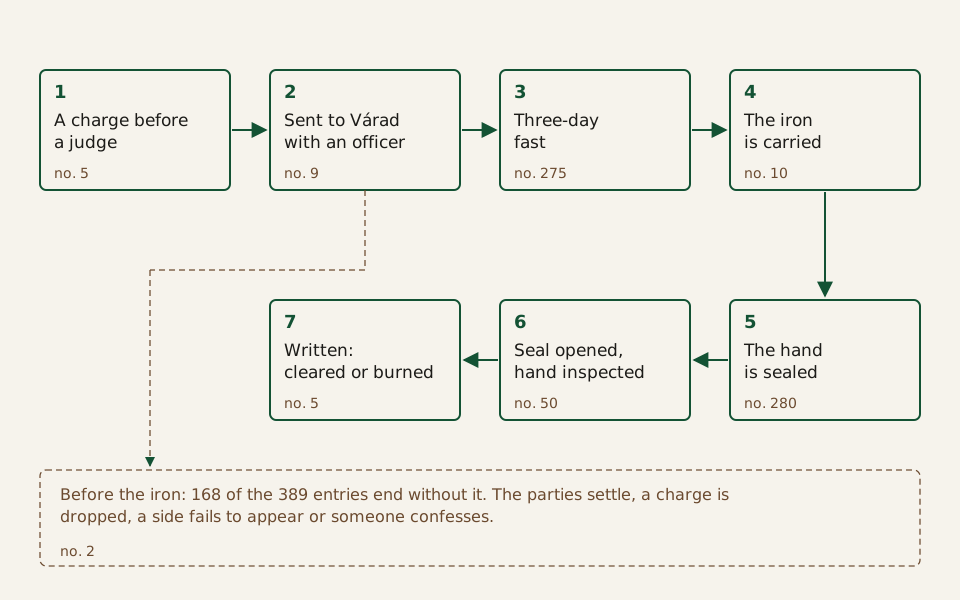
Diagram: Hoax and Hindsight · CC BY 4.0
Credit line to copy
"How a hot-iron ordeal ran at Várad, as the register records it" by Hoax and Hindsight, licensed under CC BY 4.0 (https://creativecommons.org/licenses/by/4.0/). Original: https://hoaxandhindsight.com/trials/trial-by-ordeal/
Data: Regestrum Varadinense, ed. J. Karácsonyi and S. Borovszky (Budapest, 1903)
The procedure as the Várad entries describe it, each step tagged with an entry number from the 1903 edition. The dashed branch marks the 168 of 389 entries that end before anyone carries the iron. Drawn from the table published with this page.
The procedure, one row per step with its Latin wording (CSV) (where the data comes from) Data: Regestrum Varadinense, ed. J. Karácsonyi and S. Borovszky (Budapest, 1903)
How did the hot-iron ordeal work at Várad?
A case began with a charge before a judge, often a count or his deputy. The judge sent the parties to Várad with his officer, whom the register calls a pristaldus, and the officer later reported what had happened (Exhibit A, no. 9). In a word search of the entries, theft is the charge named most often. Others include violence, killing, poisoning or sorcery, arson, and quarrels over whether a person was free.
The test came after a fast. One entry says a man came to carry the iron transacto triduano jejunio, sicut mos est, “after the three-day fast, as is the custom” (Exhibit A, no. 275; translated by Hoax and Hindsight). The register as printed in 1550 ends with the prayers said over the iron. They ask that the accused, if innocent, “may appear unharmed” after taking it in his hand (Exhibit A, p. 149; translated by Hoax and Hindsight).
Then came two questions. “Brother, are you guiltless of this crime of which you are accused?” The answer was “I am guiltless.” The second question was a single word, “Clean?”, and the reply “I am clean” (Exhibit A, p. 151; translated by Hoax and Hindsight). The register’s own words for a good result echo that answer: iustificatus, made just, or mundatus, made clean.
After the iron was carried, the hand was sealed with the chapter’s seal and opened later for the canons to inspect. The seal mattered. In one entry the canons refused to inspect a hand because the seal was not intact, and in another three men were held to be in the wrong because their hands bore a false seal in place of the chapter’s (Exhibit A, nos. 50 and 280). The register never describes a wound or says how a burn was judged; it records only the word, cleared or combustus, burned.
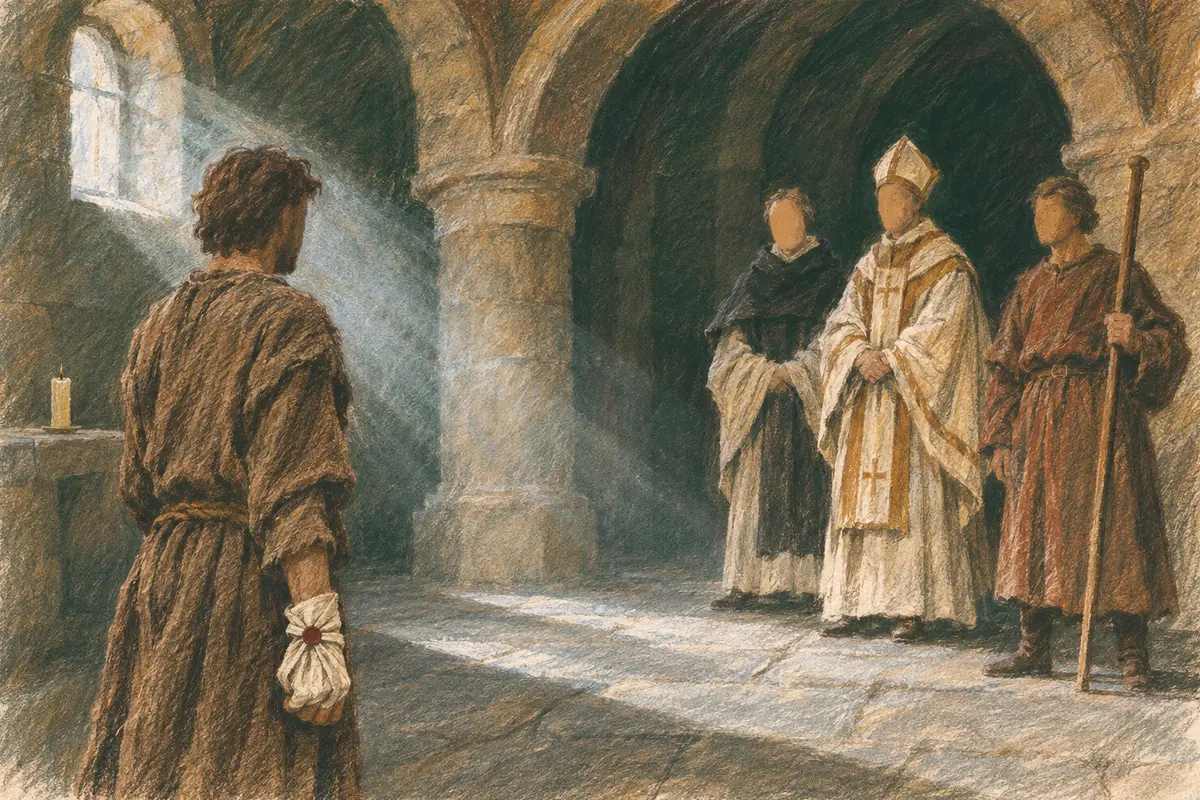
Illustration: Hoax and Hindsight. Generated schematic illustration — not a photograph or historical record. © Hoax and Hindsight, all rights reserved.
An illustration, not a record: a carrier waiting for his sealed hand to be opened. The Várad register gives only the result of that inspection, cleared or burned, never a description of the hand.
Which ordeals did the Church stop blessing in 1215?
The Fourth Lateran Council met at Rome in 1215 under Pope Innocent III. Its canon 18 deals with clergy and bloodshed: no cleric is to pronounce a sentence of blood or take part where one is carried out. It then adds that no one may “bestow any rite of blessing or consecration on a purgation by boiling or cold water or by the hot iron” (Exhibit B, col. 1007; translated by Hoax and Hindsight).
That one clause names the three ordeals the council had in mind: boiling water, cold water and the hot iron. In its own words, the canon forbids the clergy to bless an ordeal. It does not say that lay courts must stop using one, a point a scholar named Patetta made against the usual reading, as James Bradley Thayer reported in 1898 (Exhibit C, p. 37, note).
“Wasserprobe (ordeal by water), drawing in the Rituale of Lambach Abbey” · Unknown author · Public domain
Full credit
"Wasserprobe (ordeal by water), drawing in the Rituale of Lambach Abbey" by Unknown author — https://commons.wikimedia.org/wiki/File:Wasserprobe.jpg — Public domain (medieval drawing (the Commons file page dates it to the 12th century, author unknown): public domain in the US and the EU, where every term ran out centuries ago; the image is a faithful photographic reproduction of a two-dimensional public-domain work, which adds no new copyright in the US (PD-Art) or in the EU (Directive (EU) 2019/790, Art. 14). The reproduction was photographed from a plate in Peter Dinzelbacher, Das fremde Mittelalter (Essen: Magnus, 2006).); modified: cropped to the drawing (x 60-1361, y 0-712 of the 1,361 x 1,599 original), removing the Latin text below it and a pencil folio mark at the top left, re-encoded as JPEG
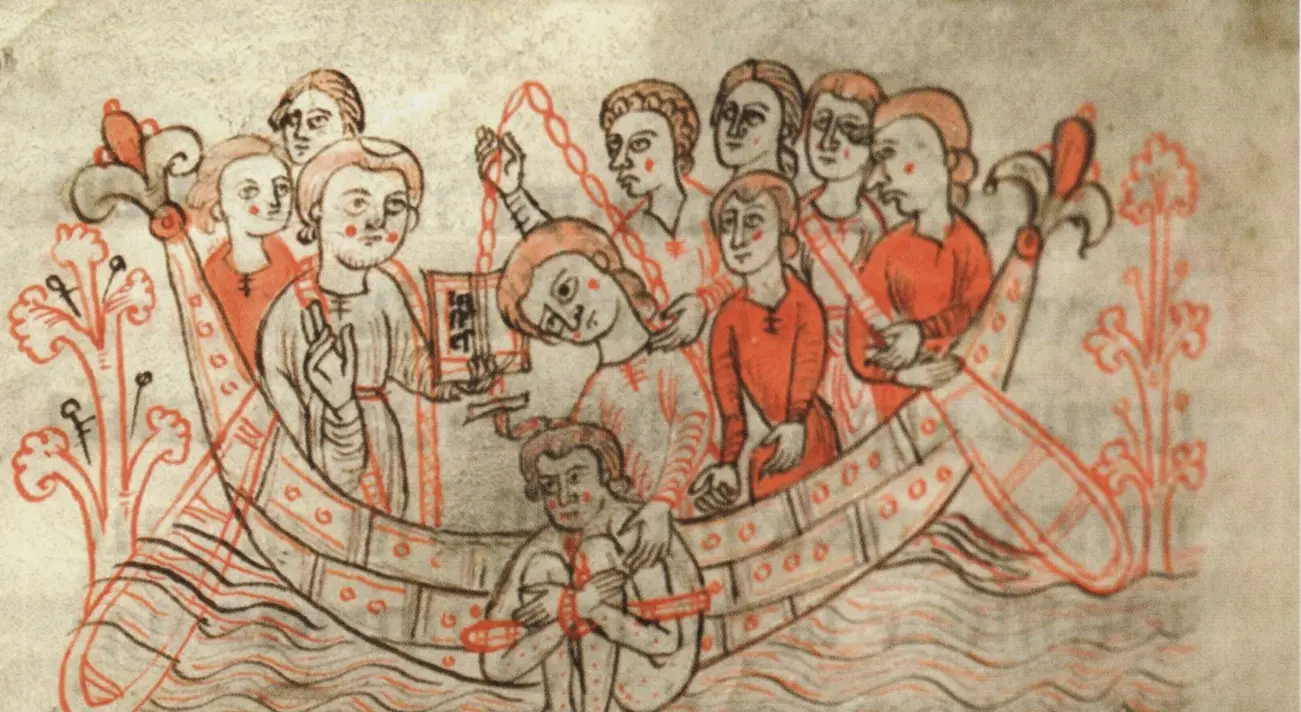
Ordeal by cold water in a twelfth-century ritual book of Lambach Abbey, as identified on the image’s source page, photographed from a plate in a 2006 book. The drawing is shown without the Latin text below it on the manuscript page.
What does the Várad register count?
Each of the 389 entries was read and put in one of five groups; the unit is the entry, not the person. If the iron was carried and every carrier with a written result was cleared, the entry counts as cleared; if every one was burned, convicted, or fled into the church saying he was burned, it counts as burned. Entries with several carriers and both results count as split. Entries where the iron was carried but no result was written, or where no one carried it, are kept apart.
In the Várad register, 131 of the 209 hot-iron cases with a written result end with every carrier cleared. Another 62 end with every carrier burned or convicted, and 16 are split. In those 16 split cases the register names 46 people as cleared and 26 as burned. The other 180 entries have no written result: 168 end before anyone carries the iron, and in 12 the iron was carried but no result was entered.
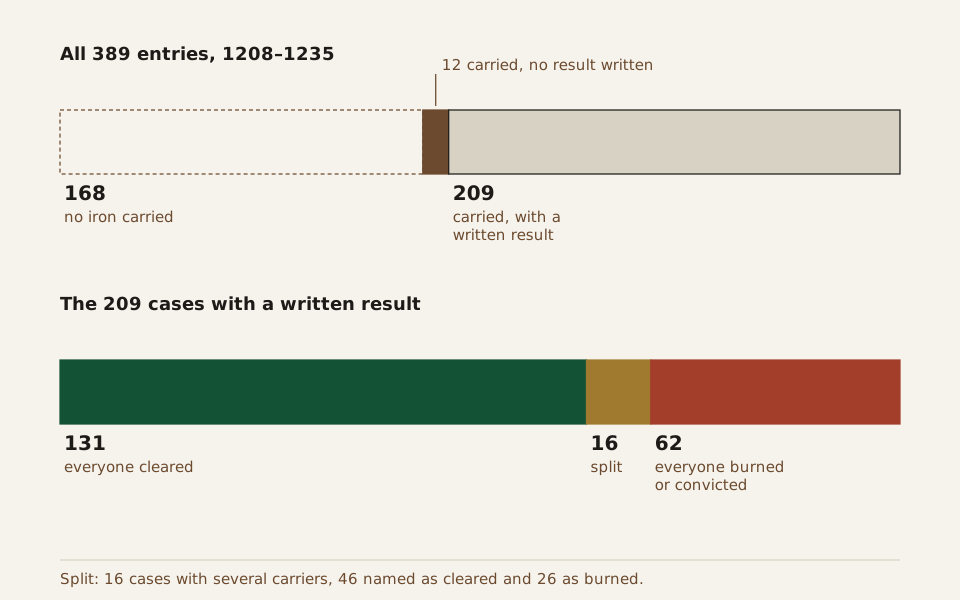
Diagram: Hoax and Hindsight · CC BY 4.0
Credit line to copy
"Outcomes of the 389 entries in the Várad register" by Hoax and Hindsight, licensed under CC BY 4.0 (https://creativecommons.org/licenses/by/4.0/). Original: https://hoaxandhindsight.com/trials/trial-by-ordeal/
Data: Regestrum Varadinense, ed. J. Karácsonyi and S. Borovszky (Budapest, 1903)
All 389 entries of the 1903 edition, and the 209 with a written result split three ways. Counted entry by entry from the Latin; the reasons for each borderline call are in the table. Drawn from the table published with this page.
| Outcome | Entries |
|---|---|
| No iron carried | 168 |
| Iron carried, no result written | 12 |
| Everyone cleared | 131 |
| Split | 16 |
| Everyone burned or convicted | 62 |
| All entries | 389 |
The Várad register, one row per entry with its outcome (CSV) (where the data comes from) Data: Regestrum Varadinense, ed. J. Karácsonyi and S. Borovszky (Budapest, 1903)
Entries stop short of the iron for several reasons. Parties agree on a payment at Várad, an accuser admits a false charge, a side fails to come on the set day, or someone confesses (Exhibit A, nos. 2, 21, 44 and 194). The count was made two ways, and both give the same totals.
Who carried the iron?
Sometimes someone else carried the iron for the accused. In one entry a man carried it for his lord and was cleared; in another a father carried it for his daughter and was burned; in a third a son was ordered to carry it for his mother and was cleared (Exhibit A, nos. 10, 197 and 215). Some entries record one man carrying for a whole group, such as his fellow villagers (Exhibit A, nos. 198 and 374).
Women appear as carriers too. A woman named Benedicta, charged with poisoning or sorcery, was written down as burned, while Cusid carried the iron to show she was no poisoner and was cleared (Exhibit A, nos. 12 and 156). One man, at the moment he should have carried the iron, took the Host from his mouth into his hand, and was judged guilty for it (Exhibit A, no. 3).
“Dieric Bouts, Justice of Emperor Otto III: Ordeal by Fire (Royal Museums of Fine Arts of Belgium, inv. 1447-1448)” · Dieric Bouts · Public domain
Full credit
"Dieric Bouts, Justice of Emperor Otto III: Ordeal by Fire (Royal Museums of Fine Arts of Belgium, inv. 1447-1448)" by Dieric Bouts — https://commons.wikimedia.org/wiki/File:Dirk_Bouts_-_Justice_of_Emperor_Otto_III_(Ordeal_by_Fire)_-_Google_Art_Project_(cropped).jpg — Public domain (painting by Dieric Bouts (died 1475 at Leuven, per the Commons creator record): public domain in the US and the EU; the image is a faithful photographic reproduction of a two-dimensional public-domain work (Google Art Project), which adds no new copyright in the US (PD-Art) or in the EU (Directive (EU) 2019/790, Art. 14); marked Public Domain Mark 1.0 on Commons); modified: scaled from 3,996 x 7,020 to 911 x 1,600 px and re-encoded as JPEG; the Commons file is itself a crop of the right-hand panel from the Google Art Project image of the pair
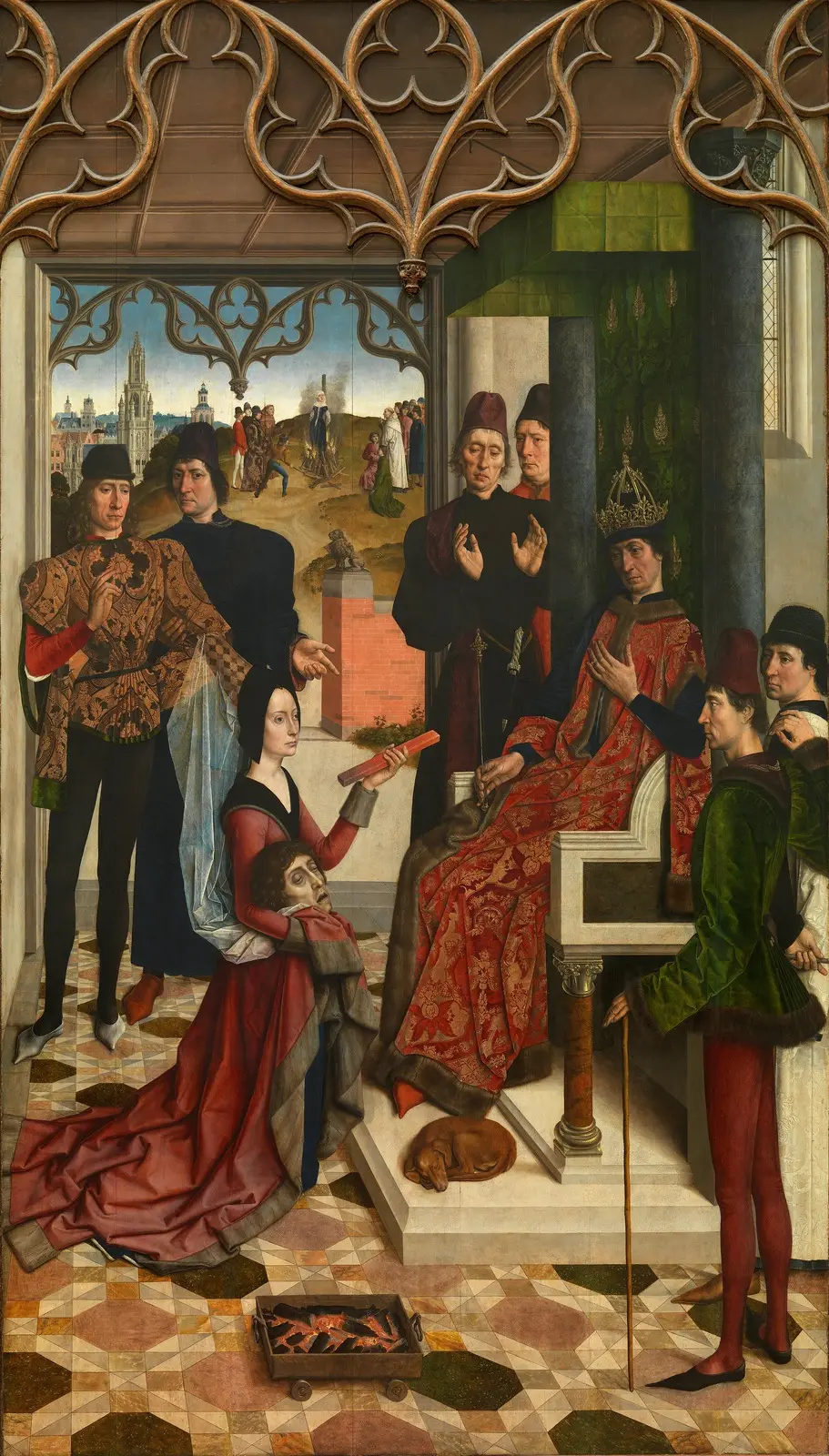
Dieric Bouts, Justice of Emperor Otto III: Ordeal by Fire, painted in 1471–75 and now in the Royal Museums of Fine Arts of Belgium, Brussels. It shows a legend, not a record: a countess kneels before the emperor holding the glowing iron of the title.
Did the ordeal stop after 1215?
Not at Várad, if the 1903 dating holds. Of the 221 entries in which the iron was carried, 132 are dated after 1215, and the last ones fall in 1234 (Exhibit A, nos. 374, 380 and 381). The chart sets the cases with a result against the year of the council.
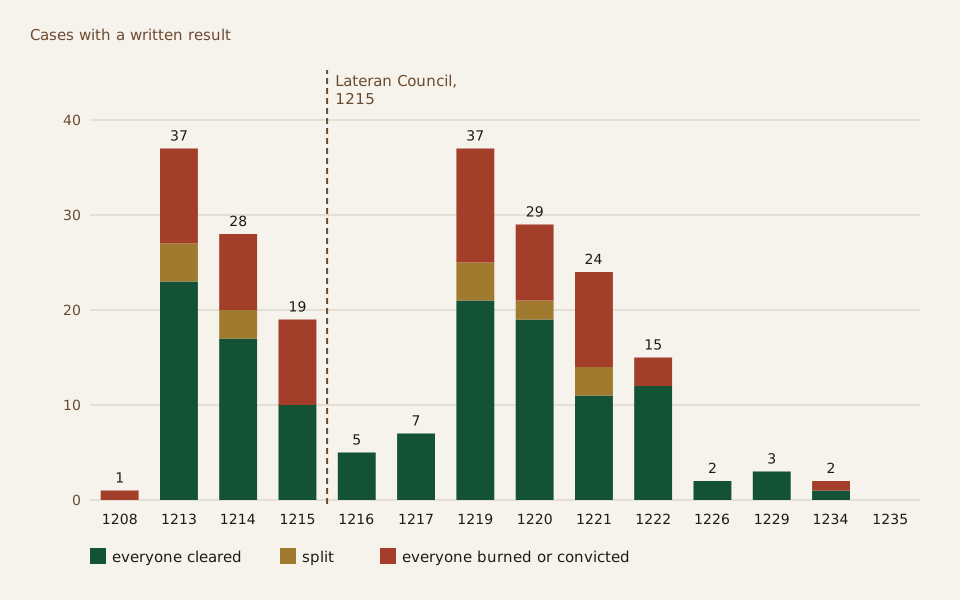
Diagram: Hoax and Hindsight · CC BY 4.0
Credit line to copy
"Hot-iron cases with a written result in the Várad register, by year" by Hoax and Hindsight, licensed under CC BY 4.0 (https://creativecommons.org/licenses/by/4.0/). Original: https://hoaxandhindsight.com/trials/trial-by-ordeal/
Data: Regestrum Varadinense, ed. J. Karácsonyi and S. Borovszky (Budapest, 1903)
Hot-iron cases with a written result in each year that has entries, as dated in the 1903 edition. The dashed line marks the 1215 council. Drawn from the table published with this page.
| Year | Everyone cleared | Split | Burned or convicted | Carried, no result | No iron |
|---|---|---|---|---|---|
| 1208 | 0 | 0 | 1 | 0 | 3 |
| 1213 | 23 | 4 | 10 | 3 | 23 |
| 1214 | 17 | 3 | 8 | 1 | 15 |
| 1215 | 10 | 0 | 9 | 0 | 21 |
| 1216 | 5 | 0 | 0 | 0 | 8 |
| 1217 | 7 | 0 | 0 | 1 | 2 |
| 1219 | 21 | 4 | 12 | 2 | 21 |
| 1220 | 19 | 2 | 8 | 1 | 15 |
| 1221 | 11 | 3 | 10 | 2 | 17 |
| 1222 | 12 | 0 | 3 | 0 | 7 |
| 1226 | 2 | 0 | 0 | 0 | 9 |
| 1229 | 3 | 0 | 0 | 1 | 12 |
| 1234 | 1 | 0 | 1 | 1 | 8 |
| 1235 | 0 | 0 | 0 | 0 | 7 |
England moved faster, by Thayer’s account. “I find no case of trial by ordeal in our printed records later than Trinity Term of the 15 John (1214),” he wrote, and he cited writs of Henry III of 1218–19 telling the judges how to try cases now that the Roman Church had forbidden the ordeal of fire and water (Exhibit C, p. 37). In his reading the ordeal “gave way, after the Lateran Council decree, to trial by jury” (Exhibit C, p. 39). Another page takes up the jury that replaced the ordeal, set against DNA in a later identity case.
The change left a gap for people who would not accept a jury. Thayer conjectured that the prison forte et dure of a 1275 statute for such prisoners should be read against the 1219 order (Exhibit C, p. 79), the same procedure behind the page on Giles Corey and the penalty for refusing a jury.
What can’t the register show?
It cannot show guilt or innocence. The canons judged a hand. The state of a hand after the iron says nothing about what its owner did, so a clearing in the book records how the hand was judged, not what the accused had done. The register also speaks for the chapter that ran the tests, and it has no entry written by an accused person.
The book has a history of its own, shown in the timeline below. It is known here through the 1550 printing, which the 1903 editors reprinted type for type and then rearranged by date (Exhibit A, pp. 152, 155 and 308). They wrote that some scholars held the date of single entries could not be fixed at all, which is why every year on this page carries the editors’ dating (Exhibit A, p. III). Nor can the book say whether every ordeal at Várad was written down.
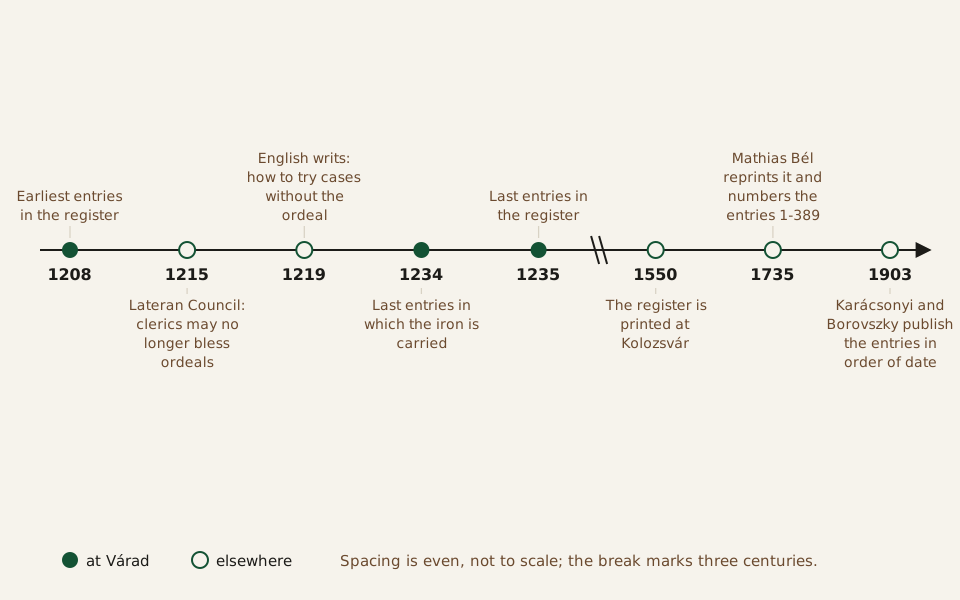
Diagram: Hoax and Hindsight · CC BY 4.0
Credit line to copy
"The Várad register from its first entries to its 1903 edition" by Hoax and Hindsight, licensed under CC BY 4.0 (https://creativecommons.org/licenses/by/4.0/). Original: https://hoaxandhindsight.com/trials/trial-by-ordeal/
Data: Regestrum Varadinense (Budapest, 1903); J. D. Mansi, vol. 22 (Venice, 1778); James Bradley Thayer (Boston, 1898)
Eight dated events from the register’s opening year to its 1903 edition, evenly spaced rather than to scale. Filled circles are events at Várad. Drawn from the table published with this page (Exhibits A to C).
The timeline, one row per event with its source (CSV) (where the data comes from) Data: Regestrum Varadinense (Budapest, 1903); J. D. Mansi, vol. 22; James Bradley Thayer (1898)
Older readers disagreed about what an ordeal was for. William Stubbs held that where an ordeal followed a jury’s accusation, it “could only be applied to those who were to all intents and purposes proved to be guilty”; Thayer answered that “the ordeal was simply a mode of trial; or, as they phrased it in those days, of clearing one’s self of a charge” (Exhibit C, p. 39, quoting Stubbs). The writer of the Mirror, a law book Maitland conjectured was written between 1285 and 1290, regretted its passing, and Thayer gives the passage in English: “It is an abuse,” it says, “that proofs and purgations are not made by the miracle of God where no other proof can be had” (Exhibit C, p. 38). Reading a sign as proof did not end with the iron either, as the Salem witch trials of 1692, where a suspect’s touch was read as a sign show.
Why so many carriers were written down as cleared is a question for historians. Robert Bartlett’s Trial by Fire and Water (1986) and Peter Leeson’s article “Ordeals” (2012) are modern studies of it, read here only as bibliographic entries, so this page does not report their arguments (Exhibits D and E). In England, Thayer noted, a man who came safely through the ordeal could still be required under the Assize of Clarendon to leave the realm (Exhibit C, p. 38).
What would overturn it:
- A manuscript or an earlier copy of the Várad register showing that the 1550 printing left out entries, for example burned carriers missing from the printed book.
- A new edition of the register that reads enough of the outcome words differently to bring the 131 cleared cases down to half or less of those with a result.
Exhibits
Records and period publications
- Exhibit A: Regestrum Varadinense examinum ferri candentis ordine chronologico digestum, descripta effigie editionis a. 1550 illustratum, ed. János Karácsonyi and Samu Borovszky (Budapest: Victor Hornyánszky, 1903).
- Exhibit B: Joannes Dominicus Mansi, Sacrorum conciliorum nova et amplissima collectio, vol. 22 (Venice: Antonio Zatta, 1778; facsimile, Paris: H. Welter, 1903), col. 1007, Fourth Lateran Council (1215), canon 18.
Studies
- Exhibit C: James Bradley Thayer, A Preliminary Treatise on Evidence at the Common Law (Boston: Little, Brown, 1898).
- Exhibit D: Robert Bartlett, Trial by Fire and Water: The Medieval Judicial Ordeal (Oxford: Clarendon Press, 1986).
- Exhibit E: Peter T. Leeson, “Ordeals,” Journal of Law and Economics 55, no. 3 (2012): 691-714.
Cite this page
Hoax and Hindsight. “Trial by Ordeal: Most Várad Cases With a Result Were Cleared.” Hoax and Hindsight, published November 6, 2026. https://hoaxandhindsight.com/trials/trial-by-ordeal/. Accessed [the date you read it].
Related cases
Salem Witch Trials: 3 of 52 Convicted in 1693, Phips Wrote
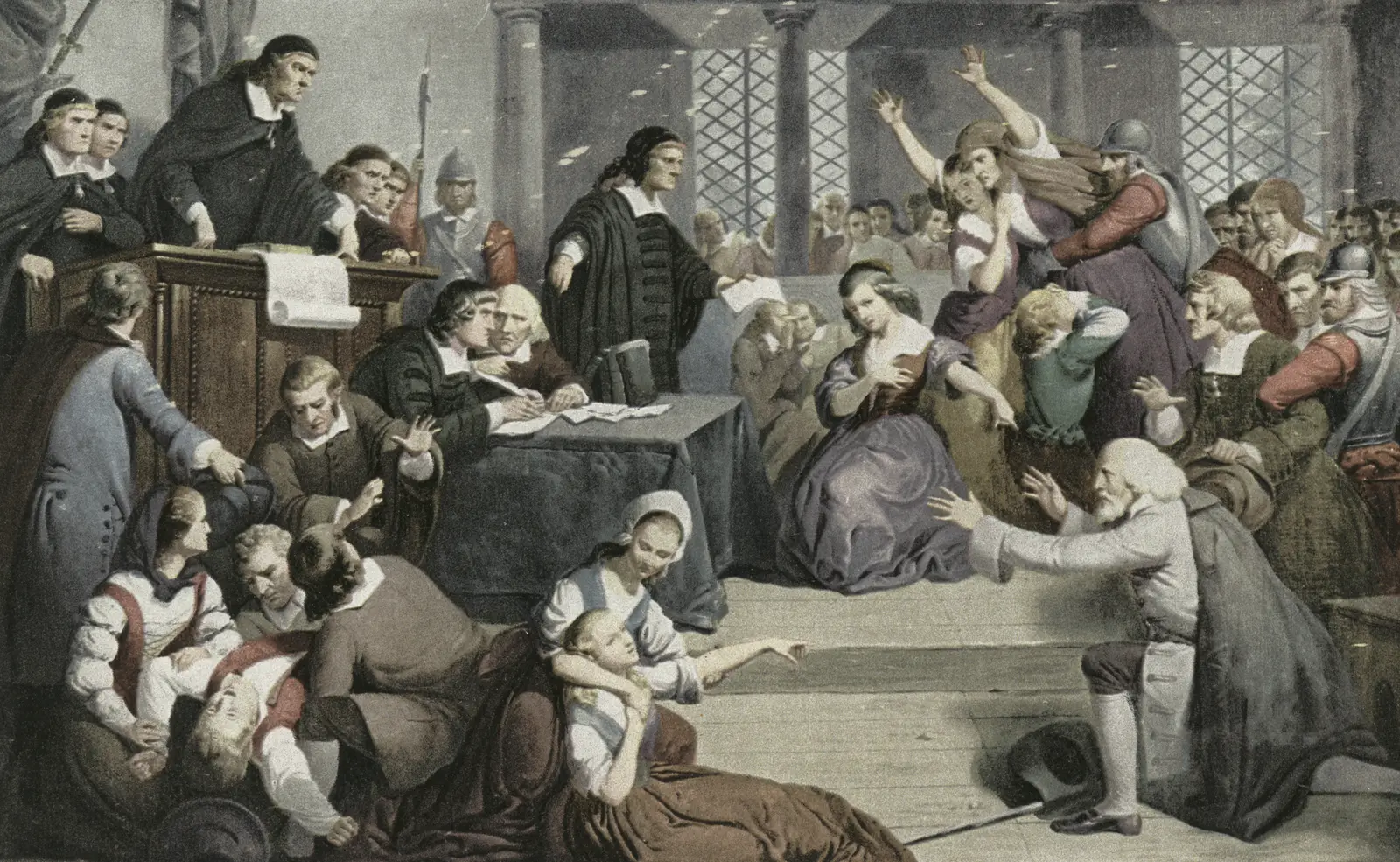
Salem witch trials: 19 hanged in 1692; in 1693, by the governor's count, all but 3 of 52 tried were cleared. What spectral evidence was and what changed.
Picture credit
"Trial of George Jacobs for Witchcraft, Salem, Mass" by T. H. Matteson; postcard by Detroit Publishing Co. — https://commons.wikimedia.org/wiki/File:Trial_of_George_Jacobs_for_Witchcraft,_Salem,_Mass_(NYPL_b12647398-75594).tiff — Public domain (painting of 1855 by T. H. Matteson (1813–1884) reproduced on a Detroit Publishing Co. postcard (series 13270, published after 1898 and before 1931): public domain in the US (published before 1931) and in the EU (painter dead since 1884; the postcard is an anonymous company publication more than 70 years old); New York Public Library scan, PD-scan); modified: cropped to the printed picture, removing the postcard's white margin and the printed caption and publisher's copyright line along the lower edge, converted from TIFF to JPEG
Galileo Trial: No ‘Eppur Si Muove’ in the 1633 Record
Galileo’s 1633 sentence found him vehemently suspected of heresy. Eppur si muove is not in it; the earliest printing found, per Mario Livio, is from 1757.
Picture credit
"Hamburg, Kunsthalle, Friedrich Karl Hausmann, Galilei vor dem Konzil" by Dguendel — https://commons.wikimedia.org/wiki/File:Hamburg,_Kunsthalle,_Friedrich_Karl_Hausmann,_Galilei_vor_dem_Konzil.jpg — CC BY 4.0 (https://creativecommons.org/licenses/by/4.0/); modified: cropped to the painted surface, removing a strip of the gilt frame along the top (16 px) and left (18 px) edges, re-encoded as JPEG
Scopes Monkey Trial: The Defense Asked for a Guilty Verdict
The Scopes monkey trial ended in a guilty verdict on July 21, 1925, after the defense asked for it to reach a higher court; the judge set the $100 fine.
Picture credit
"Dr. John R. Neal, John T. Scopes" by Bain News Service — https://commons.wikimedia.org/wiki/File:Dr._John_R._Neal,_John_T._Scopes_LCCN2014718360.jpg — Public domain (news-agency photograph by the Bain News Service, no named photographer; the negative is marked 7/10/25 (July 10, 1925). US: public domain on the ground that Bain distributed its photographs to newspapers when they were taken, which counts as publication, and this was before 1931. Risk: whether this negative was actually distributed in 1925 has not been checked; if it was never published, an anonymous unpublished US work of 1925 is protected until 120 years after creation (end of 2045). EU: anonymous work, 70 years from first making available (or, if never made available, from creation), long expired. Library of Congress Prints and Photographs, George Grantham Bain Collection, ggbain.38214, 'No known restrictions on publication' (a lead, not the basis))