Historical Hoaxes · Comparison and lineage
Anna Anderson and the Tichborne Claimant: A Jury, Then DNA
Hoax and Hindsight Published
In 1874 a London jury convicted the Tichborne Claimant of perjury; Anna Anderson’s claim was settled by DNA instead. The court gave him 14 years’ penal servitude, while DNA tests published in 1995 exposed her claim to be Grand Duchess Anastasia as false, according to a 2009 study by Michael Coble and colleagues.
Docket
- Case
- The Tichborne Claimant: The Queen v. Thomas Castro, otherwise Arthur Orton
- Years
- 1866–1874
- Place
- Wagga Wagga and Sydney, New South Wales; London
- The claim
- That he was Roger Charles Doughty Tichborne, heir to a Hampshire baronetcy, lost at sea when the Bella went down in 1854
- The verdict
- Court finding: guilty of perjury on both counts, February 28, 1874; the jury found he was not Roger Tichborne but Arthur Orton; 14 years’ penal servitude
- Hinges on
- Among the points the sentencing judge listed: his ignorance of Roger’s native tongue, tattoo marks proved on Roger’s arm, the two men’s letters, and his 1866 visit to Wapping
- Status
- Upheld: no reversal appears in the records read here; a Commons motion for a royal commission was rejected by 433 votes to 1 in 1875
Docket as CSVWhere these entries come from (JSON)Data: The Tichborne Trial: The Summing-up by the Lord Chief Justice of England (London: Ward, Lock and Tyler, 1874); The Trial at Bar of Sir Roger C. D. Tichborne, ed. E. V. Kenealy, vol. 1 (London: Englishman Office, 1875-80); Dictionary of National Biography, Supplement, vol. 3 (London, 1901), pp. 236-238, s.v. Orton, Arthur
Docket
- Case
- Anna Anderson’s claim to be Grand Duchess Anastasia of Russia
- Years
- In the press by 1928; she died in 1984; DNA findings published 1995 and 2009
- Place
- Germany and the United States
- The claim
- That she was Anastasia, a daughter of Tsar Nicholas II, alive after the family was shot in July 1918
- The verdict
- Finding of the 1995 DNA tests: an impostor, per Gill and colleagues as cited in 2009 by Coble and colleagues; the German National Library records that genetic analysis excluded kinship with the Romanovs
- Hinges on
- DNA testing that followed the official discovery, in 1991, of the larger Romanov grave and the DNA identification of its remains
- Status
- Exposed
Docket as CSVWhere these entries come from (JSON)Data: Michael D. Coble and others, PLoS ONE 4, no. 3 (2009): e4838 (CC0); Deutsche Nationalbibliothek, GND authority record 12278216X, Anderson, Anna; The Champion Chronicle (Champion, Alberta), August 23, 1928, p. 5; Peter Gill and others, Nature Genetics 9 (1995): 9-10, and 6 (1994): 130-135 (bibliographic entries only)
Both claimants said they were a lost child of a great family, and both won believers. The Claimant said he was Roger Tichborne, heir to a Hampshire baronetcy, who sailed from Rio in 1854 and was never heard of again (Exhibit D). Anna Anderson said she was Anastasia, a daughter of the last Tsar of Russia, alive after her family was shot in 1918 (Exhibit E).
The two claims were tested in different ways. Twelve jurors heard the Claimant’s case in his lifetime and weighed documents, marks on the body and the things he did not know. Anderson’s case was settled after her death by DNA. This page sets the two proofs side by side and keeps apart what was claimed, what witnesses said, what the court found and what scientists later reported, following the site’s retrial method.
Order of proceedings 5 parts
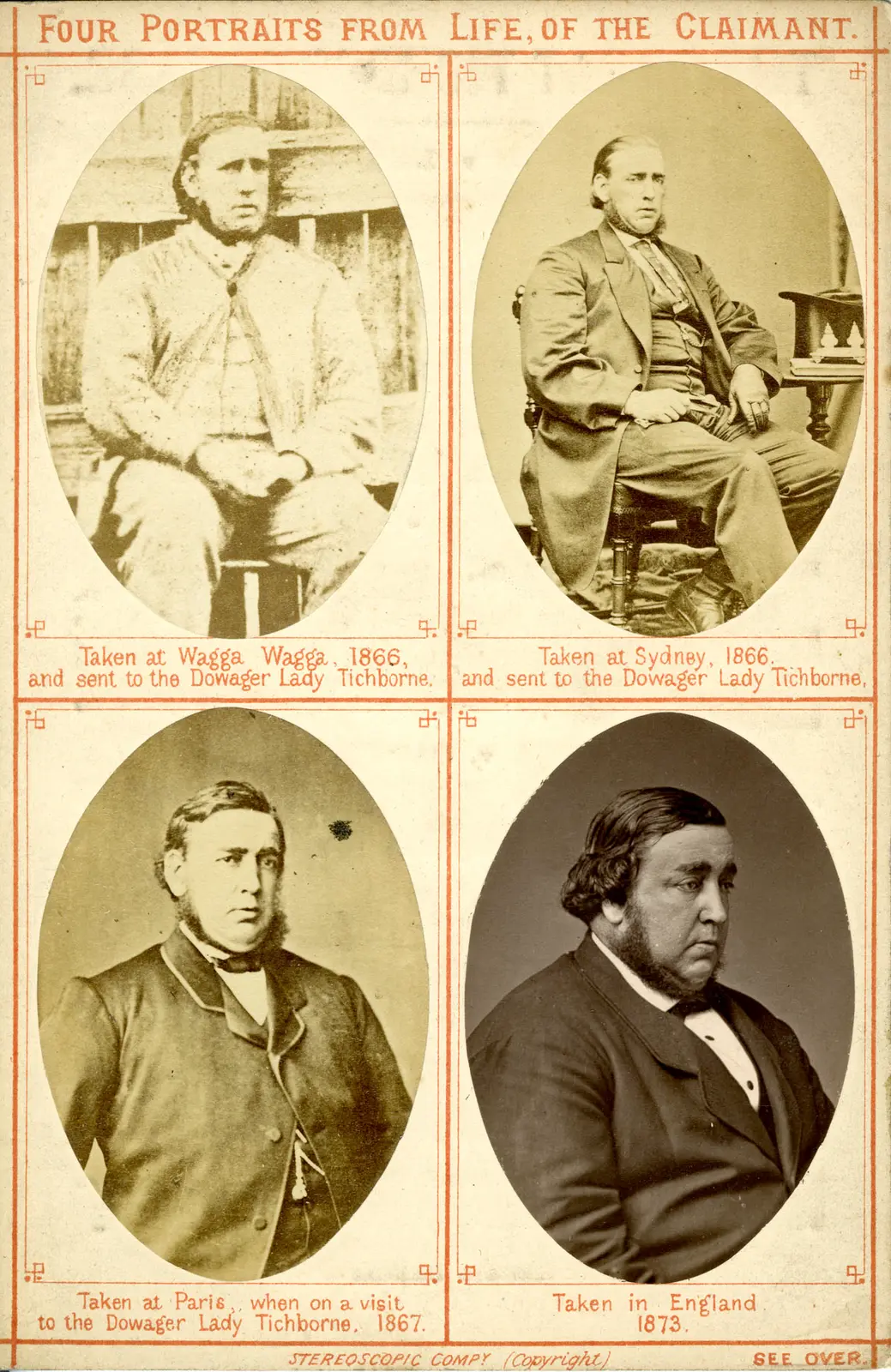
“Four Portraits from Life, of the Claimant (Stereoscopic Company, 1873)” · Unknown author · Public domain
Full credit
"Four Portraits from Life, of the Claimant (Stereoscopic Company, 1873)" by Unknown author — https://commons.wikimedia.org/wiki/File:Four_portraits_from_life,_of_the_claimant,_1873,_artists_unknown,_from_the_Digital_Commonwealth_-_fdd26a952111075306ef49b69efecaa6.jpg — Public domain (photographic card published in 1873 by the Stereoscopic Company, photographers not named: public domain in the US (published before 1931) and in the EU (anonymous work made available to the public more than 70 years ago; photographs taken 1866-1873, so no photographer could have died within the last 70 years); the scan is a faithful reproduction of a flat card from Digital Commonwealth (Massachusetts), marked Public Domain Mark 1.0 on Commons. The word (Copyright) printed on the card is the 1873 publisher’s notice; any term it claimed has long expired.)
Four Portraits from Life, of the Claimant, a card published by the Stereoscopic Company in 1873. Its captions say the two 1866 pictures were sent from Australia to the Dowager Lady Tichborne. The card shows how the man looked, not who he was.
Both cases, one row per dated event with its source (CSV) (where the data comes from) Data: The Tichborne Trial: The Summing-up by the Lord Chief Justice of England (London: Ward, Lock and Tyler, 1874); The Trial at Bar of Sir Roger C. D. Tichborne, ed. E. V. Kenealy, vol. 1 (London: Englishman Office, 1875-80); Dictionary of National Biography, Supplement, vol. 3 (London, 1901), pp. 236-238, s.v. Orton, Arthur; Michael D. Coble and others, PLoS ONE 4, no. 3 (2009): e4838 (CC0); Deutsche Nationalbibliothek, GND authority record 12278216X, Anderson, Anna; The Champion Chronicle (Champion, Alberta), August 23, 1928, p. 5; Peter Gill and others, Nature Genetics 9 (1995): 9-10, and 6 (1994): 130-135 (bibliographic entries only)
What did the 1874 jury decide about the Tichborne Claimant?
Roger Charles Doughty Tichborne was born in 1829, the elder son of a Hampshire baronet. In 1854 he sailed from Rio in the Bella, a ship never heard of again, and his will was proved in July 1855 (Exhibit D). Only his mother kept advertising for him. In November 1865 she heard through an agency in Sydney of a man at Wagga Wagga, New South Wales, who fitted the description.
That man reached London on Christmas Day 1866. Roger’s mother said she recognised him as her son at their first meeting, in Paris in January 1867. The rest of the family called him an impostor (Exhibit D). A newspaper history printed in 1874 reports her saying that “the back of his head was like his father’s” (Exhibit A, p. x).
The trustees of the family estates fought his claim in a civil trial that ran 102 days, from May 11, 1871, to March 5, 1872. A witness swore that he had tattooed Roger at Stonyhurst, and the Claimant’s arm showed no marks. After several of Roger’s relatives testified, the jury said it needed no more evidence; his counsel accepted a nonsuit, ending the case, and he was arrested for perjury (Exhibit D).
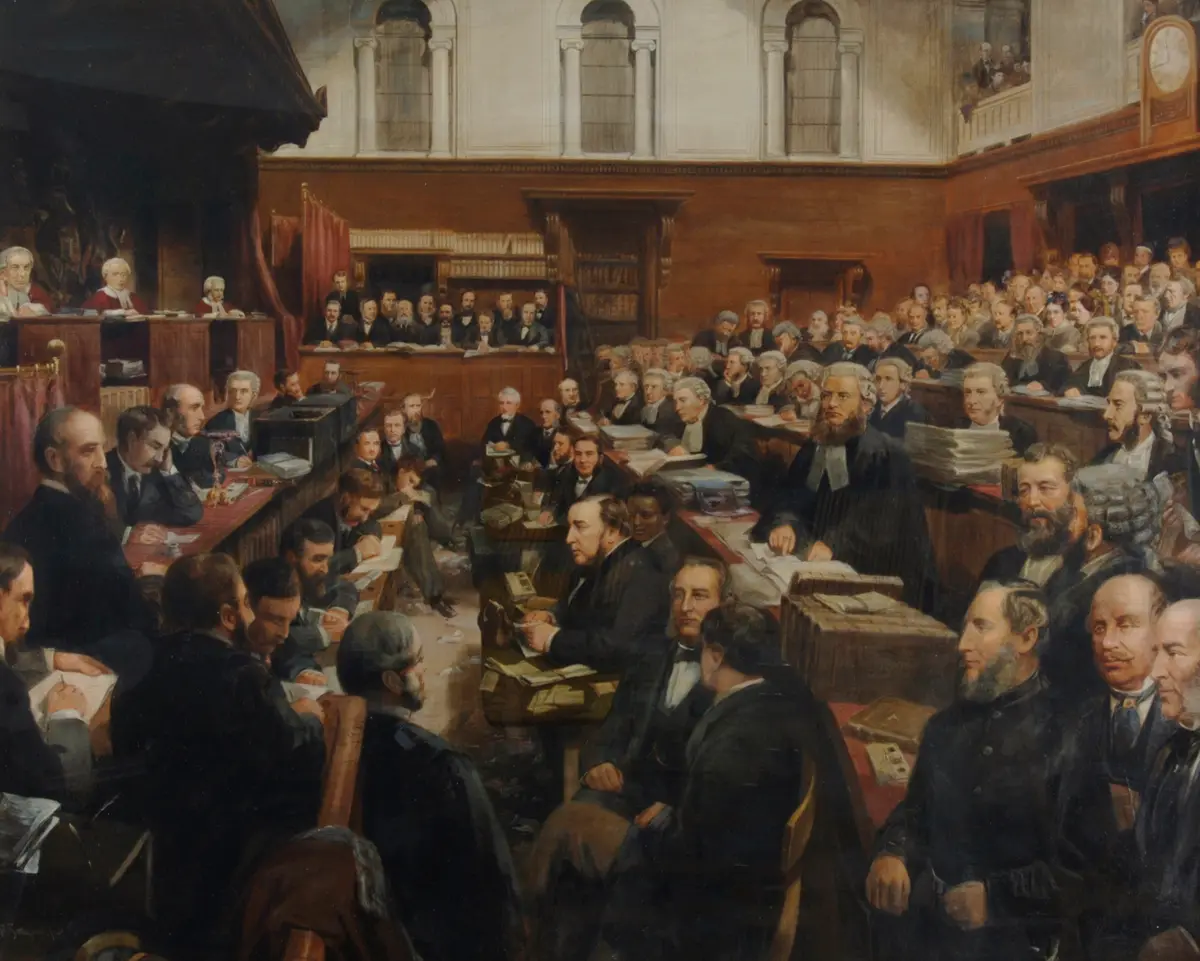
The criminal trial opened on April 23, 1873, before three judges and a special jury (Exhibit A; Exhibit B). The indictment named him “Thomas Castro, alias Orton, alias Tichborne” (Exhibit A). On February 28, 1874, the jury came back after less than half an hour with a verdict of “Guilty on all the counts” (Exhibit A, p. 285). Asked by the Lord Chief Justice, the foreman said the defendant was not Roger Tichborne and was Arthur Orton (pp. 285–286), a butcher’s son born at Wapping (Exhibit D).
“The Tichborne Trial, oil painting by Frederick Sargent (Hampshire County Council Museums Service, FA2005.237.1)” · Frederick Sargent · Public domain
Full credit
"The Tichborne Trial, oil painting by Frederick Sargent (Hampshire County Council Museums Service, FA2005.237.1)" by Frederick Sargent — https://commons.wikimedia.org/wiki/File:The_Tichborne_Trial_by_Frederick_Sargent.jpg — Public domain (oil painting by Frederick Sargent (1837-1899, per the Commons creator record; not checked against another source): public domain in the EU (painter dead for more than 70 years) and in the US (author died before 1956, so even an unpublished work is out of copyright); the image is a faithful photographic reproduction of a two-dimensional public-domain work (PD-Art), which adds no new copyright in the US or in the EU (Directive (EU) 2019/790, Art. 14); marked Public Domain Mark 1.0 on Commons. Risk noted: the photograph came from Art UK for a UK collection, and a UK museum may claim rights in the reproduction; accepted in the image rights ruling of 2026-11-05 (log, image ruling 8).)
The Tichborne Trial, an oil painting of the packed courtroom by Frederick Sargent, dated between 1873 and 1899. It is a painter’s view of the scene, not a record of what was said there.
Mr. Justice Mellor then gave him two terms of seven years’ penal servitude, the second to begin when the first ended: 14 years in all (Exhibit A, pp. 286–287). The Dictionary of National Biography (DNB) put the verdict on the 188th day of the trial (Exhibit D). In the end the question of who he was went to twelve jurors, the jury that replaced the ordeal in England, here asked to settle a man’s identity.
What evidence did the judges point to?
Mellor told the Claimant why the court agreed with the jury. “The testimony of individuals, however numerous or respectable they may be, to your personal identity with either Arthur Orton or Roger Tichborne is comparatively of little worth after so great a lapse of time,” he said, “except in the instances in which there existed special interest to observe and remember you” (Exhibit A, p. 286). The evidence of Roger’s family and of two other witnesses who had known one man or the other, he added, was “of great importance”. He also set out the Claimant’s “entire ignorance of the native tongue of Roger Tichborne”, who had spent his early years in Paris (Exhibit D), the tattoo marks “proved to have existed on the arm of the undoubted Roger Tichborne”, the two men’s letters, and his visit to Wapping under a false name (Exhibit A, p. 286).
The indictment shows how the Crown built its case. It charged 33 separate false statements, called assignments of perjury: 23 from his evidence in the 1871 civil trial and 10 from a sworn statement he made in the Court of Chancery in 1868 (Exhibit A, front matter). Of the 23, twelve concerned Roger’s life, such as his years in Paris and at Stonyhurst College. Eleven concerned Arthur Orton’s, such as a voyage to Valparaiso in 1848 and a stay at Melipilla in Chile.
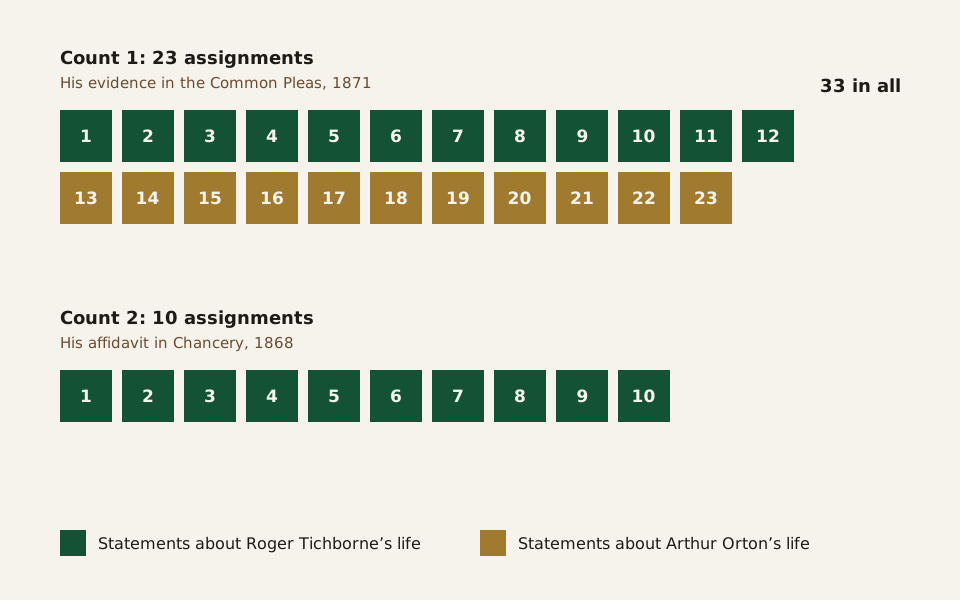
Diagram: Hoax and Hindsight · CC BY 4.0
Credit line to copy
"The 33 assignments of perjury in the 1873 indictment" by Hoax and Hindsight, licensed under CC BY 4.0 (https://creativecommons.org/licenses/by/4.0/). Original: https://hoaxandhindsight.com/proven-fakes/anna-anderson-tichborne-claimant/
Data: The Tichborne Trial: The Summing-up by the Lord Chief Justice of England (London: Ward, Lock and Tyler, 1874)
The 33 false statements charged in the indictment, one square each, numbered as in the 1874 printing of the case (Exhibit A). Drawn from the table published with this page.
The 33 assignments of perjury, one row each (CSV) (where the data comes from) Data: The Tichborne Trial: The Summing-up by the Lord Chief Justice of England (London: Ward, Lock and Tyler, 1874), front matter
The newspaper history printed with the summing-up put the method in one line. A claimant is to be judged, it said, “not by a man’s knowledge of what he might have learnt, but by his ignorance of what he must have known if he were the true man” (Exhibit A, p. xv). The Claimant had learned a great deal. According to the Dictionary of National Biography, he took into his employment two old soldiers of Roger’s regiment who had been Roger’s servants, and more than a dozen of Roger’s fellow officers came to accept him (Exhibit D).
The hidden part of this case was a name, not a body. Another page here retries the Mechanical Turk, a claim with a living player hidden behind it.
What did DNA show about Anna Anderson?
Anna Anderson’s claim belongs to a different century and a different kind of record. By August 1928 a newspaper in Champion, Alberta, was reporting the dispute over a woman in the United States “known as Madame Tchaikovsky”, who was said to be Anastasia (Exhibit C). The German National Library lists Tschaikovsky among her other names and gives her life dates as 1896 to 1984 (Exhibit F).
The Romanov family was shot early on July 17, 1918, according to historical reports cited by Coble and colleagues (Exhibit E). “The most famous claimant was Anna Anderson,” they wrote in 2009, “a Polish peasant who convinced many that she was Anastasia” (Exhibit E). They also reported that more than 200 people have claimed since 1918 to be one of the five Romanov children.
The test came after the first grave was found. A larger grave was officially found in 1991, and DNA confirmed the remains of the Tsar, the Tsarina and three of their daughters, in work published by Peter Gill and colleagues in 1994 (Exhibit E; Exhibit H). “With the discovery of the first grave, and subsequent DNA testing, Anna Anderson was exposed as an imposter,” Coble’s team wrote (Exhibit E), citing a 1995 paper by Gill and colleagues (Exhibit G). That 1995 paper was read here only as a bibliographic entry, so this page does not say which samples were compared.
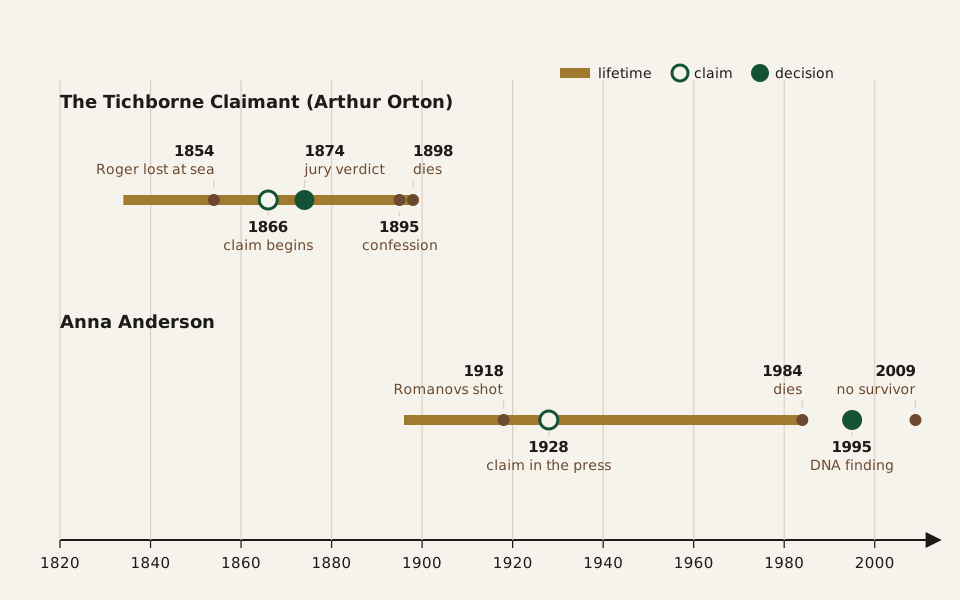
Diagram: Hoax and Hindsight · CC BY 4.0
Credit line to copy
"Two claimants on one timeline, 1820 to 2010" by Hoax and Hindsight, licensed under CC BY 4.0 (https://creativecommons.org/licenses/by/4.0/). Original: https://hoaxandhindsight.com/proven-fakes/anna-anderson-tichborne-claimant/
Data: The Tichborne Trial: The Summing-up by the Lord Chief Justice of England (London: Ward, Lock and Tyler, 1874); Dictionary of National Biography, Supplement, vol. 3 (London, 1901), pp. 236-238, s.v. Orton, Arthur; Michael D. Coble and others, PLoS ONE 4, no. 3 (2009): e4838 (CC0); Deutsche Nationalbibliothek, GND authority record 12278216X, Anderson, Anna; The Champion Chronicle (Champion, Alberta), August 23, 1928, p. 5
Both claims to scale. The jury ruled in the Claimant’s lifetime; the DNA finding was published after Anderson’s death. Drawn from the table published with this page.
She had died in 1984, so the answer came after her death (Exhibit F). The German National Library’s record states that genetic analysis excluded kinship with the Russian imperial family and that she was probably Franziska Schanzkowski, a Polish farm worker (translated by Hoax and Hindsight; Exhibit F). In 2009 Coble’s team reported DNA from a second grave, found in 2007 about 70 metres from the first, and concluded that “none of the family survived the execution” (Exhibit E).
Where do a jury and a DNA test differ?
Both cases asked whether a person was who he or she claimed to be. They answered with different tools. The table sets the two side by side.
| Point | Tichborne Claimant, 1874 | Anna Anderson, 1995 |
|---|---|---|
| Who decided | Twelve special jurors at a trial at bar before three judges | Scientists comparing DNA (Gill and colleagues, 1995) |
| When | February 28, 1874, the 188th day of the trial by the DNB’s count, in his lifetime | Published 1995; she had died in 1984 |
| What was weighed | Witnesses, letters, tattoo marks, his ignorance of Roger’s native tongue, his visit to Wapping | DNA testing that followed the identification of the remains from the first Romanov grave |
| What it found | Not Roger Tichborne but Arthur Orton; guilty of perjury on both counts | An impostor, per Coble and colleagues; kinship excluded, per the German National Library |
| What it left open | His 1895 confession, which he is said to have recanted | Her identity with Franziska Schanzkowski, given as probable |
| Later check | A Commons motion for a royal commission failed 433 to 1 in 1875 | A 2009 study found no one in the family survived July 17, 1918 |
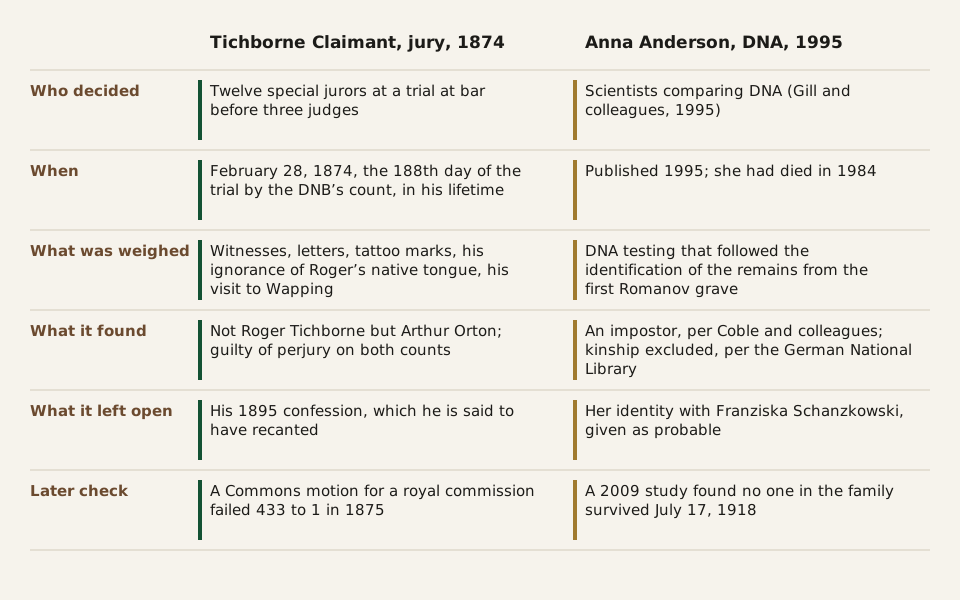
Diagram: Hoax and Hindsight · CC BY 4.0
Credit line to copy
"Two kinds of proof: a jury in 1874 and DNA in 1995" by Hoax and Hindsight, licensed under CC BY 4.0 (https://creativecommons.org/licenses/by/4.0/). Original: https://hoaxandhindsight.com/proven-fakes/anna-anderson-tichborne-claimant/
Data: The Tichborne Trial: The Summing-up by the Lord Chief Justice of England (London: Ward, Lock and Tyler, 1874); Dictionary of National Biography, Supplement, vol. 3 (London, 1901), pp. 236-238, s.v. Orton, Arthur; Michael D. Coble and others, PLoS ONE 4, no. 3 (2009): e4838 (CC0); Deutsche Nationalbibliothek, GND authority record 12278216X, Anderson, Anna
The two kinds of proof, row by row; the same text is in the table above. Drawn from the table published with this page.
The two kinds of proof, one row per point, with sources (CSV) (where the data comes from) Data: The Tichborne Trial: The Summing-up by the Lord Chief Justice of England (London: Ward, Lock and Tyler, 1874); Dictionary of National Biography, Supplement, vol. 3 (London, 1901), pp. 236-238, s.v. Orton, Arthur; Michael D. Coble and others, PLoS ONE 4, no. 3 (2009): e4838 (CC0); Deutsche Nationalbibliothek, GND authority record 12278216X, Anderson, Anna; Peter Gill and others, Nature Genetics 9 (1995): 9-10, and 6 (1994): 130-135 (bibliographic entries only)
The jury’s finding rested on many kinds of evidence weighed together. The sentencing judge trusted recognition after so many years only from witnesses with special reason to remember the man. The DNA finding rested on a comparison of genetic material, not of memories. The record read here reports it only at second hand, through Coble’s team and the library record.
Neither side’s record is neutral. One long report of the criminal trial, The Trial at Bar, was edited by the Claimant’s own lead counsel, Edward Kenealy, and printed at the office of the Englishman; its first-day report promised readers they would see “plot within plot to secure the nefarious ends of an alien Church and a corrupt Government” (Exhibit B). The 1874 volume used here for the verdict reprints a Daily News history that treats him as an impostor (Exhibit A). Ending in a criminal court also links this case to Han van Meegeren, another deception that ended at trial.
Popular version vs. the record
Each popular claim below comes from a named publication, and the record follows it.
The Claimant’s identity
He was the real Sir Roger and the court had made up its mind: Kenealy’s Trial at Bar (1875–80) calls him Sir Roger Tichborne and says one judge’s remark “indicated a foregone conclusion” (Exhibit B).
What convicted him
A contest of witnesses: the Daily News in 1874 described people who “imagine” the jury simply believed one set of witnesses over another (Exhibit A, p. xv).
The sentencing judge called recognition after so many years “comparatively of little worth” except from witnesses with special reason to remember him, and named language, tattoo marks, letters and the Wapping visit (Exhibit A, p. 286).
Anna Anderson
She was Anastasia: the German National Library catalogues a 1962 special edition of a book under her name, Ich, Anastasia, erzähle (Exhibit F), and she “convinced many”, in the words of Coble and colleagues (Exhibit E).
DNA testing exposed her as an impostor, as Coble and colleagues report the 1995 result, and their 2009 study found that no member of the family survived 1918 (Exhibit E).
“The Illustrated London News, no. 1796, January 24, 1874, front page: The Tichborne Trial: Mr. Hawkins addressing the jury” · Unknown author · Public domain
Full credit
"The Illustrated London News, no. 1796, January 24, 1874, front page: The Tichborne Trial: Mr. Hawkins addressing the jury" by Unknown author — https://commons.wikimedia.org/wiki/File:London_News_-Tichborne_Case.jpg — Public domain (wood engraving and page published in The Illustrated London News on January 24, 1874, artist and engraver not named: public domain in the US (published before 1931) and in the EU (anonymous work made available to the public more than 70 years ago); the image is a photograph of the flat printed page from the Museum of the Riverina collection, Wagga Wagga, made by a Commons contributor in 2008, a faithful reproduction that adds no new copyright in the US or in the EU (Directive (EU) 2019/790, Art. 14). Risk noted: the contributor is named as digitiser on the file page; the page is tagged public domain (UK unknown author), not CC.)
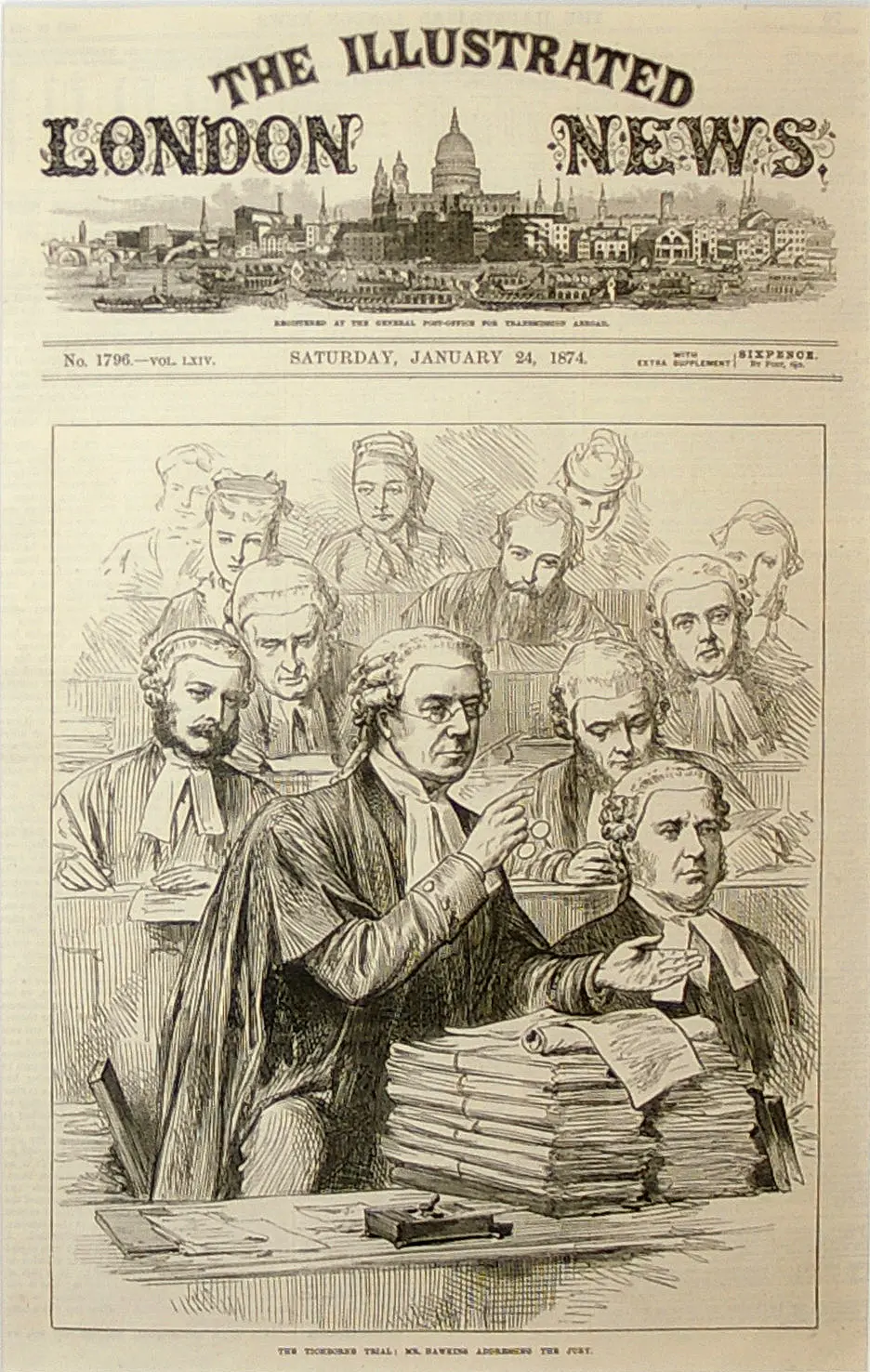
The Illustrated London News put the trial on its front page on January 24, 1874, with Henry Hawkins, who led for the Crown, addressing the jury.
Who was Anna Anderson really?
The German National Library’s authority record gives her as probably Franziska Schanzkowski, a Polish farm worker, and records that genetic analysis excluded kinship with the Russian imperial family (Exhibit F). Coble and colleagues (2009) describe her as a Polish peasant (Exhibit E).
Was Anna Anderson Anastasia?
No, according to DNA testing published in 1995 by Peter Gill and colleagues, as reported in 2009 by Coble and colleagues. The 2009 study also concluded that no member of the family survived July 17, 1918 (Exhibit E).
Why did the Tichborne case last so long?
It went through two trials. The civil action ran 102 days in 1871 and 1872, and the criminal trial reached its verdict on February 28, 1874, its 188th day by the DNB’s count (Exhibit D).
What would overturn it:
- For the Claimant: a letter, log or register entry from after April 1854, in Roger Tichborne’s known hand or tied to a named rescuing ship, that places him alive and links him to the man from Wagga Wagga.
- For Anderson: an independent laboratory retest of a sample of hers with a documented chain of custody that matched the Romanov family’s DNA and explained why the 1995 result differed.
Exhibits
Records and period publications
- Exhibit A: The Tichborne Trial: The Summing-up by the Lord Chief Justice of England, together with the Addresses of the Judges, the Verdict, and the Sentence; the whole accompanied by a History of the Case and Copious Alphabetical Index (London: Ward, Lock and Tyler, 1874).
- Exhibit B: The Trial at Bar of Sir Roger C. D. Tichborne, Bart., in the Court of Queen's Bench at Westminster, before Lord Chief Justice Cockburn, Mr. Justice Mellor, and Mr. Justice Lush, for Perjury, ed. Edward Vaughan Kenealy, vol. 1 (London: "Englishman" Office, 1875-80).
- Exhibit C: "Would Solve Anastasia Puzzle," The Champion Chronicle (Champion, Alberta), August 23, 1928, p. 5.
Studies
- Exhibit D: "Orton, Arthur (1834-1898)," in Dictionary of National Biography, Supplement, ed. Sidney Lee, vol. 3 (London: Smith, Elder, 1901), pp. 236-238.
- Exhibit E: Michael D. Coble, Odile M. Loreille, Mark J. Wadhams, Suni M. Edson, Kerry Maynard, Carna E. Meyer, Harald Niederstätter, Cordula Berger, Burkhard Berger, Anthony B. Falsetti, Peter Gill, Walther Parson and Louis N. Finelli, "Mystery Solved: The Identification of the Two Missing Romanov Children Using DNA Analysis," PLoS ONE 4, no. 3 (2009): e4838.
- Exhibit G: Peter Gill, Colin Kimpton, Rosemary Aliston-Greiner, Kevin Sullivan, Mark Stoneking, Terry Melton, Julian Nott, Suzanne Barritt, Rhonda Roby, Mitchell Holland and Victor Weedn, "Establishing the Identity of Anna Anderson Manahan," Nature Genetics 9, no. 1 (1995): 9-10.
- Exhibit H: Peter Gill, Pavel L. Ivanov, Colin Kimpton, Romelle Piercy, Nicola Benson, Gillian Tully, Ian Evett, Erika Hagelberg and Kevin Sullivan, "Identification of the Remains of the Romanov Family by DNA Analysis," Nature Genetics 6, no. 2 (1994): 130-135.
Databases and data sets
- Exhibit F: "Anderson, Anna," Gemeinsame Normdatei (GND) authority record 12278216X, Deutsche Nationalbibliothek.
Cite this page
Hoax and Hindsight. “Anna Anderson and the Tichborne Claimant: A Jury, Then DNA.” Hoax and Hindsight, published November 6, 2026. https://hoaxandhindsight.com/proven-fakes/anna-anderson-tichborne-claimant/. Accessed [the date you read it].
Related cases
 Illustration
Vinland Map: Yale Found a Pigment First Sold in the 1920s
The Vinland Map is a forgery, Yale said in 2021: a titanium pigment that went on sale in the 1920s runs through its lines. Key tests from 1965 to 2021.
Picture credit
Illustration: Hoax and Hindsight. Generated schematic illustration — not a photograph or historical record. © Hoax and Hindsight, all rights reserved.
Mechanical Turk: Its Hidden Player Was Suspected in 1784
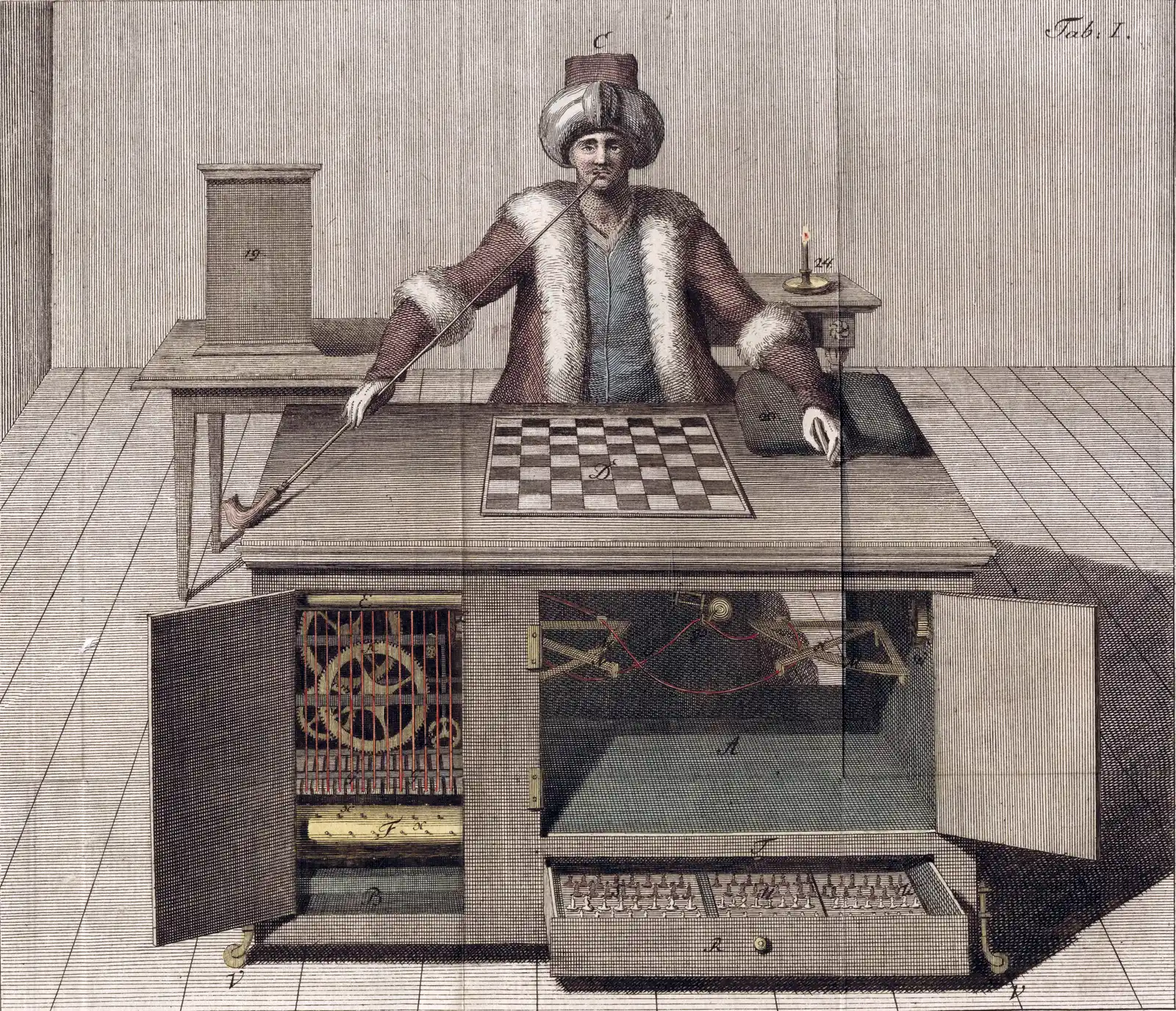
The Mechanical Turk chess automaton hid a human player. Who said so by 1784, what Willis argued in 1821, and why Napoleon’s game rests on later accounts.
Picture credit
"Plate I (Tab. I) of Joseph Friedrich zu Racknitz, Ueber den Schachspieler des Herrn von Kempelen und dessen Nachbildung (1789)" by Joseph Friedrich zu Racknitz — https://commons.wikimedia.org/wiki/File:Racknitz_-_The_Turk_1.jpg — Public domain (engraved plate published in 1789: public domain in the US (published before 1931); in the EU the term has long expired, since the book's author and any engraver working on a plate printed in 1789 died well over 70 years ago (an engraver active in 1789 cannot have lived past 1955); the scan is a faithful photographic reproduction of a two-dimensional public-domain work, which adds no new copyright in the US (PD-Art) or in the EU (Directive (EU) 2019/790, Art. 14); marked Public Domain Mark 1.0 on Commons. Commons gives the source as the Humboldt University Library (digi-hub record BV041097321, scan page 63); that record's own rights field says the copyright status was not checked, which concerns the reproduction only.)
Cottingley Fairies: Kodak Would Not Vouch, Doyle’s Book Says
Arthur Conan Doyle’s 1922 book records that Kodak’s experts found no trick in the Cottingley fairy negatives in 1920, yet would not certify them as genuine.
Picture credit
"Dancing fairies, illustration by Claude A. Shepperson in Princess Mary's Gift Book (1914)" by Claude A. Shepperson — https://commons.wikimedia.org/wiki/File:Cottingley_fairies_illustration.jpg — Public domain (US: published in London in 1914, before January 1, 1931. EU: Claude A. Shepperson died in 1921 (life dates 1867-1921 on the Commons file page and in the image-rights review of 2026-11-05), more than 70 years ago. Scan chain: the Commons file gives as its source the Internet Archive scan princessmarysgif00mary (University of California Libraries, collection cdl, not a lending item; its metadata, read 2026-11-05, gives the date [1914] and the publisher Hodder & Stoughton). Page and poem checked in review on 2026-11-06 against the same scan: the _djvu.txt text and the scan page for printed p. 104 (leaf 130 in the item's page-number file) show the drawing below the last stanzas of Alfred Noyes, 'A Spell for a Fairy' (pp. 101-104), headed 'Painting and Drawings by Claude A. Shepperson, A.R.W.S.'; the contents page lists the poem under Noyes with the same credit. The IA item metadata was re-read the same day (collection cdl and americana, possible-copyright-status NOT_IN_COPYRIGHT, not a lending item).); modified: card and share image cropped by the site build to the card proportions; the article page shows the full drawing