Historical Hoaxes · Case retrial
Cottingley Fairies: Kodak Would Not Vouch, Doyle’s Book Says
Hoax and Hindsight Published
Kodak’s experts examined the first two Cottingley fairy negatives in 1920 and found no trick, yet would not certify them. Arthur Conan Doyle’s own 1922 book records that they thought such pictures could be made by natural means, so the tests he relied on never showed that the fairies were real.
Docket
- Case
- The Cottingley fairy photographs
- Years
- 1917-1922: photographs taken in 1917 and 1920; printed in The Strand in 1920 and in Doyle's book in 1922
- Place
- Cottingley, near Bingley, Yorkshire, England
- The claim
- Five photographs taken by the cousins Elsie Wright and Frances Griffiths in 1917 and 1920 showed real fairies and a gnome
- The verdict
- Finding of the 1920 examinations: by the account in Doyle's 1922 book, Kodak's experts found no trick in the first two negatives, but said such pictures could be made by natural means and would not certify them
- Hinges on
- Whether a negative with no visible trick shows a real subject; of six opinions on the 1917 photographs reported in Doyle's book, two vouched for them, not counting a group of unnamed experts in Gardner's report
- Status
- As of current evidence: this page rests on the record printed from 1920 to 1922 and has read no later statement by either cousin
Docket as CSVWhere these entries come from (JSON)Data: Arthur Conan Doyle, The Coming of the Fairies (New York: George H. Doran, 1922)
The photographs came from Cottingley, a village near Bingley in Yorkshire. There, two cousins, Elsie Wright and Frances Griffiths, took five pictures of small winged figures in 1917 and 1920 (Exhibit A, pp. 50, 62). Doyle printed the first two in the Christmas 1920 number of The Strand Magazine, and the whole file in The Coming of the Fairies in 1922 (Exhibit A, p. 39). That book reprints the letters, test reports and press attacks behind his case, including the ones that cut against it.
This page reopens that file. Doyle’s claim is the charge, and his own documents are called as the evidence. The question is narrow: what the 1920 examinations of the negatives established. The retrial rests on the record printed from 1920 to 1922, and it has read no statement by either cousin made after 1921; the retrial method explains why a claim waits until its source can be read.
Order of proceedings 6 parts
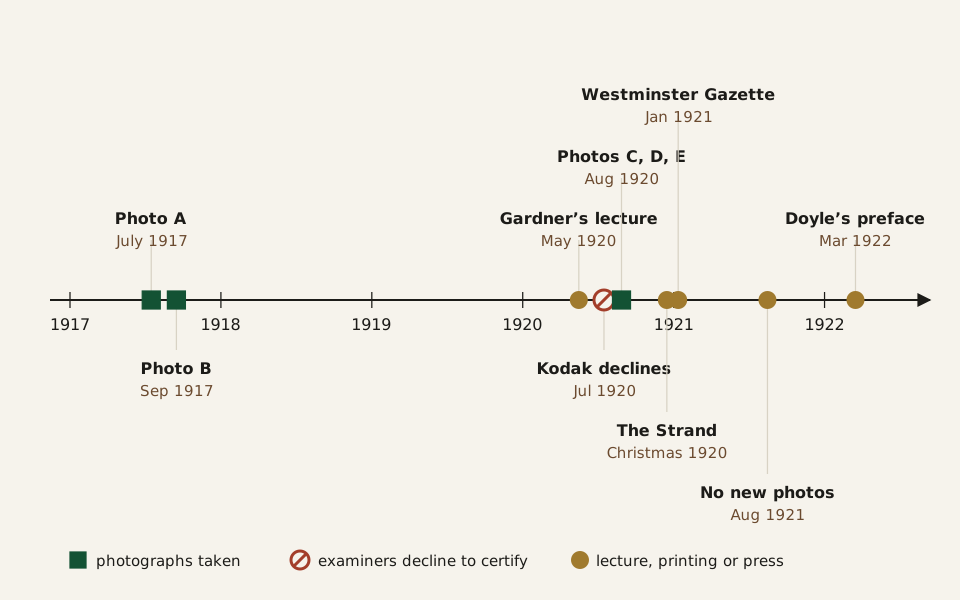
Diagram: Hoax and Hindsight · CC BY 4.0
Credit line to copy
"The Cottingley fairy photographs, July 1917 to March 1922" by Hoax and Hindsight, licensed under CC BY 4.0 (https://creativecommons.org/licenses/by/4.0/). Original: https://hoaxandhindsight.com/proven-fakes/cottingley-fairies/
Data: Arthur Conan Doyle, The Coming of the Fairies (New York: George H. Doran, 1922)
From photograph A to Doyle’s book: the five photographs, the refusal by Kodak’s experts, the printing in The Strand and the 1921 press inquiry. Drawn from the table published with this page (Exhibit A).
The events, one row per dated event, with page references (CSV) (where the data comes from) Data: Arthur Conan Doyle, The Coming of the Fairies (New York: George H. Doran, 1922)
Who took the five photographs, and when?
The accounts printed in 1920 agree on the outline. In the summer of 1917, by those accounts, Elsie Wright was sixteen and her cousin Frances Griffiths was ten (Exhibit A, pp. 42, 50). Elsie’s father, Arthur Wright, put one plate into his new “Midg” camera and let the girls take it to the beck behind the house (Exhibit A, pp. 50–51, 62, 64). The plate showed Frances with a group of dancing figures in front of her, captioned as taken by Elsie on a “Bright sunny day in July, 1917” (plate facing p. 49).
A second photograph, taken by Frances in September 1917, showed Elsie with a gnome (plate facing p. 32). Three years later the case reached Edward Gardner, a lecturer for the Theosophical Society, who left Elsie a good camera in July 1920 (p. 93). According to Gardner, the new plates had been marked privately by the Illingworth Co. The three photographs Doyle reproduced from that summer were taken on August 26 and 28, 1920 (pp. 101–102).
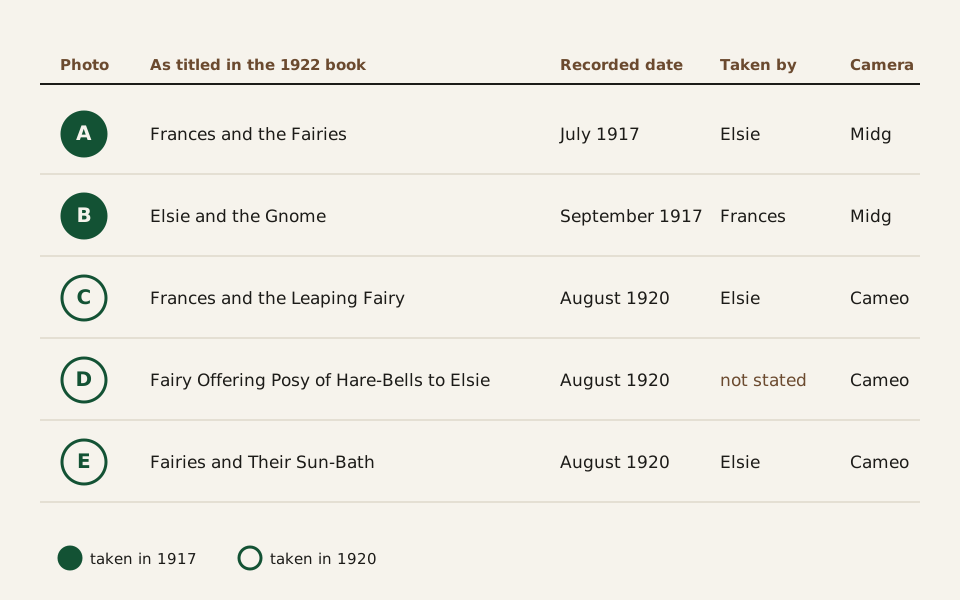
Diagram: Hoax and Hindsight · CC BY 4.0
Credit line to copy
"The five Cottingley photographs by the 1920 accounts" by Hoax and Hindsight, licensed under CC BY 4.0 (https://creativecommons.org/licenses/by/4.0/). Original: https://hoaxandhindsight.com/proven-fakes/cottingley-fairies/
Data: Arthur Conan Doyle, The Coming of the Fairies (New York: George H. Doran, 1922)
The five photographs as Doyle’s book describes them; the photographs themselves are not shown on this page. Drawn from the table published with this page (Exhibit A).
| Photograph, as titled in 1922 | Recorded date | Taken by, per the 1920 accounts | Camera |
|---|---|---|---|
| A. Frances and the Fairies | July 1917 | Elsie Wright | Midg |
| B. Elsie and the Gnome | September 1917 | Frances Griffiths | Midg |
| C. Frances and the Leaping Fairy | August 1920 | Elsie Wright | Cameo |
| D. Fairy Offering Posy of Hare-Bells to Elsie | August 1920 | Not stated in the book | Cameo |
| E. Fairies and Their Sun-Bath | August 1920 | Elsie Wright | Cameo |
The five photographs, one row per photograph, with sources (CSV) (where the data comes from) Data: Arthur Conan Doyle, The Coming of the Fairies (New York: George H. Doran, 1922)
The book records no later fairy photographs. In August 1921 the cousins met again, this time with a stereoscopic camera and a cinema camera. Doyle reports that no fairy appeared on a plate (pp. 105–106).
The 1920 article did not use these names. Doyle called the family Carpenter, of a village he called Dalesby, to spare them callers (Exhibit A, p. 42). The Westminster Gazette named the Wrights within weeks, and the book uses the real names because, its footnote says, the family withdrew their objection (pp. 61–62).
What did the photographic experts find in 1920?
Gardner first took the two 1917 negatives to a photographer named Snelling at Wealdstone, near Harrow (Exhibit A, pp. 42, 46). Gardner wrote that Snelling found a single exposure and figures that had moved while the shutter was open (p. 31). Doyle later printed his statement that the two negatives were “entirely genuine, unfaked photographs of single exposure” (p. 54).
In July 1920 Doyle took the negatives himself to the Kodak Company’s offices in Kingsway, London. A Mr. West and another expert examined them there. Doyle wrote that “neither of them could find any evidence of superposition, or other trick” (p. 33). Yet the two men believed they could produce such pictures by natural means, so “they would not undertake to say that these were preternatural.”
Gardner’s letter of July 31, 1920 put it more bluntly: “The Kodak people and also the Illingworth Co. are unwilling to testify.” (p. 36) The Illingworth company said clever studio painting and modelling could produce a similar negative. Gardner summed up that the photograph could be made by studio work, though the negatives showed no positive evidence of it. Showing that a method could work is not showing that it was used, a gap that also runs through the Mechanical Turk, where an 1821 critic showed how a hidden player could work the machine.
A report Gardner wrote on July 29, 1920 adds other experts he had consulted. One or two of them, he wrote, were against the photographs, and two claimed they could make the same kind of negative in a studio with painted models (p. 48). None of them, he added, would say positively that the photographs were faked. The report does not name them, so they may include the firms above.
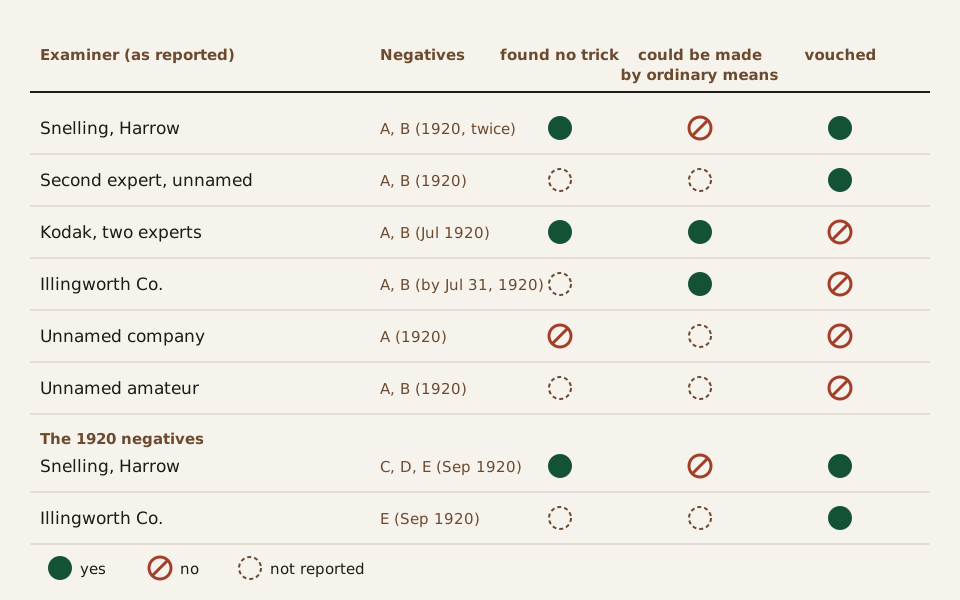
Diagram: Hoax and Hindsight · CC BY 4.0
Credit line to copy
"Eight reported opinions on the Cottingley negatives, 1920" by Hoax and Hindsight, licensed under CC BY 4.0 (https://creativecommons.org/licenses/by/4.0/). Original: https://hoaxandhindsight.com/proven-fakes/cottingley-fairies/
Data: Arthur Conan Doyle, The Coming of the Fairies (New York: George H. Doran, 1922), as reported by Doyle and E. L. Gardner
Eight opinions on the negatives in 1920, as Doyle or Gardner reported them. No examiner’s own report has been read. Drawn from the table published with this page (Exhibit A).
Look at who reports the refusal. Every account of Kodak’s view comes from Doyle or Gardner, the two men arguing that the photographs were genuine. The reasons they give differ: in Doyle’s Strand article, the experts refused “in view of some possible trap” (p. 44). A report that cuts against the reporter’s own case is unlikely to be invented, but it is still second-hand.
Of the six opinions on the 1917 photographs that the book reports, two vouched for them: Snelling and a second, unnamed expert (p. 54). Four did not: the two Kodak experts, counted as one opinion; the Illingworth company; an unnamed firm that called the background theatrical properties; and an amateur who objected to the fairies’ fashionable hair (pp. 36, 44). The unnamed experts in Gardner’s report are not counted, since they may be the same firms. For the 1920 negatives, Gardner wrote that Snelling judged the bower picture impossible to fake, and that Illingworth’s staff, to his surprise, agreed (p. 96).
The 1920 opinions, one row per reported opinion, with sources (CSV) (where the data comes from) Data: Arthur Conan Doyle, The Coming of the Fairies (New York: George H. Doran, 1922), as reported by Doyle and E. L. Gardner
Why did Doyle and Gardner accept them?
In May 1920 Gardner showed the two photographs as lantern slides at a lecture in the Mortimer Hall, London (Exhibit A, p. 47). Doyle heard of them that month, while he was gathering material for an article on fairies (pp. 15, 40). After the visit to Kodak, he wrote that “it was the character and surroundings of the children upon which the inquiry must turn, rather than upon the photos themselves” (p. 33).
Illustration: Hoax and Hindsight. Generated schematic illustration — not a photograph or historical record. © Hoax and Hindsight, all rights reserved.
An illustration, not a record: a lecture audience of 1920 watching a lantern screen. Gardner showed the two photographs as lantern slides at such a lecture in May 1920; the screen is left blank here because the photographs themselves are not shown on this page.
Gardner made the same move. Answering Hall-Edwards, he granted that the plate tests had not cleared the photographs entirely, because highly skilled processes could produce similar negatives. He rested the case on the photographs and the family’s honesty taken together (pp. 81–82).
His letter of July 31, 1920 calls Arthur Wright open and honest. It adds that Mrs. Wright had come into touch with theosophical teachings, which, Gardner wrote, explained the family’s cordial welcome (p. 37).
Doyle also wrote down what he hoped the photographs would do. Writing to Gardner from Melbourne on October 21, 1920, he said that anything widening the mental horizon “must have a good effect in breaking down materialism.” Séance messages, he added, had promised that “a visible sign was coming through” (pp. 98–99). He noted the “curious coincidence” that such an event had happened in a family already inclined to occult study, then set the thought aside as “far-fetched and remote” (p. 94).
These are Doyle’s and Gardner’s own stated reasons. This page has read no study that weighs how far such hopes shaped their judgment, so it draws no conclusion about it. Acceptance by famous names is not a test of an object, as the Vinland Map, another fake that well-known specialists accepted for years, also shows.
What did the critics propose?
The Westminster Gazette sent a special commissioner to Cottingley and printed his report on January 12, 1921; Doyle reprinted it (Exhibit A, pp. 60–69). Everyone he spoke to about it in Yorkshire, he wrote, dismissed the story as untrue. Yet he could not settle it: “I frankly confess that I failed.” (p. 61) He also learned that Elsie had worked for a few months for a photographer in Manningham Lane, Bradford, mostly running errands; the only other work she did there was “spotting” (p. 65).
Doyle called the attack by Major Hall-Edwards, an authority on radium, the most severe; it ran in the Birmingham Weekly Post (pp. 77–79). Hall-Edwards noted that Elsie had been described as drawing fairies for years and had worked for photographers. He named two possible methods. One was to cut out figures and set them near the sitter; the other was to stick onto a print “the figures of fairies cut from some publication” and photograph it again (p. 79).
Hall-Edwards also wrote that the photographs showed no evidence of movement, against Snelling’s reading. Doyle, answering the Westminster Gazette, granted that “Elsie could only have done it by cut-out images.” He then dismissed the idea, since it needed many models made in secret: “Surely this is a large order!” (p. 71)
The writer Maurice Hewlett, in John o’ London, went to the chain of evidence itself: “But why does he believe it? Because the young ladies tell him that they are genuine.” (p. 84) He judged that the girls “have pulled one of” Doyle’s legs (p. 88).
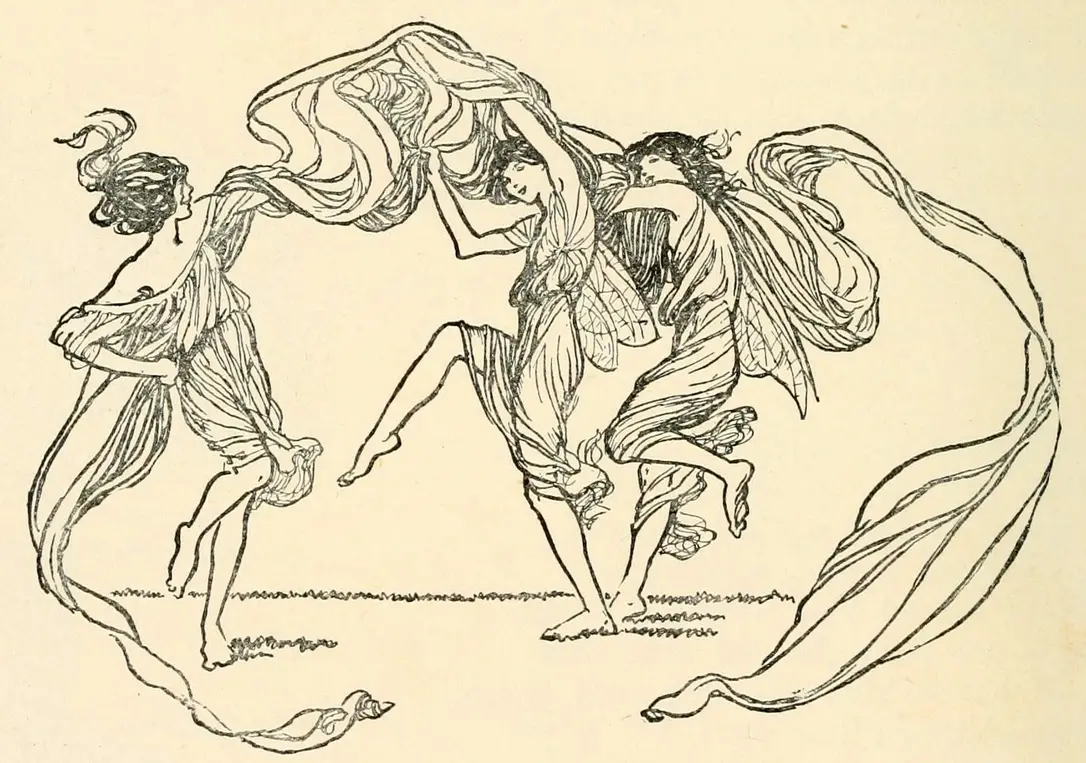
“Dancing fairies, illustration by Claude A. Shepperson in Princess Mary's Gift Book (1914)” · Claude A. Shepperson · Public domain
Full credit
"Dancing fairies, illustration by Claude A. Shepperson in Princess Mary's Gift Book (1914)" by Claude A. Shepperson — https://commons.wikimedia.org/wiki/File:Cottingley_fairies_illustration.jpg — Public domain (US: published in London in 1914, before January 1, 1931. EU: Claude A. Shepperson died in 1921 (life dates 1867-1921 on the Commons file page and in the image-rights review of 2026-11-05), more than 70 years ago. Scan chain: the Commons file gives as its source the Internet Archive scan princessmarysgif00mary (University of California Libraries, collection cdl, not a lending item; its metadata, read 2026-11-05, gives the date [1914] and the publisher Hodder & Stoughton). Page and poem checked in review on 2026-11-06 against the same scan: the _djvu.txt text and the scan page for printed p. 104 (leaf 130 in the item's page-number file) show the drawing below the last stanzas of Alfred Noyes, 'A Spell for a Fairy' (pp. 101-104), headed 'Painting and Drawings by Claude A. Shepperson, A.R.W.S.'; the contents page lists the poem under Noyes with the same credit. The IA item metadata was re-read the same day (collection cdl and americana, possible-copyright-status NOT_IN_COPYRIGHT, not a lending item).); modified: card and share image cropped by the site build to the card proportions; the article page shows the full drawing
Dancing fairies drawn by Claude Shepperson for a poem by Alfred Noyes in Princess Mary’s Gift Book, published in London in 1914, p. 104. Shown as an example of the printed fairy pictures of the time; no source read here ties it to the Cottingley figures (Exhibit B).
Printed fairy pictures of the kind Hall-Edwards had in mind were easy to find. Princess Mary’s Gift Book, published in London in 1914 (Exhibit B), includes the drawing above. This page has read no study that names a printed source for the Cottingley figures, so the drawing shows the type of source, not a proven one. Even a proven match could not expose a fake by its date alone, because a book of 1914 is older than a photograph claimed for 1917, as the terminus post quem page explains: an early date sets a floor, and a floor that fits the claim proves nothing.
What did the cousins say at the time?
In this record, the cousins never speak in their own writing. Every statement of theirs reaches the page through someone else: a parent, Gardner, Doyle or a reporter. Each of those people had a view on the photographs before passing the words on.
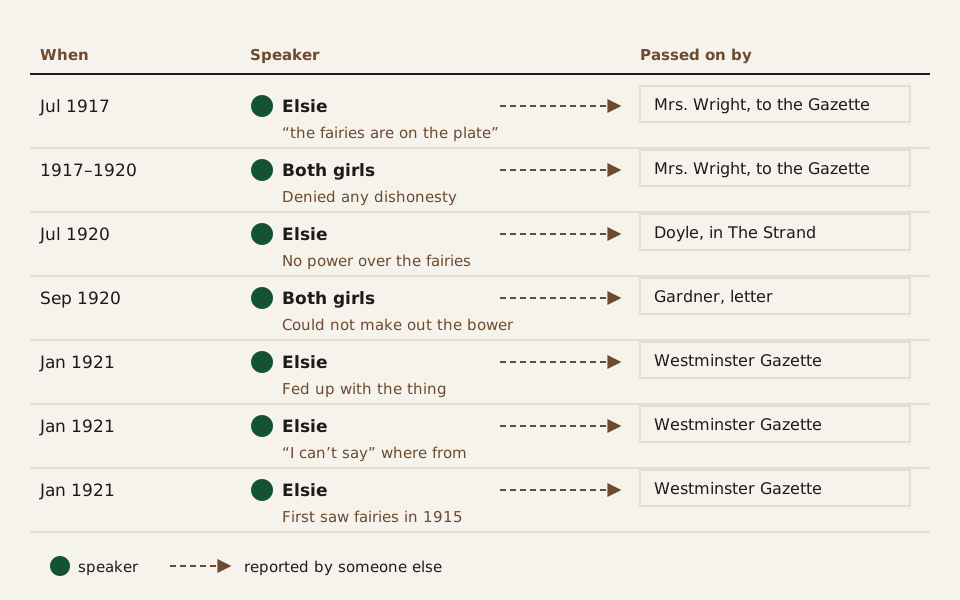
Diagram: Hoax and Hindsight · CC BY 4.0
Credit line to copy
"The cousins’ statements in the 1920–1922 record, and who passed each one on" by Hoax and Hindsight, licensed under CC BY 4.0 (https://creativecommons.org/licenses/by/4.0/). Original: https://hoaxandhindsight.com/proven-fakes/cottingley-fairies/
Data: Arthur Conan Doyle, The Coming of the Fairies (New York: George H. Doran, 1922), including the Westminster Gazette report of January 12, 1921 as reprinted there
Seven statements by Elsie Wright and Frances Griffiths in Doyle’s book, with the person who passed each one on. Drawn from the table published with this page (Exhibit A).
Mrs. Wright told the Westminster Gazette that as the first plate was developed, Elsie cried out, “Oh, Frances, the fairies are on the plate!” (Exhibit A, p. 64) Doyle’s Strand article had already told the same story under the false names (p. 43). Mrs. Wright also told the commissioner that the parents had questioned the girls about how they faked the pictures. “The children persisted in their story, and denied any act of dishonesty.” (p. 66)
Doyle reported that during Gardner’s visit in July 1920, Elsie said she had no power over the fairies and simply sat quietly until they came (p. 52).
When the commissioner found Elsie at Sharpe’s Christmas Card Manufactory in Bradford, she first refused to see him. Then, like her parents, she said she was “fed up” with the thing (p. 67). Asked where the fairies came from, “Miss Wright hesitated, and laughingly answered, ‘I can’t say.’” (p. 68) She told him the cousins had first seen fairies in 1915 (p. 69).
The cousins’ statements, one row per statement, with who reported it (CSV) (where the data comes from) Data: Arthur Conan Doyle, The Coming of the Fairies (New York: George H. Doran, 1922)
Popular version vs. the record
The three claims below were made for the photographs in 1920, and Doyle printed all of them in his 1922 book. Each is set against what the same book records.
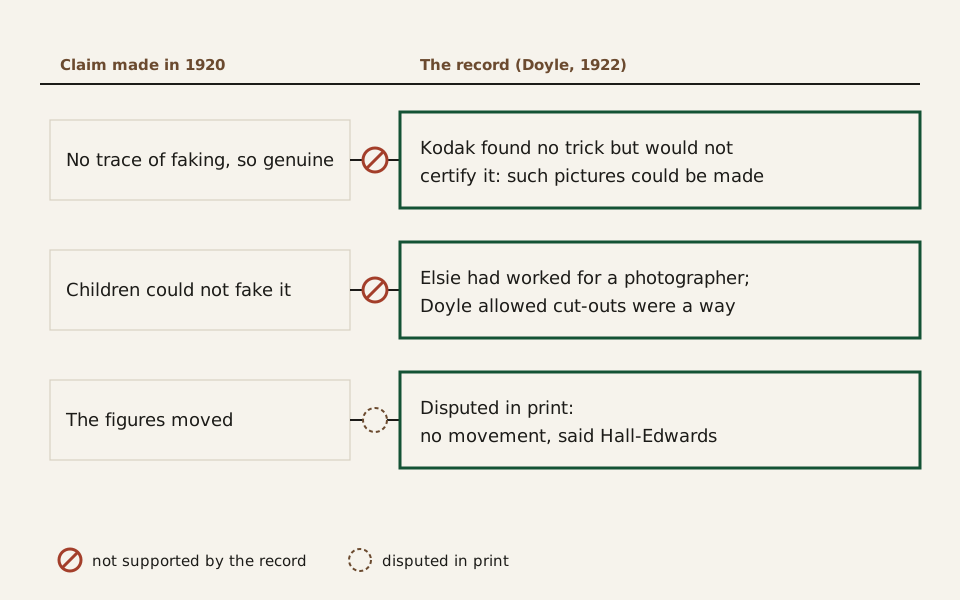
Diagram: Hoax and Hindsight · CC BY 4.0
Credit line to copy
"Three 1920 claims for the Cottingley photographs and the record" by Hoax and Hindsight, licensed under CC BY 4.0 (https://creativecommons.org/licenses/by/4.0/). Original: https://hoaxandhindsight.com/proven-fakes/cottingley-fairies/
Data: Arthur Conan Doyle, The Coming of the Fairies (New York: George H. Doran, 1922)
Three claims made for the photographs in 1920 and the record that answers each, all from Doyle’s own book. Drawn from the table below (Exhibit A).
The first negative was “asserted by expert photographers to bear not the slightest trace of combination work,” so it was a true photograph (caption to photograph A, Exhibit A, plate facing p. 49).
Kodak’s two experts also found no trick, but said such pictures could be made by natural means and would not certify them; the Illingworth Co. said studio work could make a similar negative (Exhibit A, pp. 33, 36).
Doyle wrote in The Strand in 1920 that “it was surely impossible that a little village with an amateur photographer could have the plant and the skill to turn out a fake” (Exhibit A, p. 45).
Elsie had worked for a Bradford photographer for a few months, as the Westminster Gazette found, and Doyle himself allowed that cut-out figures were a way it could be done (Exhibit A, pp. 65, 71).
Snelling found that the fairy figures had moved during the exposure (reported by Gardner in 1920, Exhibit A, p. 31).
Disputed in print: Hall-Edwards wrote, after the Strand article, that the photographs show no evidence of movement, and the book records no measurement either way (Exhibit A, p. 79).
Were the Cottingley fairies real?
Nothing in the record printed from 1920 to 1922 shows that they were. According to Arthur Conan Doyle’s 1922 book, the Kodak experts who found no trick in the first two negatives also said such pictures could be made by natural means. They would not certify them as genuine.
Did Kodak say the Cottingley photographs were genuine?
No. According to Doyle’s 1922 book, two Kodak experts in London found no sign of superposition or other trick in July 1920. They still would not say the pictures were preternatural, because they believed they could produce such pictures by natural means.
Who took the Cottingley fairy photographs?
By the 1920 accounts that Doyle reprinted, Elsie Wright took the first photograph in July 1917, and her cousin Frances Griffiths took the second in September 1917. Those accounts give their ages as sixteen and ten. Three more followed on August 26 and 28, 1920; Elsie took at least two of them, and the book does not say who took the third.
What would overturn it:
- Kodak’s own record of the July 1920 examination, if one survives, stating that its experts judged the negatives genuine; that would show that Doyle and Gardner misreported them.
- A technical study of the original negatives that finds combination work or retouching the 1920 examiners did not report; the 1920 finding of no visible trick would then give way to a test result.
Exhibits
- Exhibit A: Arthur Conan Doyle, The Coming of the Fairies (New York: George H. Doran, 1922).
- Exhibit B: Princess Mary’s Gift Book (London: Hodder & Stoughton, [1914]).
Cite this page
Hoax and Hindsight. “Cottingley Fairies: Kodak Would Not Vouch, Doyle’s Book Says.” Hoax and Hindsight, published November 6, 2026. https://hoaxandhindsight.com/proven-fakes/cottingley-fairies/. Accessed [the date you read it].
Related cases
 Illustration
Vinland Map: Yale Found a Pigment First Sold in the 1920s
The Vinland Map is a forgery, Yale said in 2021: a titanium pigment that went on sale in the 1920s runs through its lines. Key tests from 1965 to 2021.
Picture credit
Illustration: Hoax and Hindsight. Generated schematic illustration — not a photograph or historical record. © Hoax and Hindsight, all rights reserved.
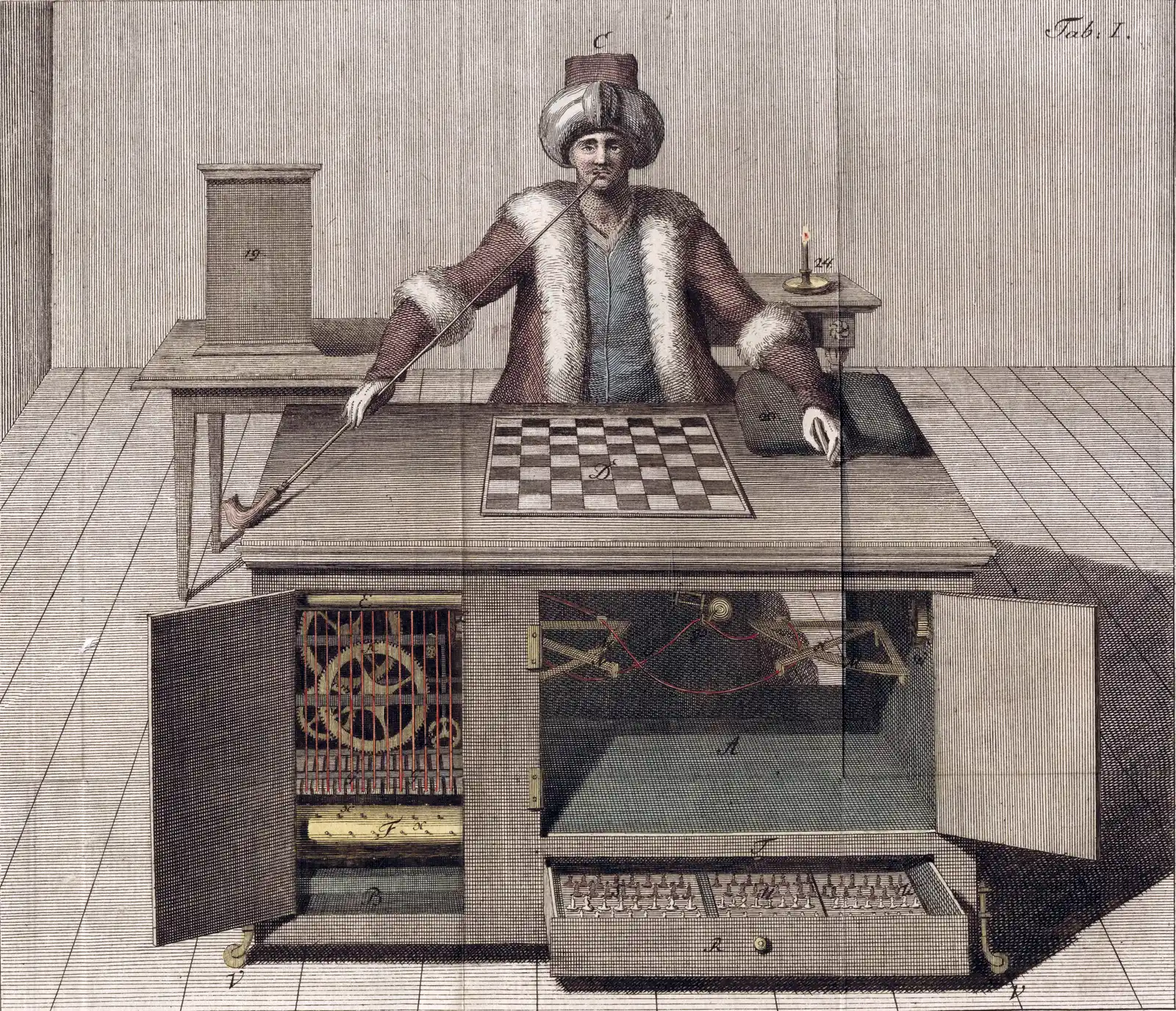
Mechanical Turk: Its Hidden Player Was Suspected in 1784
The Mechanical Turk chess automaton hid a human player. Who said so by 1784, what Willis argued in 1821, and why Napoleon’s game rests on later accounts.
Picture credit
"Plate I (Tab. I) of Joseph Friedrich zu Racknitz, Ueber den Schachspieler des Herrn von Kempelen und dessen Nachbildung (1789)" by Joseph Friedrich zu Racknitz — https://commons.wikimedia.org/wiki/File:Racknitz_-_The_Turk_1.jpg — Public domain (engraved plate published in 1789: public domain in the US (published before 1931); in the EU the term has long expired, since the book's author and any engraver working on a plate printed in 1789 died well over 70 years ago (an engraver active in 1789 cannot have lived past 1955); the scan is a faithful photographic reproduction of a two-dimensional public-domain work, which adds no new copyright in the US (PD-Art) or in the EU (Directive (EU) 2019/790, Art. 14); marked Public Domain Mark 1.0 on Commons. Commons gives the source as the Humboldt University Library (digi-hub record BV041097321, scan page 63); that record's own rights field says the copyright status was not checked, which concerns the reproduction only.)
Anna Anderson and the Tichborne Claimant: A Jury, Then DNA
A London jury convicted the Tichborne Claimant of perjury in 1874; DNA tests published in 1995 exposed Anna Anderson, per a 2009 study. Two proofs compared.
Picture credit
"The Tichborne Trial, oil painting by Frederick Sargent (Hampshire County Council Museums Service, FA2005.237.1)" by Frederick Sargent — https://commons.wikimedia.org/wiki/File:The_Tichborne_Trial_by_Frederick_Sargent.jpg — Public domain (oil painting by Frederick Sargent (1837-1899, per the Commons creator record; not checked against another source): public domain in the EU (painter dead for more than 70 years) and in the US (author died before 1956, so even an unpublished work is out of copyright); the image is a faithful photographic reproduction of a two-dimensional public-domain work (PD-Art), which adds no new copyright in the US or in the EU (Directive (EU) 2019/790, Art. 14); marked Public Domain Mark 1.0 on Commons. Risk noted: the photograph came from Art UK for a UK collection, and a UK museum may claim rights in the reproduction; accepted in the image rights ruling of 2026-11-05 (log, image ruling 8).)