Historical Hoaxes · Case retrial
Mechanical Turk: Its Hidden Player Was Suspected in 1784
Hoax and Hindsight Published
The Mechanical Turk’s show began with its cabinet doors opened one by one, yet a human player sat hidden inside. Spectators put that guess in print by 1784, Robert Willis showed in an 1821 book how a player could stay out of sight, and Napoleon’s famous game with it is known here only from accounts printed from 1839 on.
Docket
- Case
- The Mechanical Turk, the chess-playing figure built by Wolfgang von Kempelen
- Years
- Begun in 1769 and finished in six months, by Windisch’s account; destroyed by fire in Philadelphia on July 5, 1854, by George Allen’s 1859 account
- Place
- Shown in Vienna, across Europe, and in the United States from 1826
- The claim
- That a machine played chess by itself; before each game its cabinet was opened part by part to show machinery inside
- The verdict
- Finding of the 1821 analysis by Robert Willis: a hidden human player could work the figure, and probably did; later accounts, one said to come from a hidden player, agree
- Hinges on
- What people who watched or studied the cabinet wrote, and what was later reported from its hidden players
- Status
- Exposed
The Turk was a carved figure in Turkish dress, seated behind a wooden cabinet with a chessboard on top (Exhibit B). Wolfgang von Kempelen began it in 1769 after a promise made at the imperial court in Vienna, and finished it in six months, by the account of Karl Gottlieb von Windisch (Exhibit C). It toured Europe, crossed to the United States in 1826, and burned in Philadelphia in 1854, 85 years after Kempelen began it (Exhibits G, H). The name is now also used by an online work service; this page is about the chess machine.
Its showmen made one claim: that a machine played chess by itself. This page treats that claim as the charge. It calls the witnesses in the order they wrote, starting with the people who watched the cabinet being opened.
Order of proceedings 6 parts
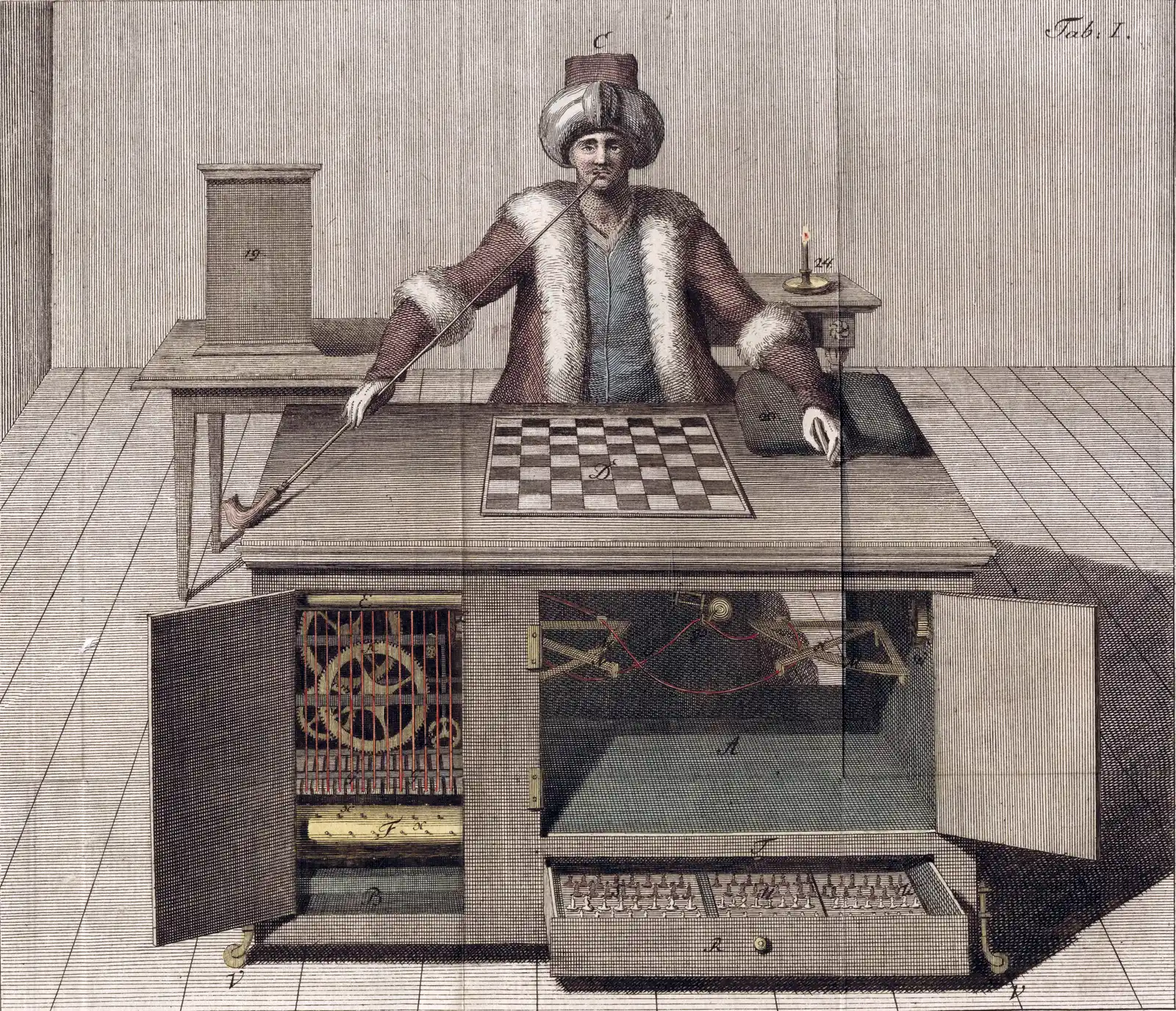
“Plate I (Tab. I) of Joseph Friedrich zu Racknitz, Ueber den Schachspieler des Herrn von Kempelen und dessen Nachbildung (1789)” · Joseph Friedrich zu Racknitz · Public domain
Full credit
"Plate I (Tab. I) of Joseph Friedrich zu Racknitz, Ueber den Schachspieler des Herrn von Kempelen und dessen Nachbildung (1789)" by Joseph Friedrich zu Racknitz — https://commons.wikimedia.org/wiki/File:Racknitz_-_The_Turk_1.jpg — Public domain (engraved plate published in 1789: public domain in the US (published before 1931); in the EU the term has long expired, since the book's author and any engraver working on a plate printed in 1789 died well over 70 years ago (an engraver active in 1789 cannot have lived past 1955); the scan is a faithful photographic reproduction of a two-dimensional public-domain work, which adds no new copyright in the US (PD-Art) or in the EU (Directive (EU) 2019/790, Art. 14); marked Public Domain Mark 1.0 on Commons. Commons gives the source as the Humboldt University Library (digi-hub record BV041097321, scan page 63); that record's own rights field says the copyright status was not checked, which concerns the reproduction only.)
Plate 1 of Joseph Friedrich zu Racknitz’s 1789 book on the Turk: the cabinet opened for the audience, with wheels on the left and an emptier cupboard on the right (Exhibit E).
How did the show open the cabinet?
Robert Willis set down the routine in a book dated December 1820 and printed in 1821 (Exhibit A). The exhibitor unlocked the front door of the small cupboard, which held packed machinery lined with dark cloth, then opened its back door, held a lighted candle there and locked it again. Next came the drawer. It held the chessmen and a cushion for the figure’s arm.
Then the exhibitor opened the large cupboard front and back, with the candle held behind it, wheeled the chest round, lifted the figure’s robes and opened small doors in its trunk and thigh. Finally he shut the doors and turned a key as if winding a spring. The Turk began to move. Edgar Allan Poe described the same order in 1836 and wrote that the exhibitor never departed from it “in any material particular” (Exhibit B, p. 322).
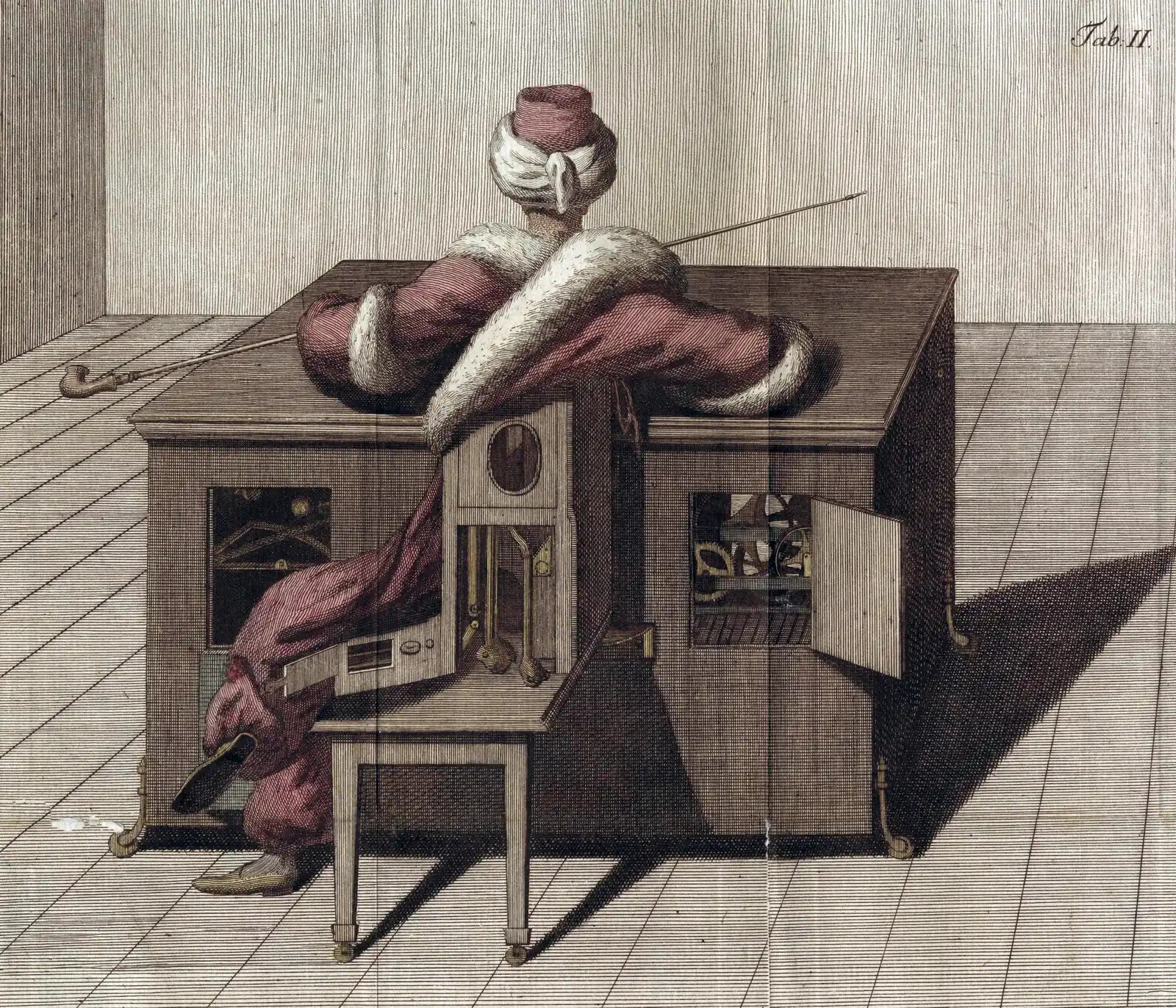
“Plate II (Tab. II) of Joseph Friedrich zu Racknitz, Ueber den Schachspieler des Herrn von Kempelen und dessen Nachbildung (1789)” · Joseph Friedrich zu Racknitz · Public domain
Full credit
"Plate II (Tab. II) of Joseph Friedrich zu Racknitz, Ueber den Schachspieler des Herrn von Kempelen und dessen Nachbildung (1789)" by Joseph Friedrich zu Racknitz — https://commons.wikimedia.org/wiki/File:Racknitz_-_The_Turk_2.jpg — Public domain (engraved plate published in 1789: public domain in the US (published before 1931); in the EU the term has long expired, since the book's author and any engraver working on a plate printed in 1789 died well over 70 years ago (an engraver active in 1789 cannot have lived past 1955); the scan is a faithful photographic reproduction of a two-dimensional public-domain work, which adds no new copyright in the US (PD-Art) or in the EU (Directive (EU) 2019/790, Art. 14); marked Public Domain Mark 1.0 on Commons. Commons gives the source as the Humboldt University Library, the same library as plate I.)
Plate 2 of Racknitz’s 1789 book: the Turk from behind, robe lifted and a door in its back open on rods and levers, as at step 5 below (Exhibit E). The table gives the routine as Willis described it in 1821, with his reading of where the hidden player was at each step (Exhibits A, B).
| Step | Shown to the audience | Where Willis put the player |
|---|---|---|
| 1 | Front door of the small cupboard | Behind the packed machinery |
| 2 | Back door of the small cupboard, candle held behind | Out of the candle’s path; the door is then locked and a screen closed |
| 3 | Drawer pulled out, chessmen taken out | Using the time to shift position |
| 4 | Large cupboard, front and back, candle held behind | In the rear of the small cupboard and behind the drawer |
| 5 | Chest turned round, robes lifted, doors in trunk and thigh | Nearly half the chest is still out of sight |
| 6 | Doors closed and locked | Draws in his legs and rises into the figure |
| 7 | Key turned as if winding a spring | Takes it as the signal to begin |
Willis saw two weak points in this display. The order never varied, which made no sense if the machinery itself was the point. And the key seemed to turn the same number of times whether the Turk then made 63 moves, 7 moves or none, so it could hardly be driving anything. He read the whole display as “a mere stratagem, calculated to distract the attention, and mislead the judgment, of the spectators” (Exhibit A).
Who said a person was inside, and when?
The guess is older than the analysis. Windisch, in a letter dated Pressburg, September 7, 1783, wrote that at his first sight of the Turk he suspected the cabinet “certainly contained a child” of ten to twelve (Exhibit C, pp. 13–14). Many in the company said so openly, he wrote. Then Kempelen opened every door and rolled the machine round the room, Windisch found nothing that could hide even his hat, and he gave up the idea (pp. 14–15).
A year later in London, Philip Thicknesse printed the opposite conclusion. In his pamphlet, “the real mover is concealed in the Counter,” which had room for a child of ten to fourteen, and “That this is the case, is past all doubt” (Exhibit D, pp. 10–11). Poe later reported a Paris pamphlet of 1785 that put a dwarf inside, but that pamphlet was not read for this page (Exhibit B, p. 321).
In 1789 Joseph Friedrich zu Racknitz, a friend of Kempelen, published his own reconstruction, with a preface dated at Dresden. He built two models, the first to show how “the person hidden in the machine” got through a game, and he offered his account “only as a hypothesis, only as a conjecture” (Exhibit E, preface, translated by Hoax and Hindsight). Quotations from 18th-century printings on this page use a modern s for the old long s.
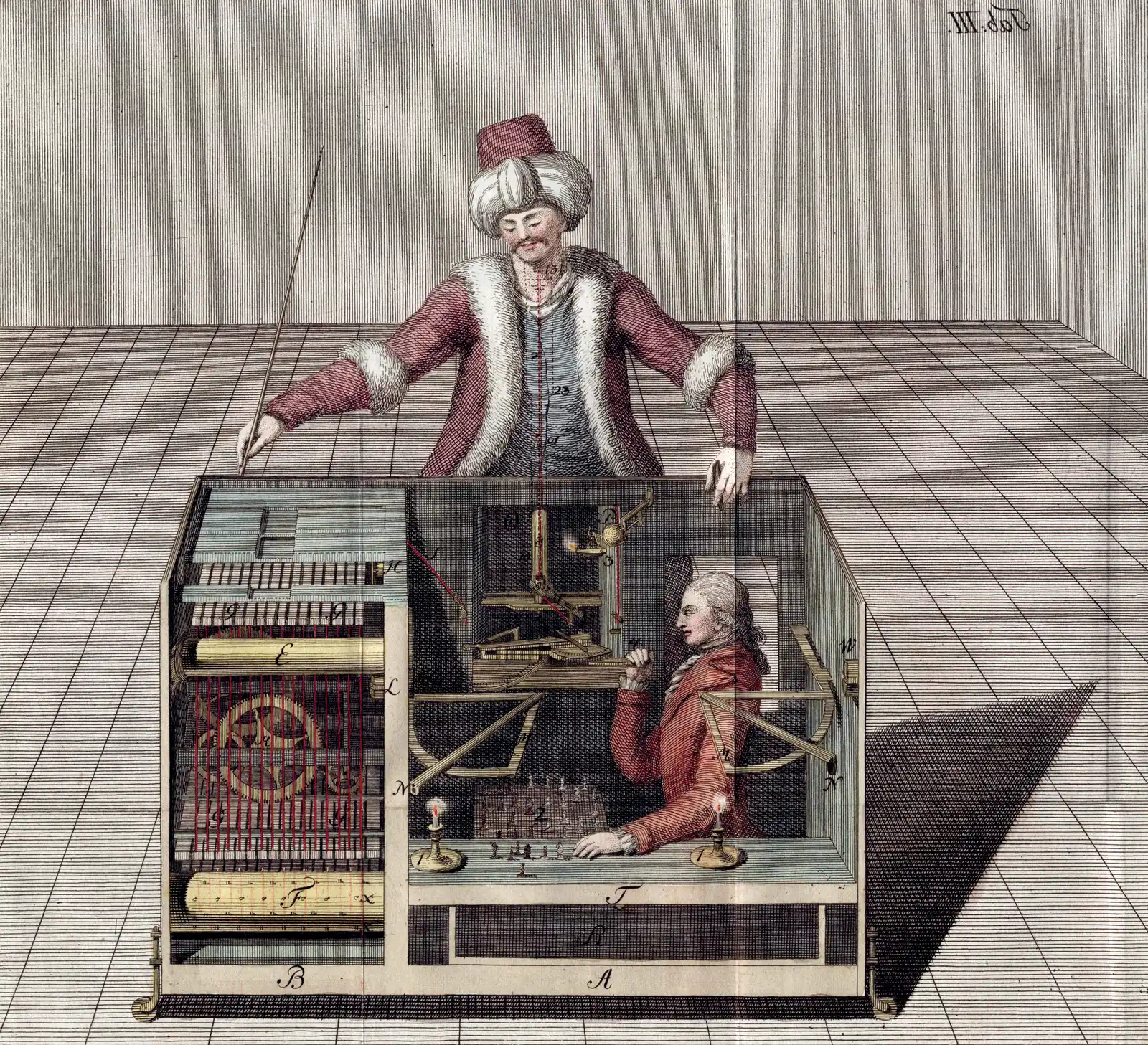
“Plate III (Tab. III) of Joseph Friedrich zu Racknitz, Ueber den Schachspieler des Herrn von Kempelen und dessen Nachbildung (1789)” · Joseph Friedrich zu Racknitz · Public domain
Full credit
"Plate III (Tab. III) of Joseph Friedrich zu Racknitz, Ueber den Schachspieler des Herrn von Kempelen und dessen Nachbildung (1789)" by Joseph Friedrich zu Racknitz — https://commons.wikimedia.org/wiki/File:Racknitz_-_The_Turk_3.jpg — Public domain (engraved plate published in 1789: public domain in the US (published before 1931); in the EU the term has long expired, since the book's author and any engraver working on a plate printed in 1789 died well over 70 years ago (an engraver active in 1789 cannot have lived past 1955); the scan is a faithful photographic reproduction of a two-dimensional public-domain work, which adds no new copyright in the US (PD-Art) or in the EU (Directive (EU) 2019/790, Art. 14); marked Public Domain Mark 1.0 on Commons. Commons gives the source as the Humboldt University Library, the same library as plate I.)
Plate 3 of Racknitz’s 1789 book: the cabinet drawn as if cut open, with a man seated inside at a small chessboard between two candles. It is his reconstruction of a hidden player, offered as a hypothesis (Exhibit E).
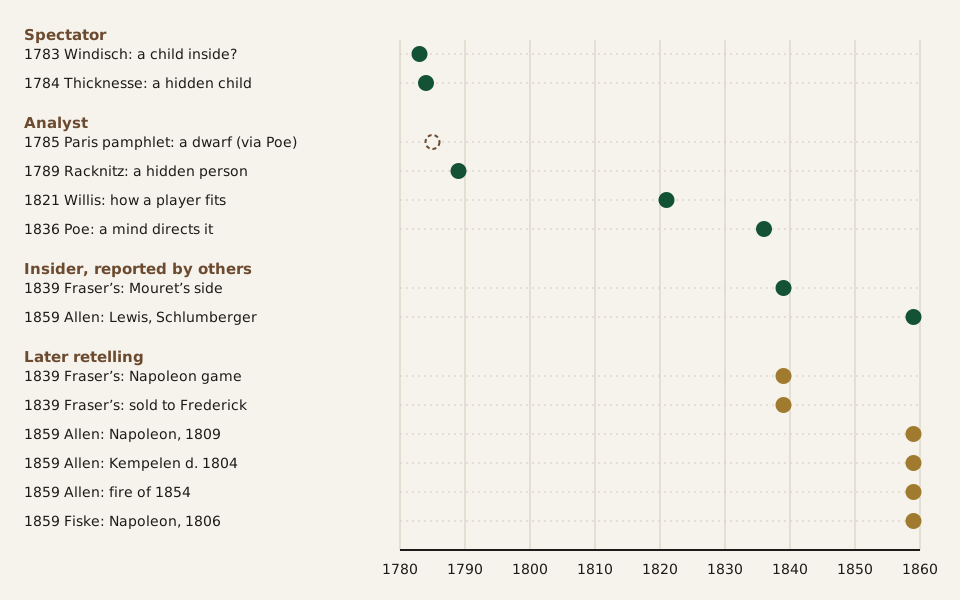
Diagram: Hoax and Hindsight · CC BY 4.0
Credit line to copy
"Accounts of the Mechanical Turk, 1783 to 1859, by the writer’s relation to the machine" by Hoax and Hindsight, licensed under CC BY 4.0 (https://creativecommons.org/licenses/by/4.0/). Original: https://hoaxandhindsight.com/proven-fakes/mechanical-turk/
Data: Public-domain printings of 1784–1859 listed in the Exhibits (Windisch, Thicknesse, Racknitz, Willis, Poe, Fraser's Magazine, Fiske and Allen)
Every account on this page, by the year it was printed (for Windisch, the date of his letter) and the writer’s relation to the machine. The dashed circle is the 1785 Paris pamphlet, known here only from Poe (Exhibits A to H).
| Year | Writer | Relation | What the account says |
|---|---|---|---|
| 1783 | Karl Gottlieb von Windisch | Spectator | He and many others suspected a hidden child; the opened doors changed his mind |
| 1784 | Philip Thicknesse | Spectator | A hidden player works it, past all doubt |
| 1785 | Paris pamphlet, author not named | Analyst | A dwarf inside (known only from Poe, 1836) |
| 1789 | Joseph Friedrich zu Racknitz | Analyst | A person hidden in the machine, offered as a hypothesis |
| 1821 | Robert Willis | Analyst | How a player could fit and stay unseen; probably so |
| 1836 | Edgar Allan Poe | Analyst | A mind, not machinery, directs the moves |
| 1839 | Fraser’s Magazine | Insider, reported | The player sat in the chest and read the moves from magnets |
| 1839 | Fraser’s Magazine | Later retelling | Napoleon played it after reaching Berlin |
| 1839 | Fraser’s Magazine | Later retelling | Frederick the Great bought it |
| 1859 | George Allen | Later retelling | Napoleon played it at Schönbrunn in 1809 |
| 1859 | George Allen | Later retelling | Kempelen still owned it when he died in 1804 |
| 1859 | George Allen | Insider, reported | William Lewis was once a hidden player; Schlumberger was the last |
| 1859 | George Allen | Later retelling | It burned in Philadelphia on July 5, 1854 |
| 1859 | Daniel Willard Fiske | Later retelling | It beat Napoleon in Berlin in 1806 |
Every account, one row per account, with sources (CSV) (where the data comes from) Data: Public-domain printings of 1784–1859 listed in the Exhibits
This record makes the Turk a counterexample to the wish-shaped fake, this site’s name for fakes that research shows were accepted partly because they fit what audiences hoped to see. In the records read here, people who watched the Turk in the 1780s suspected a hidden player, and one of them printed it in 1784. Its long career cannot be put down to audiences who had no reason to suspect.
What did Willis and Poe work out?
Willis published his book in 1821 without his name; Fraser’s Magazine named him in 1839 as “Mr. Robert Willis, of the University of Cambridge” (Exhibit F, p. 726). He sorted automata into three kinds, and the third kind is one “wholly directed and controlled by a concealed human agent” (Exhibit A). A machine, he argued, could not meet the changing demands of a chess game.
He then showed how a skilled player of ordinary size could stay hidden. A space behind the drawer was never shown, a false back let the player move between the cupboards, and the drawer gave him time to change position. In the end the player’s head sat inside the figure above the table, and he saw the board through its waistcoat. Willis judged the method enough for “rendering it probable that the Chess Player belongs in reality to the third class of Automata” (Exhibit A).
Poe’s essay appeared unsigned in the Southern Literary Messenger in April 1836 (Exhibit B). He compared the Turk with Charles Babbage’s calculating engine: a sum follows from its data step by step, but no chess move follows of necessity from the one before. He wrote: “It is quite certain that the operations of the Automaton are regulated by mind, and by nothing else.” (p. 319) That is a dated, printed claim that a machine could not do something, a useful contrast with the line ‘everything that can be invented has been invented’, checked against its source.
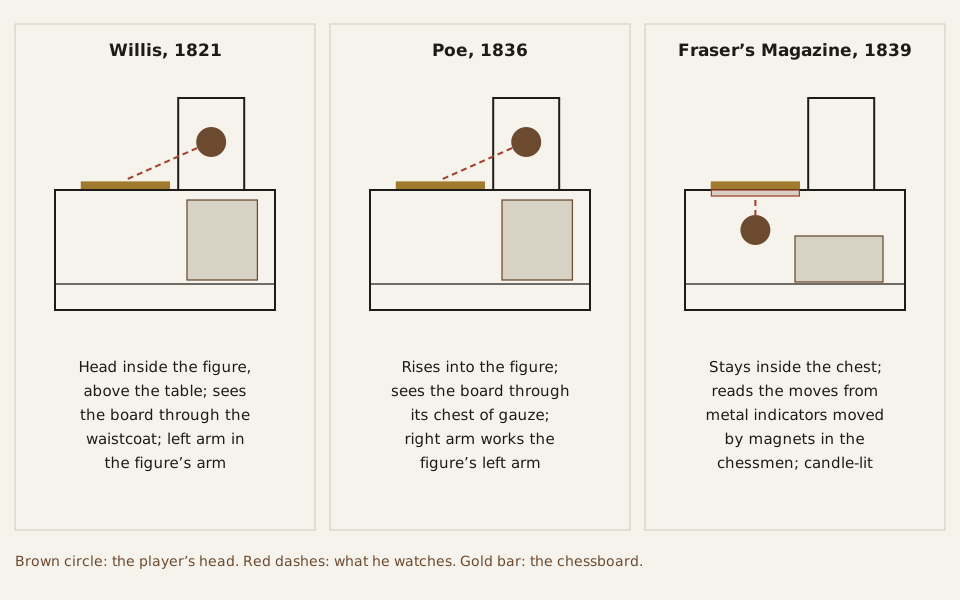
Diagram: Hoax and Hindsight · CC BY 4.0
Credit line to copy
"Where three accounts put the Turk’s hidden player: Willis 1821, Poe 1836, Fraser’s Magazine 1839" by Hoax and Hindsight, licensed under CC BY 4.0 (https://creativecommons.org/licenses/by/4.0/). Original: https://hoaxandhindsight.com/proven-fakes/mechanical-turk/
Data: Robert Willis (1821); Edgar Allan Poe, Southern Literary Messenger (April 1836); Fraser's Magazine (June 1839)
Where three accounts put the hidden player and what he watched: Willis in 1821, Poe in 1836, and Fraser’s Magazine in 1839. Plain box drawings from the written descriptions (Exhibits A, B, F).
Poe knew Willis’s essay without its author’s name and believed it first appeared in a Baltimore weekly. He granted that its result was right in the main, but said its author had managed to “blunder upon a plausible solution” (Exhibit B, p. 321). He also called untenable the idea of a hidden space behind the drawer, which he credited to Sir David Brewster (p. 323), though Willis had described that space himself (Exhibit A).
Poe’s own case rested on what he saw at the shows. The Turk played with its left arm, which Poe took as a clue that a man inside was working it (p. 326). He also noted that a man named Schlumberger travelled with Maelzel but was never seen while the Turk played, and that in Richmond, when Schlumberger fell ill, the Turk did not play (pp. 325–326).
“Edgar A. Poe, mezzotint and engraving by John Sartain, 1849, after a painting then in the collection of R. W. Griswold (National Portrait Gallery, Smithsonian Institution, S/NPG.78.36)” · John Sartain · Public domain
Full credit
"Edgar A. Poe, mezzotint and engraving by John Sartain, 1849, after a painting then in the collection of R. W. Griswold (National Portrait Gallery, Smithsonian Institution, S/NPG.78.36)" by John Sartain — https://commons.wikimedia.org/wiki/File:Edgar_Allan_Poe_by_John_Sartain,_1849,_mezzotint_and_engraving_on_paper,_from_the_National_Portrait_Gallery_-_NPG-S-NPG_78_36.jpg — Public domain (print engraved in 1849: public domain in the US (made and issued as a print in 1849; even if treated as unpublished, the term for a work by an author active as an adult in 1849 has expired); in the EU the term has expired, since the engraver, adult and working in 1849, and the painter of a picture that existed by 1849 cannot have lived past 1955 (life plus 70 years). The photograph is the museum's own (National Portrait Gallery, Smithsonian Institution; Phase One camera data in the file, 2018), released by the museum under CC0 1.0 according to the Commons file page (npg.si.edu object npg_S_NPG.78.36; museum page not read); a faithful reproduction of a two-dimensional public-domain work adds no new copyright in the US or the EU (Directive (EU) 2019/790, Art. 14) in any case. Engraver's name from the engraved line under the portrait: 'Engraved by J. Sartain from the Original picture in the Collection of R. W. Griswold'.); modified: Resized from 5,163 x 8,571 px to 1,445 x 2,400 px; not cropped (the paper margin, title line and engraver's line are kept).
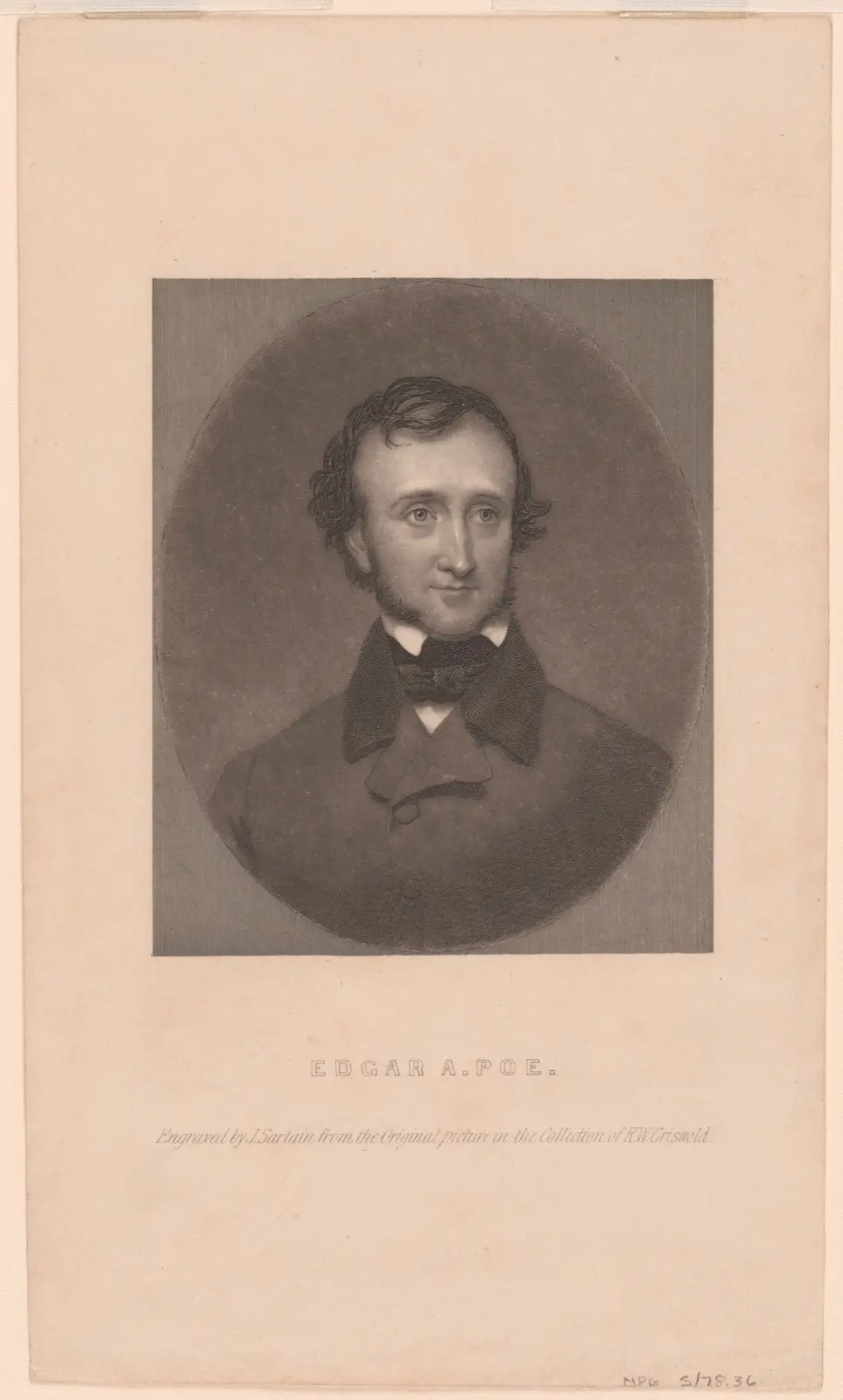
Edgar Allan Poe, engraved by John Sartain in 1849 from a painting then owned by R. W. Griswold. Poe’s essay on the Turk had appeared unsigned in 1836 (Exhibit B).
Poe made errors of his own. He wrote that Maelzel took the Turk to London in 1783 and 1784 (p. 319). Willis gives Kempelen as the one who brought it to England about 1783 (Exhibit A), and George Allen wrote in 1859 that Maelzel bought it from Kempelen’s son after Kempelen died in 1804 (Exhibit G, p. 424).
Who sat inside, and what became of the Turk?
The earliest account from the players’ side read for this page appeared in 1839. An unsigned article in Fraser’s Magazine said that Mouret, a strong French player who had worked the Turk, had sold its secret to a French penny magazine (Exhibit F, p. 728). Allen later supposed that this was an article of 1834 (Exhibit G, p. 424). That French article was not read for this page, so the account below is Fraser’s retelling of what it reported.
The 1839 article says: “The man who really played the Chess-Automaton was concealed in the chest.” (Exhibit F, p. 728) He sat on a low stool on castors and shifted from part to part as each was shown. He followed the moves on metal indicators under the board, moved by magnets in the chessmen, and played them out on a small pegged board by candlelight (pp. 728–729). The same article called Willis’s account “partly, but not wholly, based on truth” (p. 726).
Names followed. Fraser’s said an English player worked the Turk for about a year in London from 1819 before Mouret took over (Exhibit F, p. 726). Allen, writing from Philadelphia, addressed his 1859 history to the chess author William Lewis as “the sole survivor of all the Directors of the Automaton” (Exhibit G, p. 421). Another page here retries a claim with a living person behind it, Anna Anderson and the Tichborne claimant.
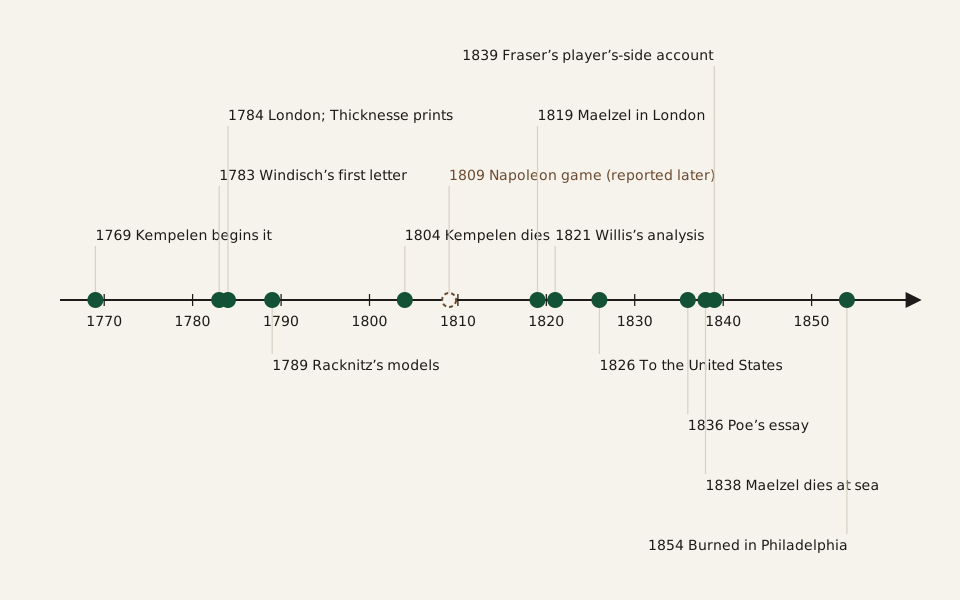
Diagram: Hoax and Hindsight · CC BY 4.0
Credit line to copy
"Dated events in the life of the Mechanical Turk, 1769 to 1854" by Hoax and Hindsight, licensed under CC BY 4.0 (https://creativecommons.org/licenses/by/4.0/). Original: https://hoaxandhindsight.com/proven-fakes/mechanical-turk/
Data: Public-domain printings of 1784–1859 listed in the Exhibits
Dated events from 1769 to 1854. The 1809 game with Napoleon is drawn as a dashed circle because the later accounts of it disagree on its year and place, and no record from the time was read for this page (Exhibits A to H).
The dated events, one row per event, with sources (CSV) (where the data comes from) Data: Public-domain printings of 1784–1859 listed in the Exhibits
Allen traced the end. Schlumberger, Maelzel’s last hidden player, died of yellow fever in Havana early in 1838, and Maelzel died at sea on July 21 that year (Exhibit G, pp. 470, 474). The Turk later went to Philadelphia’s Chinese Museum, and on July 5, 1854, a fire spread there from the National Theatre, across a narrow alley. Allen wrote: “There was plenty of time to have rescued the Chess-player, if anybody had thought of it.” (p. 483) Doubts printed by the very people who promoted a deception also sit at the center of the Cottingley fairy photographs.
Did the Turk beat Napoleon?
The earliest telling read for this page is the 1839 Fraser’s article (Exhibit F, pp. 724–725). In it, the Turk is brought out again when Napoleon reaches Berlin, and Napoleon then plays it, though the article does not say where the game took place. He made a false move on purpose, and the figure put the piece back; at a second false move it took the piece off; at a third it swept every piece from the board.
Illustration: Hoax and Hindsight. Generated schematic illustration — not a photograph or historical record. © Hoax and Hindsight, all rights reserved.
An illustration of an imagined scene of the kind of salon showing the Turk toured: an audience facing a covered cabinet. Not a record of any game, and not a picture of the Turk itself.
The same article says Kempelen had sold the Turk and its secret to Frederick the Great, who left it in a lumber room for 30 years (Exhibit F, p. 724). Allen disagreed on both points in 1859. He put the game at Schönbrunn in 1809, “and not in 1805 nor in Berlin”, relying on an article in Palamède, the chess journal of La Bourdonnais, and on people who reported Maelzel’s own account. The game’s details, he said, had been distorted in the retelling (Exhibit G, p. 424).
On Frederick, Allen noted that Kempelen “died with it in his own possession on the 26th day of March, 1804” (Exhibit G, p. 424). So he could have sold Frederick nothing but the secret, and Allen doubted even that.
Even the 1859 book that printed Allen’s letter tells the story another way in its own sketch of chess history: there, Maelzel brings the Turk out in Berlin in 1806, when Napoleon entered the city, and it defeats the emperor (Exhibit H, p. 46). No record written in 1809 was read for this page. The 1839 telling came 30 years after Allen’s date for the game, and Allen’s own came 50 years after it, so this page treats the game as reported, not recorded.
Popular version vs. the record
Each popular claim below is the charge, with the record set after it. As on every page here, the retrial method applies: the claim must come from a named publication, and the record comes last.
Napoleon played the Turk, tested it with three false moves, and it swept the pieces off the board. Fraser’s Magazine printed this in June 1839, after Napoleon’s arrival in Berlin (Exhibit F, pp. 724–725).
No account written in 1809 was read here. Allen placed the game at Schönbrunn in 1809 and said its details had been distorted, so the earliest version read here came 30 years after the game, by Allen’s date. (Exhibits F, G)
Kempelen sold the Turk to Frederick the Great, who shut it away for years. Fraser’s Magazine printed this in 1839 (Exhibit F, p. 724).
Allen wrote in 1859 that Kempelen still owned the machine when he died on March 26, 1804, and that his son sold it to Maelzel. Windisch, writing in 1783, described Kempelen showing it. (Exhibits C, G)
Its audiences took it for a pure machine. Poe wrote in 1836 that the most general opinion was that no human agency was involved (Exhibit B, p. 321).
This partly matches the record. Windisch was persuaded by the opened doors, but he wrote in 1783 that many in the company first said a child was inside, and Thicknesse printed that a hidden player worked it in 1784. (Exhibits C, D)
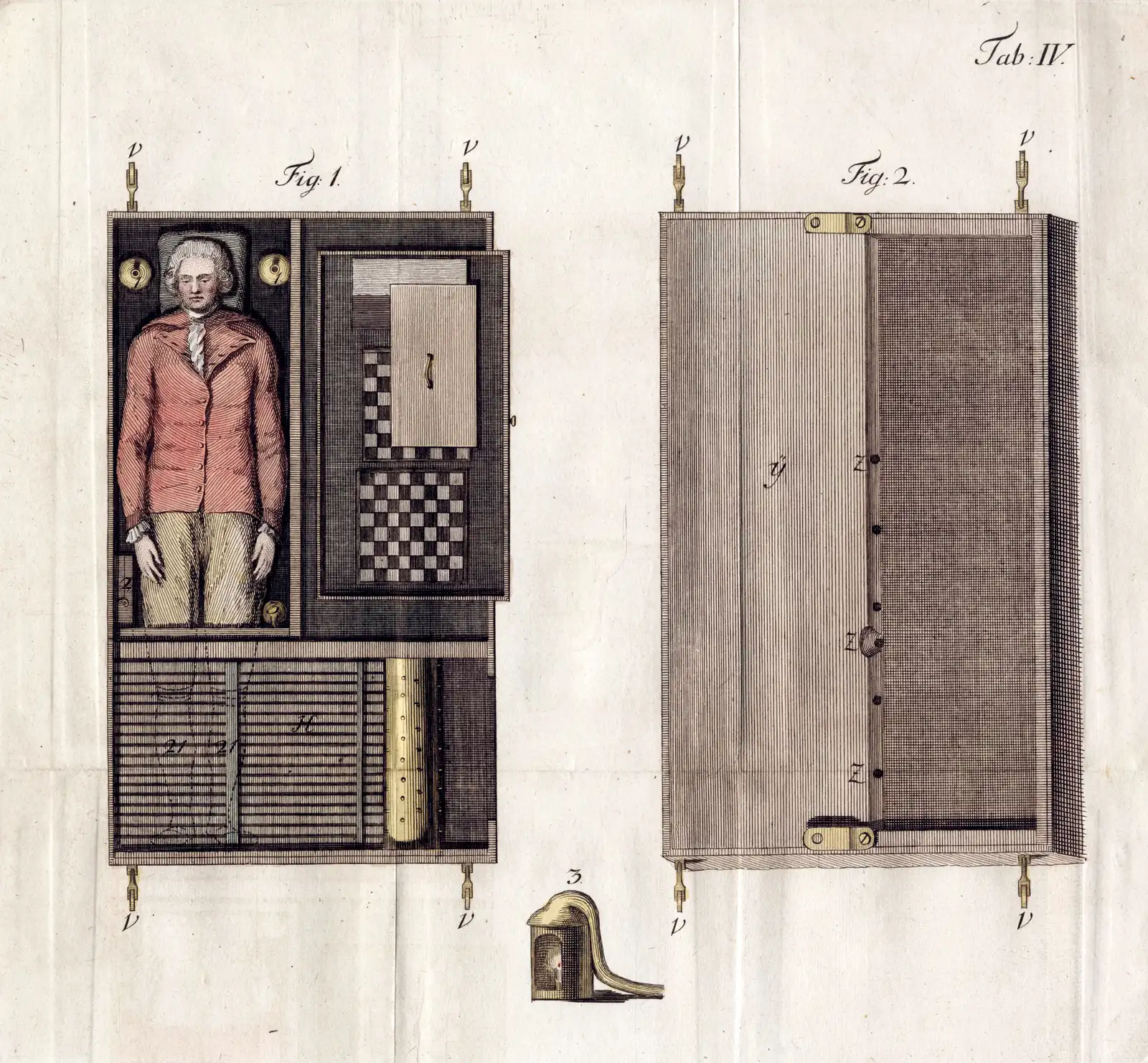
“Plate IV (Tab. IV) of Joseph Friedrich zu Racknitz, Ueber den Schachspieler des Herrn von Kempelen und dessen Nachbildung (1789)” · Joseph Friedrich zu Racknitz · Public domain
Full credit
"Plate IV (Tab. IV) of Joseph Friedrich zu Racknitz, Ueber den Schachspieler des Herrn von Kempelen und dessen Nachbildung (1789)" by Joseph Friedrich zu Racknitz — https://commons.wikimedia.org/wiki/File:Racknitz_-_The_Turk_4.jpg — Public domain (engraved plate published in 1789: public domain in the US (published before 1931); in the EU the term has long expired, since the book's author and any engraver working on a plate printed in 1789 died well over 70 years ago (an engraver active in 1789 cannot have lived past 1955); the scan is a faithful photographic reproduction of a two-dimensional public-domain work, which adds no new copyright in the US (PD-Art) or in the EU (Directive (EU) 2019/790, Art. 14); marked Public Domain Mark 1.0 on Commons. Commons gives the source as the Humboldt University Library, the same library as plate I.)
Plate 4 of Racknitz’s 1789 book: the inside of the cabinet drawn flat, with a hidden player shown in place. The idea that a person worked the Turk was in print in Kempelen’s lifetime (Exhibits E, G).
How did the Mechanical Turk work?
A skilled chess player hid inside the cabinet, by the accounts of Willis in 1821 and of Fraser’s Magazine in 1839. The opening routine showed the cabinet one part at a time while the player moved out of each part before it was shown. According to the 1839 account, he then followed the moves from magnets under the board and guided the figure’s arm.
Who was inside the Mechanical Turk?
Several players over the years. Fraser’s Magazine named the Frenchman Mouret and an unnamed English player in London from 1819. George Allen in 1859 named William Lewis as a former player and Schlumberger as Maelzel’s last, who died in Havana in 1838.
Did the Mechanical Turk beat Napoleon?
The game is reported, not recorded, in the sources read here. The earliest telling found is from 1839 and ties it to Napoleon’s arrival in Berlin; George Allen in 1859 put it at Schönbrunn in 1809 and said its details had been distorted. No account from 1809 was found.
What happened to the Mechanical Turk?
It burned in a fire at the Chinese Museum in Philadelphia on July 5, 1854, by George Allen’s 1859 account. That was 85 years after Kempelen began it in 1769, by Windisch’s account.
What would overturn it:
- A record from Schönbrunn in 1809 describing the game. A letter, diary or court list written at the time, naming Napoleon and the Turk, would move the game from report to record; one placing Napoleon elsewhere would count against it.
- Kempelen’s own papers showing an automatic player. Workshop drawings or a surviving mechanism that chose moves with no person inside would reopen the finding that a hidden player worked the Turk.
Exhibits
- Exhibit A: [Robert Willis], An Attempt to Analyse the Automaton Chess Player of Mr. de Kempelen (London: J. Booth, 1821). Published without the author’s name; dated December 1820.
- Exhibit B: [Edgar Allan Poe], “Maelzel’s Chess-Player,” Southern Literary Messenger 2, no. 5 (April 1836): 318–326.
- Exhibit C: [Karl Gottlieb von Windisch], Inanimate Reason; or a Circumstantial Account of that Astonishing Piece of Mechanism, M. de Kempelen’s Chess-Player (London: S. Bladon, 1784). English translation, translator not named, of letters dated from Pressburg in 1783.
- Exhibit D: Philip Thicknesse, The Speaking Figure, and the Automaton Chess-Player, Exposed and Detected (London: John Stockdale, 1784).
- Exhibit E: Joseph Friedrich zu Racknitz, Ueber den Schachspieler des Herrn von Kempelen und dessen Nachbildung (Breitkopf, 1789), preface (“Vorbericht”), dated Dresden, September 1789.
- Exhibit F: “Anatomy of the Chess Automaton,” Fraser’s Magazine for Town and Country 19, no. 114 (June 1839): 717–731. Unsigned.
- Exhibit G: George Allen, “The History of the Automaton Chess-Player in America,” a letter to William Lewis signed “G. A., Philadelphia, May 18th, 1859,” in Daniel Willard Fiske, The Book of the First American Chess Congress (New York: Rudd & Carleton, 1859), 420–484.
- Exhibit H: Daniel Willard Fiske, The Book of the First American Chess Congress (New York: Rudd & Carleton, 1859), sketch of the history of chess, pp. 35, 46, and chess in America, p. 336.
Cite this page
Hoax and Hindsight. “Mechanical Turk: Its Hidden Player Was Suspected in 1784.” Hoax and Hindsight, published November 6, 2026. https://hoaxandhindsight.com/proven-fakes/mechanical-turk/. Accessed [the date you read it].
Related cases
 Illustration
Vinland Map: Yale Found a Pigment First Sold in the 1920s
The Vinland Map is a forgery, Yale said in 2021: a titanium pigment that went on sale in the 1920s runs through its lines. Key tests from 1965 to 2021.
Picture credit
Illustration: Hoax and Hindsight. Generated schematic illustration — not a photograph or historical record. © Hoax and Hindsight, all rights reserved.
Cottingley Fairies: Kodak Would Not Vouch, Doyle’s Book Says
Arthur Conan Doyle’s 1922 book records that Kodak’s experts found no trick in the Cottingley fairy negatives in 1920, yet would not certify them as genuine.
Picture credit
"Dancing fairies, illustration by Claude A. Shepperson in Princess Mary's Gift Book (1914)" by Claude A. Shepperson — https://commons.wikimedia.org/wiki/File:Cottingley_fairies_illustration.jpg — Public domain (US: published in London in 1914, before January 1, 1931. EU: Claude A. Shepperson died in 1921 (life dates 1867-1921 on the Commons file page and in the image-rights review of 2026-11-05), more than 70 years ago. Scan chain: the Commons file gives as its source the Internet Archive scan princessmarysgif00mary (University of California Libraries, collection cdl, not a lending item; its metadata, read 2026-11-05, gives the date [1914] and the publisher Hodder & Stoughton). Page and poem checked in review on 2026-11-06 against the same scan: the _djvu.txt text and the scan page for printed p. 104 (leaf 130 in the item's page-number file) show the drawing below the last stanzas of Alfred Noyes, 'A Spell for a Fairy' (pp. 101-104), headed 'Painting and Drawings by Claude A. Shepperson, A.R.W.S.'; the contents page lists the poem under Noyes with the same credit. The IA item metadata was re-read the same day (collection cdl and americana, possible-copyright-status NOT_IN_COPYRIGHT, not a lending item).); modified: card and share image cropped by the site build to the card proportions; the article page shows the full drawing
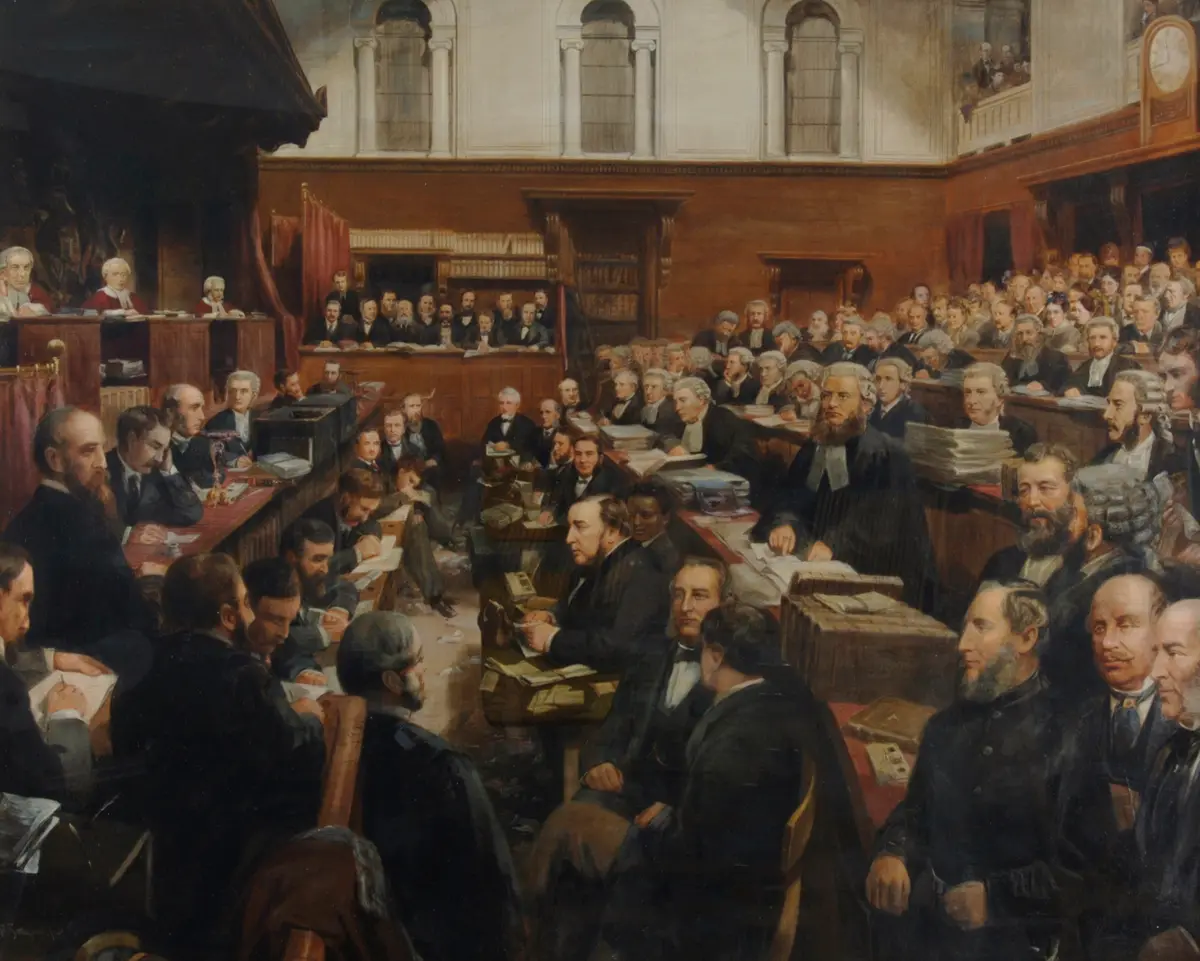
Anna Anderson and the Tichborne Claimant: A Jury, Then DNA
A London jury convicted the Tichborne Claimant of perjury in 1874; DNA tests published in 1995 exposed Anna Anderson, per a 2009 study. Two proofs compared.
Picture credit
"The Tichborne Trial, oil painting by Frederick Sargent (Hampshire County Council Museums Service, FA2005.237.1)" by Frederick Sargent — https://commons.wikimedia.org/wiki/File:The_Tichborne_Trial_by_Frederick_Sargent.jpg — Public domain (oil painting by Frederick Sargent (1837-1899, per the Commons creator record; not checked against another source): public domain in the EU (painter dead for more than 70 years) and in the US (author died before 1956, so even an unpublished work is out of copyright); the image is a faithful photographic reproduction of a two-dimensional public-domain work (PD-Art), which adds no new copyright in the US or in the EU (Directive (EU) 2019/790, Art. 14); marked Public Domain Mark 1.0 on Commons. Risk noted: the photograph came from Art UK for a UK collection, and a UK museum may claim rights in the reproduction; accepted in the image rights ruling of 2026-11-05 (log, image ruling 8).)