Past Futures · Comparison and lineage
“Everything That Can Be Invented”: Not in Duell’s Report
Hoax and Hindsight Published
“Everything that can be invented has been invented” is not in Charles H. Duell’s report for 1899, pages iii–xii. That Patent Office report ends by asking Congress to help inventors, and the earliest printing of the line found for this page is a joke in Punch’s Almanack for 1899, spoken by an office boy.
Docket
- Case
- “Everything that can be invented has been invented”
- Years
- Attributed to 1899; Duell’s report for that year is dated January 31, 1900
- Place
- U.S. Patent Office, Washington
- The claim
- That the head of the Patent Office said invention was finished and wanted his office closed
- The verdict
- Finding of the source check: the line is not in Duell’s report for 1899 (pp. iii-xii), which asks Congress to help inventors; the earliest printing found here is a joke in Punch’s Almanack for 1899
- Hinges on
- The text of the 1899 report and the earliest printing of the line found for this page
- Status
- As of current evidence
Docket as CSVWhere these entries come from (JSON)Data: Report of the Commissioner of Patents for 1899 (1900); Punch's Almanack for 1899; John Baillie (2014)
The line is still pinned on Duell, who was U.S. Commissioner of Patents in 1899. A 2014 editorial in Endoscopy International Open called it a famous quote attributed to him and said he had pressed that year for his own office to be closed, while noting that it is not clear he ever said it (Exhibit E). This page treats that attribution as the charge and calls the printed record, starting with the report Duell signed.
Order of proceedings 4 parts
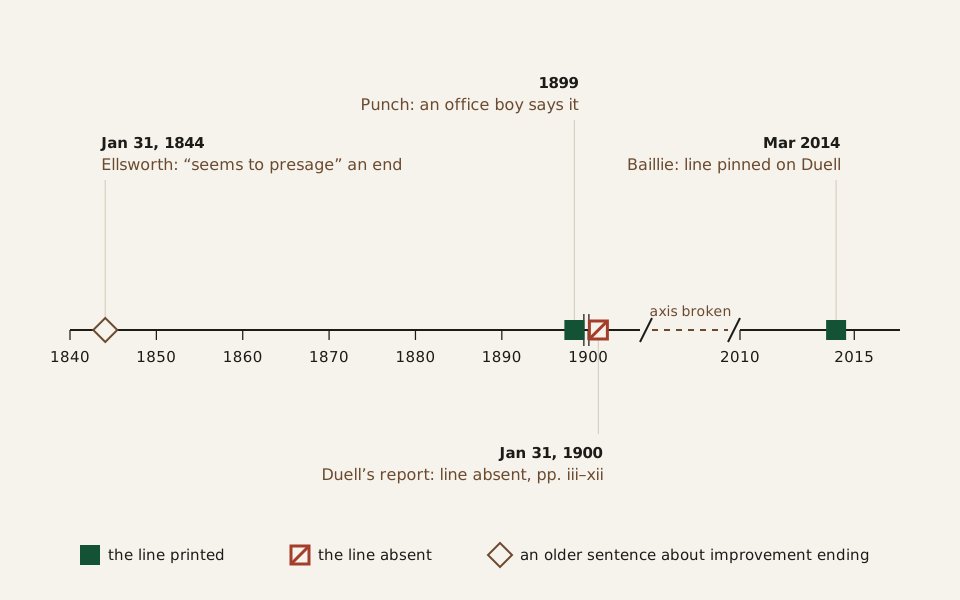
Diagram: Hoax and Hindsight · CC BY 4.0
Credit line to copy
"Printings of the line and its neighbours, 1844 to 2014" by Hoax and Hindsight, licensed under CC BY 4.0 (https://creativecommons.org/licenses/by/4.0/). Original: https://hoaxandhindsight.com/past-futures/everything-that-can-be-invented/
Data: Report of the Commissioner of Patents for 1843 (1844) and for 1899 (1900); Punch's Almanack for 1899; John Baillie (2014)
Four printings read for this page, by date: an older sentence by Commissioner H. L. Ellsworth, the Punch joke, Duell’s own report, and a 2014 attribution. The two reports are placed at the dates they were signed. The date on which the line was tied to Duell’s name was not traced (Exhibits A, B, C, E).
The printings, one row per printing, with sources (CSV) (where the data comes from) Data: Report of the Commissioner of Patents for 1843 (1844) and for 1899 (1900); Punch's Almanack for 1899; John Baillie (2014)
What does Duell’s report for 1899 say?
The report covers the business of the Patent Office for the year ending December 31, 1899. Duell dated it January 31, 1900, and it was laid before the Senate on February 19, 1900 (Exhibit A, p. iii). He signed it as Commissioner and wrote that he had then held the post for two years (p. xi).
Its numbers describe an office with more work every year. In 1899 it received 38,937 applications for patents on inventions, 2,400 for designs and 106 for reissues, 41,443 in all, and it issued 25,435 patents, designs included (pp. iii–iv). The “field of search,” the earlier patents and books an examiner had to check, “increases greatly every year,” and the new system of classes had to be “sufficiently elastic to provide for future growth” (p. viii).
Most of the closing pages are requests. The business of the office “increases from year to year,” Duell wrote, so it needed more space, and he backed Senate Bill No. 1,159 for a fireproof building “including a Hall of Inventions” (p. x). He asked for money to keep the library “abreast of the progress” in the mechanical and manufacturing arts, and for a rule that an application pending more than three years would lose part of its seventeen-year term (p. xi). The report is his own account to Congress, written partly to win room and money, so it shows what he chose to tell lawmakers, not every view he held.
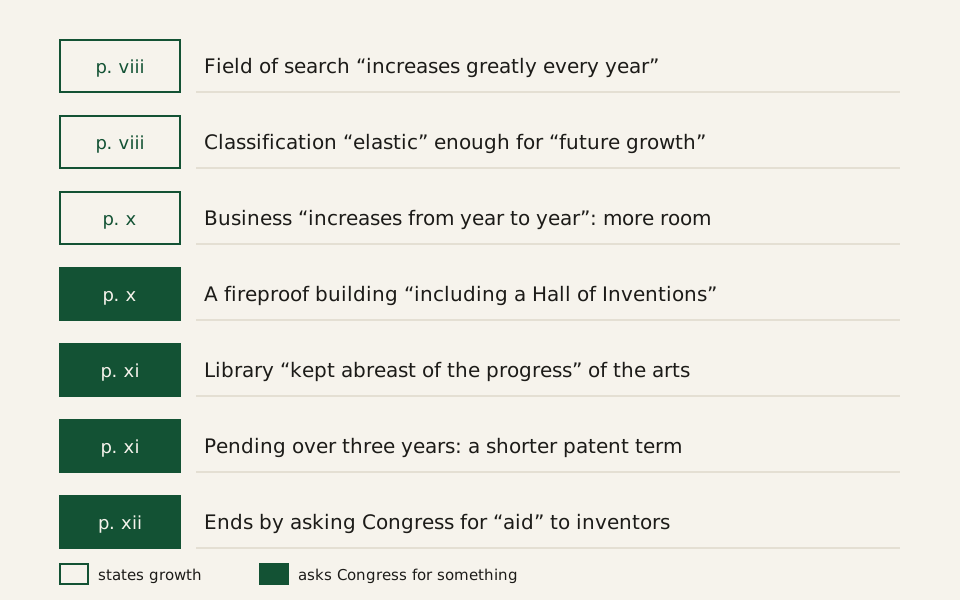
Diagram: Hoax and Hindsight · CC BY 4.0
Credit line to copy
"What Duell’s report for 1899 says about growth and asks of Congress" by Hoax and Hindsight, licensed under CC BY 4.0 (https://creativecommons.org/licenses/by/4.0/). Original: https://hoaxandhindsight.com/past-futures/everything-that-can-be-invented/
Data: Report of the Commissioner of Patents to Congress, for the Year Ending December 31, 1899 (Washington: Government Printing Office, 1900)
Seven statements from the report for 1899, in page order. Hollow tags state growth; filled tags ask Congress for something (Exhibit A).
The last page quotes President McKinley’s annual message of December 5, 1899: “To invention we must turn as one of the most powerful aids to the accomplishment of such a result.” Duell then closed with a question: “May not our inventors hopefully look to the Fifty-sixth Congress for aid and effectual encouragement in improving the American patent system?” (Exhibit A, p. xii) Nowhere from page iii to page xii does the report say that invention was over.
The two reports, one row per statement, with pages (CSV) (where the data comes from) Data: Report of the Commissioner of Patents for 1843 (1844) and for 1899 (1900)
Where does the line come from?
The earliest printing of the line found for this page is in Punch’s Almanack for 1899, in a run of short comic scenes headed “The Coming Century” (Exhibit B). One scene is set in the office of a publisher. A visitor called Genius asks for the manager of the book department and is told there is none, and that the pictures are done by machinery.
When he asks whether there is a clerk who can examine patents, an office boy answers that none is needed: “Everything that can be invented has been invented.” (Exhibit B) The joke is about a future run by machines. Its speaker is a boy in a publisher’s office, and no commissioner or patent office appears in the joke. The Almanack pages in the volume read here carry no page numbers, so the citation gives the title of the scene.
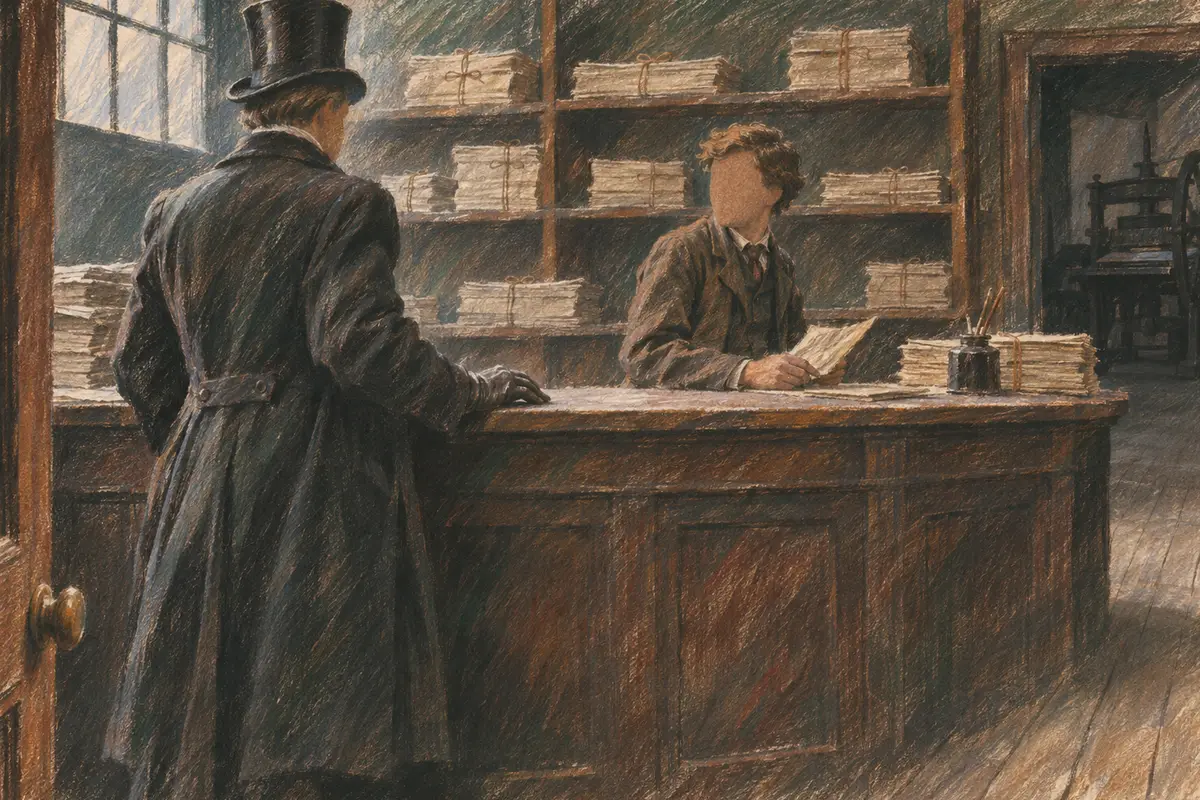
Illustration: Hoax and Hindsight. Generated schematic illustration — not a photograph or historical record. © Hoax and Hindsight, all rights reserved.
An illustration of an imagined scene, not a page from Punch: a visitor at the counter of a publisher’s office and the office boy who answers him, the setting of the joke in the Almanack for 1899.
An earliest printing found is a limit, not a first use. In dating terms it is a terminus ante quem, a date by which the line must already have existed; an older printing may still turn up. The same reasoning is set out on how a dated printing gives a latest date, not a first one.
This page did not trace when the line first became attached to Duell’s name. Between the Almanack joke and the 2014 editorial, no printing that names Duell was read here, and the timeline above leaves that stretch empty.
Do other claims of impossibility have a source?
One commissioner came close to the famous line, 56 years before Duell’s report. H. L. Ellsworth’s report for 1843, dated January 31, 1844, has this sentence: “The advancement of the arts from year to year taxes our credulity, and seems to presage the arrival of that period when human improvement must end.” (Exhibit C, p. 5)
Read in place, the sentence follows his note on papers about recent improvements, which the office’s examiners wrote at his request and which Ellsworth called “full of encouragement and gratification to the American people” (pp. 5–6). Earlier in the same report he wrote that the progress of improvement in the arts brought “a renewed demand for greater accommodations” every year (p. 2). Like Duell, he used growth to ask for room.
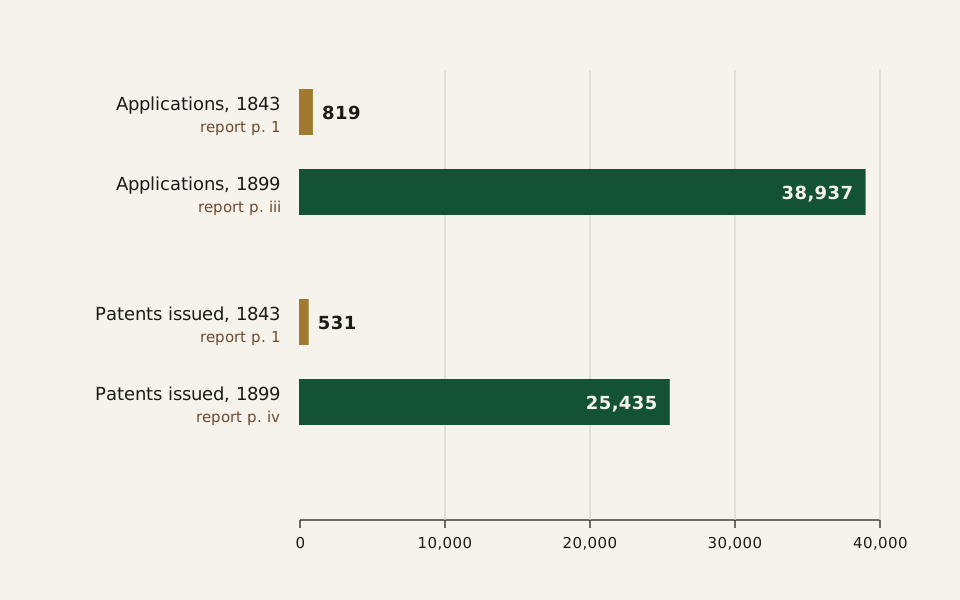
Diagram: Hoax and Hindsight · CC BY 4.0
Credit line to copy
"Applications and patents in Ellsworth’s report for 1843 and Duell’s report for 1899" by Hoax and Hindsight, licensed under CC BY 4.0 (https://creativecommons.org/licenses/by/4.0/). Original: https://hoaxandhindsight.com/past-futures/everything-that-can-be-invented/
Data: Report of the Commissioner of Patents for 1843 (1844), p. 1; Report of the Commissioner of Patents for 1899 (1900), pp. iii-iv
Applications and patents as each report counts them: Ellsworth’s for 1843 (p. 1) and Duell’s for 1899 (pp. iii–iv). The 1899 application figure counts inventions only (Exhibits A, C).
The two reports show how much the work grew. Ellsworth counted 819 applications for patents in 1843 and 531 patents issued (Exhibit C, p. 1). Duell counted 38,937 applications for inventions in 1899, nearly 48 times as many, and 25,435 patents issued (Exhibit A, pp. iii–iv).
An impossibility claim with a firm source looks different. In April 1836 the Southern Literary Messenger printed an unsigned essay by Edgar Allan Poe on the Mechanical Turk, a chess-playing figure then on tour (Exhibit D). If the Turk were a “pure machine,” he wrote, “we must be prepared to admit that it is, beyond all comparison, the most wonderful of the inventions of mankind” (p. 319). He then argued that it was not one: “It is quite certain that the operations of the Automaton are regulated by mind, and by nothing else.” (p. 319)
Poe’s claim has a date, a journal and a page, so it can be tested. Later accounts bear him out about the Turk itself, as the retrial of the Mechanical Turk and Poe’s 1836 argument sets out. The line pinned on Duell has no such anchor, so this page checks a source instead of scoring a forecast. Forecasts with a printed date are scored item by item under the Hindsight score rules, as with Halley’s 1705 forecast of the comet’s return and the Ladies’ Home Journal’s 1900 forecasts, scored item by item.
Popular version vs. the record
Each popular claim below is the charge, with the record set after it, under the retrial method: the claim must come from a named publication, and the record comes last.
Duell said “everything that can be invented has been invented.” John Baillie repeated it in Endoscopy International Open in 2014 as a famous quote attributed to Duell, adding that it is not clear he said it (Exhibit E, pp. E43–E44).
The line is not in Duell’s report for 1899 (pp. iii–xii). The earliest printing found here is a joke in Punch’s Almanack for 1899, spoken by an office boy, with no commissioner in it. (Exhibits A, B)
Duell wanted his office closed. The same editorial says he “lobbied in 1899 for the closure of his department” (Exhibit E, pp. E43–E44).
His report asks Congress for a larger fireproof building with a Hall of Inventions, more money for the library and a shorter patent term for applications left pending over three years, and it ends by asking for “aid” to inventors. (Exhibit A, pp. x–xii)
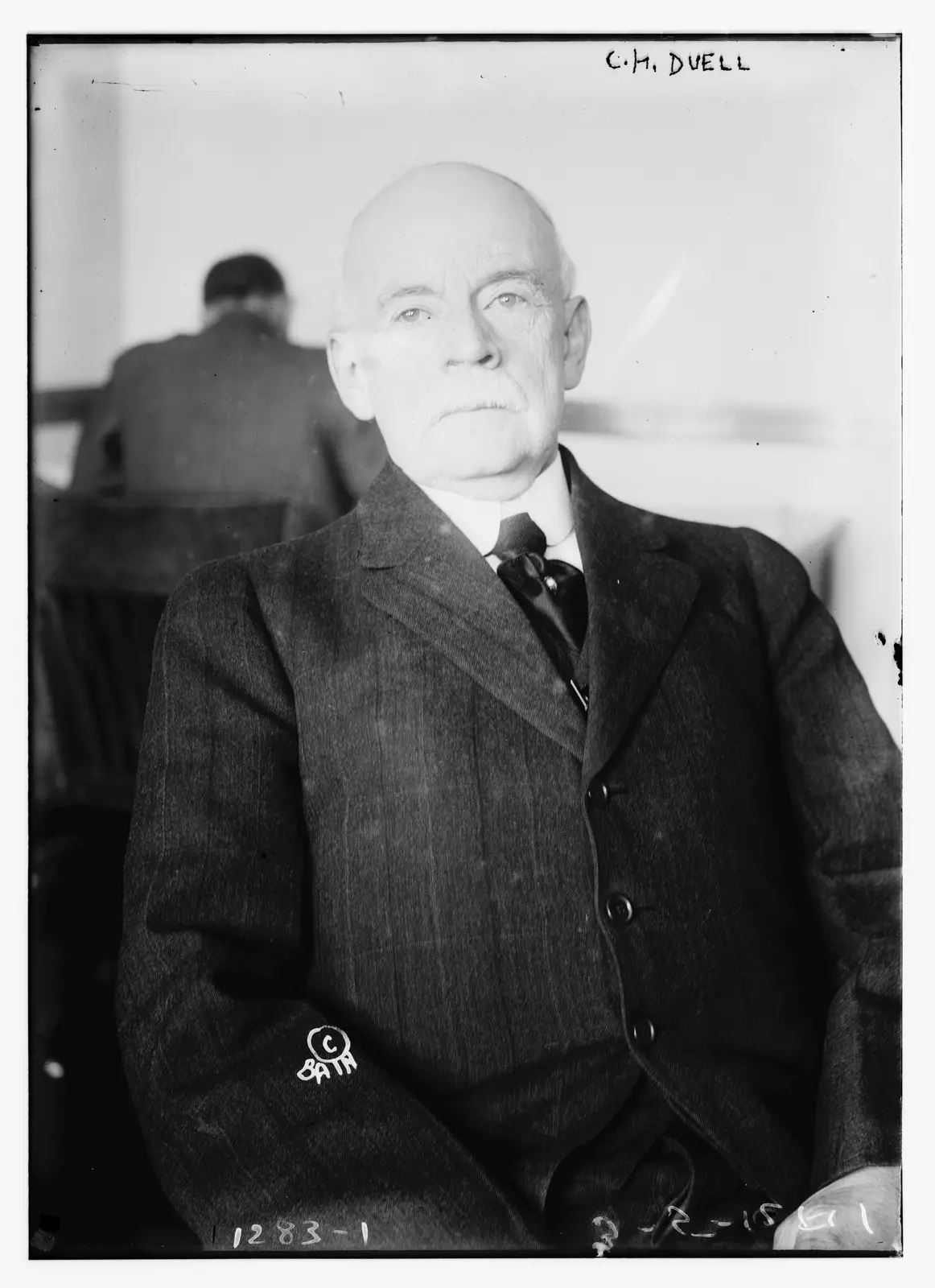
“C.H. Duell” · Bain News Service · Public domain
Full credit
"C.H. Duell" by Bain News Service — https://commons.wikimedia.org/wiki/File:C.H._Duell_LCCN2014686661.jpg — Public domain (news-agency photograph by the Bain News Service, no named photographer; the negative is marked 3-2-15, read here as March 2, 1915 (Bain negatives are marked month-day-year; the library's date of 1900 is a catalogue placeholder). US: public domain on the ground that Bain distributed its photographs to newspapers when they were taken, which counts as publication, and this was before 1931. Risk: whether this negative was actually distributed in 1915 has not been checked; if it was never published, an anonymous unpublished US work of 1915 is protected until 120 years after creation (end of 2035). EU: anonymous work, 70 years from first making available (or, if never made available, from creation), long expired. Library of Congress Prints and Photographs, George Grantham Bain Collection, ggbain.06669, 'No known restrictions on publication' (a lead, not the basis))
Charles H. Duell, photographed by the Bain News Service. The negative is marked 3-2-15, most likely March 2, 1915, which would be 15 years after he signed the report for 1899 (Exhibit A).
Who said “everything that can be invented has been invented”?
In the earliest printing found for this page, an office boy says it in a comic scene in Punch’s Almanack for 1899. The line is not in the text of Charles H. Duell’s report for 1899, pages iii to xii, and no printing before 2014 that names him was read here.
What did Charles Duell actually say?
His report for 1899, dated January 31, 1900, says the business of the Patent Office “increases from year to year” and backs a fireproof building including a Hall of Inventions. It ends by asking whether inventors may look to Congress “for aid and effectual encouragement.”
Did Duell want to close the Patent Office?
Not in his report for 1899, the document read here. It asks for a larger building, more money for the library and a shorter patent term for applications left pending more than three years.
What would overturn it:
- A printing from Duell’s time in office that quotes him saying the line. A report, speech or newspaper interview with a date and page would move the attribution from charge to record.
- A printing of the line older than Punch’s Almanack for 1899. It would replace the joke as the earliest known source, though it would not by itself tie the line to Duell.
Exhibits
- Exhibit A: Report of the Commissioner of Patents to Congress, for the Year Ending December 31, 1899 (Washington: Government Printing Office, 1900), signed C. H. Duell, Commissioner, dated January 31, 1900; laid before the Senate February 19, 1900.
- Exhibit B: “The Coming Century” (Scene: Office of a Publisher), Punch’s Almanack for 1899, bound in Punch, or the London Charivari, vol. 116 (London, 1899), unnumbered Almanack pages; unsigned.
- Exhibit C: Report of the Commissioner of Patents, for the Year 1843, House Doc. No. 177, 28th Congress, 1st Session (Washington: Blair & Rives, 1844), signed H. L. Ellsworth, dated January 31, 1844.
- Exhibit D: [Edgar Allan Poe], “Maelzel’s Chess-Player,” Southern Literary Messenger 2, no. 5 (April 1836): 318–326.
- Exhibit E: John Baillie, “ERCP in the elderly: handle with care,” Endoscopy International Open 2, no. 1 (2014): E43–E44, doi:10.1055/s-0034-1365483.
Cite this page
Hoax and Hindsight. ““Everything That Can Be Invented”: Not in Duell’s Report.” Hoax and Hindsight, published November 6, 2026. https://hoaxandhindsight.com/past-futures/everything-that-can-be-invented/. Accessed [the date you read it].
Related cases
Ladies’ Home Journal 1900 Predictions: 68 Items, 48 Scored
Ladies’ Home Journal 1900 predictions for 2000, split into 68 items and scored: 11 of 48 came true, 27 of 48 counting partial hits; 20 items not scorable.
Picture credit
"The Ladies’ Home Journal, May 1900: The Spring-Tide Awakening of Life and Labor (poster)" by Frank Walter Taylor — https://commons.wikimedia.org/wiki/File:Rudyard_Kipling%27s_Great_Animal_Stories_The_Ladies%27_Home_Journal_May,_1900_-_Ten_cents_The_Spring-Tide_Awakening_of_Life_and_Labor_The_Curtis_Publishing_Company,_Phi,_asset_R2lUHTjMXnRWIWGJgUnisGyp.tif — Public domain (US: published in 1900, before 1931 (public domain). EU: designer Frank Walter Taylor died on July 27, 1921 (date of death 27 July 1921 on the Commons category page F. Walter Taylor, whose infobox is drawn from Wikidata; page archived in the image rights check of 2026-11-05; ULAN 500009621 gives the same years; not confirmed from a printed source), more than 70 years ago; the poster is signed 'designed by Frank Walter Taylor'. Scan chain: Commons file uploaded from the image bank of the city of Antwerp (dams.antwerpen.be asset R2lUHTjMXnRWIWGJgUnisGyp), object held by the Letterenhuis, Antwerp, AV.14.6.54. The poster's own notice of British and American copyright in 1900 has expired.); modified: converted from TIFF to JPEG, scaled from 3,080 x 4,568 to 1,349 x 2,000 px; not cropped (paper edges kept)
Halley’s Comet: The 1758 Return Halley Foretold, Never Saw
Halley’s Comet: in 1705 Halley wrote it would return in 1758. It was seen on Christmas night 1758, after his death. His forecast, split into 5 claims, scored.
Picture credit
"Halley’s Comet 1835-6 (plate I in The Story of the Comets)" by C. P. Smyth — https://commons.wikimedia.org/wiki/File:The_story_of_the_comets_-_Plate_I.jpg — Public domain (US: published 1909, before 1931 (PD-1923 on Commons). EU: C. P. Smyth died 1900 and George F. Chambers died 1915, both more than 70 years ago; the plate maker is not named and the book was published in 1909, more than 70 years ago. Scan chain: Commons file from en.wikisource Page:The_story_of_the_comets.djvu/6, whose djvu is the University of Toronto (Gerstein Library) scan on the Internet Archive (storyofcometssim00chamuoft).)
 Illustration
Albert Robida’s Novel vs. 1956: Strict 3/9, Lenient 6/9
Albert Robida’s La Vie électrique, set in December 1955, split into 27 items and scored: 3 of 9 came true, 6 of 9 with partial hits; 18 are not scorable.
Picture credit
Illustration: Hoax and Hindsight. Generated schematic illustration — not a photograph or historical record. © Hoax and Hindsight, all rights reserved.