Past Futures · Prediction ledger
Halley’s Comet: The 1758 Return Halley Foretold, Never Saw
Hoax and Hindsight Published
Halley’s 1705 forecast said the comet would return “in the Year 1758,” and it was seen on Christmas night 1758. Split into five claims from A Synopsis of the Astronomy of Comets (London, 1705) and scored under fixed rules, the forecast gets 3 of 4 by the strict count and 4 of 4 by the lenient count, with one claim not scorable; the date itself is a partial hit, because the comet passed closest to the Sun only in March 1759.
Docket
- Case
- Edmond Halley’s 1705 forecast of the comet’s return
- Years
- 1705 → 1758–1759
- Place
- Forecast printed in London; the earliest known sighting of the return was at Prohlis, near Dresden
- The claim
- The comets of 1531, 1607 and 1682 were one comet, and it would “return again in the Year 1758”
- The verdict
- Hindsight score: strict 3/4, lenient 4/4; 1 not scorable; judged 2026-11-05
- Hinges on
- The earliest known sighting on December 25, 1758, and the perihelion on March 12, 1759, set against Halley’s words “in the Year 1758”
- Status
- Expired
Edmond Halley never saw the return he named. He died in 1742, sixteen years before the comet came back, according to the astronomer George F. Chambers in The Story of the Comets (1909; Exhibit C). The forecast itself is printed on page 22 of the 1705 English edition (Exhibit A), where the title page spells his name Edmund.
As with any old prediction on this site, the claims are listed first, and each one is then graded against what happened. The grades follow the Hindsight score rules, and the sources are cited as Exhibits under the site’s retrial method.
Order of proceedings 7 parts
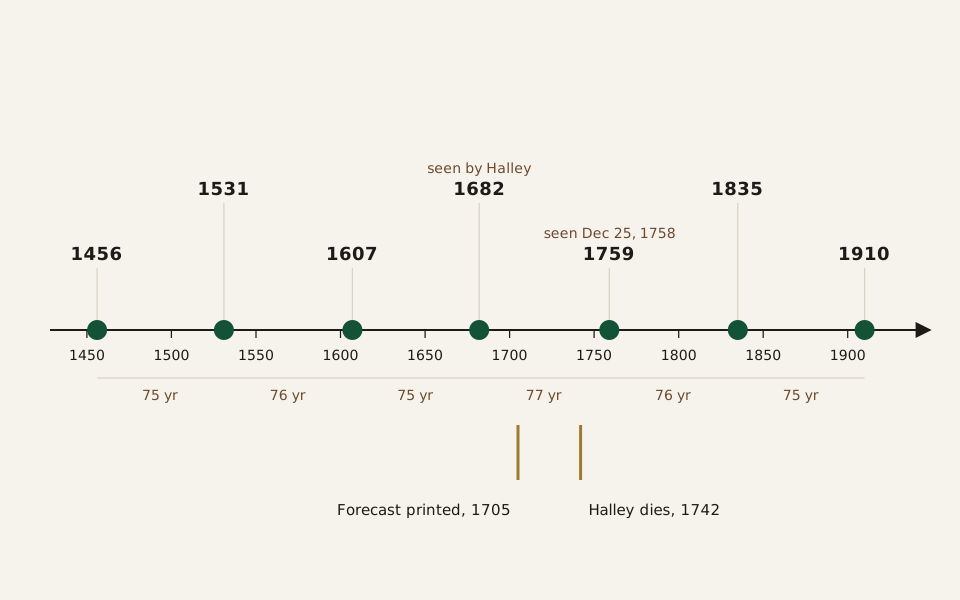
Diagram: Hoax and Hindsight · CC BY 4.0
Credit line to copy
"Returns of Halley’s Comet, 1456 to 1910" by Hoax and Hindsight, licensed under CC BY 4.0 (https://creativecommons.org/licenses/by/4.0/). Original: https://hoaxandhindsight.com/past-futures/halleys-comet/
Data: Edmund Halley, A Synopsis of the Astronomy of Comets (1705); George F. Chambers, The Story of the Comets (1909); Encyclopaedia Britannica, 11th ed., vol. 6 (1910), "Comet"
Seven returns of the comet, from 1456 to 1910, with the gap in years between each pair; the earliest known sighting of the 1759 return was on December 25, 1758. Drawn from the table of returns published with this page, compiled from Halley (Exhibit A), Chambers (Exhibit C) and the 1911 Britannica (Exhibit D).
The returns, one row per appearance with sources (CSV) (where the data comes from) Data: Edmund Halley, A Synopsis of the Astronomy of Comets (1705); George F. Chambers, The Story of the Comets (1909); Encyclopaedia Britannica, 11th ed., vol. 6 (1910), "Comet"
What did Halley print in 1705?
Halley had worked out orbits for every comet with good enough observations and set them out in one table (Exhibit A, pp. 6–7). Three of them looked alike. He wrote that there were “many Things which make me believe” that the comet Peter Apian watched in 1531 was the one Kepler and Longomontanus described in 1607, “and which I my self have seen return” in 1682 (Exhibit A, p. 21).
“Halley’s Comet, Jan. 9, 1683 (N. S.), shewing luminous sector” · Johannes Hevelius · Public domain
Full credit
"Halley’s Comet, Jan. 9, 1683 (N. S.), shewing luminous sector" by Johannes Hevelius — https://commons.wikimedia.org/wiki/File:The_story_of_the_comets_-_Halleys%27s_Comet,_Jan._9,_1683_(N._S.),_shewing_luminous_sector.jpg — Public domain (US: the 1909 reproduction was published before 1931 (PD-1923 on Commons). EU: Hevelius died on January 28, 1687 (Encyclopaedia Britannica, 11th ed., vol. 13 (1910), article Hevelius, Johann, p. 417) and Chambers in 1915, both more than 70 years ago; the woodcut maker is not named and the book appeared in 1909. Scan chain: en.wikisource Page:The_story_of_the_comets.djvu/147, from the University of Toronto scan on the Internet Archive (storyofcometssim00chamuoft).)
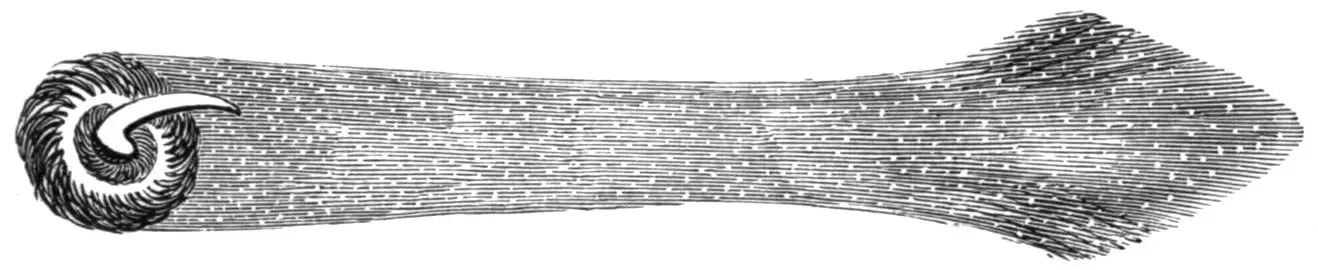
The comet Halley saw in 1682, as drawn by Johannes Hevelius, reproduced in Chambers, The Story of the Comets (1909), p. 105. Chambers dates the drawing January 9, 1683, in his caption, but his text says the ray was seen from about September 8, 1682.
The gaps between those sightings were not equal. Halley addressed that head on. The inequality, he wrote, “is not so great neither, as that it may not be owing to Physical Causes,” and he compared the pull that Jupiter puts on Saturn. He added a fourth sighting, a comet of summer 1456, and then came to the sentence that made the comet his: “Hence I dare venture to foretell, That it will return again in the Year 1758” (Exhibit A, p. 22).
The 1705 printing matters because it was public long before the test. A dated book shows that the forecast existed by that date at the latest, the kind of evidence explained on how a printed date sets the latest possible date. The dated printing also separates it from a famous line that cannot be traced to the man it is pinned on, the case retried on the 1899 patent-office quotation.
How was the forecast split and scored?
The paragraph on pages 21 and 22 makes five claims that can be checked one at a time. The list below was fixed before any claim was graded; the downloadable table uses the same list. One more sentence was left out: Halley floated the idea that the comets of 1532 and 1661 might be one, then set it aside in the same paragraph because Apian’s observations were “too rude and unskilful, for any thing of Certainty.”
- The comets of 1531, 1607 and 1682 were one comet.
- The unequal gaps between them could come from physical causes.
- The comet of 1456 was the same one.
- It would return in the year 1758.
- If it did, Halley wrote, “we shall have no Reason to doubt” that the other comets return too.
Only item 4 carries a deadline in Halley’s words: the end of 1758. For items 1 to 3 this site reads the deadline as the 1758–1759 return and the orbit work published by 1910. Item 5 has no deadline at all: Halley left the other comets to astronomers “for many Ages” (Exhibit A, p. 22). The same rules score the 1900 Ladies’ Home Journal forecast and Albert Robida’s picture of 1955.
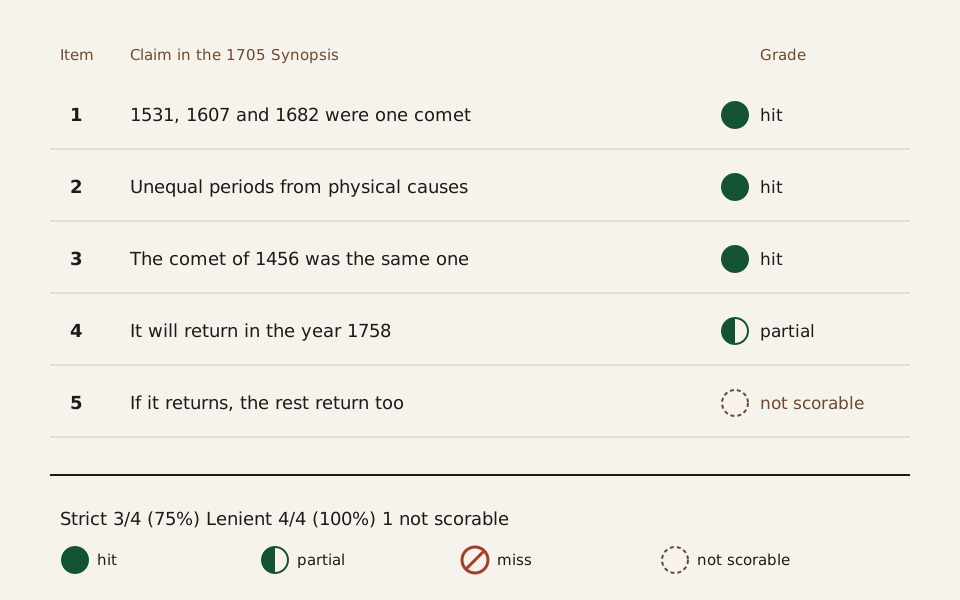
Diagram: Hoax and Hindsight · CC BY 4.0
Credit line to copy
"Halley’s 1705 forecast, item by item" by Hoax and Hindsight, licensed under CC BY 4.0 (https://creativecommons.org/licenses/by/4.0/). Original: https://hoaxandhindsight.com/past-futures/halleys-comet/
Data: Edmund Halley, A Synopsis of the Astronomy of Comets (1705); George F. Chambers, The Story of the Comets (1909); Encyclopaedia Britannica, 11th ed., vol. 6 (1910), "Comet"
Halley’s 1705 forecast, item by item, with the grade for each. Drawn from the forecast table published with this page; claims from Halley (Exhibit A), graded under this site’s rules against the evidence in Chambers (Exhibit C) and the 1911 Britannica (Exhibit D).
| Item | Claim | Grade | Reason | Source |
|---|---|---|---|---|
| 1 | The comets of 1531, 1607 and 1682 were one comet | hit | It came back as forecast, and both reference works of 1909–1910 read here list all three as returns of one comet | Exhibit C, Exhibit D |
| 2 | Unequal gaps could come from physical causes | hit | Clairaut’s 1758 sum of the pull of Jupiter and Saturn put the perihelion 32 days from the real date, which Chambers calls just within his limits | Exhibit C, pp. 107–110 |
| 3 | The comet of 1456 was the same one | hit | Pingré, Chambers reports, turned Halley’s guess into a certainty, and the 1911 Britannica’s table of periodic comets gives a perihelion in June 1456 | Exhibit C, Exhibit D |
| 4 | It will return in the year 1758 | partial | Seen on December 25, 1758, but closest to the Sun on March 12, 1759 | Exhibit C, pp. 109–110 |
| 5 | If it returns, the rest return too | not scorable | No deadline and no list of which comets, or when | Exhibit A, p. 22 |
The five claims, with grades, reasons and sources (CSV) (where the data comes from) Data: Edmund Halley, A Synopsis of the Astronomy of Comets (1705); George F. Chambers, The Story of the Comets (1909); Encyclopaedia Britannica, 11th ed., vol. 6 (1910), "Comet"
By the strict count, 3 of the 4 scorable claims are hits, or 75%. By the lenient count, which adds the partial hit, 4 of 4 hold up. Item 5 is left out of both counts.
When did the comet come back?
The test for item 4 was set before grading: if both the first sighting and the perihelion fell in 1758, the claim is a hit; if one did, it is partial. Perihelion is the point where a comet passes closest to the Sun, and astronomers time its returns by it. The comet met one condition, not both.
Astronomers in Paris had worked the problem first. On November 14, 1758, Alexis Clairaut told the Academy of Sciences that Jupiter would hold the comet back 518 days and Saturn another 100, and he gave April 13, 1759, for the perihelion, allowing a month either way (Exhibit C, pp. 108–109). Clairaut’s paper is known here only through Chambers.
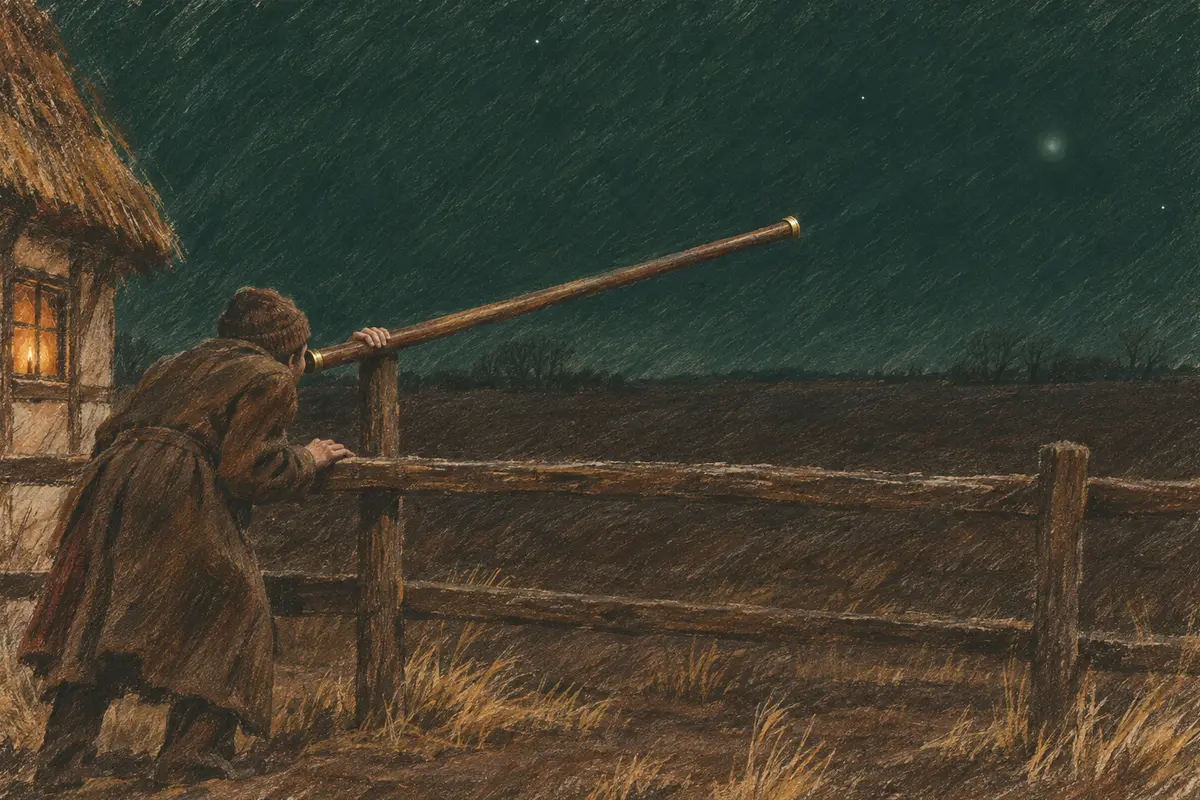
Illustration: Hoax and Hindsight. Generated schematic illustration — not a photograph or historical record. © Hoax and Hindsight, all rights reserved.
Illustration of a winter night in 1758: a farmyard watcher searching the sky with a telescope. Not a record of the first known sighting.
In Chambers’s account, the first person to find it was not a professional. He names Palitzsch, a farmer at Prohlis near Dresden who studied astronomy, and says he “saw it on the night of Christmas Day, 1758,” with a telescope of eight feet focus (Exhibit C, p. 109). Charles Messier in Paris caught it on January 21, 1759. The comet passed perihelion on March 12, 1759, which Chambers calls “just within the limits assigned by Clairaut” (Exhibit C, p. 110), though the gap from Clairaut’s date is 32 days, one day more than a calendar month.
So the comet was back in sight within the year Halley named, with six days to spare, and it reached perihelion on March 12, 1759, 77 days after the first sighting. That split is why item 4 is graded partial, not hit.
Did Halley change the date before he died?
He did, in his later tables. Halley’s astronomical tables came out in 1749, after his death, and an English abridgement printed in London in 1757 reports what they said (Exhibit B). There he recalls that in 1705 he had told readers to watch for the return, “which I expected about the year 1758” (p. 15).
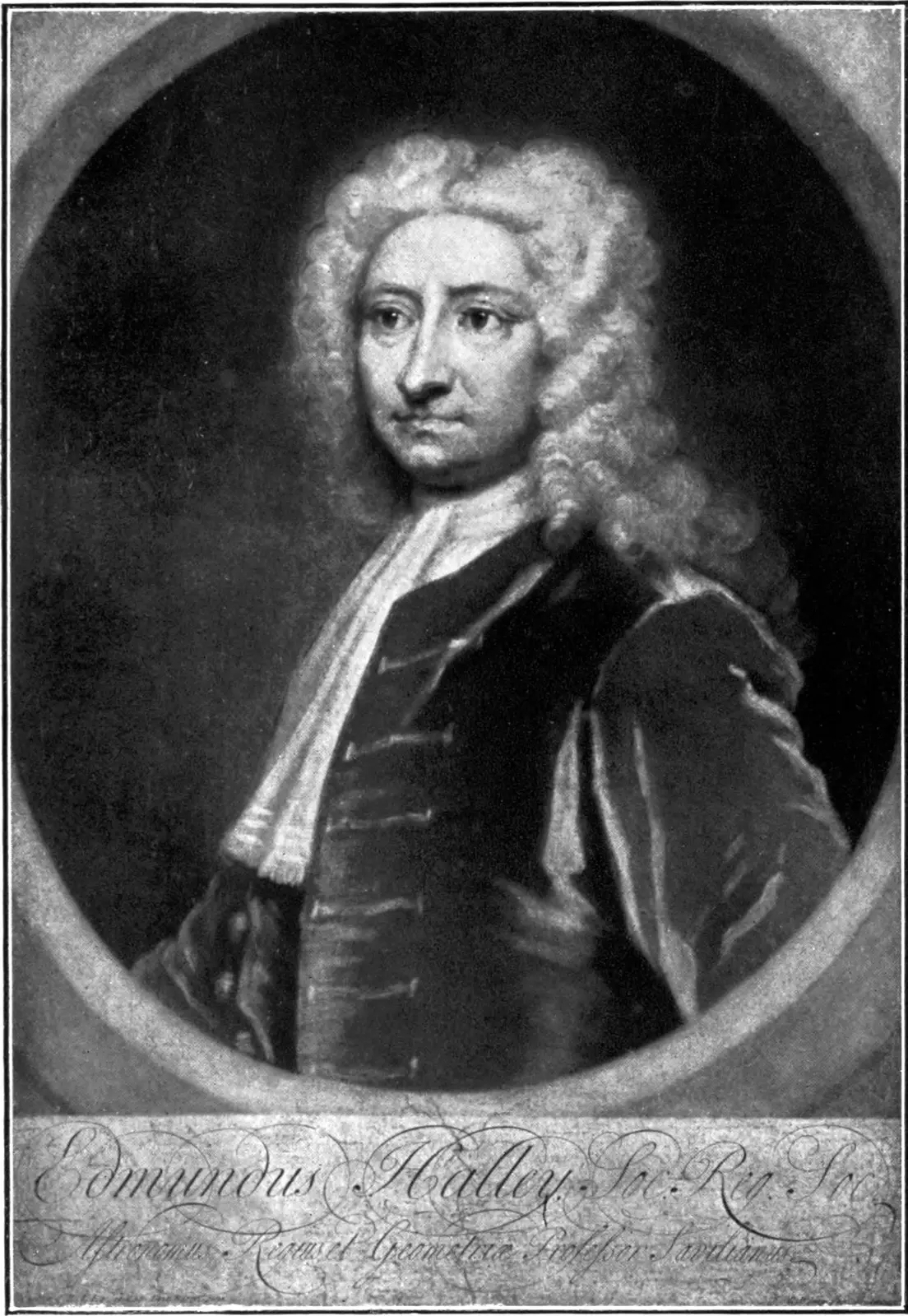
“Edmund Halley (plate XIa in The Story of the Comets)” · Unknown author · Public domain
Full credit
"Edmund Halley (plate XIa in The Story of the Comets)" by Unknown author — https://commons.wikimedia.org/wiki/File:The_story_of_the_comets_-_Plate_XIa.jpg — Public domain (US: the 1909 reproduction was published before 1931 (PD-1923 on Commons). EU: the engraver is not named on the plate (the small lettering at the foot is not legible), so the anonymous-work rule applies: 70 years from lawful publication, at the latest 1909, so expired; the engraving itself names Halley as Astronomer Royal, a post he held before his death in 1742. Scan chain: en.wikisource Page:The_story_of_the_comets.djvu/143, from the University of Toronto scan on the Internet Archive (storyofcometssim00chamuoft).)
Edmund Halley in an engraved portrait inscribed with his titles, reproduced as plate XIa in Chambers, The Story of the Comets (1909).
The later text is more careful about the date. It says the pull of the planets might stretch the next period past 76 years, so the comet “may not be seen again till the end of the year 1758, or beginning of 1759” (Exhibit B, p. 18). That wording fits the event better than the 1705 sentence does, but this page scores the 1705 text, which was the one in print first.
The later tables were written in Latin, and Chambers gives Halley’s line in English: if the comet came back “according to our prediction about the year 1758,” then “impartial posterity will not refuse to acknowledge that this was first discovered by an Englishman” (Exhibit C, p. 106). The 1757 abridgement puts the same claim in reported speech (Exhibit B, p. 20). Nothing in either text speaks of a hope or fear about the world beyond credit for the discovery. For the time-stamped wish, Halley is a counterexample: his forecast is a sum worked from orbits, with little in it to read about his own era’s wishes.
What did the 1835 and 1910 returns add?
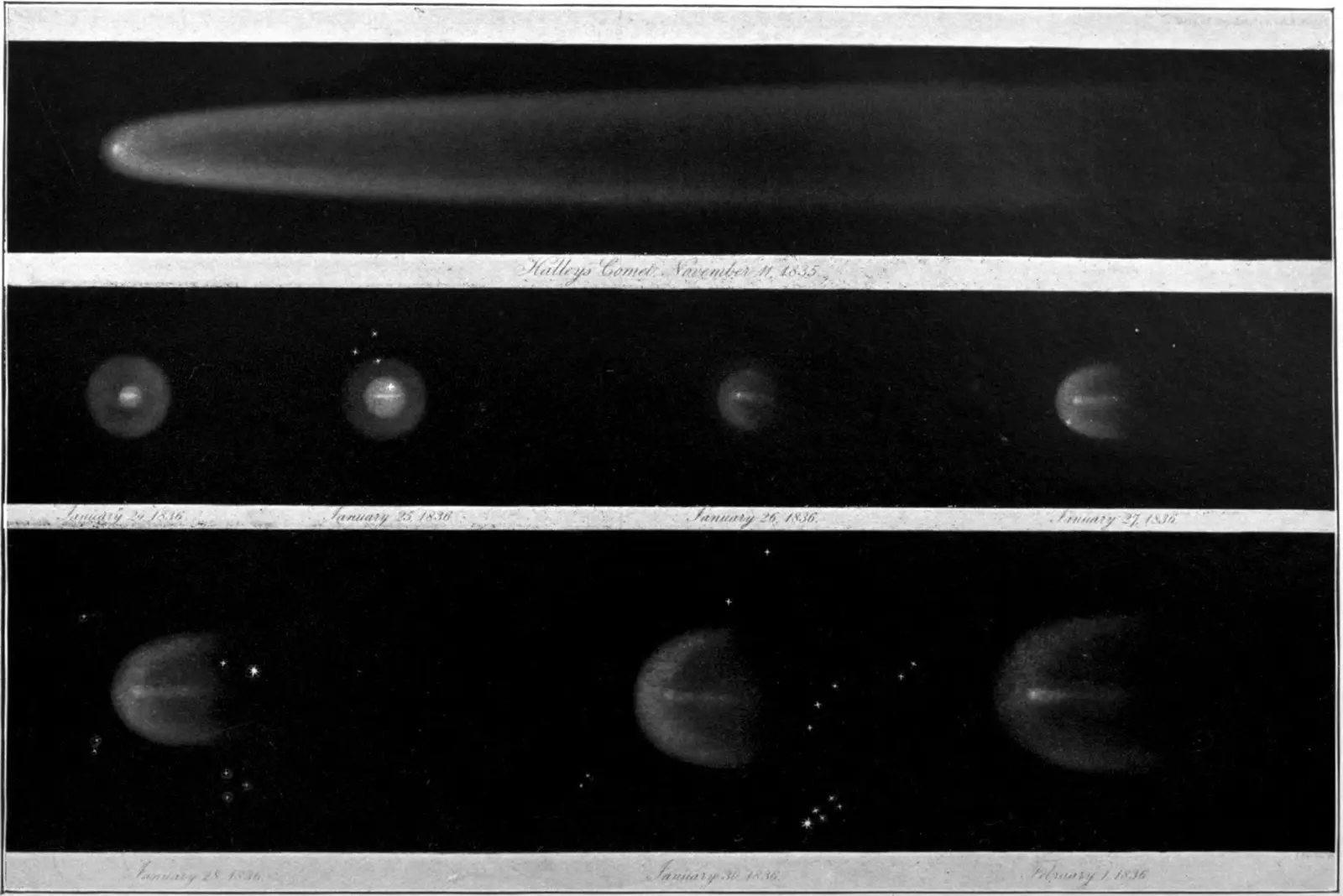
Each return after 1759 retested the period, and each came on a schedule set in advance. In 1835 the comet was first seen on August 6 at the Collegio Romano in Rome, and the perihelion fell on November 15, 1835 (Exhibit C, pp. 112–113). Chambers gives November 16 on the page before; the 1911 Britannica table gives November 15 (Exhibit D).
“Halley’s Comet 1835-6 (plate I in The Story of the Comets)” · C. P. Smyth · Public domain
Full credit
"Halley’s Comet 1835-6 (plate I in The Story of the Comets)" by C. P. Smyth — https://commons.wikimedia.org/wiki/File:The_story_of_the_comets_-_Plate_I.jpg — Public domain (US: published 1909, before 1931 (PD-1923 on Commons). EU: C. P. Smyth died 1900 and George F. Chambers died 1915, both more than 70 years ago; the plate maker is not named and the book was published in 1909, more than 70 years ago. Scan chain: Commons file from en.wikisource Page:The_story_of_the_comets.djvu/6, whose djvu is the University of Toronto (Gerstein Library) scan on the Internet Archive (storyofcometssim00chamuoft).)
Halley’s Comet in 1835–36, drawn by C. P. Smyth: the long tail on November 11, 1835, then the head without a tail on seven nights in January and February 1836. Plate I in George F. Chambers, The Story of the Comets (1909).
For 1910, the 1911 Britannica records that Max Wolf at Heidelberg detected the comet on photographic plates exposed on September 11, 1909, and that it was then found on a Greenwich plate of September 9 (Exhibit D). Chambers, writing in 1909, expected the perihelion “about the middle of April” 1910 (Exhibit C, pp. 123–124). Over all seven returns in the table, the gaps run from 75 to 77 years.
Was there a panic in 1910?
What can be shown is that the danger was raised in print before the comet arrived. In a passage of Comet Lore (1910) written before the date, Edwin Emerson wrote that the Earth would pass through the comet’s tail on May 18, 1910 (Exhibit E). He reported that the spectroscope had found cyanogen, a poisonous compound, in the tail, and he admitted that no one could say for certain what would happen.
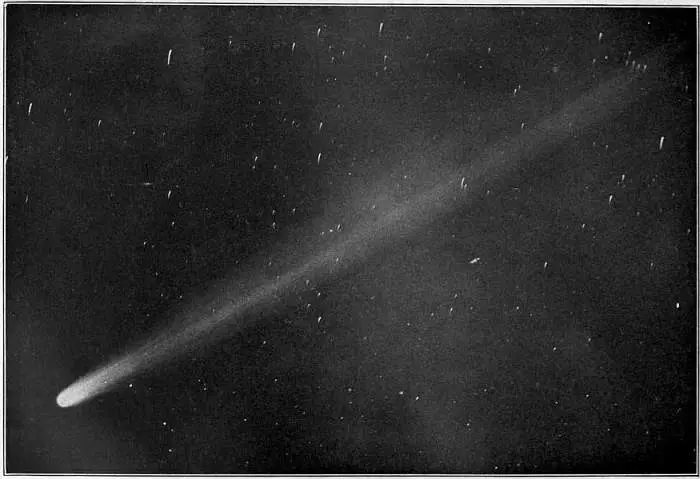
“Halley’s Comet, 1910, May 4 (Encyclopaedia Britannica, 11th ed., Comet, fig. 4)” · E. E. Barnard · Public domain
Full credit
"Halley’s Comet, 1910, May 4 (Encyclopaedia Britannica, 11th ed., Comet, fig. 4)" by E. E. Barnard — https://commons.wikimedia.org/wiki/File:EB1911_-_Comet_Fig._4.%E2%80%94Halley%E2%80%99s_Comet,_1910.jpg — Public domain (US: published in the Encyclopaedia Britannica, 11th ed., vol. 6 (1910), before 1931. EU: E. E. Barnard died in 1923, more than 70 years ago (PD-old-70-expired on Commons). The plate caption in the Britannica (en.wikisource Page:EB1911 - Volume 06.djvu/784) reads 'Halley's Comet, 1910, May 4. By permission of Yerkes Observatory (E. E. Barnard).')
Halley’s Comet on May 4, 1910, photographed by E. E. Barnard at Yerkes Observatory and printed in the 1911 Encyclopaedia Britannica, vol. 6, plate II (Exhibit D).
Whether ordinary readers panicked is a separate question, and it needs the newspapers of May 1910. This page could not read them, so the stories of a public scare and of comet pills are not scored here and are not repeated as fact. Ronald Stoyan’s Atlas of Great Comets (2015) has a chapter on the 1910 return as a whole, cited here from its bibliographic entry only (Exhibit F).
Popular version vs. the record
The forecast has been retold in print with a different year or a wider window. The chart sets the versions against the events: Halley’s 1705 year, his 1749 wording, Clairaut’s window, and the three dated events.
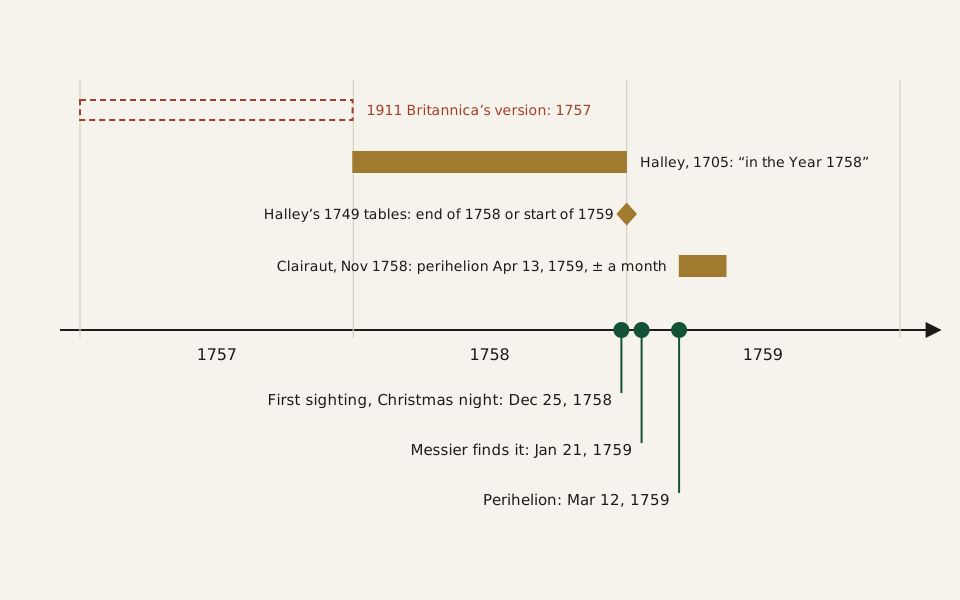
Diagram: Hoax and Hindsight · CC BY 4.0
Credit line to copy
"Forecasts and events, 1757 to 1759" by Hoax and Hindsight, licensed under CC BY 4.0 (https://creativecommons.org/licenses/by/4.0/). Original: https://hoaxandhindsight.com/past-futures/halleys-comet/
Data: Edmund Halley, A Synopsis of the Astronomy of Comets (1705); A Compendious View of the Astronomy of Comets (1757); George F. Chambers, The Story of the Comets (1909); Encyclopaedia Britannica, 11th ed., vol. 6 (1910), "Comet"
Forecasts above the line, events below, January 1757 to December 1759. Drawn from the dates table published with this page; sources per row in the table (Exhibits A to D).
The forecasts and events of 1757 to 1759, with sources (CSV) (where the data comes from) Data: Edmund Halley, A Synopsis of the Astronomy of Comets (1705); A Compendious View of the Astronomy of Comets (1757); George F. Chambers, The Story of the Comets (1909); Encyclopaedia Britannica, 11th ed., vol. 6 (1910), "Comet"
The year Halley gave
The 1911 Encyclopaedia Britannica says Halley “predicted its return for 1757” (vol. 6, “Comet,” p. 763; Exhibit D)
The 1705 Synopsis says “in the Year 1758” (Exhibit A, p. 22): the year given is 1758, not 1757
The wording of the forecast
Chambers (1909) says Halley was led to “predict its return about the end of 1758 or the beginning of 1759” (p. 106; Exhibit C)
That matches Halley’s later tables of 1749, as the 1757 abridgement reports them (Exhibit B, p. 18); the 1705 text named 1758 alone
Did Halley live to see his comet return?
No. Edmond Halley died in 1742, and the earliest known sighting of its return was on December 25, 1758, sixteen years later (Exhibit C, pp. 107, 109).
Who first saw Halley’s Comet in 1758?
Palitzsch, a farmer and amateur astronomer at Prohlis near Dresden, saw it on Christmas night 1758, according to Chambers (1909). Charles Messier in Paris found it on January 21, 1759.
How did Halley work out the date?
Halley computed orbits for the comets of 1531, 1607 and 1682 and found that “All the Elements agree” (Exhibit A, p. 21). The 1705 text does not show the sum behind 1758. The three years are 76 and 75 years apart, and 76 years after 1682 is 1758; his later tables also allowed for the pull of the planets on the period (Exhibit B, p. 18).
What would overturn it:
- An earlier printing of Halley’s forecast with a different year or a wider window than “the Year 1758” would change the grade of item 4.
- A recomputed perihelion falling in 1758 would change item 4 to a hit. An earlier sighting would not, since the first sighting already falls in 1758.
Exhibits
Records and period publications
- Exhibit A: Edmund Halley, A Synopsis of the Astronomy of Comets (London: John Senex, 1705), the English translation of Astronomiae cometicae synopsis, first printed in Latin in the Philosophical Transactions, vol. 24 (1705).
- Exhibit B: A Compendious View of the Astronomy of Comets, written in Latin by Edmund Halley and inserted in the quarto edition of his Astronomical Tables (W. Innys, 1749), translated by G. T. (London: J. Millan, 1757).
- Exhibit C: George F. Chambers, The Story of the Comets Simply Told for General Readers (Oxford: Clarendon Press, 1909).
- Exhibit D: Simon Newcomb, "Comet," Encyclopaedia Britannica, 11th ed., vol. 6 (Cambridge, 1910), p. 763 and plate II.
- Exhibit E: Edwin Emerson, Comet Lore: Halley's Comet in History and Astronomy (New York: Schilling Press, 1910).
Studies
- Exhibit F: Ronald Stoyan, Atlas of Great Comets (Cambridge: Cambridge University Press, 2015), chapter "Comet Halley 1910". doi:10.1017/CBO9781316145166.029
Cite this page
Hoax and Hindsight. “Halley’s Comet: The 1758 Return Halley Foretold, Never Saw.” Hoax and Hindsight, published November 6, 2026. https://hoaxandhindsight.com/past-futures/halleys-comet/. Accessed [the date you read it].
Related cases
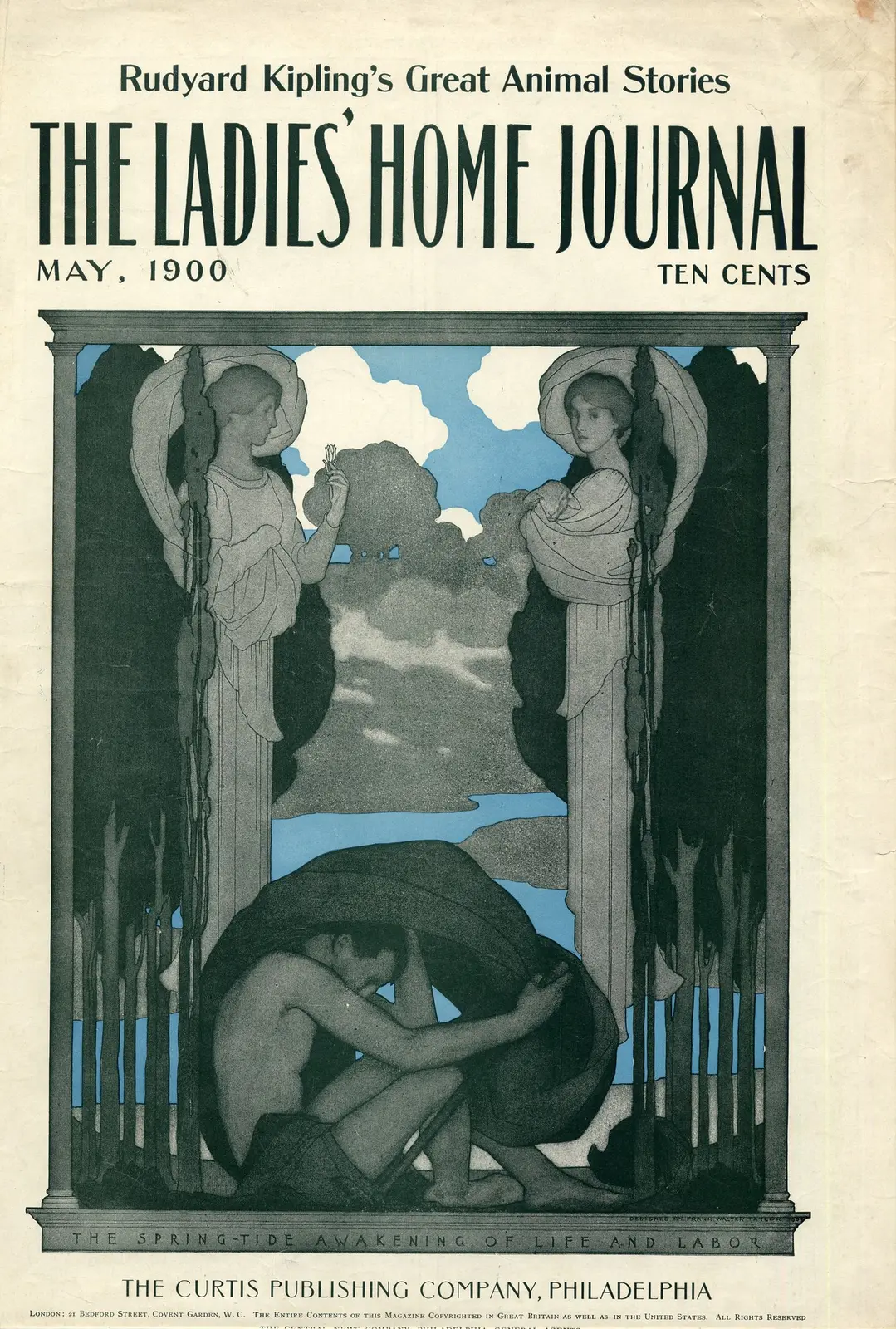
Ladies’ Home Journal 1900 Predictions: 68 Items, 48 Scored
Ladies’ Home Journal 1900 predictions for 2000, split into 68 items and scored: 11 of 48 came true, 27 of 48 counting partial hits; 20 items not scorable.
Picture credit
"The Ladies’ Home Journal, May 1900: The Spring-Tide Awakening of Life and Labor (poster)" by Frank Walter Taylor — https://commons.wikimedia.org/wiki/File:Rudyard_Kipling%27s_Great_Animal_Stories_The_Ladies%27_Home_Journal_May,_1900_-_Ten_cents_The_Spring-Tide_Awakening_of_Life_and_Labor_The_Curtis_Publishing_Company,_Phi,_asset_R2lUHTjMXnRWIWGJgUnisGyp.tif — Public domain (US: published in 1900, before 1931 (public domain). EU: designer Frank Walter Taylor died on July 27, 1921 (date of death 27 July 1921 on the Commons category page F. Walter Taylor, whose infobox is drawn from Wikidata; page archived in the image rights check of 2026-11-05; ULAN 500009621 gives the same years; not confirmed from a printed source), more than 70 years ago; the poster is signed 'designed by Frank Walter Taylor'. Scan chain: Commons file uploaded from the image bank of the city of Antwerp (dams.antwerpen.be asset R2lUHTjMXnRWIWGJgUnisGyp), object held by the Letterenhuis, Antwerp, AV.14.6.54. The poster's own notice of British and American copyright in 1900 has expired.); modified: converted from TIFF to JPEG, scaled from 3,080 x 4,568 to 1,349 x 2,000 px; not cropped (paper edges kept)
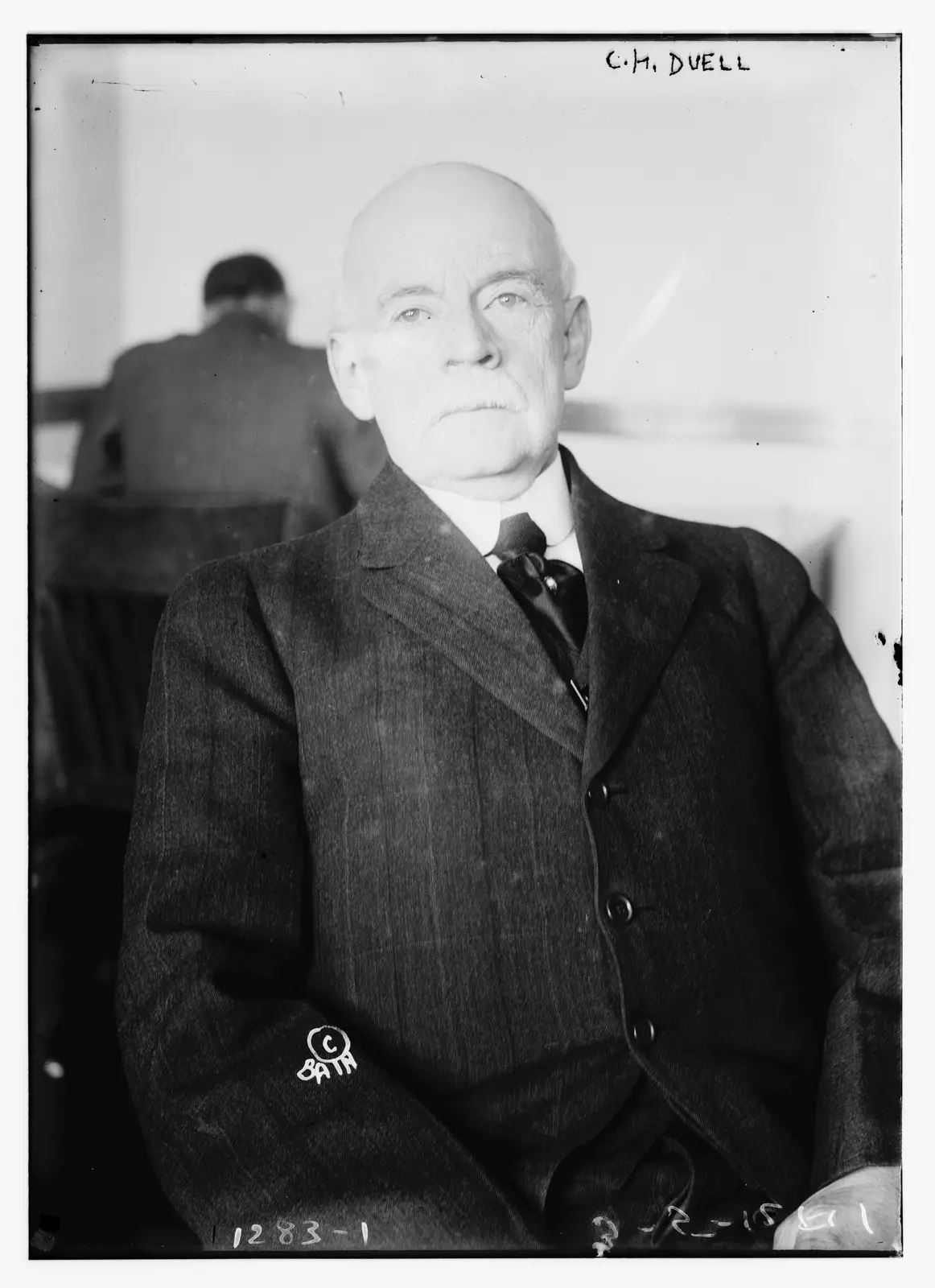
“Everything That Can Be Invented”: Not in Duell’s Report
Charles Duell’s Patent Office report for 1899 asks Congress to help inventors. The line is not in its pp. iii–xii; the earliest printing found is a Punch joke.
Picture credit
"C.H. Duell" by Bain News Service — https://commons.wikimedia.org/wiki/File:C.H._Duell_LCCN2014686661.jpg — Public domain (news-agency photograph by the Bain News Service, no named photographer; the negative is marked 3-2-15, read here as March 2, 1915 (Bain negatives are marked month-day-year; the library's date of 1900 is a catalogue placeholder). US: public domain on the ground that Bain distributed its photographs to newspapers when they were taken, which counts as publication, and this was before 1931. Risk: whether this negative was actually distributed in 1915 has not been checked; if it was never published, an anonymous unpublished US work of 1915 is protected until 120 years after creation (end of 2035). EU: anonymous work, 70 years from first making available (or, if never made available, from creation), long expired. Library of Congress Prints and Photographs, George Grantham Bain Collection, ggbain.06669, 'No known restrictions on publication' (a lead, not the basis))
 Illustration
Albert Robida’s Novel vs. 1956: Strict 3/9, Lenient 6/9
Albert Robida’s La Vie électrique, set in December 1955, split into 27 items and scored: 3 of 9 came true, 6 of 9 with partial hits; 18 are not scorable.
Picture credit
Illustration: Hoax and Hindsight. Generated schematic illustration — not a photograph or historical record. © Hoax and Hindsight, all rights reserved.