Past Futures · Prediction ledger
Ladies’ Home Journal 1900 Predictions: 68 Items, 48 Scored
Hoax and Hindsight Published
When 2000 ended, so did the hundred years that John Elfreth Watkins Jr. gave his Ladies’ Home Journal forecast. Split into 68 checkable items and scored against the record, his December 1900 article gets 11 of 48 by the strict count and 27 of 48 by the lenient count, with 20 items not scorable.
Docket
- Case
- “What May Happen in the Next Hundred Years,” The Ladies’ Home Journal, December 1900
- Years
- 1900 → 2000
- Place
- Printed in Philadelphia by the Curtis Publishing Company
- The claim
- 28 headed forecasts for the year 2000, split here into 68 checkable items, by John Elfreth Watkins Jr.
- The verdict
- Hindsight score: strict 11/48, lenient 27/48; 20 not scorable; judged 2026-11-06
- Hinges on
- How the 28 forecasts were split into items, and the federal statistics of 1997 to 2001 that settle most of them
- Status
- Partly not yet due (1 item)
The article, “What May Happen in the Next Hundred Years,” fills page 8 of The Ladies’ Home Journal for December 1900 (Exhibit A). The Curtis Publishing Company put the magazine out from Philadelphia. Watkins wrote that he had taken the question to leading scientists at the country’s great institutions and copied down their answers. He names none of them, so every forecast here is his report of what unnamed experts told him.
He also set the deadline himself. The introduction asks what will have been achieved “before the dawn of 2001—a century from now” (Exhibit A, p. 8), so this page judges each item as of the end of 2000. The grades follow the Hindsight score rules. The same rules score Halley’s 1705 comet forecast and Albert Robida’s picture of 1955, and the sources are cited as Exhibits under the site’s retrial method.
Order of proceedings 6 parts
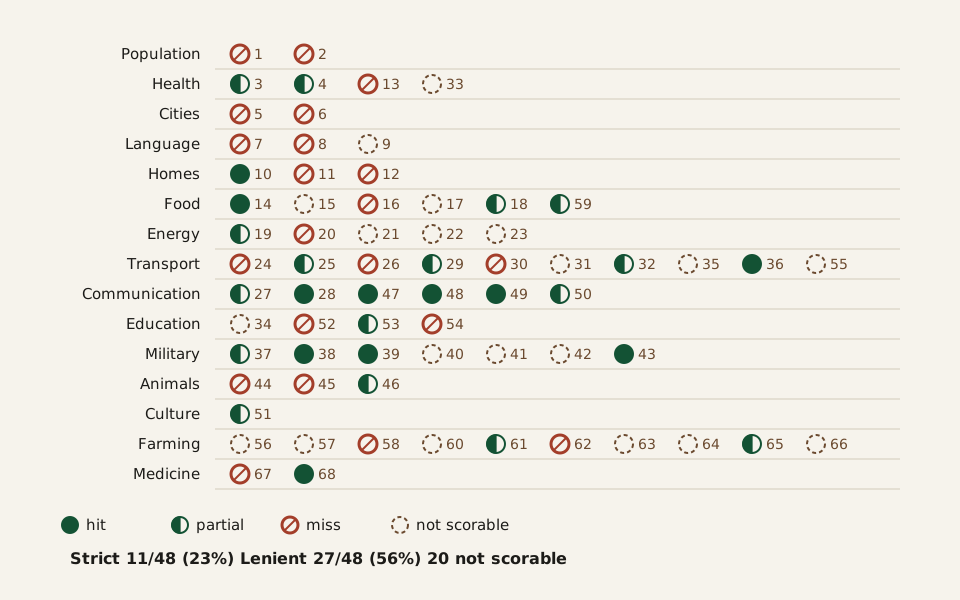
Diagram: Hoax and Hindsight · CC BY 4.0
Credit line to copy
"The 68 items of the 1900 forecast, by topic and grade" by Hoax and Hindsight, licensed under CC BY 4.0 (https://creativecommons.org/licenses/by/4.0/). Original: https://hoaxandhindsight.com/past-futures/ladies-home-journal-predictions/
Data: John Elfreth Watkins Jr., “What May Happen in the Next Hundred Years,” The Ladies’ Home Journal (December 1900); Statistical Abstract of the United States: 1999 and 2001; The World Factbook 2000; and the other sources named in each row
All 68 items of the forecast, grouped by topic, with the grade of each. Drawn from the item table published with this page; claims from Watkins (Exhibit A), grades from the sources named in each row.
Where did the forecast appear?
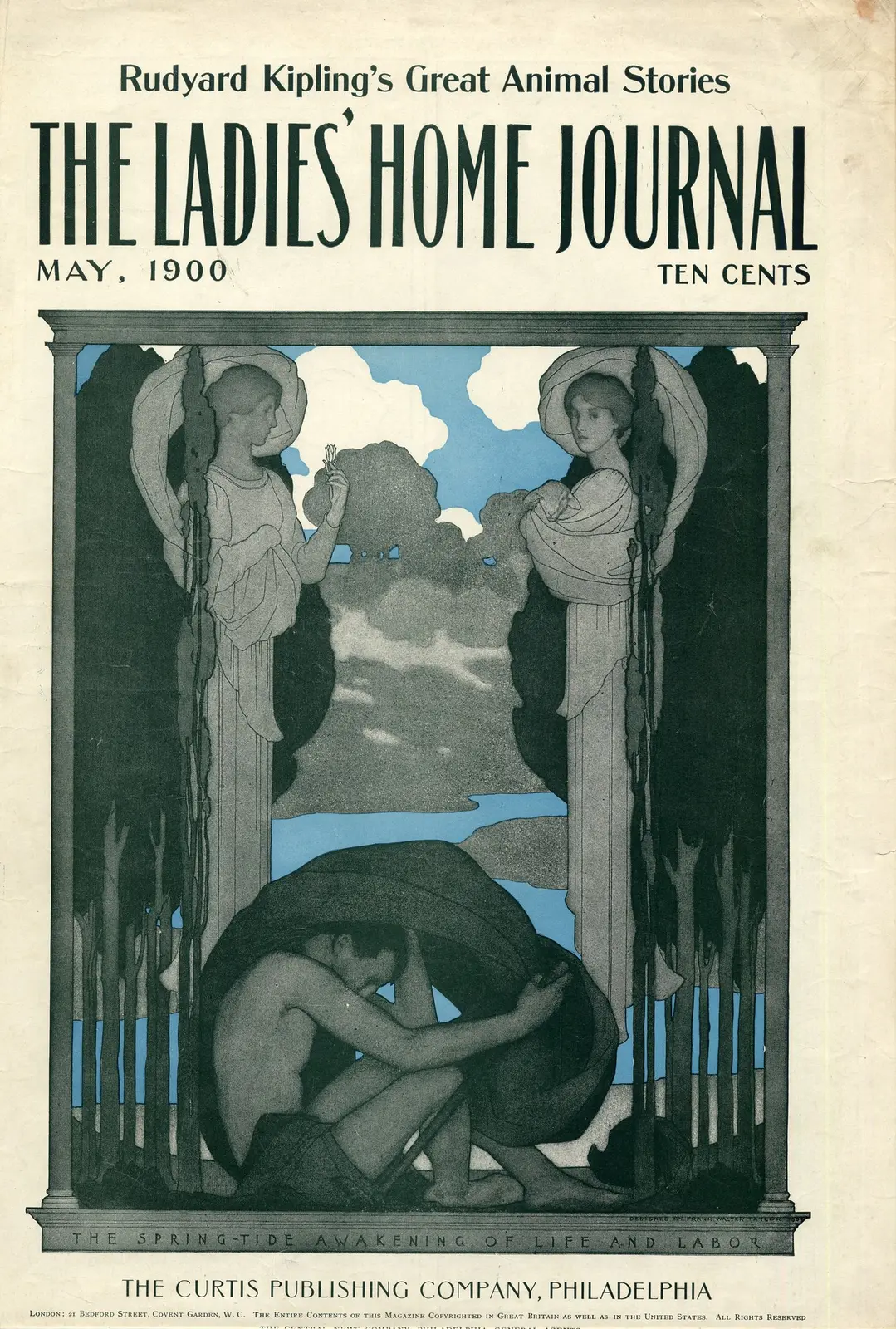
The Journal was a ten-cent monthly, as its own poster for May 1900 shows, and the December 1900 issue set Watkins’s page among fiction, household features and advertising (Exhibit A, contents). His forecast ran as 28 short paragraphs, each opening with a headline, from population and spelling to roses and medicine. Some of it was already under way. The page itself notes that photographs were being telegraphed over short distances.
“The Ladies’ Home Journal, May 1900: The Spring-Tide Awakening of Life and Labor (poster)” · Frank Walter Taylor · Public domain
Full credit
"The Ladies’ Home Journal, May 1900: The Spring-Tide Awakening of Life and Labor (poster)" by Frank Walter Taylor — https://commons.wikimedia.org/wiki/File:Rudyard_Kipling%27s_Great_Animal_Stories_The_Ladies%27_Home_Journal_May,_1900_-_Ten_cents_The_Spring-Tide_Awakening_of_Life_and_Labor_The_Curtis_Publishing_Company,_Phi,_asset_R2lUHTjMXnRWIWGJgUnisGyp.tif — Public domain (US: published in 1900, before 1931 (public domain). EU: designer Frank Walter Taylor died on July 27, 1921 (date of death 27 July 1921 on the Commons category page F. Walter Taylor, whose infobox is drawn from Wikidata; page archived in the image rights check of 2026-11-05; ULAN 500009621 gives the same years; not confirmed from a printed source), more than 70 years ago; the poster is signed 'designed by Frank Walter Taylor'. Scan chain: Commons file uploaded from the image bank of the city of Antwerp (dams.antwerpen.be asset R2lUHTjMXnRWIWGJgUnisGyp), object held by the Letterenhuis, Antwerp, AV.14.6.54. The poster's own notice of British and American copyright in 1900 has expired.); modified: converted from TIFF to JPEG, scaled from 3,080 x 4,568 to 1,349 x 2,000 px; not cropped (paper edges kept)
Poster for the May 1900 issue of The Ladies’ Home Journal, designed by Frank Walter Taylor. The predictions appeared seven months later, in the December 1900 issue.
The issue date matters as much as the text. A dated magazine shows that the forecasts were in print by December 1900 at the latest, so nothing that happened later could have shaped the wording. That kind of proof is set out on how a printed date sets the latest possible date.
How was the forecast split?
Each of the 28 paragraphs gave at least one item. A further sentence became its own item when it named something else that could be checked in 2000. The paragraph on war gave six items; most others gave one to three. Sentences that describe 1900, give reasons, or explain how an item would work were not scored, and neither were other side details inside a paragraph, such as figs grown across the country or ships that dive in a storm.
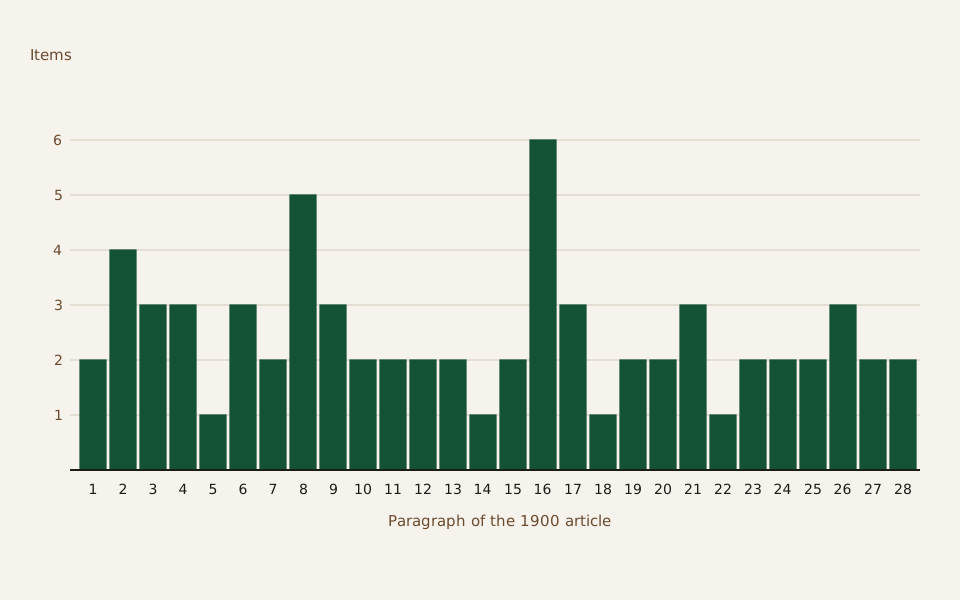
Diagram: Hoax and Hindsight · CC BY 4.0
Credit line to copy
"How the 28 headed forecasts were split into 68 items" by Hoax and Hindsight, licensed under CC BY 4.0 (https://creativecommons.org/licenses/by/4.0/). Original: https://hoaxandhindsight.com/past-futures/ladies-home-journal-predictions/
Data: The Ladies’ Home Journal, vol. 18, no. 1
Items per paragraph, paragraphs 1 to 28 in the order printed. Drawn from the item table published with this page.
The list of 68 items was fixed on November 5, 2026, before any item was graded, and it is the same list as the downloadable table. Every item carries the end of 2000 as its deadline, except item 21, which names its own years: hard coal lasting to 2050 or 2100 and soft coal to 2200 or 2300. The table restates each claim in the site’s own words. Where a word has shifted since 1900, the item follows the article’s own usage: its air-ships float, and it names flying machines separately, so item 36 is scored on lighter-than-air craft, not airplanes.
The ledger
Most items are settled by federal statistics for 1997 to 2001. The main ones are the Statistical Abstract of the United States for 1999 and 2001 (Exhibits H and I) and The World Factbook 2000 (Exhibit J). Accounts printed between 1917 and 1922 settle the early inventions (Exhibits C to E), and federal reports (Exhibits F and G) and later studies (Exhibits K to R) settle the items on health, livestock, crops and flowers.
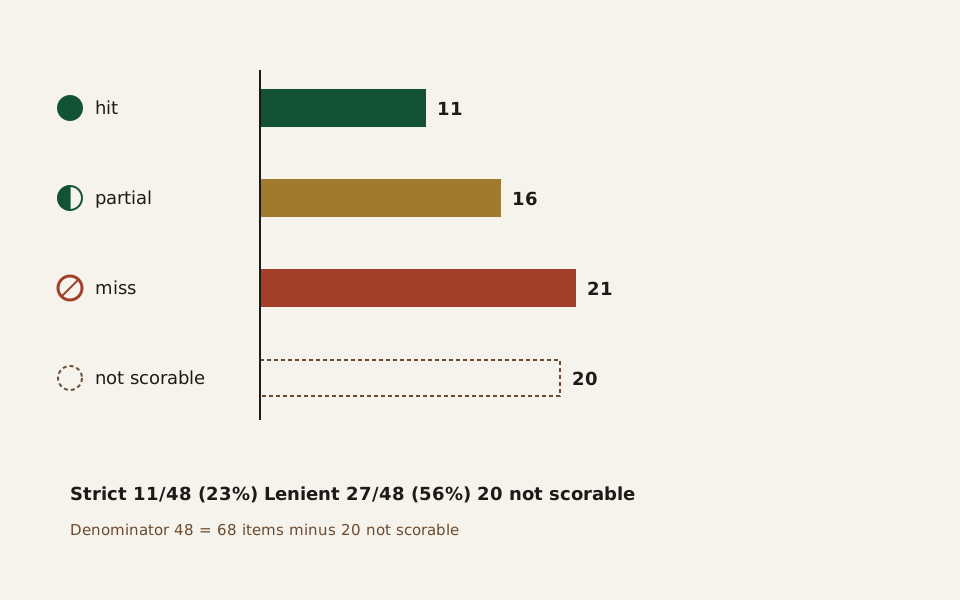
Diagram: Hoax and Hindsight · CC BY 4.0
Credit line to copy
"Grades of the 68 items" by Hoax and Hindsight, licensed under CC BY 4.0 (https://creativecommons.org/licenses/by/4.0/). Original: https://hoaxandhindsight.com/past-futures/ladies-home-journal-predictions/
Data: John Elfreth Watkins Jr., “What May Happen in the Next Hundred Years,” The Ladies’ Home Journal (December 1900); Statistical Abstract of the United States: 1999 and 2001; The World Factbook 2000; and the other sources named in each row
Grade counts for the 68 items, with the strict and lenient rates over the 48 scorable items. Drawn from the item table published with this page.
| Item | Claim | Grade | Source |
|---|---|---|---|
| 1 | 350 to 500 million people | miss | Exhibit I, Table 1; Exhibit J |
| 2 | Nicaragua, Mexico and others join | miss | Exhibit J |
| 3 | Americans 1 to 2 inches taller | partial | Exhibit K; Exhibit L |
| 4 | A life span of 50 years | partial | Exhibit H, Table 1421; Exhibit J |
| 5 | City houses disappear | miss | Exhibit H, Table 1415 |
| 6 | A few-minute, one-cent commute | miss | Exhibit H, Table 1037 |
| 7 | No C, X or Q | miss | Exhibit I; Exhibit J |
| 8 | Spelling by sound | miss | Exhibit I; Exhibit J |
| 9 | English first, Russian second | not scorable | Exhibit A |
| 10 | Heated and cooled air at home | hit | Exhibit I, Tables 952 and 962 |
| 11 | Air piped from central plants | miss | Exhibit I, Table 962 |
| 12 | Homes without chimneys | miss | Exhibit I, Table 962 |
| 13 | No mosquitoes, flies or roaches | miss | Exhibit F |
| 14 | Ready-cooked meals bought | hit | Exhibit H, Table 1424 |
| 15 | Meals by tube or wagon, dishes sent back | not scorable | Exhibit A |
| 16 | Home cooking an extravagance | miss | Exhibit H, Table 1424 |
| 17 | Arrests for exposed food | not scorable | Exhibit A |
| 18 | Liquid-air refrigerators | partial | Exhibit I, Table 952; Exhibit C, ch. V |
| 19 | No coal for heating or cooking | partial | Exhibit I, Tables 911 and 962 |
| 20 | Coal scarce and dearer | miss | Exhibit I, Table 885 |
| 21 | Coal lasting to 2050–2300 | not scorable | Exhibit A |
| 22 | Water power, every river harnessed | not scorable | Exhibit A |
| 23 | Wave and tide power | not scorable | Exhibit A |
| 24 | No street cars | miss | Exhibit I, Table 1104 |
| 25 | Subways and elevated lines | partial | Exhibit I, Table 1104 |
| 26 | Cities free from noise | miss | Exhibit I, Table 961 |
| 27 | Photographs sent by wire | partial | Exhibit C, ch. XIII; Exhibit J |
| 28 | Photographs in natural color | hit | Exhibit C, ch. XVI |
| 29 | 150 mph trains, coast to coast in a day | partial | Exhibit J |
| 30 | Electric trains, no coal | miss | Exhibit J |
| 31 | Automobiles cheaper than horses | not scorable | Exhibit A |
| 32 | Automobiles replace horse vehicles | partial | Exhibit H, Table 1439 |
| 33 | Everyone walks ten miles | not scorable | Exhibit A |
| 34 | Compulsory exercise, gymnasiums | not scorable | Exhibit A |
| 35 | Liverpool in two days by ship | not scorable | Exhibit A |
| 36 | Airships carry little traffic | hit | Exhibit E; Exhibit H, Table 1080; Exhibit I, Table 1052 |
| 37 | Airships as warships and labs | partial | Exhibit E |
| 38 | Bombing from the air | hit | Exhibit E |
| 39 | Armored forts on wheels | hit | Exhibit D, ch. XXIII |
| 40 | Guns firing 25 miles | not scorable | Exhibit A |
| 41 | Submarines that destroy a navy | not scorable | Exhibit A |
| 42 | Silent cartridges | not scorable | Exhibit A |
| 43 | Aerial photographs of the enemy | hit | Exhibit D, ch. XXIV |
| 44 | No wild animals, rats or mice | miss | Exhibit G, Exhibit F |
| 45 | Horse practically extinct | miss | Exhibit H, Table 436; Exhibit I, Table 808 |
| 46 | Hornless cattle and sheep | partial | Exhibit M |
| 47 | Distant events shown live | hit | Exhibit J |
| 48 | Wireless telephone worldwide | hit | Exhibit J |
| 49 | Calls without an operator | hit | Exhibit I, Table 1150; Exhibit J |
| 50 | Music into homes | partial | Exhibit I, Table 1142; Exhibit J |
| 51 | Publicly funded opera | partial | Exhibit I, Tables 1235 and 1237 |
| 52 | Free university | miss | Exhibit I, Table 278 |
| 53 | Free help for poor pupils | partial | Exhibit I, Table 549 |
| 54 | Simplified English grammar | miss | Exhibit I; Exhibit J |
| 55 | Deliveries by pneumatic tube | not scorable | Exhibit A |
| 56 | Electric light and heat for crops | not scorable | Exhibit A |
| 57 | Electric currents on soil and seeds | not scorable | Exhibit A |
| 58 | Oranges in Philadelphia | miss | Exhibit H, Table 1136 |
| 59 | Southern-hemisphere fruit in winter | partial | Exhibit I, Table 819 |
| 60 | Apple-sized strawberries | not scorable | Exhibit A |
| 61 | Seedless fruit | partial | Exhibit Q |
| 62 | Beet-sized peas and beans | miss | Exhibit P |
| 63 | Cane the chief sugar again | not scorable | Exhibit A |
| 64 | Milkweed rubber | not scorable | Exhibit A |
| 65 | Black, blue and green roses | partial | Exhibit R; Exhibit O |
| 66 | Cabbage-sized roses | not scorable | Exhibit A |
| 67 | Drugs through the skin | miss | Exhibit N |
| 68 | Seeing living organs | hit | Exhibit I, Table 169 |
The 68 items, with deadlines, tests, grades, reasons and sources (CSV) (where the data comes from) Data: John Elfreth Watkins Jr., “What May Happen in the Next Hundred Years,” The Ladies’ Home Journal (December 1900); Statistical Abstract of the United States: 1999 and 2001; The World Factbook 2000; and the other sources named in each row
By the strict count, 11 of the 48 scorable items are hits, or 23%. By the lenient count, which adds the 16 partial hits, 27 of 48 hold up, or 56%. Twenty items are left out of both counts. Every item was rechecked on November 6, 2026, and the 22 whose grade changed keep their earlier grade in the previous_grade column of the download.
What came true?
Most of the hits cluster in communication and war. Color photography was in use by 1917 (Exhibit C), and by 2000, 24 ocean cable systems and 61 Intelsat earth stations carried American calls abroad (Exhibit J). Aircraft dropping bombs, armored vehicles on tracks and photographs taken over enemy lines all appeared in the First World War (Exhibits D and E).
The forecast on health counts only as a partial hit. It said Americans would live 50 years instead of 35, which this page reads as a figure to replace the old one, not a floor. Lives did grow longer, but far past the forecast: the federal series gives 76.5 years of life expected at birth in 1997 (Exhibit H, Table 1421), so the rise came true and the figure did not. For 1900 itself the same series gives 47.3 years, counting only the states that then registered deaths, well above the 35 printed in the article.
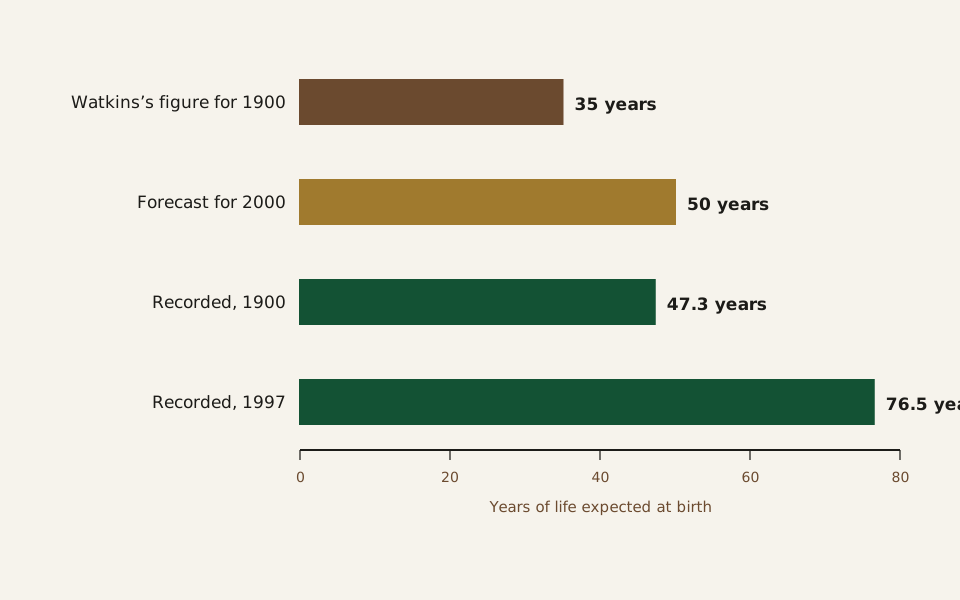
Diagram: Hoax and Hindsight · CC BY 4.0
Credit line to copy
"Life expectancy: the 1900 forecast against the record" by Hoax and Hindsight, licensed under CC BY 4.0 (https://creativecommons.org/licenses/by/4.0/). Original: https://hoaxandhindsight.com/past-futures/ladies-home-journal-predictions/
Data: The Ladies’ Home Journal, vol. 18, no. 1; Statistical Abstract of the United States: 1999
Life expectancy at birth: the figures in the 1900 article against the record for 1900 (death-registration states only) and 1997. Drawn from Watkins (Exhibit A, p. 8) and the Statistical Abstract of the United States: 1999, Table 1421 (Exhibit H).
Several partial hits came true in one part only. Homes almost stopped burning coal, which was the main heating fuel in under 0.2 percent of them in 1999, yet coal made about 56 percent of utility electricity (Exhibit I, Tables 911 and 962). Refrigerators reached nearly every home, but they made cold by compressing a gas, the method described in 1917 (Exhibit C), not with liquid air. Pictures went by wire over hundreds of miles by 1917 (Exhibit C), but no source read here shows news pictures printed within an hour.
What missed, and what can’t be scored?
The misses run through population, cities, spelling and farming. The United States counted 281.4 million people in 2000 and its territories about 4.3 million more, far from 350 to 500 million, and no Latin American country had joined the Union (Exhibits I and J). Street noise or traffic was reported at about 29 million homes in 1999 (Exhibit I, Table 961).
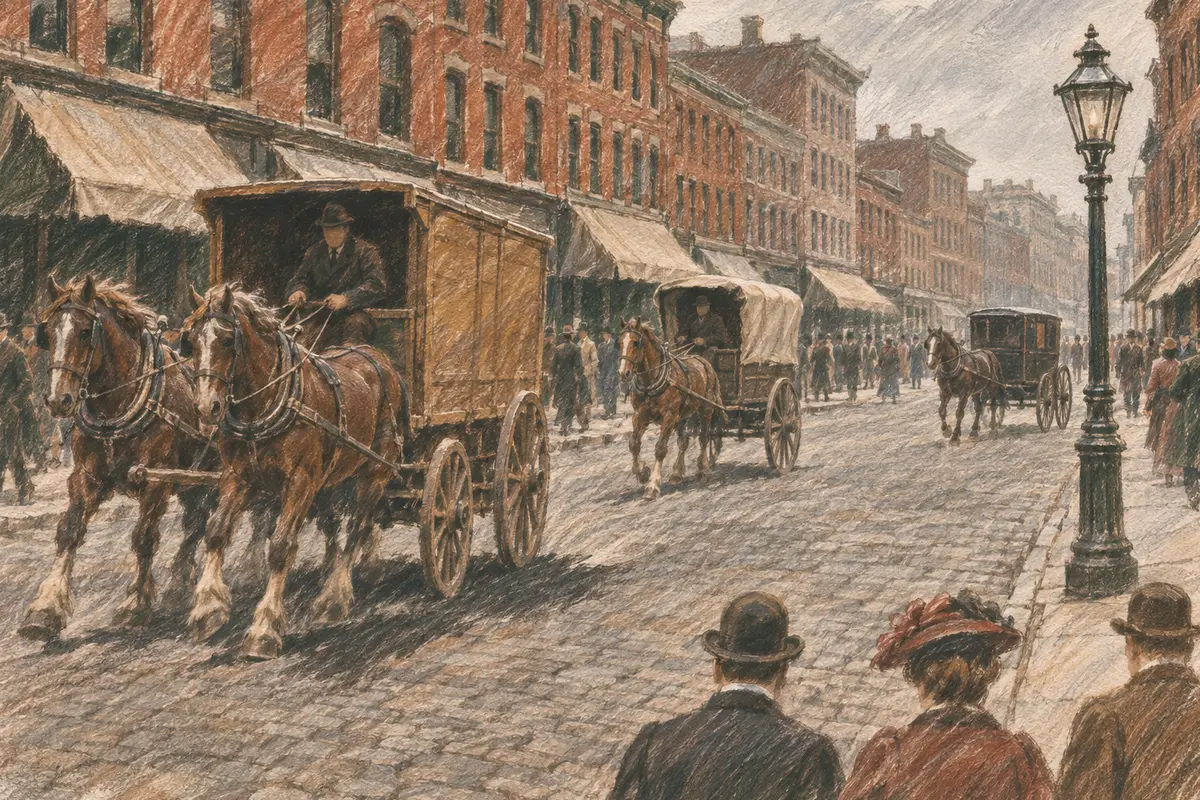
Illustration: Hoax and Hindsight. Generated schematic illustration — not a photograph or historical record. © Hoax and Hindsight, all rights reserved.
An illustration, not a record: a city street around 1900, loud with horse traffic. The forecast of cities free from noise is graded a miss; street noise or traffic was reported at about 29 million homes in 1999.
None of the farm forecasts came true in full. Oranges came from four states led by Florida, California and Arizona (Exhibit H). Field peas grown in trials from 1996 to 1998 weighed a fraction of a gram a seed, according to Poggio and colleagues (2005; Exhibit P).
Twenty items could not be scored. Two are too loosely worded to test: English as the most widely spoken language, which depends on how speakers are counted, and automobiles cheaper than horses, which depends on whether price, upkeep or wages are meant. The arrest of storekeepers who leave food exposed has no line between exposed and covered food, and item 21 on the coal supply is not yet due. For the other 16, among them apple-sized strawberries, wave power, cane sugar and a two-day Atlantic crossing, no source read here settles the test, so they are left out rather than scored as misses.
Why did 1900 want these things?
Some of the forecasts answer worries printed elsewhere in the same issue. A serial in the issue, Elizabeth Stuart Phelps’s The Successors of Mary the First, follows a suburban couple whose neighbors ride the commuter train and who cannot find a cook (Exhibit B, p. 13). Watkins’s page promised cheap trips from the suburbs and ready-cooked meals that would make a hired cook unnecessary.
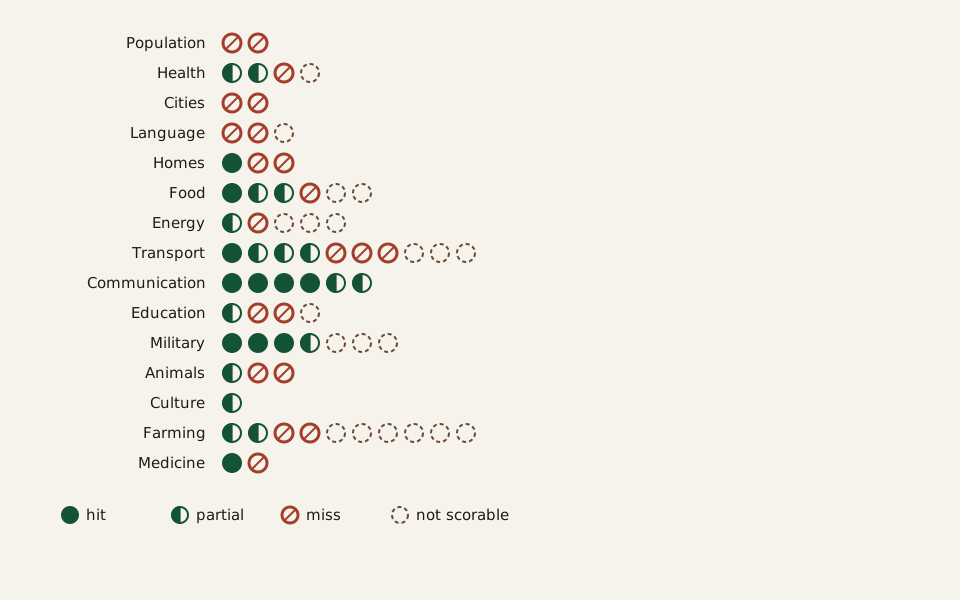
Diagram: Hoax and Hindsight · CC BY 4.0
Credit line to copy
"Grades by topic" by Hoax and Hindsight, licensed under CC BY 4.0 (https://creativecommons.org/licenses/by/4.0/). Original: https://hoaxandhindsight.com/past-futures/ladies-home-journal-predictions/
Data: John Elfreth Watkins Jr., “What May Happen in the Next Hundred Years,” The Ladies’ Home Journal (December 1900); Statistical Abstract of the United States: 1999 and 2001; The World Factbook 2000; and the other sources named in each row
Grades by topic. Drawn from the item table published with this page.
An advertisement for Tone Bros. spices in the same issue warns readers, “Don’t buy bulk spices,” and claims that they are over 66 percent adulteration (Exhibit B). Watkins’s forecast of arrests for food left open to the air answers the same worry. Because the issue itself shows these hopes and fears, these items fit the time-stamped wish. The other items are scored, and nothing more is read into them.
What would overturn it:
- Another printing of the article, such as a reprint or a regional edition, whose wording would change how the paragraphs split into items.
- A revised federal figure for 2000 that crosses the line set for an item, or a record from before 2001 that settles one of the 16 items left unscored for want of a source, such as the size of strawberries or a ship’s crossing time.
Exhibits
Records and period publications
- Exhibit A: John Elfreth Watkins Jr., “What May Happen in the Next Hundred Years,” The Ladies’ Home Journal, vol. 18, no. 1 (Philadelphia: Curtis Publishing Company, December 1900), p. 8.
- Exhibit B: The Ladies’ Home Journal, vol. 18, no. 1 (December 1900): Elizabeth Stuart Phelps, “The Successors of Mary the First,” chapters V–VI, p. 13; advertisement for Tone Bros. spices, Des Moines, in the same issue (page number not legible in the Internet Archive scan).
- Exhibit C: Thomas W. Corbin, Marvels of Scientific Invention (Philadelphia: J. B. Lippincott; London: Seeley, Service, 1917).
- Exhibit D: Thomas W. Corbin, The Romance of War Inventions (London: Seeley, Service, 1918).
- Exhibit E: Harry Vissering, Zeppelin: The Story of a Great Achievement (Chicago, 1922).
- Exhibit F: Centers for Disease Control and Prevention, “Update: West Nile Virus Activity—Eastern United States, 2000,” MMWR 49, no. 46 (2000): 1044–1047.
- Exhibit G: Centers for Disease Control and Prevention, “Update: Hantavirus Pulmonary Syndrome—United States, 1999,” MMWR 48, no. 24 (1999): 521–525.
Studies
- Exhibit K: C. L. Ogden, C. D. Fryar, M. D. Carroll and K. M. Flegal, “Mean Body Weight, Height, and Body Mass Index, United States 1960–2002,” Advance Data no. 347 (2004): 1–17.
- Exhibit L: J. Komlos and B. E. Lauderdale, “The Mysterious Trend in American Heights in the 20th Century,” Annals of Human Biology 34, no. 2 (2007): 206–215, doi:10.1080/03014460601116803.
- Exhibit M: N. Wiedemar et al., “Independent Polled Mutations Leading to Complex Gene Expression Differences in Cattle,” PLoS ONE 9, no. 3 (2014): e93435, doi:10.1371/journal.pone.0093435.
- Exhibit N: R. Panchagnula, O. Pillai, V. B. Nair and P. Ramarao, “Transdermal Iontophoresis Revisited,” Current Opinion in Chemical Biology 4, no. 4 (2000): 468–473, doi:10.1016/s1367-5931(00)00111-3.
- Exhibit O: A. N. Nanjaraj Urs et al., “Cloning and Expression of a Nonribosomal Peptide Synthetase to Generate Blue Rose,” ACS Synthetic Biology 8, no. 8 (2019): 1698–1704, doi:10.1021/acssynbio.8b00187.
- Exhibit P: S. L. Poggio, E. H. Satorre, S. Dethiou and G. M. Gonzalo, “Pod and Seed Numbers as a Function of Photothermal Quotient during the Seed Set Period of Field Pea (Pisum sativum) Crops,” European Journal of Agronomy 22, no. 1 (2005): 55–69, doi:10.1016/j.eja.2003.12.003.
- Exhibit Q: R. L. Emershad and D. W. Ramming, “Somatic Embryogenesis and Plant Development from Immature Zygotic Embryos of Seedless Grapes (Vitis vinifera L.),” Plant Cell Reports 14, no. 1 (1994): 6–12, doi:10.1007/BF00233289.
- Exhibit R: H. Yan et al., “The Rosa chinensis cv. Viridiflora Phyllody Phenotype Is Associated with Misexpression of Flower Organ Identity Genes,” Frontiers in Plant Science 7 (2016): 996, doi:10.3389/fpls.2016.00996.
Databases and data sets
- Exhibit H: U.S. Census Bureau, Statistical Abstract of the United States: 1999 (Washington, 1999).
- Exhibit I: U.S. Census Bureau, Statistical Abstract of the United States: 2001 (Washington, 2001).
- Exhibit J: Central Intelligence Agency, The World Factbook 2000 (Washington, 2000).
Cite this page
Hoax and Hindsight. “Ladies’ Home Journal 1900 Predictions: 68 Items, 48 Scored.” Hoax and Hindsight, published November 6, 2026. https://hoaxandhindsight.com/past-futures/ladies-home-journal-predictions/. Accessed [the date you read it].
Related cases
Halley’s Comet: The 1758 Return Halley Foretold, Never Saw
Halley’s Comet: in 1705 Halley wrote it would return in 1758. It was seen on Christmas night 1758, after his death. His forecast, split into 5 claims, scored.
Picture credit
"Halley’s Comet 1835-6 (plate I in The Story of the Comets)" by C. P. Smyth — https://commons.wikimedia.org/wiki/File:The_story_of_the_comets_-_Plate_I.jpg — Public domain (US: published 1909, before 1931 (PD-1923 on Commons). EU: C. P. Smyth died 1900 and George F. Chambers died 1915, both more than 70 years ago; the plate maker is not named and the book was published in 1909, more than 70 years ago. Scan chain: Commons file from en.wikisource Page:The_story_of_the_comets.djvu/6, whose djvu is the University of Toronto (Gerstein Library) scan on the Internet Archive (storyofcometssim00chamuoft).)
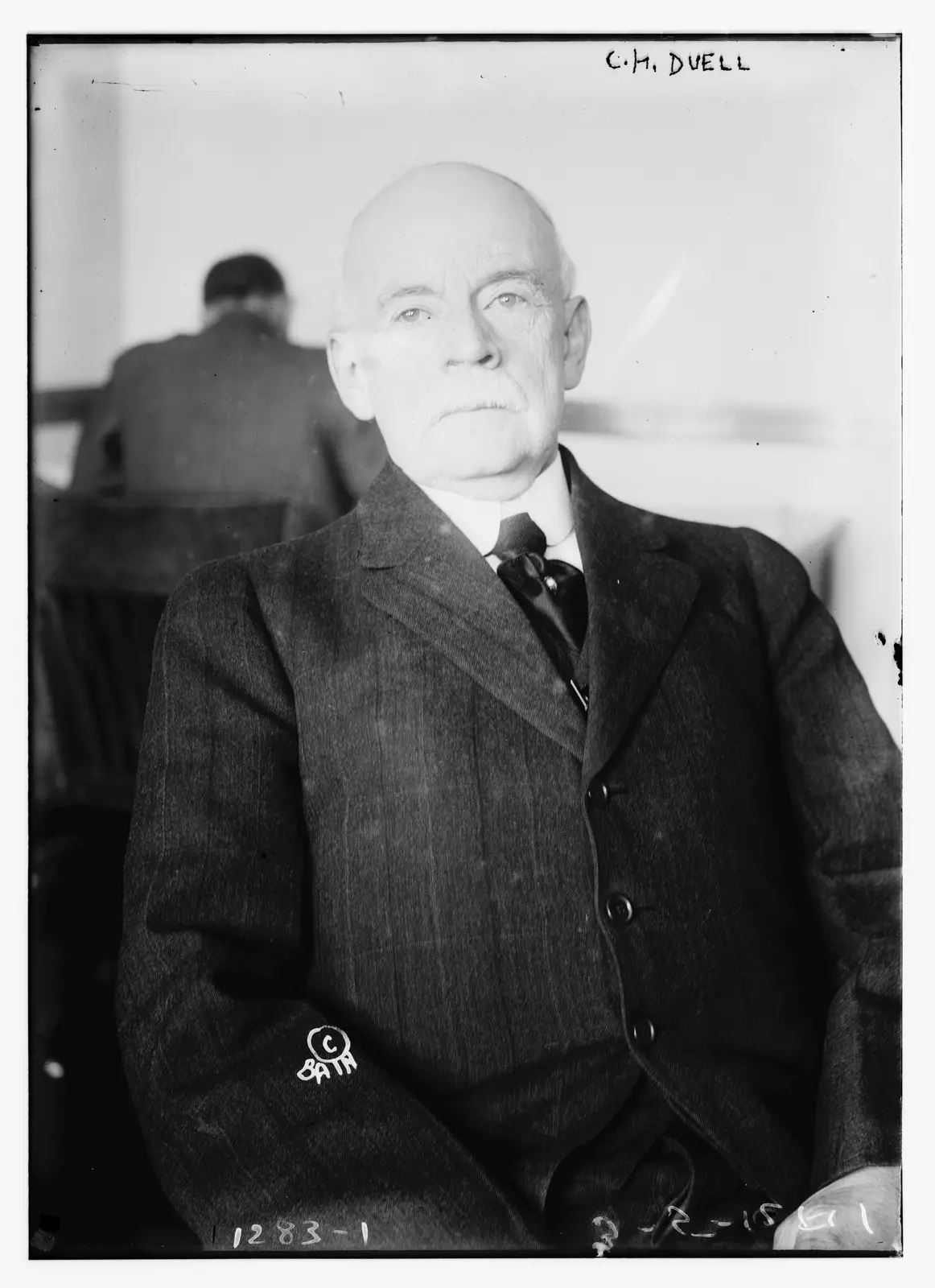
“Everything That Can Be Invented”: Not in Duell’s Report
Charles Duell’s Patent Office report for 1899 asks Congress to help inventors. The line is not in its pp. iii–xii; the earliest printing found is a Punch joke.
Picture credit
"C.H. Duell" by Bain News Service — https://commons.wikimedia.org/wiki/File:C.H._Duell_LCCN2014686661.jpg — Public domain (news-agency photograph by the Bain News Service, no named photographer; the negative is marked 3-2-15, read here as March 2, 1915 (Bain negatives are marked month-day-year; the library's date of 1900 is a catalogue placeholder). US: public domain on the ground that Bain distributed its photographs to newspapers when they were taken, which counts as publication, and this was before 1931. Risk: whether this negative was actually distributed in 1915 has not been checked; if it was never published, an anonymous unpublished US work of 1915 is protected until 120 years after creation (end of 2035). EU: anonymous work, 70 years from first making available (or, if never made available, from creation), long expired. Library of Congress Prints and Photographs, George Grantham Bain Collection, ggbain.06669, 'No known restrictions on publication' (a lead, not the basis))
 Illustration
Albert Robida’s Novel vs. 1956: Strict 3/9, Lenient 6/9
Albert Robida’s La Vie électrique, set in December 1955, split into 27 items and scored: 3 of 9 came true, 6 of 9 with partial hits; 18 are not scorable.
Picture credit
Illustration: Hoax and Hindsight. Generated schematic illustration — not a photograph or historical record. © Hoax and Hindsight, all rights reserved.