Past Futures · Prediction ledger
Albert Robida’s Novel vs. 1956: Strict 3/9, Lenient 6/9
Hoax and Hindsight Published
December 1955 has come and gone, so Albert Robida’s novel La Vie électrique, set in that month, can be checked. Read as a forecast for 1955 and 1956, the years the story covers, and split into 27 items, it scores 3 of 9 by the strict count and 6 of 9 counting the three partial hits, with 18 items not scorable; the book’s jokes are set aside, not scored.
Docket
- Case
- La Vie électrique, the illustrated novel by Albert Robida
- Years
- 1890s → 1955–1956 (the book's setting)
- Place
- Paris, where the book was published; the story is set in France and Switzerland
- The claim
- 27 features of life in 1955–1956 that the book presents as fact
- The verdict
- Hindsight score: strict 3/9, lenient 6/9; 18 not scorable; judged 2026-11-06
- Hinges on
- Which passages count as forecasts and which as jokes, and which items a source read here can settle
- Status
- Expired
Docket as CSVWhere these entries come from (JSON)Data: Albert Robida, La Vie électrique, and the sources named in each row
Robida wrote and drew the book, and the Librairie illustrée in Paris published it as Le Vingtième Siècle: La Vie électrique (Exhibit A). The title page carries no date, and the Getty Research Institute copy is catalogued as 1893. The story opens on the afternoon of December 12, 1955, and runs into army manoeuvres the following August. Robida died at Neuilly-sur-Seine on October 11, 1926, according to the authority record of the national library of France (Exhibit H).
The book is satire, so this page scores only what it presents as plain fact about its own present. The deadline, the end of 1956, is this site’s reading of a story that ends in that year, not a date Robida gave.
The grades follow the Hindsight score rules, the same rules used for the 1900 Ladies’ Home Journal forecast and Halley’s comet forecast. A book printed in the 1890s cannot have been shaped by the 1950s, and a dated printing sets that kind of latest possible date. The sources are cited as Exhibits under the site’s retrial method.
Order of proceedings 5 parts
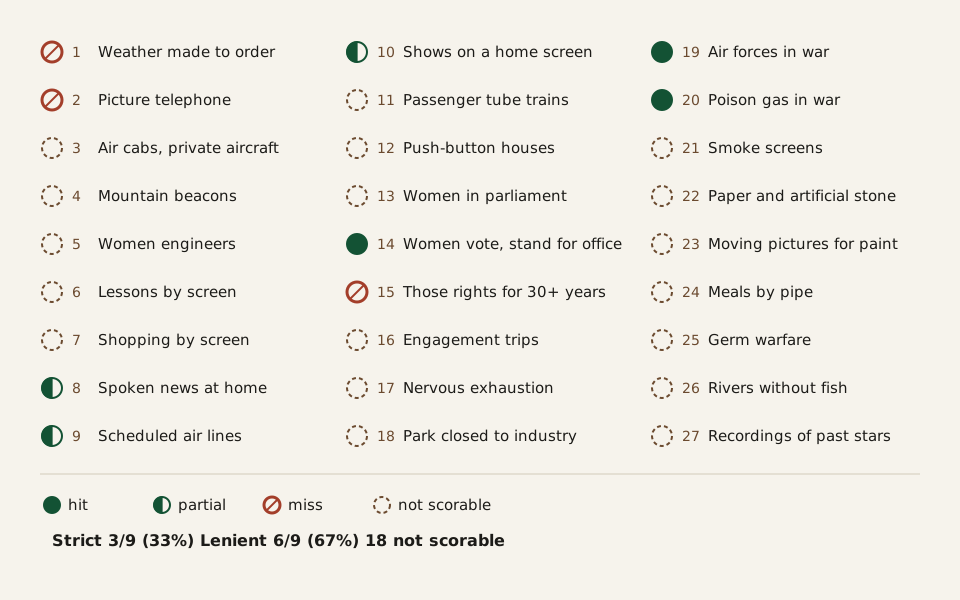
Diagram: Hoax and Hindsight · CC BY 4.0
Credit line to copy
"The 27 items of La Vie électrique and their grades" by Hoax and Hindsight, licensed under CC BY 4.0 (https://creativecommons.org/licenses/by/4.0/). Original: https://hoaxandhindsight.com/past-futures/albert-robida/
Data: Albert Robida, La Vie électrique (Exhibit A), and the sources named in each row of the item table
All 27 items in list order, with the grade of each. Drawn from the item table published with this page; claims from Robida (Exhibit A), grades from the sources named in each row.
How was the book split into items?
An item is a technology, a public service, or a social or political arrangement that the narrator presents as an ordinary part of France or Europe in December 1955 and 1956. The items come from the features named in the chapter summaries of the book’s own table of contents, and from the ways of travelling and talking at a distance shown in use in the first three chapters. A further item was added when a passage stated a separate fact that could be checked, such as how long women had held the vote.
Jokes are set aside. Electric storms that escape from power reservoirs and kill people on the telephone, a parliamentary party for men, and a compulsory national medicine are played for laughs, so they are not scored as misses. Plot events, invented people and firms, and things already in use when the book appeared, such as the telephone and the phonograph, are left out too. The list of 27 items was fixed on November 6, 2026, before any item was graded.
The split rules and the passages set aside, with reasons (CSV) (where the data comes from) Data: Albert Robida, La Vie électrique, and the sources named in each row
Illustration: Hoax and Hindsight. Generated schematic illustration — not a photograph or historical record. © Hoax and Hindsight, all rights reserved.
An illustration of an imagined scene, not a plate from the book: an electric city of December 1955 as a novel of the 1890s pictured it, with air cabs over the rooftops. Robida’s own drawings are not shown on this page.
The ledger
Each item was checked against records from the mid-1950s or later accounts of that period. A United Nations statistical yearbook for 1956 (Exhibit G) and a United Nations yearbook on human rights for 1946 (Exhibit B) settle most of the scorable items. Single sources settle the rest: an engineering journal on video telephones (Exhibit C), a government survey of weather control (Exhibit D) and an account of war inventions from 1918 (Exhibit E).
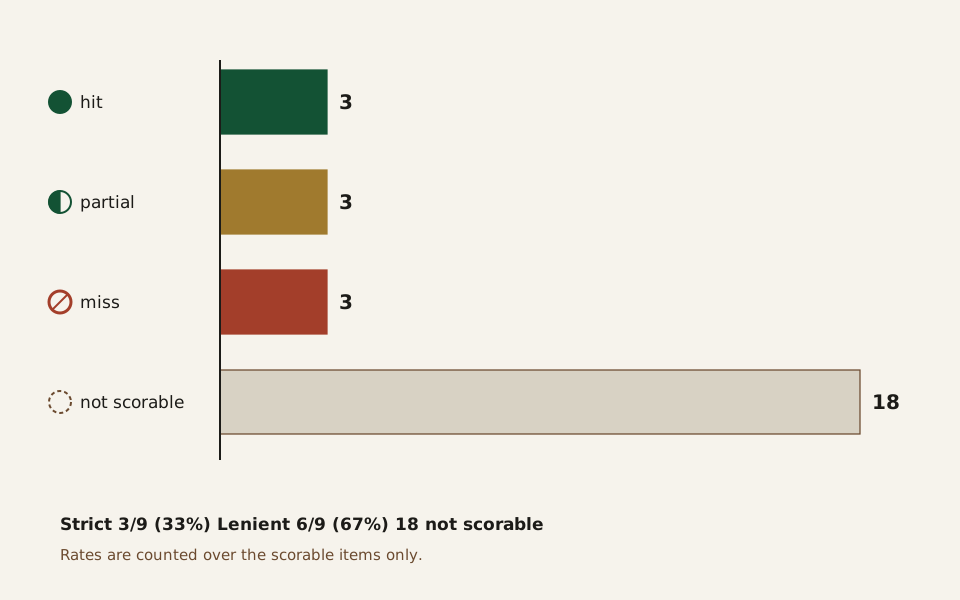
Diagram: Hoax and Hindsight · CC BY 4.0
Credit line to copy
"Grades of the 27 items" by Hoax and Hindsight, licensed under CC BY 4.0 (https://creativecommons.org/licenses/by/4.0/). Original: https://hoaxandhindsight.com/past-futures/albert-robida/
Data: Albert Robida, La Vie électrique (Exhibit A), and the sources named in each row of the item table
Grade counts for the 27 items, with the strict and lenient rates over the 9 scorable items. Drawn from the item table published with this page.
| Item | Claim | Grade | Source |
|---|---|---|---|
| 1 | Weather made to order | miss | Exhibit D |
| 2 | Picture telephone at home | miss | Exhibit C |
| 3 | Air cabs and private aircraft | not scorable | none read |
| 4 | Mountain beacons for aircraft | not scorable | none read |
| 5 | Women engineers | not scorable | none read |
| 6 | Lessons by screen at home | not scorable | none read |
| 7 | Shopping by screen | not scorable | none read |
| 8 | Spoken news at home | partial | Exhibit G, Table 185 |
| 9 | Scheduled passenger air lines | partial | Exhibit G, Table 143 |
| 10 | Shows on a home screen | partial | Exhibit G, Tables 1 and 187 |
| 11 | Passenger trains in tubes | not scorable | none read |
| 12 | Push-button houses | not scorable | none read |
| 13 | Women in parliament and cabinet | not scorable | Exhibit B |
| 14 | Women vote and stand for office | hit | Exhibit B |
| 15 | Those rights for over thirty years | miss | Exhibit B |
| 16 | Trial engagement trips | not scorable | none read |
| 17 | Nervous exhaustion | not scorable | none read |
| 18 | A national park closed to industry | not scorable | none read |
| 19 | Air forces in war | hit | Exhibit E, ch. XXIV |
| 20 | Poison gas in war | hit | Exhibit E, ch. I |
| 21 | Smoke screens | not scorable | none read |
| 22 | Paper and artificial-stone buildings | not scorable | none read |
| 23 | Moving pictures in place of painting | not scorable | none read |
| 24 | Meals by pipe, homes without kitchens | not scorable | none read |
| 25 | Germ warfare | not scorable | none read |
| 26 | Rivers too polluted for fish | not scorable | none read |
| 27 | Recordings of past performers | not scorable | none read |
The 27 items, with deadlines, tests, grades, reasons and sources (CSV) (where the data comes from) Data: Albert Robida, La Vie électrique, and the sources named in each row
By the strict count, 3 of the 9 scorable items are hits, or 33%. The lenient count adds the three partial hits: 6 of 9 hold up, or 67%. Items 8 and 9 were first graded hits and were regraded on November 6, 2026; their earlier grades stay in the previous_grade column of the download.
Eighteen items are left out of both counts. Several of them, such as air cabs, passenger tubes and meals sent by pipe, look as if they would fail, but no source read for this page measures them, so the two rates describe nine items and not the whole book.
What came true?
The three hits concern war and the vote. In the army manoeuvres of 1956, air forces mobilise beside land and undersea forces, and chemical troops carry asphyxiating gas. Both had arrived by 1918: Corbin describes aeroplanes scouting, fighting and bombing, and a German attack with chlorine gas on Canadian troops (Exhibit E). The book’s women vote and sit in elected office, and French women gained the right to vote and to stand for election by an ordinance of April 21, 1944 (Exhibit B, p. 112).
Three items count only as partial hits. Over the book’s Paris, express air lines arrive from the provinces and abroad, and a giant airliner comes in from South America. In 1955 scheduled airlines outside mainland China and the USSR flew about 61.1 billion passenger-kilometres on domestic and international services (Exhibit G, Table 143). The scheduled lines came true, but that table does not show how often they linked Europe’s cities or whether airliners arrived from other continents.
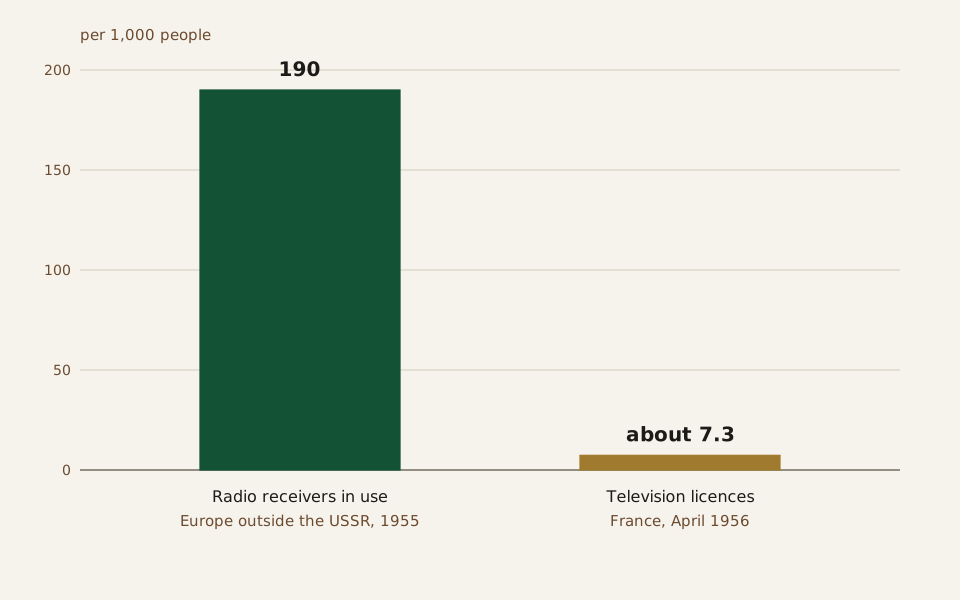
Diagram: Hoax and Hindsight · CC BY 4.0
Credit line to copy
"Radio sets and television licences per 1,000 people, mid-1950s" by Hoax and Hindsight, licensed under CC BY 4.0 (https://creativecommons.org/licenses/by/4.0/). Original: https://hoaxandhindsight.com/past-futures/albert-robida/
Data: United Nations, Statistical Yearbook 1956, Tables 1, 185 and 187
Radio sets in use in Europe outside the USSR in 1955 (a UNESCO estimate), against television licences in France in April 1956, each per 1,000 people; the licences are set against the 1954 census population. Drawn from the UN Statistical Yearbook 1956 (Exhibit G), Tables 1, 185 and 187.
Robida’s Telejournal reads the news aloud at breakfast. By a UNESCO estimate, about 78 million radio sets were in use in Europe outside the USSR in 1955, 190 for every 1,000 people (Exhibit G, Table 185). That table counts sets, not news programmes. The receiver at home came true; no source read for this page shows the news part.
Television is the third. Plays, concerts and news pictures do reach screens at home in the book, and even a modest civil servant’s family in the Alps has one. France had issued 314,000 television licences by April 1956, about 7 for every 1,000 people at the 1954 census count of 42,843,520 (Exhibit G, Tables 1 and 187). Broadcast pictures came true; the screen in every home did not.
What missed, and what can’t be scored?
The picture telephone missed. Two-way video calls were shown between two New York buildings in 1930, but the Bell System’s own account says practical service depended on technology developed mainly in the 1960s (Exhibit C). Weather control missed as well. A survey written after a federal advisory committee reported in December 1957 found that seeding clouds could add a little local rain, and concluded: “In general, the present known capabilities for controlling the weather are quite modest.” (Exhibit D, first page)
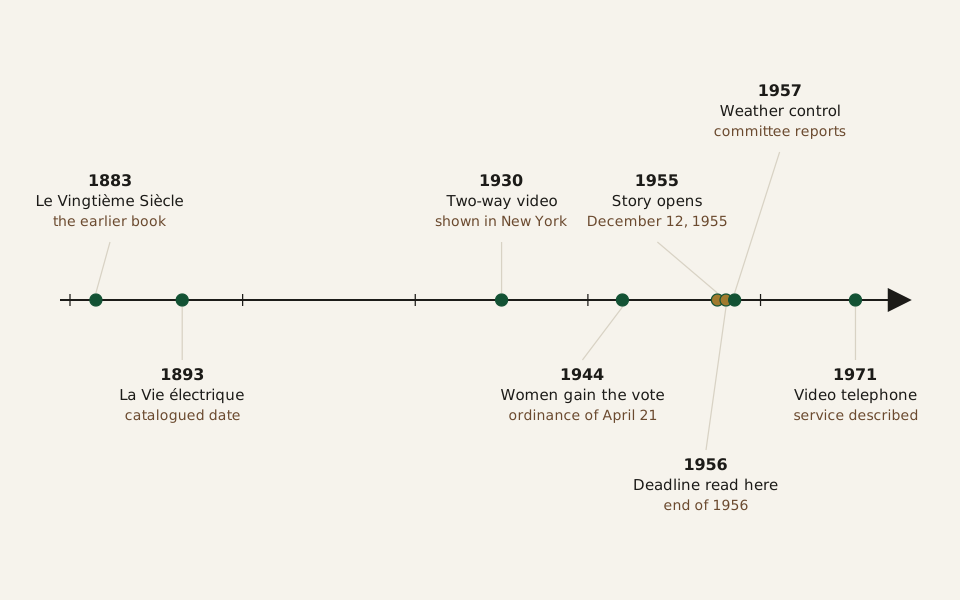
Diagram: Hoax and Hindsight · CC BY 4.0
Credit line to copy
"Dates behind the misses, 1883 to 1971" by Hoax and Hindsight, licensed under CC BY 4.0 (https://creativecommons.org/licenses/by/4.0/). Original: https://hoaxandhindsight.com/past-futures/albert-robida/
Data: Robida, La Vie électrique; Yearbook on Human Rights for 1946; The Bell System Technical Journal (1971); CIA, Survey of Weather Modification; Houghton Library date for Le Vingtième Siècle (1883)
Dates behind the misses, 1883 to 1971, with the story’s own years marked. Drawn from Exhibits A to D and H; the 1893 date is the catalogue date of the Getty Research Institute copy.
The third miss comes from the book’s own detail. Its women hold office as “électrice, éligible, ayant les mêmes droits politiques et sociaux que l’homme depuis plus de trente ans” (“voters and eligible for office, with the same political and social rights as men for more than thirty years”, translated by Hoax and Hindsight; Exhibit A, pt. 2, ch. II, p. 136).
That would date the rights to before about 1925. In France they dated from 1944, and the laws of the Third Republic had not given women equal political rights (Exhibit B, p. 112).
Eighteen items could not be scored. Two are too loosely worded to test: nervous exhaustion across a whole population, and moving pictures taking the place of painting. For the other 16, among them air cabs, tube trains, shopping by screen and a national park closed to industry, no source read for this page settles the test. They are left out of both rates rather than counted as misses.
Why did the 1890s fear the pace of electric life?
One item can be read as a dated fear. In the book, the hurried electric life of the title has worn people out, and each summer crowds of the exhausted flee to the Brittany park, where machines are banned (Exhibit A, pt. 1, ch. VI; pt. 2, ch. II and VIII).
The same fear was in print within a few years of the book. Max Nordau’s Degeneration first appeared in English in London in February 1895. It blamed railways, letters and newspapers for the strain and wrote: “All these activities, however, even the simplest, involve an effort of the nervous system and a wearing of tissue.” (Exhibit F, Book I, ch. IV)
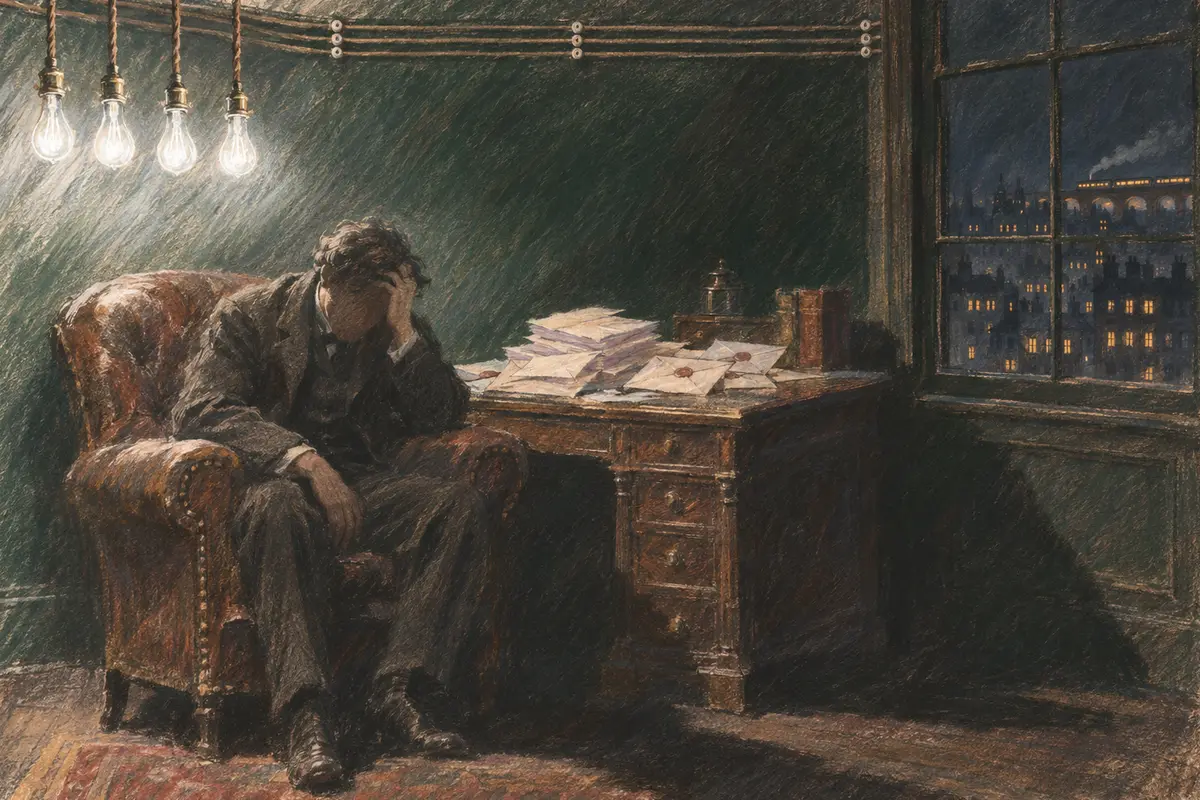
Illustration: Hoax and Hindsight. Generated schematic illustration — not a photograph or historical record. © Hoax and Hindsight, all rights reserved.
An illustration of an imagined scene, not a plate from the book: the weariness of electric life as the 1890s feared it, a man worn out under bare lamps among letters and papers.
Because the book and a source from its own years both show this fear, item 17 fits the time-stamped wish. The item itself stays unscored, since the book names no measure by which exhaustion across a nation could be checked. For the other items, no period source on their hopes or fears was read for this page, so they are scored and nothing more is read into them.
What would overturn it:
- A dated first printing or publisher’s record that puts the book or its setting in another year, which would change the deadline and the date behind the forecasts.
- A record from 1955 or 1956 that settles one of the 16 items left unscored for want of a source, such as a count of private aircraft in France or a list of the country’s national parks.
Exhibits
Records and period publications
- Exhibit A: Albert Robida, Le Vingtième Siècle: La Vie électrique, text and drawings by the author (Paris: Librairie illustrée, n.d.; the Getty Research Institute copy is catalogued as 1893).
- Exhibit B: United Nations, Yearbook on Human Rights for 1946 (Lake Success, 1947), France: Constitution of 27 October 1946, preamble, p. 105; 'Fundamental Rights in France since the Liberation', p. 112.
- Exhibit C: Jack A. Baird, “Foreword,” in “The Picturephone System,” The Bell System Technical Journal 50, no. 2 (February 1971): 219–220.
- Exhibit D: Central Intelligence Agency, “Survey of Weather Modification” (undated; it cites the Final Report of the Advisory Committee on Weather Control of December 31, 1957), document CIA-RDP78-03425A002100020023-2, released 2013.
- Exhibit E: Thomas W. Corbin, The Romance of War Inventions (London: Seeley, Service, 1918).
- Exhibit F: Max Nordau, Degeneration, translated from the second edition of the German work (London: William Heinemann, first English edition February 1895; popular edition 1898), Book I, ch. IV.
Databases and data sets
- Exhibit G: United Nations, Statistical Office, Statistical Yearbook 1956 (New York, 1956), Tables 1, 143, 185 and 187.
- Exhibit H: Bibliothèque nationale de France, authority record “Albert Robida (1848-1926)”, data.bnf.fr, ark:/12148/cb12169844v (metadata under the Licence Ouverte; retrieved 2026-11-06).
Cite this page
Hoax and Hindsight. “Albert Robida’s Novel vs. 1956: Strict 3/9, Lenient 6/9.” Hoax and Hindsight, published November 6, 2026. https://hoaxandhindsight.com/past-futures/albert-robida/. Accessed [the date you read it].
Related cases
Ladies’ Home Journal 1900 Predictions: 68 Items, 48 Scored
Ladies’ Home Journal 1900 predictions for 2000, split into 68 items and scored: 11 of 48 came true, 27 of 48 counting partial hits; 20 items not scorable.
Picture credit
"The Ladies’ Home Journal, May 1900: The Spring-Tide Awakening of Life and Labor (poster)" by Frank Walter Taylor — https://commons.wikimedia.org/wiki/File:Rudyard_Kipling%27s_Great_Animal_Stories_The_Ladies%27_Home_Journal_May,_1900_-_Ten_cents_The_Spring-Tide_Awakening_of_Life_and_Labor_The_Curtis_Publishing_Company,_Phi,_asset_R2lUHTjMXnRWIWGJgUnisGyp.tif — Public domain (US: published in 1900, before 1931 (public domain). EU: designer Frank Walter Taylor died on July 27, 1921 (date of death 27 July 1921 on the Commons category page F. Walter Taylor, whose infobox is drawn from Wikidata; page archived in the image rights check of 2026-11-05; ULAN 500009621 gives the same years; not confirmed from a printed source), more than 70 years ago; the poster is signed 'designed by Frank Walter Taylor'. Scan chain: Commons file uploaded from the image bank of the city of Antwerp (dams.antwerpen.be asset R2lUHTjMXnRWIWGJgUnisGyp), object held by the Letterenhuis, Antwerp, AV.14.6.54. The poster's own notice of British and American copyright in 1900 has expired.); modified: converted from TIFF to JPEG, scaled from 3,080 x 4,568 to 1,349 x 2,000 px; not cropped (paper edges kept)
Halley’s Comet: The 1758 Return Halley Foretold, Never Saw
Halley’s Comet: in 1705 Halley wrote it would return in 1758. It was seen on Christmas night 1758, after his death. His forecast, split into 5 claims, scored.
Picture credit
"Halley’s Comet 1835-6 (plate I in The Story of the Comets)" by C. P. Smyth — https://commons.wikimedia.org/wiki/File:The_story_of_the_comets_-_Plate_I.jpg — Public domain (US: published 1909, before 1931 (PD-1923 on Commons). EU: C. P. Smyth died 1900 and George F. Chambers died 1915, both more than 70 years ago; the plate maker is not named and the book was published in 1909, more than 70 years ago. Scan chain: Commons file from en.wikisource Page:The_story_of_the_comets.djvu/6, whose djvu is the University of Toronto (Gerstein Library) scan on the Internet Archive (storyofcometssim00chamuoft).)
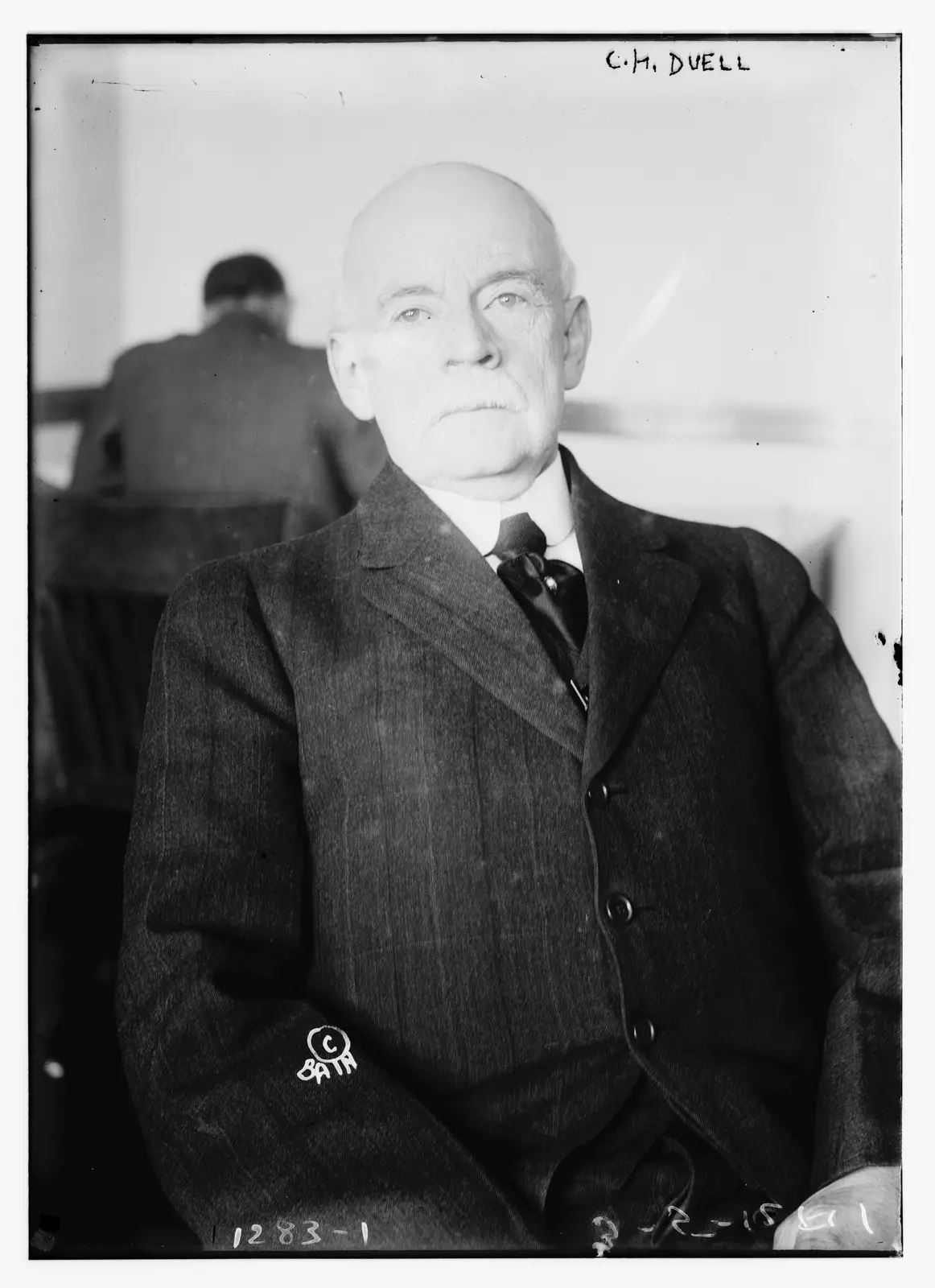
“Everything That Can Be Invented”: Not in Duell’s Report
Charles Duell’s Patent Office report for 1899 asks Congress to help inventors. The line is not in its pp. iii–xii; the earliest printing found is a Punch joke.
Picture credit
"C.H. Duell" by Bain News Service — https://commons.wikimedia.org/wiki/File:C.H._Duell_LCCN2014686661.jpg — Public domain (news-agency photograph by the Bain News Service, no named photographer; the negative is marked 3-2-15, read here as March 2, 1915 (Bain negatives are marked month-day-year; the library's date of 1900 is a catalogue placeholder). US: public domain on the ground that Bain distributed its photographs to newspapers when they were taken, which counts as publication, and this was before 1931. Risk: whether this negative was actually distributed in 1915 has not been checked; if it was never published, an anonymous unpublished US work of 1915 is protected until 120 years after creation (end of 2035). EU: anonymous work, 70 years from first making available (or, if never made available, from creation), long expired. Library of Congress Prints and Photographs, George Grantham Bain Collection, ggbain.06669, 'No known restrictions on publication' (a lead, not the basis))