Reading the Evidence · Method and mechanism
Terminus Post Quem: Newest Original Part Sets a Date Floor
Hoax and Hindsight Published
A terminus post quem is the earliest date a thing can have, because nothing is older than its newest part. It sets a floor, not a date: a layer holding a coin struck in AD 151 formed in 151 or later, and the rule alone cannot say how much later.
Method
- Method
- Terminus post quem and terminus ante quem: date limits drawn from what an object or layer contains, and from what seals or records it
- What it measures
- The earliest date a layer or object can have, set by its newest dated part; for the ante quem, the latest date, set by a dated record or seal that already includes it
- What it can show
- That a layer or object is no older than its newest dated component, or no younger than a dated record or structure that contains or seals it
- What it cannot show
- How long after the limit the thing was made or buried, or whether the dated part was added later; a floor (terminus post quem) that falls before the claimed date proves nothing either way
- Key case
- A coin sealed in a layer; the Vinland Map, whose lines hold a titanium pigment first produced commercially in the 1920s, so by current evidence the drawing is no older (Yale, 2021)
The Latin means “the limit after which.” Its partner, the terminus ante quem or “limit before which,” works from the other side: a thing sealed under a dated wall, or quoted in a dated book, cannot be younger than that wall or book. Together the two limits bracket a date, but neither says where inside the bracket the true date falls.
The Egyptologist Flinders Petrie set out the reasoning in 1904 without using the Latin terms. Material facts, he wrote, “when rightly understood, are the most conclusive evidence,” and two of his first examples were limits of this kind (Exhibit A, pp. 138–139). This site’s retrial method leans on the same reasoning whenever a page calls something the earliest known: the page names the dated source that sets the limit. The section below is made up for this page, not taken from a real site.
Order of proceedings 5 parts
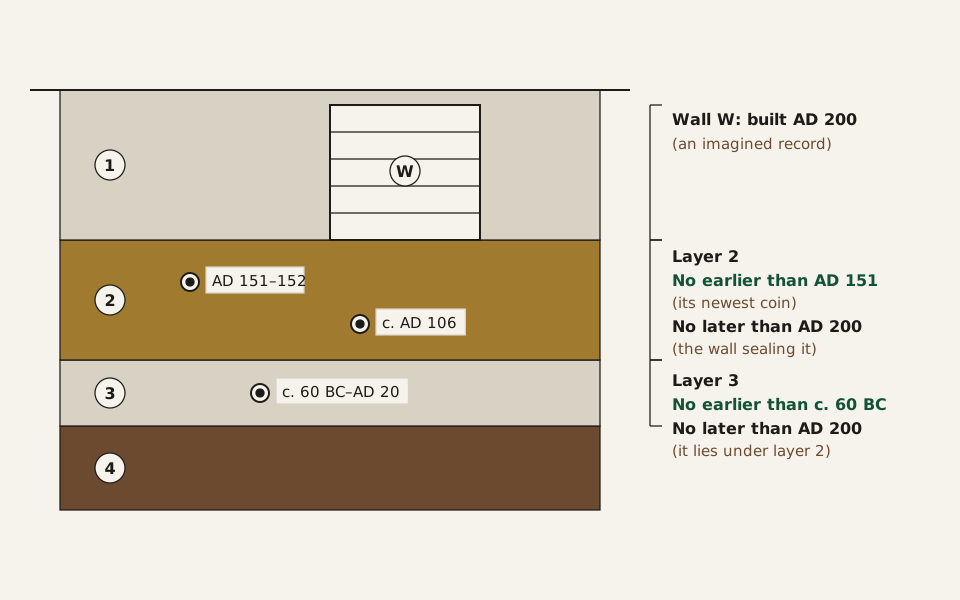
Diagram: Hoax and Hindsight · CC BY 4.0
Credit line to copy
"An illustrative section: a layer dated between two limits" by Hoax and Hindsight, licensed under CC BY 4.0 (https://creativecommons.org/licenses/by/4.0/). Original: https://hoaxandhindsight.com/archaeology-retested/terminus-post-quem/
Data: Illustrative section designed for this page; coin dates from Portable Antiquities Scheme records 90889, 595673 and 983439 as published on Wikimedia Commons; reasoning after W. M. Flinders Petrie, Methods & Aims in Archaeology (London, 1904), pp. 138-139 and 145
An illustrative section, not a real site. Layer 2 holds coins of AD 151–152 and about AD 106, so it formed no earlier than AD 151; a wall built on it in AD 200, an imagined record, means it formed no later than AD 200. Drawn from the table published with this page.
The illustrative section, one row per unit with its limits (CSV) (where the data comes from) Data: Illustrative section designed for this page (not a real site); coin dates from Portable Antiquities Scheme records as published on Wikimedia Commons
How does a terminus post quem work?
Start with the newest dated thing inside a layer, a pit fill or an object. Whatever contains it was finished at the same time or later, so that date is the floor. In the drawing, layer 2 holds a denarius of Trajan struck about AD 106 and a denarius of Antoninus Pius struck in AD 151–152. The newer coin sets the floor at AD 151; the older coin adds nothing, because the layer had to wait for the newer one.
Petrie gave a compact example of the same logic: “a restruck coin with one type over another, as Barchocheb over Hadrian” (Exhibit A, p. 139). A coin struck on top of a coin of the emperor Hadrian cannot be older than the coin underneath it. The underlying coin is the dated part, and the restrike is the thing being dated.
"Roman Coin: Denarius of Antoninus Pius (PAS FindID 90889)" by The Portable Antiquities Scheme/ The Trustees of the British Museum — https://commons.wikimedia.org/wiki/File:Roman_Coin,_Denarius_of_Antoninus_Pius_(FindID_90889).jpg — CC BY-SA 4.0 (https://creativecommons.org/licenses/by-sa/4.0/)
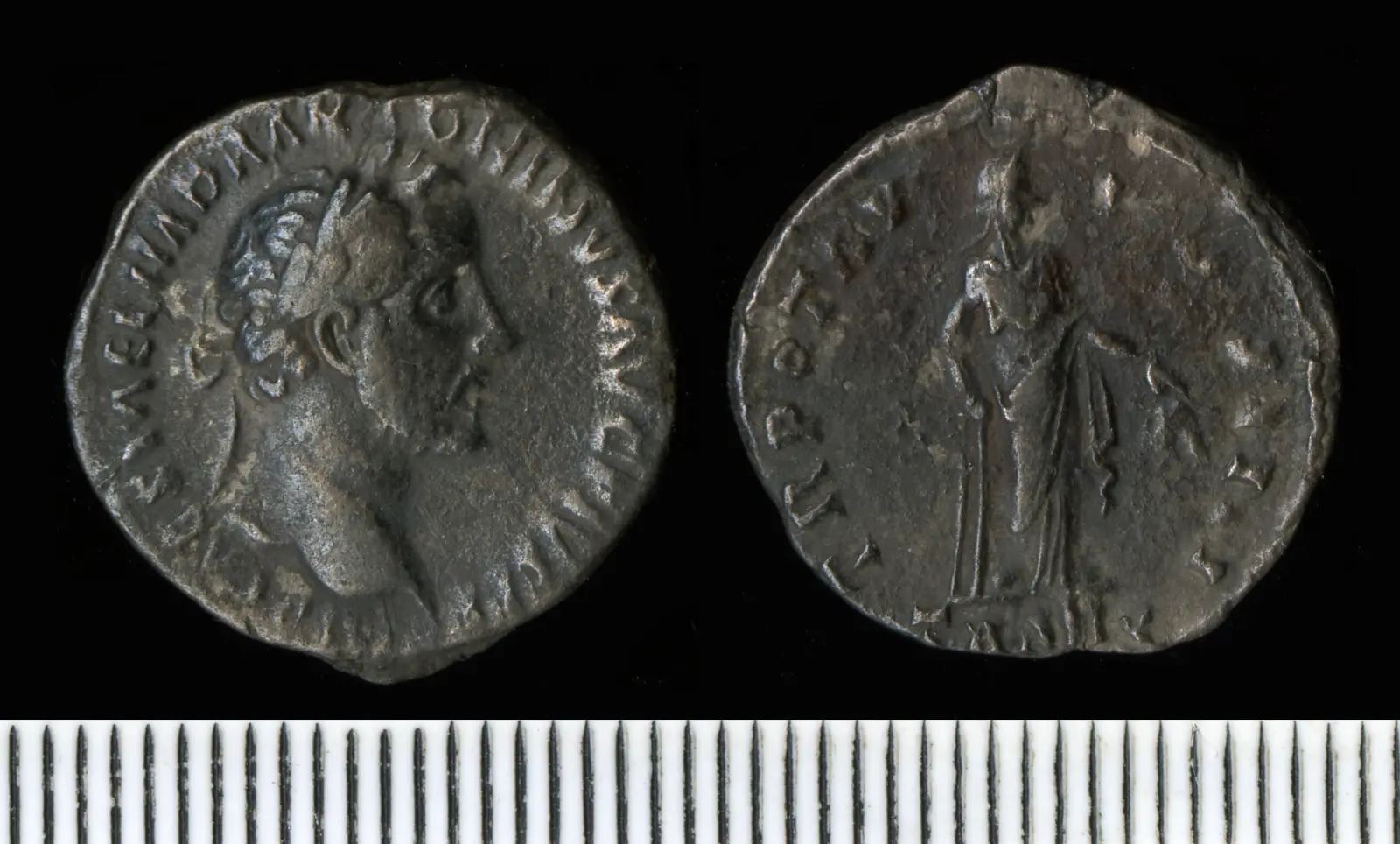
A silver denarius of Antoninus Pius, struck in AD 151–152, recorded by the Portable Antiquities Scheme from a find in the Darlington area and photographed in 2012. A coin dated this narrowly gives a sharp floor to any layer it is sealed in.
The other half of the rule is the seal. A floor holds only if nothing newer could have got in later. Petrie trusted groups of objects burnt in pits and then covered, because they “cannot possibly have been disturbed later on to insert objects” (Exhibit A, p. 145). A later pit cut down from above can carry a newer coin into an old layer, the trap described on the stratigraphy page, where a later pit lies deeper than older layers.
Why do some coins give sharper limits than others?
A terminus post quem is only as sharp as the date of its dated part. The Antoninus Pius coin carries the emperor’s titles, and the Portable Antiquities Scheme record dates it to AD 151–152 (Exhibit J). The Iron Age stater below has no inscription. It is classed by its design, so its record gives a span instead: about 60 BC to AD 20.
"Cranborne chase stater (PAS FindID 983439)" by The Portable Antiquities Scheme — https://commons.wikimedia.org/wiki/File:Cranborne_chase_stater_(FindID_983439).jpg — CC BY 2.0 (https://creativecommons.org/licenses/by/2.0/); modified: card and share image cropped to 16:10 by the site build; the article page shows the full frame
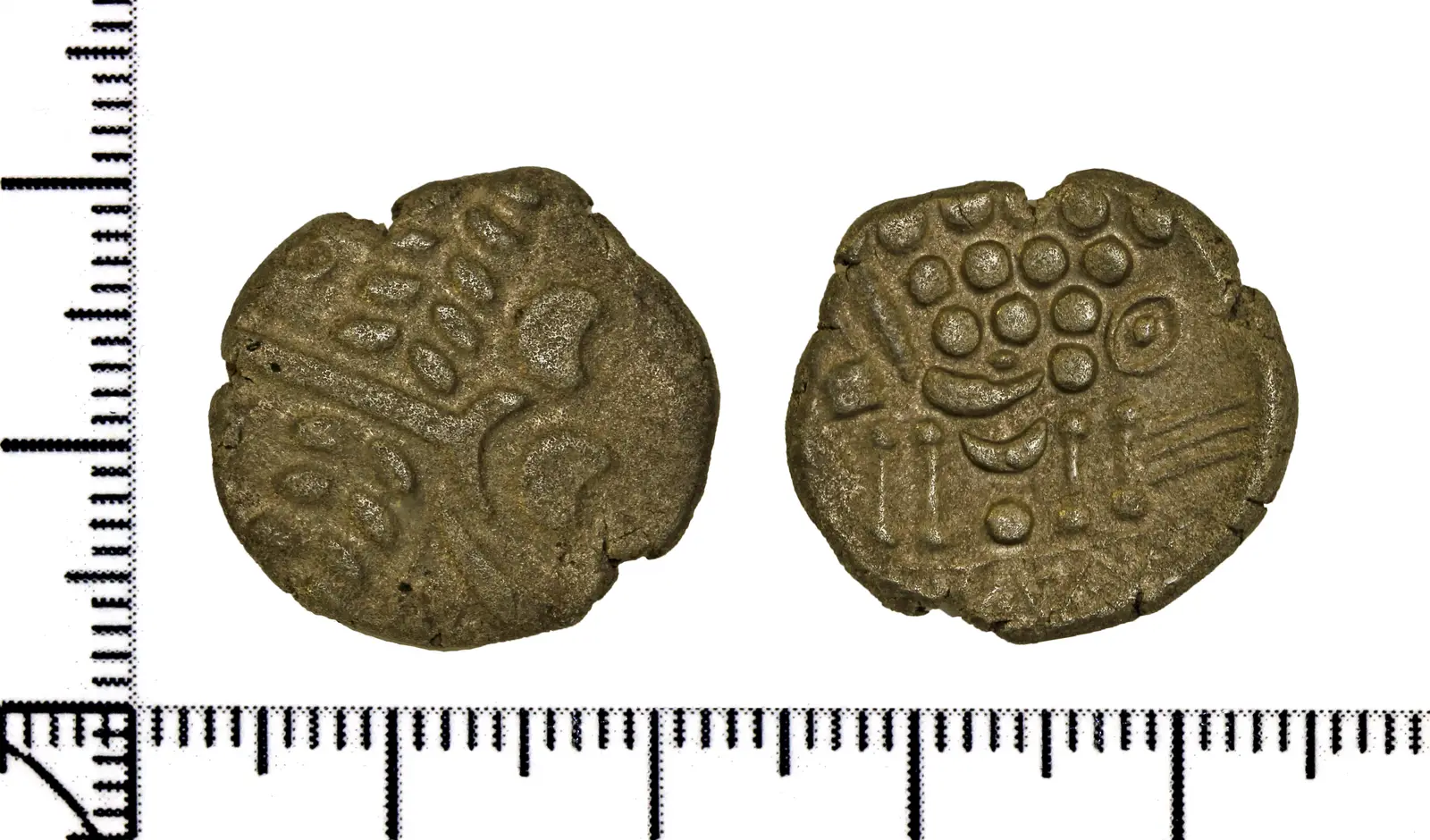
Iron Age silver stater of the Cranborne Chase type, c. 60 BC–AD 20, recorded by the Portable Antiquities Scheme from a find in Hampshire. A stylized wreath is on one face and a stylized horse on the other.
A layer holding only the stater can be no older than about 60 BC. That early end of the range is the safe floor, even though the coin may have been struck as late as AD 20. The range runs 79 years, because there is no year zero between 1 BC and AD 1.
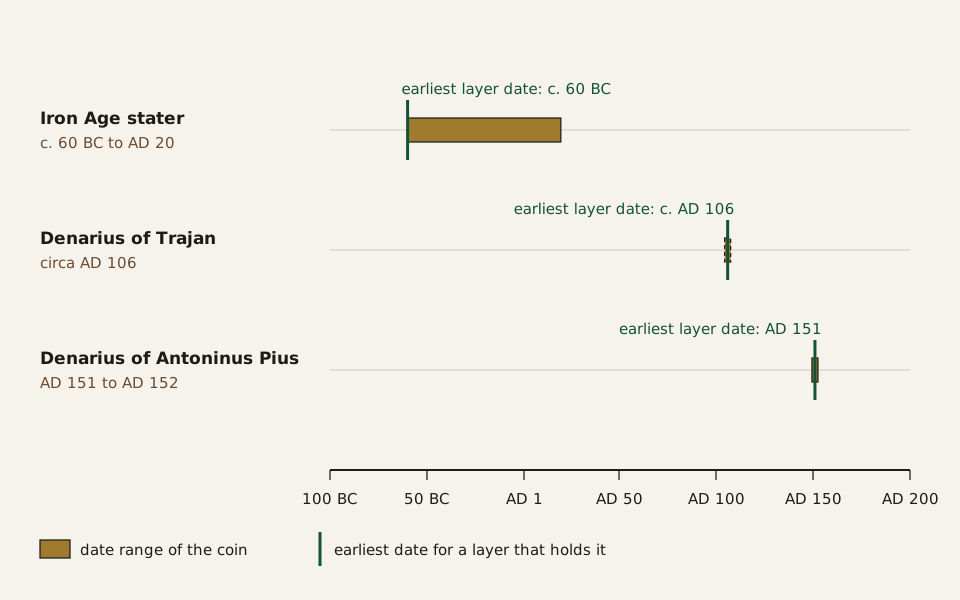
Diagram: Hoax and Hindsight · CC BY 4.0
Credit line to copy
"Three coin types and the earliest date each gives a layer" by Hoax and Hindsight, licensed under CC BY 4.0 (https://creativecommons.org/licenses/by/4.0/). Original: https://hoaxandhindsight.com/archaeology-retested/terminus-post-quem/
Data: Portable Antiquities Scheme records 983439, 595673 and 90889, as published with their photographs on Wikimedia Commons
The three coin types on this page, each with the earliest date it can give a layer. Drawn from the table published with this page, from the Portable Antiquities Scheme records (Exhibit J).
The coins and printed dates, one row per item with its limit (CSV) (where the data comes from) Data: Portable Antiquities Scheme records as published on Wikimedia Commons; Edmund Halley (1705); George F. Chambers (1909); The Ladies' Home Journal (December 1900); Giuseppe Baretti (1757); A. Favaro (1907)
What can’t a terminus post quem show?
It cannot say how long after the floor a layer formed or an object was made. Coins stay in use for years before they are lost. Petrie put numbers on that for late Roman coinage: “in a hundred years only an eighth survived in use, and in half a century more only a twenty-fifth remained” (Exhibit A, p. 150).
He judged the delay usually short: “In certainly nine cases out of ten we must expect that a dated object was buried within less than two or three generations from its original period” (Exhibit A, p. 151). That is his estimate for the Egyptian tomb groups he knew, not a rule for every site. For those groups he called “the dated object being older than the tomb” “practically the only danger” (Exhibit A, p. 150). An old object in a late deposit does not break the floor; it only sets the floor too early, further from the true date.
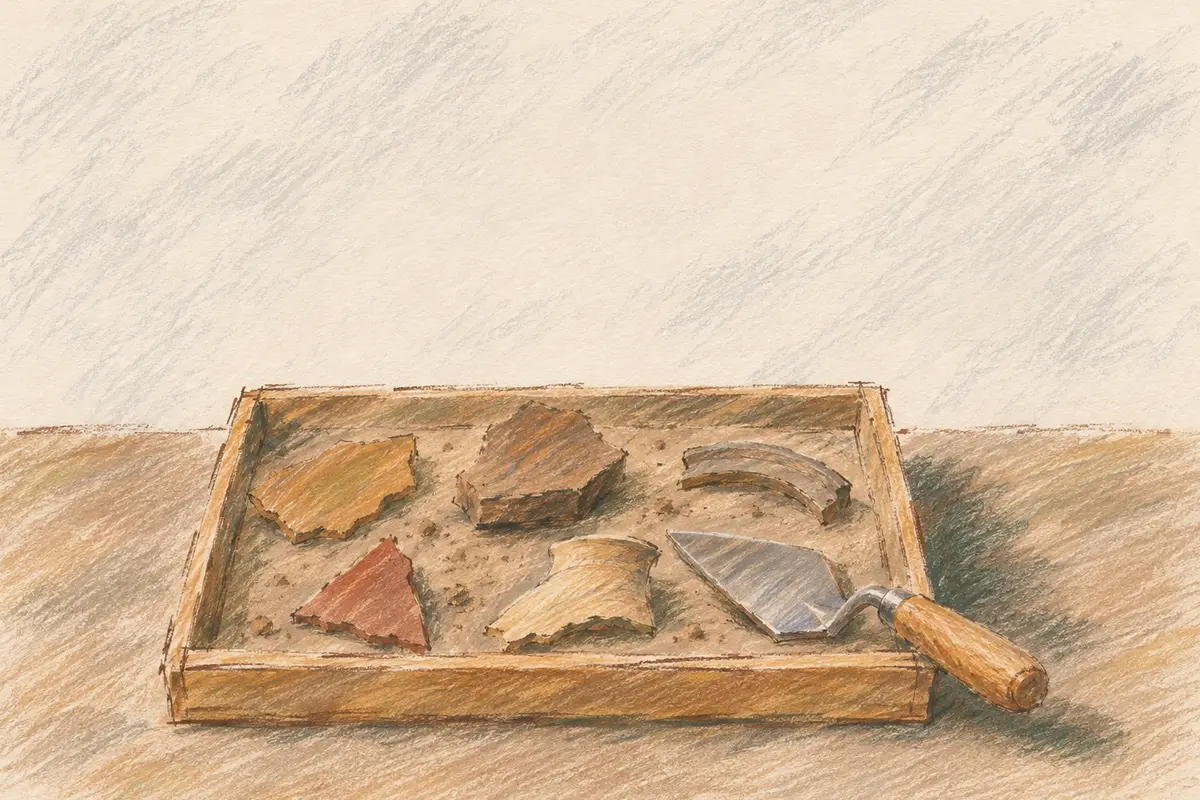
Illustration: Hoax and Hindsight. Generated schematic illustration — not a photograph or historical record. © Hoax and Hindsight, all rights reserved.
An illustration, not a record: plain sherds in a finds tray. Nothing in a tray says how long its contents circulated before they were buried; a floor date says only that they were buried no earlier than it.
The rule also fails if the dated part is not original to the thing being dated. A coin carried down a later burrow, or a modern pigment in a later repair, gives a floor for the intrusion, not for what surrounds it. And a floor that falls before the claimed date proves nothing either way, as the next section shows.
Nor can the rule prove that an object is genuine. Passing it means only that no dated part has been found that is too new, and a forger can work on old material. By Yale’s 2021 account, the Vinland Map’s parchment probably came from a genuine medieval volume, yet its lines hold a pigment of the 1920s (Exhibit G). The age of the material and the age of the work on it are separate questions.
Which fakes were caught by a modern ingredient?
For a forgery, the dated part is a material that did not exist when the object claims to have been made. The test is one comparison: whether the latest date the claim allows falls before the floor set by that material. The chart and table put three cases from this site through it.
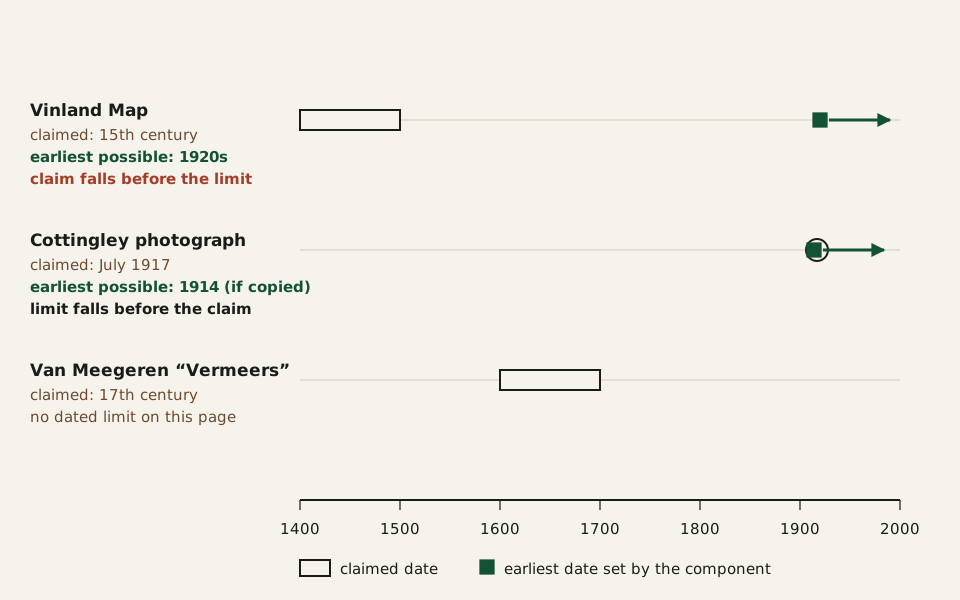
Diagram: Hoax and Hindsight · CC BY 4.0
Credit line to copy
"Three claimed dates against the earliest dates set by a modern component" by Hoax and Hindsight, licensed under CC BY 4.0 (https://creativecommons.org/licenses/by/4.0/). Original: https://hoaxandhindsight.com/archaeology-retested/terminus-post-quem/
Data: Mike Cummings, Yale News, September 1, 2021; Arthur Conan Doyle, The Coming of the Fairies (New York: Doran, 1922); Princess Mary's Gift Book (London: Hodder & Stoughton, 1914)
Three cases. Open shapes are the claimed dates; filled squares are the earliest dates set by a component, with the arrow pointing to the years still possible. Drawn from the table published with this page (Exhibits E to G, L and M).
| Case | Claimed date | Dated component | Earliest possible date | Claim earlier than the floor? |
|---|---|---|---|---|
| Vinland Map | 15th century | Anatase, a titanium pigment, in the drawn lines (Yale, 2021) | 1920s | Yes |
| Cottingley fairy photograph | July 1917 | Fairy figures, if copied from a 1914 book | 1914 | No |
| Van Meegeren “Vermeers” | 17th century | Phenol traces from a Bakelite-type hardener, according to Godley (1951) | Not computed here | Not computed |
Three cases, one row per object with its limit (CSV) (where the data comes from) Data: Mike Cummings, Yale News, September 1, 2021; Arthur Conan Doyle (1922); Princess Mary's Gift Book (1914); John Godley (1951); P. B. Coremans (1949)
The Vinland Map is the clean case. Yale reported in 2021 that a titanium pigment first produced commercially in the 1920s runs through the map’s lines and text, and that its particles resemble a pigment made in Norway in 1923 (Exhibit G). By current evidence, then, a drawing in that ink can be no older than the 1920s, whatever the age of its parchment, as the Vinland Map page, which dates the parchment and the ink separately sets out.
The Cottingley photographs show the method’s blind side. Arthur Conan Doyle’s 1922 book dates the photograph of Frances and the fairies to a “Bright sunny day in July, 1917” (Exhibit E). If the fairy figures were copied from an illustration in Princess Mary’s Gift Book, published in 1914 (Exhibit F), the floor is 1914, three years before the claimed date. The limit fits the claim, so it cannot expose a fake; that case is retried on the Cottingley Fairies page, which retries the photographs and the 1914 book.
The van Meegeren paintings were sold as works by Johannes Vermeer. According to John Godley’s 1951 biography, van Meegeren hardened his paint with phenol and formaldehyde, the chemicals used to make Bakelite, and chemists found traces of phenol in the paintings once they knew to look (Exhibit M, pp. 13, 20, 128). The 1949 report by Paul Coremans was read here only as a bibliographic entry (Exhibit L), and no dated first year for that resin has been read, so the case enters no floor; it belongs to the Han van Meegeren page, another forgery judged by its materials. Letter forms and language can serve as a floor too, if a form can be shown not to exist before a known date; that argument is weighed on the Kensington Runestone page.
What is a terminus ante quem?
The ceiling works the other way. Something already sealed, recorded or quoted by a dated source cannot be younger than that source. Petrie’s example was a photograph: a Maori tattooed head in a daguerreotype “would prove the tatuing to be known between 1840 and 1860” (Exhibit A, pp. 138–139). For texts, the date of printing does the same job.
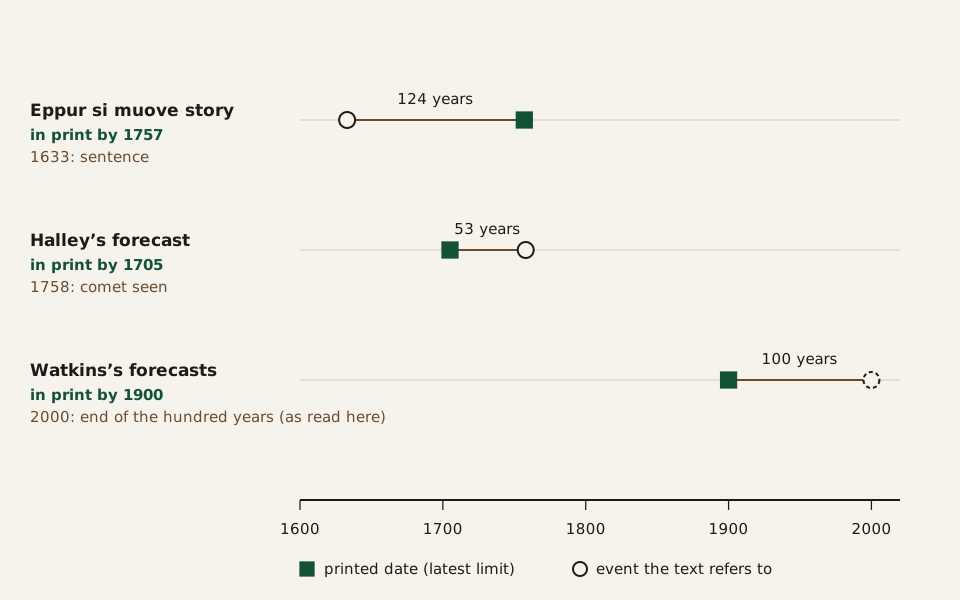
Diagram: Hoax and Hindsight · CC BY 4.0
Credit line to copy
"Three printed dates used as the latest limit" by Hoax and Hindsight, licensed under CC BY 4.0 (https://creativecommons.org/licenses/by/4.0/). Original: https://hoaxandhindsight.com/archaeology-retested/terminus-post-quem/
Data: Edmund Halley, A Synopsis of the Astronomy of Comets (London, 1705), p. 22; George F. Chambers, The Story of the Comets (Oxford, 1909), p. 109; The Ladies' Home Journal, vol. 18, no. 1 (December 1900), p. 8; Giuseppe Baretti, The Italian Library (London, 1757), p. 52; A. Favaro, Le opere di Galileo Galilei, vol. 19 (Florence, 1907)
Three printed dates used as ceilings. Each filled square is the date a text was in print; each circle is the event it refers to. Drawn from the table published with this page (Exhibits B to D, H and I).
Edmund Halley’s Synopsis of the Astronomy of Comets, printed in London in 1705, says the comet “will return again in the Year 1758” (Exhibit B, p. 22). It was seen on Christmas night 1758 (Exhibit H, p. 109). The printed date proves the forecast was in print 53 years before the comet was seen again, which is what lets the Halley’s Comet page score the 1705 forecast claim by claim.
The December 1900 issue of The Ladies’ Home Journal carried John Elfreth Watkins Jr.’s “What May Happen in the Next Hundred Years” on page 8 (Exhibit D). Its forecasts were in print by that month, so every later outcome can be measured against them. They are scored on the page that grades Watkins’s 1900 forecasts item by item.
A printed date also limits a story. Giuseppe Baretti’s Italian Library, printed in London in 1757, says Galileo spoke the words “Eppur si move,” which Baretti glosses as “still it moves,” once he was set at liberty (Exhibit C, p. 52). That is the earliest printing found so far, according to Mario Livio (Exhibit K).
The story therefore existed by 1757, 124 years after the sentence of June 22, 1633 (Exhibit I), but the book cannot show how much earlier it began. Whether the 1633 record holds the words is a separate question, tried on the Galileo trial page, which sets the story against the 1633 sentence.
What would overturn it:
- Evidence that the titanium in the Vinland Map’s lines is a later addition. If independent analyses showed the anatase sits in a retouching or surface contamination, not in the original ink lines, the 1920s floor would date that later work, not the drawing, and the map’s row in this page’s table would have to change.
- A sealed deposit with a newer coin inside. A well-recorded deposit, sealed under a structure of known date, that held a coin struck after that date, with no pit or burrow to explain it, would show that a seal can fail and would weaken the reasoning as this page states it.
Exhibits
Records and period publications
- Exhibit A: W. M. Flinders Petrie, Methods & Aims in Archaeology (London: Macmillan, 1904).
- Exhibit B: Edmund Halley, A Synopsis of the Astronomy of Comets (London: John Senex, 1705), the English translation of Astronomiae cometicae synopsis, first printed in Latin in the Philosophical Transactions, vol. 24 (1705).
- Exhibit C: Giuseppe Baretti, The Italian Library: Containing an Account of the Lives and Works of the Most Valuable Authors of Italy (London: A. Millar, 1757), p. 52, entry for Galileo's Dialogo (Florence: Landini, 1632).
- Exhibit D: John Elfreth Watkins Jr., “What May Happen in the Next Hundred Years,” The Ladies’ Home Journal, vol. 18, no. 1 (Philadelphia: Curtis Publishing Company, December 1900), p. 8.
- Exhibit E: Arthur Conan Doyle, The Coming of the Fairies (New York: George H. Doran, 1922).
- Exhibit F: Princess Mary’s Gift Book (London: Hodder & Stoughton, [1914]).
- Exhibit G: Mike Cummings, “Analysis unlocks secret of the Vinland Map — it’s a fake,” Yale News, September 1, 2021.
- Exhibit H: George F. Chambers, The Story of the Comets Simply Told for General Readers (Oxford: Clarendon Press, 1909).
- Exhibit I: Antonio Favaro, ed., Le opere di Galileo Galilei, Edizione nazionale, vol. 19 (Florence: G. Barbèra, 1907): document XXIV, 'Processo di Galileo', including the sentence and abjuration of June 22, 1633 (pp. 402–407), and Vincenzio Viviani's 'Racconto istorico' of Galileo's life.
Studies
- Exhibit K: Mario Livio, ‘Did Galileo Truly Say, “And Yet It Moves”? A Modern Detective Story,’ Scientific American Observations blog, 2020.
- Exhibit L: P. B. Coremans, Van Meegeren’s Faked Vermeers and De Hooghs: A Scientific Examination, translated by A. Hardy and C. M. Hutt (Amsterdam: Meulenhoff, 1949).
- Exhibit M: John Godley, Master Art Forger: The Story of Han van Meegeren (New York: Wilfred Funk, 1951).
Databases and data sets
- Exhibit J: Portable Antiquities Scheme, finds records 983439 (Iron Age silver stater, Hampshire), 595673 (denarius of Trajan, Wiltshire) and 90889 (denarius of Antoninus Pius, Darlington), as published with their photographs on Wikimedia Commons.

Cite this page
Hoax and Hindsight. “Terminus Post Quem: Newest Original Part Sets a Date Floor.” Hoax and Hindsight, published November 6, 2026. https://hoaxandhindsight.com/archaeology-retested/terminus-post-quem/. Accessed [the date you read it].
Related cases
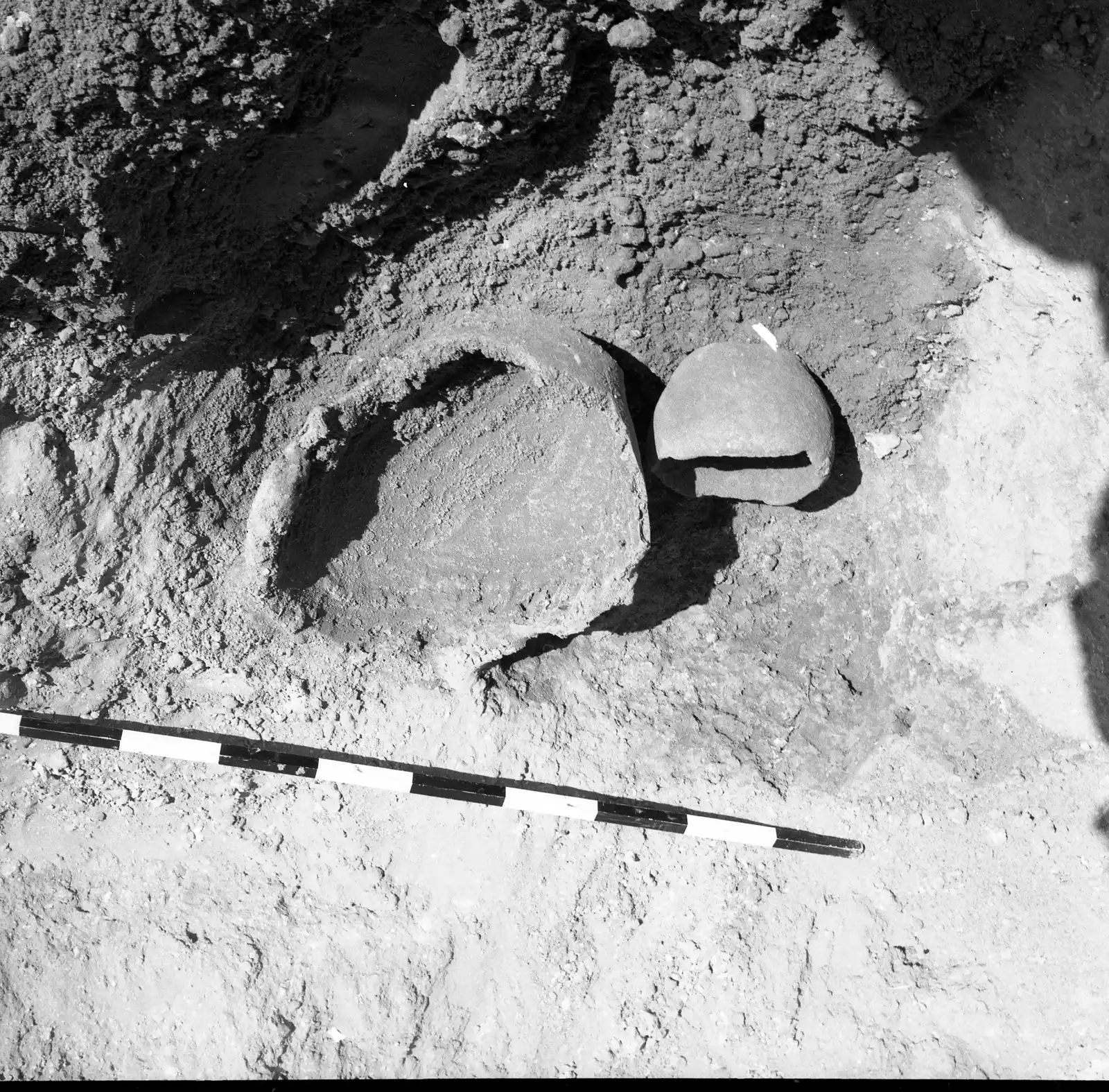
Stratigraphy: The Deepest Layer in a Dig Isn’t Always Oldest
Stratigraphy reads the order of layers: lower is earlier, unless a later pit, burrow or collapse cuts through. It gives a sequence, not a calendar date.
Picture credit
"Archaeological excavation (חפירה ארכיאולוגית), Israel, August 1957" by Benno Rothenberg / Meitar Collection / National Library of Israel / The Pritzker Family National Photography Collection — https://commons.wikimedia.org/wiki/File:Archaeological_excavations_(997009157511605171.jpg — CC BY 4.0 (https://creativecommons.org/licenses/by/4.0/); modified: card and share image cropped to 16:10 by the site build; the article page shows the full frame
 Illustration
Kensington Runestone: Its 1910 Panel’s Own Expert Said No
In 1910 a Minnesota panel backed the Kensington Runestone on one condition; its specialist rejected it. By current evidence it is not accepted as medieval.
Picture credit
Illustration: Hoax and Hindsight. Generated schematic illustration — not a photograph or historical record. © Hoax and Hindsight, all rights reserved.
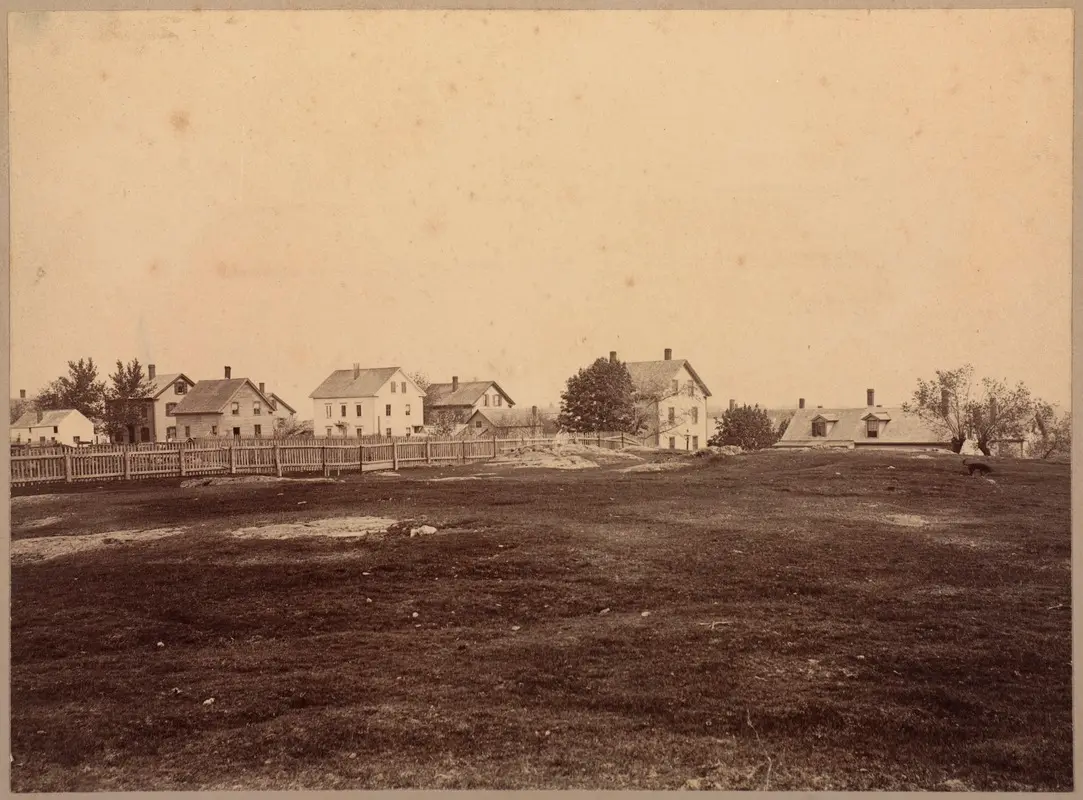
Proctor’s Ledge: Perley Put Salem’s Hangings There in 1921
Salem's 1692 hangings most likely took place at Proctor's Ledge, below Gallows Hill's summit, as Perley argued in 1921. No archaeological dig has been reported.
Picture credit
"Gallows Hill, Salem, where the witches were hung." by Unknown author — https://commons.wikimedia.org/wiki/File:Gallows_Hill,_Salem,_where_the_witches_were_hung._-_DPLA_-_64eb4c9dba10556ef5bc3647d684749c.jpg — Public domain (anonymous mounted photograph dated by the cataloguer between 1895 and 1905. US: if published, before 1931; if never published, an anonymous unpublished work is protected 120 years from creation, which ended at the latest at the end of 2025; the Boston Public Library marks it No Copyright - United States. EU: anonymous work, more than 70 years since it was made and since any publication. Risk noted: no publication record was checked, and the photographer is not known.); modified: card and share image only: cropped by the site build inside the photograph's mount; the article page shows the whole mount uncropped