Historical Hoaxes · Case retrial
Han van Meegeren: A Forgery Trial, Not Treason, per Godley
Hoax and Hindsight Published
In 1945 Han van Meegeren told police that the “Vermeer” found in Hermann Göring’s collection was his own work. By John Godley’s 1951 account, the collaboration charges were then dropped, and an Amsterdam court tried him in 1947 for forging signatures and gave him a year in prison; he died that December, before serving it.
Docket
- Case
- The van Meegeren forgeries
- Years
- 1937 to 1947, from the sale of Christ at Emmaus to the trial and his death
- Place
- The Netherlands; tried in Amsterdam
- The claim
- That Christ at Emmaus and five other paintings he sold were by Vermeer, and two more by Pieter de Hooch
- The verdict
- Court finding: November 1947, guilty of forging signatures and sentenced to one year in prison, as reported by Godley (1951); the written judgment was not read
- Hinges on
- The signatures he admitted forging, after the commission’s X-ray and paint evidence and its finding that the eight paintings were forgeries
- Status
- Upheld: no appeal or reversal appears in the account read here; he died on December 30, 1947, before serving the sentence
Han van Meegeren was a Dutch painter. Between 1937 and the war years, by Godley’s count, he sold eight paintings as the work of two Dutch masters of the 1600s: six as Johannes Vermeer and two as Pieter de Hooch. The last of them reached Göring. That sale brought the police to his door in 1945.
He was first held as a suspected traitor. Popular retellings call him the forger who cheated the Nazis. This page sets that story against the records that can still be read: press captions from 1945 and 1947, a newsreel listing, a police evidence box, two published studies, and the biography John Godley wrote in 1951 at the request of van Meegeren’s family. Its method is the site’s usual one: each claim is called as a witness, and the court papers come last.
Order of proceedings 6 parts
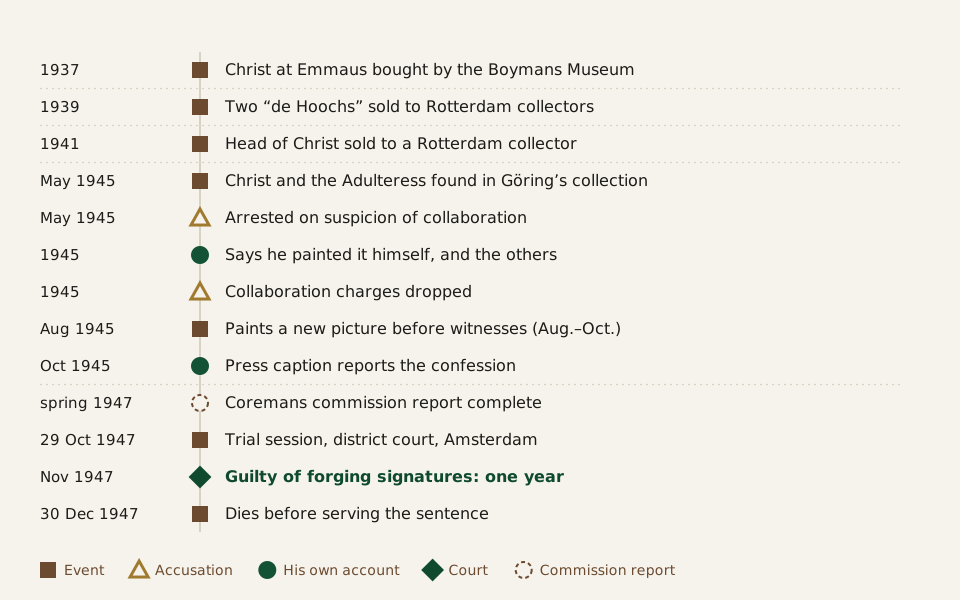
Diagram: Hoax and Hindsight · CC BY 4.0
Credit line to copy
"The van Meegeren case, 1937 to 1947" by Hoax and Hindsight, licensed under CC BY 4.0 (https://creativecommons.org/licenses/by/4.0/). Original: https://hoaxandhindsight.com/proven-fakes/han-van-meegeren/
Data: John Godley, Master Art Forger (1951); Anefo caption of October 1945 (Rijksmuseum); Anefo photographs of 29 October 1947 (Nationaal Archief); Polygoon newsreel, week 44 of 1947
The case from 1937 to 1947, one row per dated event. The marker shows what kind of source stands behind each row: an event, an accusation, his own account, the court, or the commission’s report. Drawn from the table published with this page (Exhibits A, D, E and F).
The events of 1937 to 1947, one row per event, with sources (CSV) (where the data comes from) Data: John Godley, Master Art Forger (1951); Anefo (Rijksmuseum, Nationaal Archief); Polygoon (Netherlands Institute for Sound and Vision)
What did van Meegeren say in 1945?
In the spring of 1945, Allied investigators found Christ and the Adulteress, a painting signed as a Vermeer, in Göring’s collection. A written record of its sale led Dutch investigators along a chain of dealers to van Meegeren (Exhibit F, pp. 25, 200). At the end of May 1945 the political police called at his house in Amsterdam.
He first said he had bought the picture from an Italian family whose name he would not give. Godley writes that this made the authorities suspect him of acting as a go-between for Nazi sympathizers, and he was held (Exhibit F, pp. 26, 201). The question, as Godley puts it, was whether he was a traitor; nobody yet doubted the painting. After repeated questioning, he said he had painted it himself, and the others too (Exhibit F, p. 27).
That confession is testimony, not proof. He gave it under arrest, and it served him: a man who sold the Germans his own fake had not sold them a Dutch treasure. Godley reports that the collaboration charges were later dropped (Exhibit F, pp. 28, 207).
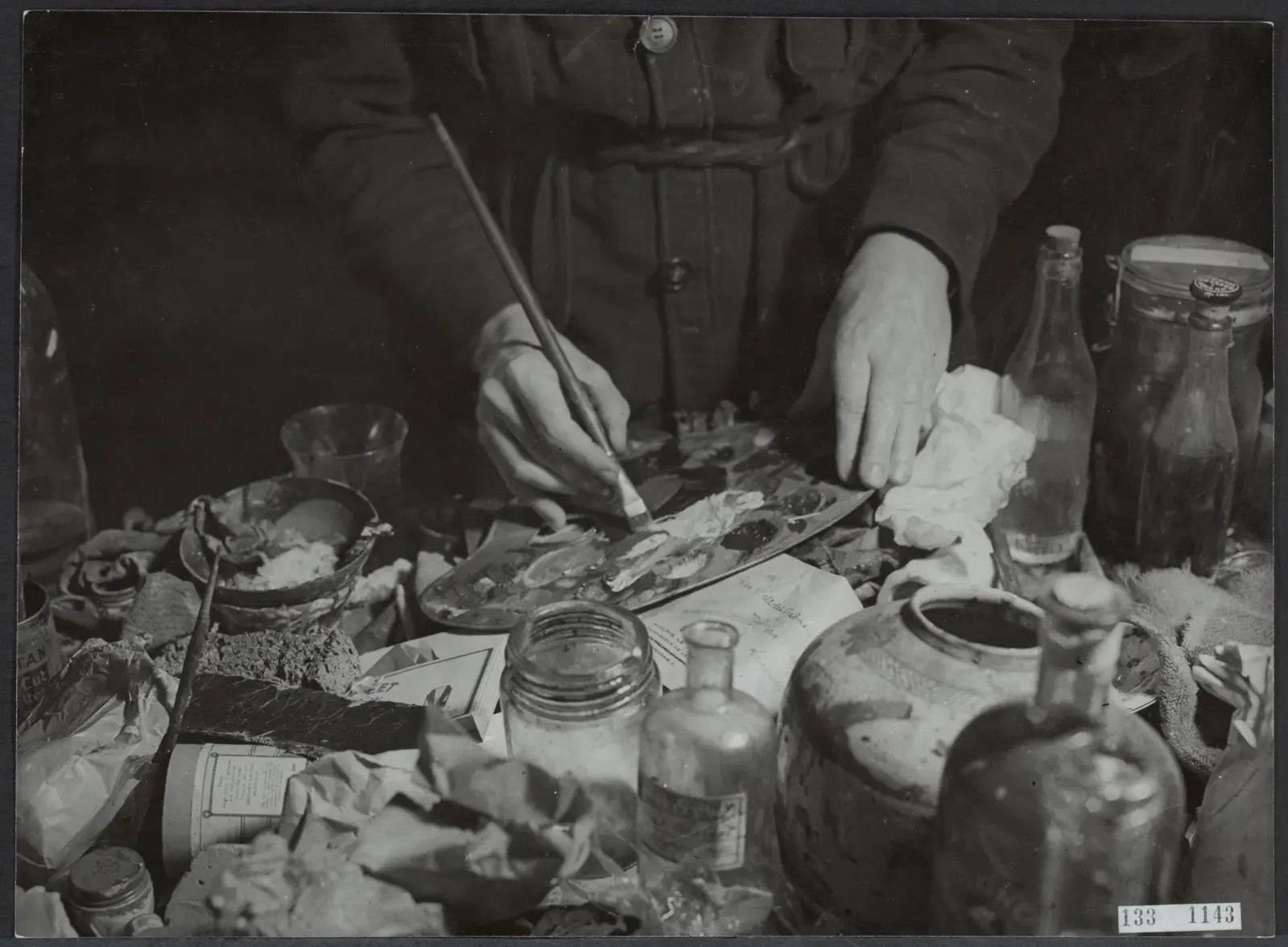
A press caption written that October survives on the back of an Anefo photograph now in the Rijksmuseum. In Dutch it opens, “Enige maanden geleden deed de kunstschilder Hans van Meegeren de opzienbarende bekentenis,” which means “Some months ago the painter Hans van Meegeren made the sensational confession” (translated by Hoax and Hindsight). It goes on to say that he had painted the Emmaus picture, not Vermeer, and that he offered to paint a new picture in Vermeer’s style before witnesses (Exhibit A).
"Amsterdam. In het atelier van Han van Meegeren" by Koos Raucamp / Anefo, Nationaal Archief — https://commons.wikimedia.org/wiki/File:Amsterdam._In_het_atelier_van_Han_van_Meegeren,_Bestanddeelnr_133-1143.jpg — CC0 1.0 (https://creativecommons.org/publicdomain/zero/1.0/)
Hands at a palette in van Meegeren’s Amsterdam studio, October 1945, photographed by Koos Raucamp for the Anefo agency. The face and the canvas are out of frame (Exhibit B).
Godley dates that demonstration from August to October 1945. Six witnesses watched and police guarded him while he painted a biblical scene, Young Christ Teaching in the Temple (Exhibit F, pp. 27, 207). By Godley’s account it was meant to show only that his claim was possible. The authorities then set up an international commission to examine the paintings (Exhibit F, pp. 27, 208).
Which paintings did he say were his?
By his own account, he had painted all eight pictures that were sold. Godley lists them: six “Vermeers” and two “de Hoochs” (Exhibit F, p. 2). The first and most admired was Christ at Emmaus. It was certified as a Vermeer by Dr. Bredius, a well-known authority, and bought for the Boymans Museum in Rotterdam at the end of 1937 (Exhibit F, p. 18).
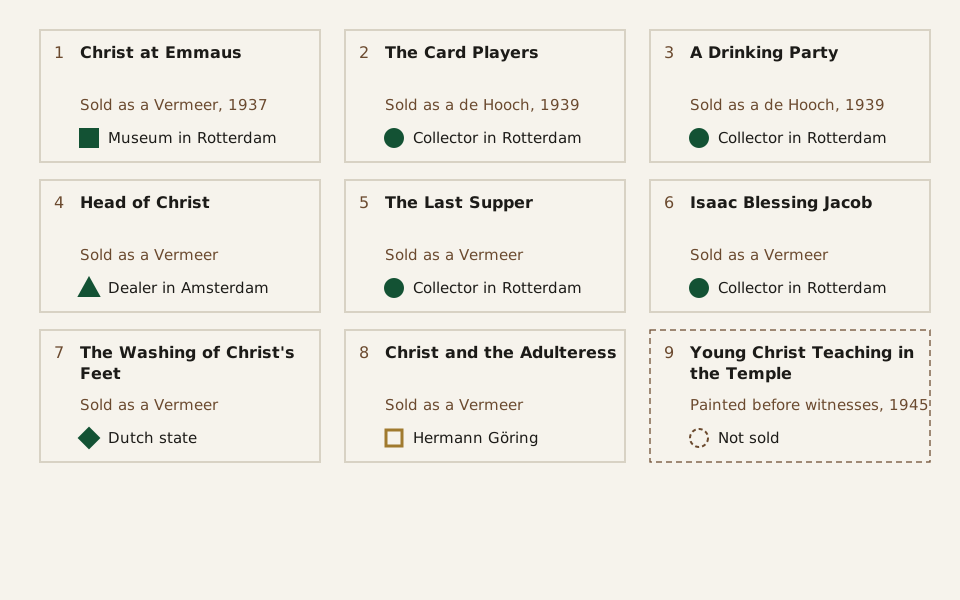
Diagram: Hoax and Hindsight · CC BY 4.0
Credit line to copy
"The paintings van Meegeren sold, by final buyer" by Hoax and Hindsight, licensed under CC BY 4.0 (https://creativecommons.org/licenses/by/4.0/). Original: https://hoaxandhindsight.com/proven-fakes/han-van-meegeren/
Data: John Godley, Master Art Forger (1951)
The eight paintings van Meegeren sold, and the 1945 demonstration piece, by final buyer as Godley names them. Box shapes and labels only; no painting is shown. Drawn from the table published with this page (Exhibit F).
| # | Painting | Sold as | Final buyer | Year |
|---|---|---|---|---|
| 1 | Christ at Emmaus | Vermeer | Boymans Museum, Rotterdam | 1937 |
| 2 | The Card Players | de Hooch | Collector in Rotterdam | 1939 |
| 3 | A Drinking Party | de Hooch | Collector in Rotterdam | 1939 |
| 4 | Head of Christ | Vermeer | Dealer in Amsterdam, after a Rotterdam collector returned it | 1940 or 1941 |
| 5 | The Last Supper | Vermeer | Collector in Rotterdam | 1940, or a few months after No. 4 |
| 6 | Isaac Blessing Jacob | Vermeer | Collector in Rotterdam | Not stated |
| 7 | The Washing of Christ’s Feet | Vermeer | The Dutch state | Not stated |
| 8 | Christ and the Adulteress | Vermeer | Hermann Göring | Not stated |
Seven of the eight paintings ended with holders in the Netherlands: a museum, collectors in Rotterdam, an Amsterdam dealer, and the Dutch state, which bought The Washing of Christ’s Feet after a government committee declared it a Vermeer (Exhibit F, pp. 176–177). The dealer had sold Head of Christ to a Rotterdam collector, who handed it back when he bought The Last Supper (Exhibit F, pp. 174–175). Only one went to Göring.
Godley does not give a firm date for that last painting: on one page he has it begun at the end of 1942, on another at the end of 1943 (Exhibit F, pp. 170, 192). His years for two earlier sales also differ: one page puts Head of Christ and The Last Supper in 1940, another dates the sale of Head of Christ to 1941 and has The Last Supper follow within a few months (Exhibit F, pp. 168, 174–175). He also lists pictures that never reached the market. A “Hals,” a “Terborch” and two more “Vermeers” were found in van Meegeren’s house in Nice after the confession (Exhibit F, p. 21).
The paintings, one row per painting, with final buyer and source (CSV) (where the data comes from) Data: John Godley, Master Art Forger (1951)
What did the commission’s tests show?
The Belgian scientist P. B. Coremans led the international commission. By Godley’s account its report was complete by the spring of 1947 (Exhibit F, p. 208). Coremans published his findings in 1949 as Van Meegeren’s Faked Vermeers and De Hooghs (Exhibit G). That book has not been read here, so the test results below come from Godley’s account of the trial, which is a second-hand report.
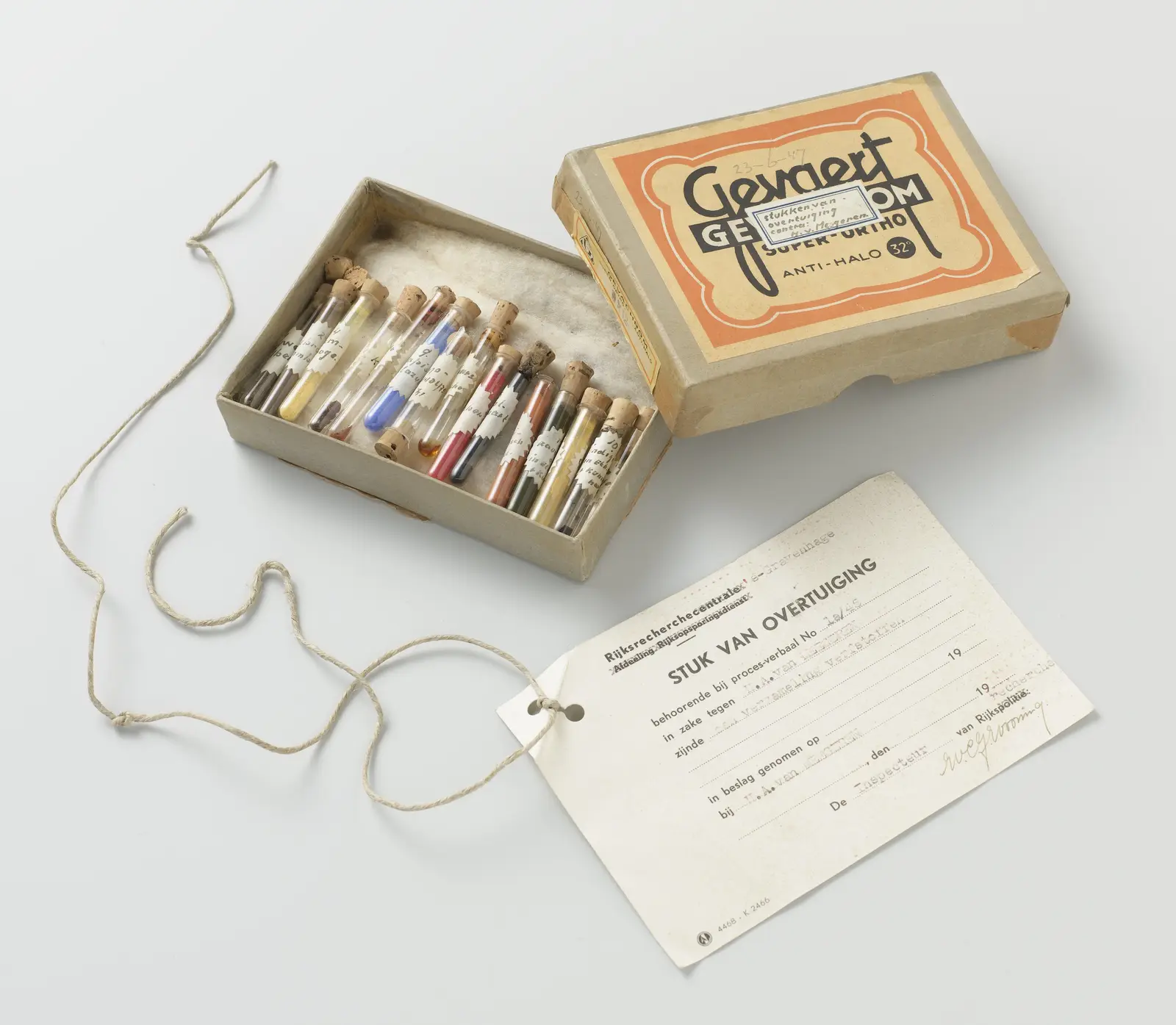
According to Godley, Coremans showed the court X-rays that revealed older pictures under several of the forgeries. He also showed sections cut from the paint, with old paint from the earlier pictures lying between the canvas and van Meegeren’s layer (Exhibit F, pp. 227–228). A second commission member, A. W. de Wild, said the forger had taken a paint recipe from de Wild’s own treatise on Vermeer’s methods (Exhibit F, p. 229). A 2019 study of radiocarbon dating in paintings, citing Coremans, also says he scraped old paintings to reuse their canvases (Exhibit H).
Outside experts were asked too. Godley writes that two British specialists, from the British Museum’s research laboratory and the National Gallery, spent a month with the pictures in early 1947 and sent in their own reports (Exhibit F, p. 208).
"Stuk van overtuiging behorende bij het proces-verbaal tegen H.A. van Meegeren" by Unknown author — https://commons.wikimedia.org/wiki/File:Stuk_van_overtuiging_behorende_bij_het_proces-verbaal_tegen_H.A._van_Meegeren,_NG-2010-135.jpg — CC0 1.0 (https://creativecommons.org/publicdomain/zero/1.0/)
A box of fifteen glass tubes of pigments and binders, kept as evidence against van Meegeren. Its tag belongs to police report No. 1a/45 of the national detective force, and the date 23-6-47 is written on the lid. Rijksmuseum, NG-2010-135 (Exhibit C).
Godley also says that van Meegeren hardened his paint with phenol and formaldehyde, the chemicals used to make Bakelite (Exhibit F, pp. 13, 128). Chemists found no phenol in routine tests, Godley writes, but found traces of it in Christ at Emmaus and the rest once they knew to look (Exhibit F, p. 20). A plastic of that kind would set the earliest possible date for the paint, the logic of a terminus post quem, the earliest date a part allows. This page has not read a dated first year for that resin, so it computes no such date.
The same reasoning exposed the Vinland Map, another forgery judged by what is in its ink: a material that came later than the object’s claimed date.
What was he tried for in 1947?
Press photographs date the trial session to 29 October 1947 (Exhibit E). A newsreel of week 44 of 1947, as its archive describes it, shows the trial opening before the district court in Amsterdam. In the listing, the forgeries arrive by truck, are hung in the courtroom as evidence, and are guarded by police (Exhibit D). One Anefo caption names the court the Gerechtshof, the Dutch word for an appeals court; the newsreel listing and Godley both place the trial in the district court (Exhibits D, E and F).
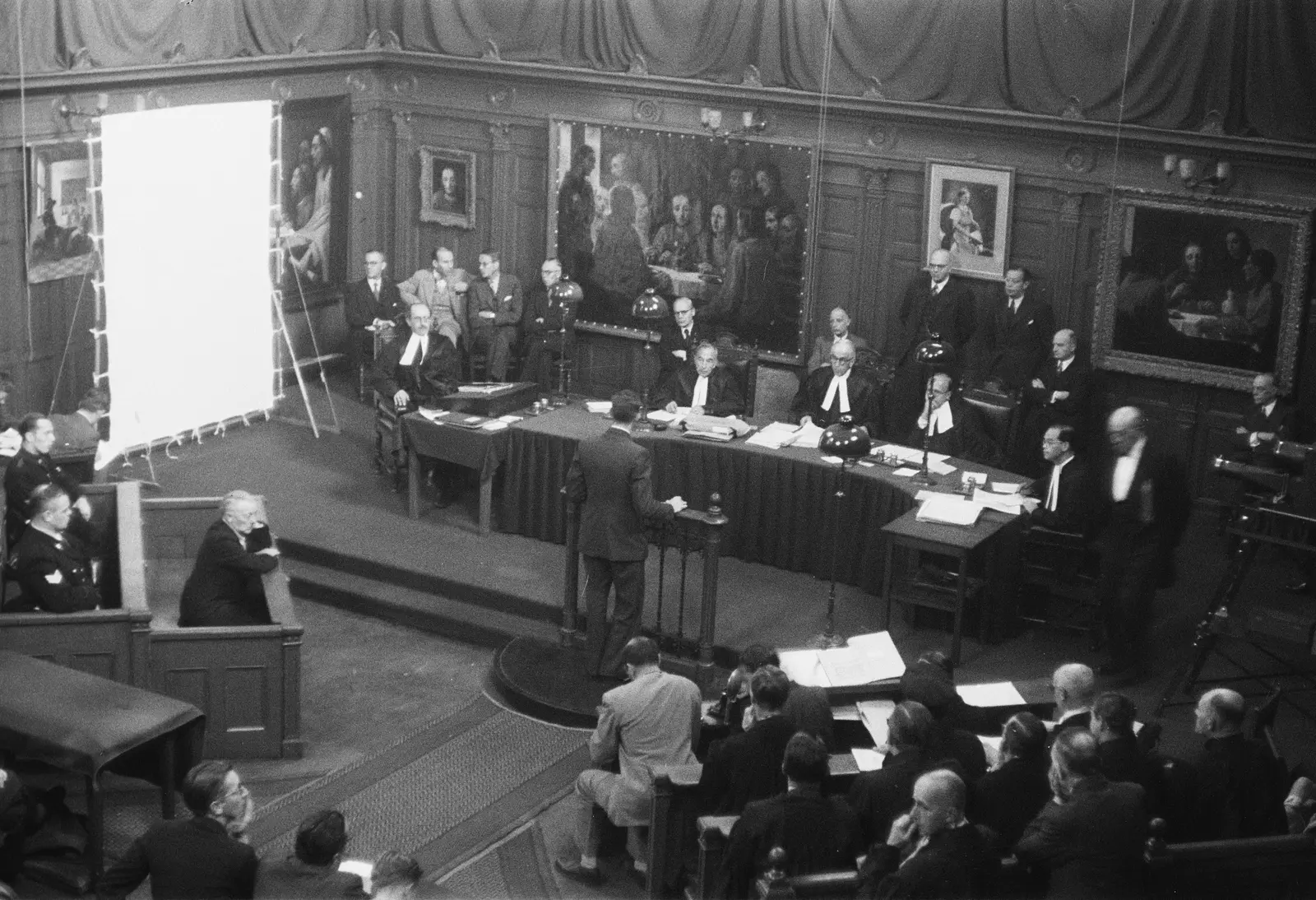
"Proces Van Meegeren" by Harry Sagers / Anefo, Nationaal Archief — https://commons.wikimedia.org/wiki/File:Proces_Van_Meegeren,_Bestanddeelnr_902-4286.jpg — CC0 1.0 (https://creativecommons.org/publicdomain/zero/1.0/)
The courtroom at van Meegeren’s trial, Amsterdam, 29 October 1947, photographed by Harry Sagers for Anefo. The paintings on the walls were hung as evidence; a screen at left was used for projected photographs (Exhibits D, E and F).
The charge was not collaboration. Godley writes that prosecutors doubted they could prove false pretences, since van Meegeren might say he never told a buyer a picture was by Vermeer. But each picture bore a forged signature of Vermeer or de Hooch, and that became the charge (Exhibit F, p. 209).
In Godley’s account of the hearing, an official reads the indictment: “He is accused of forging signatures” (Exhibit F, p. 227). Van Meegeren admitted it.
At the close of the hearing, two years in prison were asked for (Exhibit F, p. 238). A fortnight later, at a special sitting, the court found him guilty and sentenced him to one year; Godley says his poor health was one reason the sentence was light (Exhibit F, p. 239). These are Godley’s words for the court’s finding. Neither the written judgment nor any Dutch newspaper report of 1947 has been read for this page.
Godley’s account of the hearing needs care of its own. He tells it in the present tense, like a scene, and in that chapter he does not say that he was there. The newsreel listing is the archive’s description of the film, not the film itself. Neither is a court record, so this page uses them for what happened in the room and keeps the court’s finding to the charge and the sentence.
Like the Tichborne Claimant, another deception that ended in a criminal court, this case ended with a sentence. Van Meegeren never served his. He collapsed, was taken to an Amsterdam hospital, and died there on 30 December 1947 (Exhibit F, pp. 1, 240–241). The 2019 study and library catalogue entries for later books give the same years of life, 1889 to 1947 (Exhibits H, J and K).
Why were the paintings accepted?
The case for Christ at Emmaus was built to fit a gap. Godley explains that few of Vermeer’s paintings can be dated, and that one early work, Christ with Martha and Mary, has a biblical subject. Van Meegeren, he says, set out to fill a gap in the painter’s career with religious pictures that experts might believe had been lost (Exhibit F, pp. 7–8, 14). Once the picture was accepted, connoisseurs debated whether Vermeer had seen a Caravaggio of the same subject; that debate took its authenticity for granted (Exhibit F, p. 14).
Illustration: Hoax and Hindsight. Generated schematic illustration — not a photograph or historical record. © Hoax and Hindsight, all rights reserved.
An illustration of an imagined scene in a museum gallery of the 1940s, with visitors facing empty frames. Not a picture of any museum or painting; no work by Vermeer or van Meegeren is shown.
In Godley’s reading, then, Christ at Emmaus is what this site calls the wish-shaped fake: a forgery accepted partly because it fit what its audience expected. That reading is Godley’s, and it is not the whole story. He describes the wartime pictures as made with less and less care, and explains their sale by other causes: secret deals, buyers who feared a masterpiece would go to Germany, and the same few dealers handling several pictures (Exhibit F, pp. 170, 175, 193–194).
Testing played a part as well. In Godley’s account of the trial, de Wild was asked why the early examinations had passed the pictures. He answered that one dealer had twice refused to let the paintings in his keeping be X-rayed (Exhibit F, p. 229). That is a witness’s explanation, given in court by a member of the commission, and Godley notes that it left the other sales unexplained.
Godley also had a point of view. He wrote at the request of van Meegeren’s family, and he names the painter’s son and daughter as his main sources (Exhibit F, author’s note). His book calls the collaboration charges false and puts the critics’ errors at the centre of the story (Exhibit F, pp. 31, 194–195). A later book by Jonathan Lopez (2008) is subtitled Unvarnishing the Legend of Master Forger Han van Meegeren; it was read here only as a catalogue entry, and its arguments are not reported (Exhibit J).
Popular version vs. the record
Each popular claim below comes from a named publication, and the record follows it.
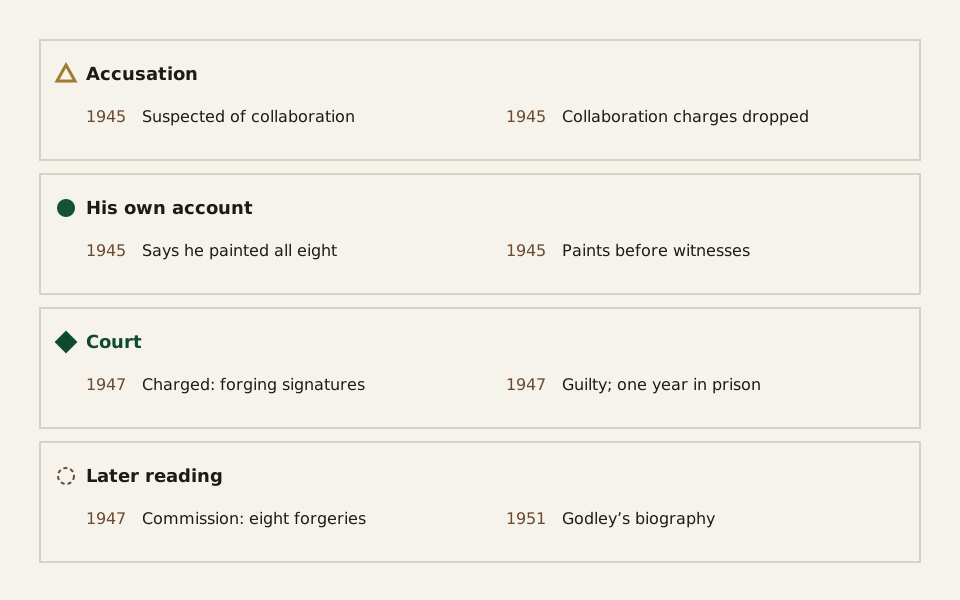
Diagram: Hoax and Hindsight · CC BY 4.0
Credit line to copy
"Four levels of statement in the van Meegeren case" by Hoax and Hindsight, licensed under CC BY 4.0 (https://creativecommons.org/licenses/by/4.0/). Original: https://hoaxandhindsight.com/proven-fakes/han-van-meegeren/
Data: John Godley, Master Art Forger (1951); Anefo caption of October 1945 (Rijksmuseum)
Four kinds of statement in this case, kept apart: what he was accused of, what he said, what the court decided, and what was written later. Each item is cited in the text (Exhibits A, E and F).
He was the forger who swindled the Nazis. The subtitle of Frank Wynne’s 2007 book calls him “the forger who swindled the Nazis” (Exhibit K).
This holds for one painting and leaves out the rest. By Godley’s list, one went to Göring, but seven of the eight paintings ended with holders in the Netherlands, among them a Rotterdam museum and the Dutch state (Exhibit F, pp. 2, 18, 176–177).
He confessed to escape a charge of collaboration. A 2022 study says he “admitted to the forgeries in order to avoid being accused of collaborating with Nazis” (Exhibit I).
This matches the record read here. Godley reports an arrest on suspicion of collaboration at the end of May 1945, then the confession, then the dropping of those charges (Exhibit F, pp. 26–28, 207). Godley gives the same reason (Exhibit F, p. 27), but no statement in van Meegeren’s own words about why he confessed was read here.
He painted before witnesses to prove he was the forger. The Rijksmuseum’s title for the 1945 photograph says he painted it to prove he had forged the Emmaus picture (Exhibit A).
Godley gives it a narrower aim: to show only that his claim was possible. It did not settle the matter; an international commission was then set up, and the trial waited until October 1947 (Exhibit F, pp. 27, 208).
Göring paid for his “Vermeer” with paintings, not money. Godley states this as fact (Exhibit F, p. 195).
The only source for it read here is van Meegeren himself. Godley quotes him telling the police that the dealer had explained Göring paid in other Dutch paintings (Exhibit F, p. 202). That is the suspect’s statement, repeated by a biographer; no sale record was read here.
Was Han van Meegeren tried for treason?
No, by the account read here. He was arrested in 1945 on suspicion of collaboration, but Godley reports that those charges were dropped. In 1947 he was tried for forging signatures and sentenced to one year (Exhibit F, pp. 207, 227, 239).
Why did van Meegeren confess?
He confessed under arrest, while suspected of selling a Dutch treasure to Göring. A 2022 study says he admitted the forgeries to avoid that accusation, and Godley gives the same reason (Exhibits F and I).
Why did experts accept van Meegeren’s paintings?
By Godley’s 1951 account, his first “Vermeer” filled a gap in what was known of the painter, came with a scholar’s certificate, and was made with care. The later ones were sold in secret wartime deals through the same few dealers (Exhibit F, pp. 7–8, 18, 170, 193).
What happened to van Meegeren after the trial?
He was sentenced to one year in prison in November 1947 but had not begun the term when he fell ill. He died in an Amsterdam hospital on 30 December 1947, according to Godley (Exhibit F, pp. 239–241).
What would overturn it:
- The written judgment of 1947. A copy of the Amsterdam court’s judgment naming a different charge, such as fraud alongside or in place of forging signatures, or a different sentence, would change this page’s account of the trial, which now rests on Godley.
- A record of Christ at Emmaus before 1936. A dated photograph, sale or inventory showing the painting before Godley’s date for its making would reopen the forgery finding for that picture, whatever van Meegeren said in 1945.
Exhibits
Records and period publications
- Exhibit A: Anefo press photograph with typed caption, “De nieuwe Vermeer van Hans van Meegeren,” October 1945 (photograph attributed to K. Raucamp), Rijksmuseum, Amsterdam, RP-F-2005-10.
- Exhibit B: Koos Raucamp (Anefo), “Amsterdam. In het atelier van Han van Meegeren,” photograph, October 1945, Nationaal Archief, The Hague, Fotocollectie Rijksvoorlichtingsdienst, 2.24.10.02, 133-1143.
- Exhibit C: Rijksrecherche, The Hague, box of pigment samples, “Stuk van overtuiging behorende bij het proces-verbaal tegen H.A. van Meegeren,” before 23 June 1947, Rijksmuseum, Amsterdam, NG-2010-135.
- Exhibit D: “Proces Van Meegeren,” Polygoon Hollands Nieuws, newsreel, week 44 of 1947, Netherlands Institute for Sound and Vision, PGM4011956 (catalogue description).
- Exhibit E: Harry Sagers and Bram Wisman (Anefo), photographs of the van Meegeren trial, 29 October 1947, Nationaal Archief, The Hague, Fotocollectie Anefo, 902-4285 to 902-4287 (“Proces Van Meegeren”) and 934-6704 (“Van Meegeren voor het Gerechtshof”).


Studies
- Exhibit F: John Godley, Master Art Forger: The Story of Han van Meegeren (New York: Wilfred Funk, 1951).
- Exhibit G: P. B. Coremans, Van Meegeren’s Faked Vermeers and De Hooghs: A Scientific Examination, translated by A. Hardy and C. M. Hutt (Amsterdam: Meulenhoff, 1949).
- Exhibit H: Laura Hendriks, Irka Hajdas, Ester S. B. Ferreira, et al., “Uncovering modern paint forgeries by radiocarbon dating,” Proceedings of the National Academy of Sciences 116 (2019): 13210.
- Exhibit I: Barbara I. Łydżba-Kopczyńska and Janusz Szwabiński, “Attribution Markers and Data Mining in Art Authentication,” Molecules 27, no. 1 (2022): 70 (published online December 23, 2021).
- Exhibit J: Jonathan Lopez, The Man Who Made Vermeers: Unvarnishing the Legend of Master Forger Han van Meegeren (Orlando: Harcourt, 2008).
- Exhibit K: Frank Wynne, I Was Vermeer: The Legend of the Forger Who Swindled the Nazis (London: Bloomsbury, 2007).
Cite this page
Hoax and Hindsight. “Han van Meegeren: A Forgery Trial, Not Treason, per Godley.” Hoax and Hindsight, published November 6, 2026. https://hoaxandhindsight.com/proven-fakes/han-van-meegeren/. Accessed [the date you read it].
Related cases
 Illustration
Vinland Map: Yale Found a Pigment First Sold in the 1920s
The Vinland Map is a forgery, Yale said in 2021: a titanium pigment that went on sale in the 1920s runs through its lines. Key tests from 1965 to 2021.
Picture credit
Illustration: Hoax and Hindsight. Generated schematic illustration — not a photograph or historical record. © Hoax and Hindsight, all rights reserved.
Mechanical Turk: Its Hidden Player Was Suspected in 1784
The Mechanical Turk chess automaton hid a human player. Who said so by 1784, what Willis argued in 1821, and why Napoleon’s game rests on later accounts.
Picture credit
"Plate I (Tab. I) of Joseph Friedrich zu Racknitz, Ueber den Schachspieler des Herrn von Kempelen und dessen Nachbildung (1789)" by Joseph Friedrich zu Racknitz — https://commons.wikimedia.org/wiki/File:Racknitz_-_The_Turk_1.jpg — Public domain (engraved plate published in 1789: public domain in the US (published before 1931); in the EU the term has long expired, since the book's author and any engraver working on a plate printed in 1789 died well over 70 years ago (an engraver active in 1789 cannot have lived past 1955); the scan is a faithful photographic reproduction of a two-dimensional public-domain work, which adds no new copyright in the US (PD-Art) or in the EU (Directive (EU) 2019/790, Art. 14); marked Public Domain Mark 1.0 on Commons. Commons gives the source as the Humboldt University Library (digi-hub record BV041097321, scan page 63); that record's own rights field says the copyright status was not checked, which concerns the reproduction only.)
Cottingley Fairies: Kodak Would Not Vouch, Doyle’s Book Says
Arthur Conan Doyle’s 1922 book records that Kodak’s experts found no trick in the Cottingley fairy negatives in 1920, yet would not certify them as genuine.
Picture credit
"Dancing fairies, illustration by Claude A. Shepperson in Princess Mary's Gift Book (1914)" by Claude A. Shepperson — https://commons.wikimedia.org/wiki/File:Cottingley_fairies_illustration.jpg — Public domain (US: published in London in 1914, before January 1, 1931. EU: Claude A. Shepperson died in 1921 (life dates 1867-1921 on the Commons file page and in the image-rights review of 2026-11-05), more than 70 years ago. Scan chain: the Commons file gives as its source the Internet Archive scan princessmarysgif00mary (University of California Libraries, collection cdl, not a lending item; its metadata, read 2026-11-05, gives the date [1914] and the publisher Hodder & Stoughton). Page and poem checked in review on 2026-11-06 against the same scan: the _djvu.txt text and the scan page for printed p. 104 (leaf 130 in the item's page-number file) show the drawing below the last stanzas of Alfred Noyes, 'A Spell for a Fairy' (pp. 101-104), headed 'Painting and Drawings by Claude A. Shepperson, A.R.W.S.'; the contents page lists the poem under Noyes with the same credit. The IA item metadata was re-read the same day (collection cdl and americana, possible-copyright-status NOT_IN_COPYRIGHT, not a lending item).); modified: card and share image cropped by the site build to the card proportions; the article page shows the full drawing